 Add to Chrome
 Add to Firefox
 Add to Edge
dVLA-RL: Reinforcement Learning over Denoising Trajectories for Discrete Diffusion Vision-Language-Action Models
Jun 22, 2026
Vision-Language-Action (VLA) models have established a powerful paradigm for generalist robotic manipulation by grounding control into the semantic reasoning of VLMs. Prevailing architectures typically model actions continuously via diffusion or flow processes, or discretely through either autoregressive generation or parallel decoding. Recently, Discrete Diffusion VLAs (dVLAs) have emerged as a distinct alternative, unifying vision, language, and action into a single discrete token space via masked generative modeling. While combining iterative refinement with unified representations, its training has thus far been restricted to Supervised Fine-Tuning (SFT), leaving the potential of Reinforcement Learning (RL) for further policy refinement largely unexplored. A fundamental challenge in RL for dVLAs is that the marginal probability of the final action generated by dVLAs remains intractable. To solve this problem, we propose \textbf{dVLA-RL}, shifting the learning objective from the marginal action probability to the joint probability of the sampled generation path. Specifically, by modeling the denoising process as a Markov Decision Process (MDP), we mathematically formulate this path probability as a product of step-wise transitions. This trajectory-level objective provides a unified formulation that natively accommodates variable denoising steps. Leveraging this intrinsic fexibility, we introduce a unified step scheduling approach for complex multi-task learning, tailoring denoising steps to specific task complexities to maximize both success rates and computational effciency. Extensive evaluations demonstrate that our approach achieves a success rate of \textbf{99.7\%} on LIBERO. Furthermore, it establishes strong VLA-based results on RoboTwin 2.0 by delivering a \textbf{30.6\%} improvement over the SFT baseline, remaining competitive with strong World-Action Model baselines.

AHA-WAM:Asynchronous Horizon-Adaptive World-Action Modeling with Observation-Guided Context Routing
Jun 08, 2026World-action models have emerged as a promising paradigm for robot manipulation, jointly modeling visual scene dynamics and actions to inject physical priors into policy learning. However, existing world-action models couple world prediction and action execution at the same temporal resolution, forcing the world branch to model near-term frame variations that are redundant and weakly informative. We posit that strictly binding world prediction and action execution to the same temporal rhythm may underutilize the potential of the video branch for embodied control. Therefore, we propose AHA-WAM, an Asynchronous Horizon-Adaptive World-Action Model built on a dual Diffusion Transformer (DiT) architecture that reorganizes world-action modeling around this temporal asymmetry. AHA-WAM instantiates the video DiT as a low-frequency world planner that maintains rolling key-value memory over past observations and exposes reusable layerwise latent context encoding long-horizon scene evolution, while a high-frequency action DiT executes short action chunks in closed loop by querying this context through layerwise joint attention. To support asynchronous execution, we introduce horizon-adaptive offset training and Observation-Guided Video-Context Routing (OVCR), which together let the action expert exploit long-horizon world context while remaining responsive to real-time execution state without rerunning the video DiT. Experiments on RoboTwin and real-world manipulation tasks show that AHA-WAM achieves state-of-the-art performance without any robot-data pretraining, attaining 92.80% average success on RoboTwin and 78.3% success across 4 real-world tasks, while reaching 24.17 Hz closed-loop control with a 4.59x speedup over Fast-WAM.
LoongFlow: Directed Evolutionary Search via a Cognitive Plan-Execute-Summarize Paradigm
Dec 30, 2025The transition from static Large Language Models (LLMs) to self-improving agents is hindered by the lack of structured reasoning in traditional evolutionary approaches. Existing methods often struggle with premature convergence and inefficient exploration in high-dimensional code spaces. To address these challenges, we introduce LoongFlow, a self-evolving agent framework that achieves state-of-the-art solution quality with significantly reduced computational costs. Unlike "blind" mutation operators, LoongFlow integrates LLMs into a cognitive "Plan-Execute-Summarize" (PES) paradigm, effectively mapping the evolutionary search to a reasoning-heavy process. To sustain long-term architectural coherence, we incorporate a hybrid evolutionary memory system. By synergizing Multi-Island models with MAP-Elites and adaptive Boltzmann selection, this system theoretically balances the exploration-exploitation trade-off, maintaining diverse behavioral niches to prevent optimization stagnation. We instantiate LoongFlow with a General Agent for algorithmic discovery and an ML Agent for pipeline optimization. Extensive evaluations on the AlphaEvolve benchmark and Kaggle competitions demonstrate that LoongFlow outperforms leading baselines (e.g., OpenEvolve, ShinkaEvolve) by up to 60% in evolutionary efficiency while discovering superior solutions. LoongFlow marks a substantial step forward in autonomous scientific discovery, enabling the generation of expert-level solutions with reduced computational overhead.
DAGC: Data-Volume-Aware Adaptive Sparsification Gradient Compression for Distributed Machine Learning in Mobile Computing
Nov 13, 2023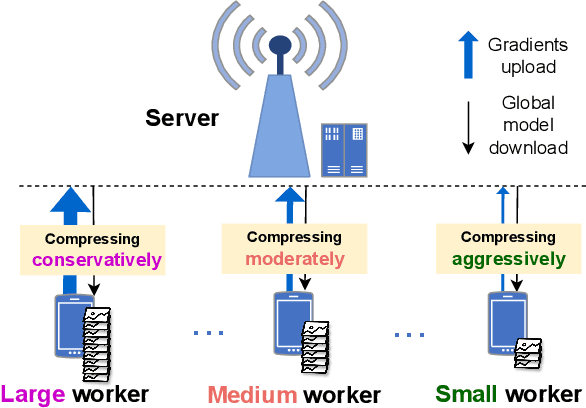

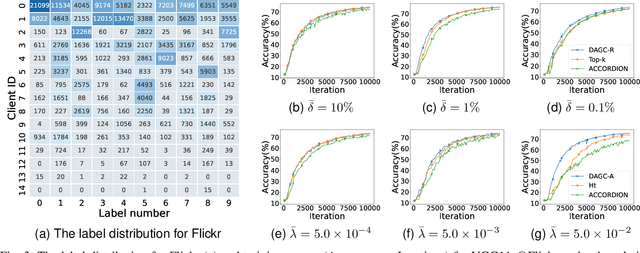
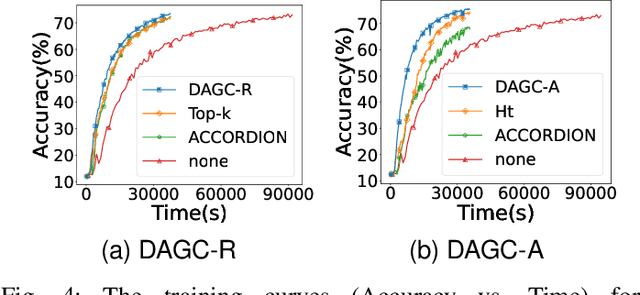
Distributed machine learning (DML) in mobile environments faces significant communication bottlenecks. Gradient compression has emerged as an effective solution to this issue, offering substantial benefits in environments with limited bandwidth and metered data. Yet, they encounter severe performance drop in non-IID environments due to a one-size-fits-all compression approach, which does not account for the varying data volumes across workers. Assigning varying compression ratios to workers with distinct data distributions and volumes is thus a promising solution. This study introduces an analysis of distributed SGD with non-uniform compression, which reveals that the convergence rate (indicative of the iterations needed to achieve a certain accuracy) is influenced by compression ratios applied to workers with differing volumes. Accordingly, we frame relative compression ratio assignment as an $n$-variables chi-square nonlinear optimization problem, constrained by a fixed and limited communication budget. We propose DAGC-R, which assigns the worker handling larger data volumes the conservative compression. Recognizing the computational limitations of mobile devices, we DAGC-A, which are computationally less demanding and enhances the robustness of the absolute gradient compressor in non-IID scenarios. Our experiments confirm that both the DAGC-A and DAGC-R can achieve better performance when dealing with highly imbalanced data volume distribution and restricted communication.