 Add to Chrome
 Add to Firefox
 Add to Edge
GUI-explorer: Autonomous Exploration and Mining of Transition-aware Knowledge for GUI Agent
May 22, 2025
GUI automation faces critical challenges in dynamic environments. MLLMs suffer from two key issues: misinterpreting UI components and outdated knowledge. Traditional fine-tuning methods are costly for app-specific knowledge updates. We propose GUI-explorer, a training-free GUI agent that incorporates two fundamental mechanisms: (1) Autonomous Exploration of Function-aware Trajectory. To comprehensively cover all application functionalities, we design a Function-aware Task Goal Generator that automatically constructs exploration goals by analyzing GUI structural information (e.g., screenshots and activity hierarchies). This enables systematic exploration to collect diverse trajectories. (2) Unsupervised Mining of Transition-aware Knowledge. To establish precise screen-operation logic, we develop a Transition-aware Knowledge Extractor that extracts effective screen-operation logic through unsupervised analysis the state transition of structured interaction triples (observation, action, outcome). This eliminates the need for human involvement in knowledge extraction. With a task success rate of 53.7% on SPA-Bench and 47.4% on AndroidWorld, GUI-explorer shows significant improvements over SOTA agents. It requires no parameter updates for new apps. GUI-explorer is open-sourced and publicly available at https://github.com/JiuTian-VL/GUI-explorer.

Hunyuan-TurboS: Advancing Large Language Models through Mamba-Transformer Synergy and Adaptive Chain-of-Thought
May 21, 2025As Large Language Models (LLMs) rapidly advance, we introduce Hunyuan-TurboS, a novel large hybrid Transformer-Mamba Mixture of Experts (MoE) model. It synergistically combines Mamba's long-sequence processing efficiency with Transformer's superior contextual understanding. Hunyuan-TurboS features an adaptive long-short chain-of-thought (CoT) mechanism, dynamically switching between rapid responses for simple queries and deep "thinking" modes for complex problems, optimizing computational resources. Architecturally, this 56B activated (560B total) parameter model employs 128 layers (Mamba2, Attention, FFN) with an innovative AMF/MF block pattern. Faster Mamba2 ensures linear complexity, Grouped-Query Attention minimizes KV cache, and FFNs use an MoE structure. Pre-trained on 16T high-quality tokens, it supports a 256K context length and is the first industry-deployed large-scale Mamba model. Our comprehensive post-training strategy enhances capabilities via Supervised Fine-Tuning (3M instructions), a novel Adaptive Long-short CoT Fusion method, Multi-round Deliberation Learning for iterative improvement, and a two-stage Large-scale Reinforcement Learning process targeting STEM and general instruction-following. Evaluations show strong performance: overall top 7 rank on LMSYS Chatbot Arena with a score of 1356, outperforming leading models like Gemini-2.0-Flash-001 (1352) and o4-mini-2025-04-16 (1345). TurboS also achieves an average of 77.9% across 23 automated benchmarks. Hunyuan-TurboS balances high performance and efficiency, offering substantial capabilities at lower inference costs than many reasoning models, establishing a new paradigm for efficient large-scale pre-trained models.
Flow-GRPO: Training Flow Matching Models via Online RL
May 08, 2025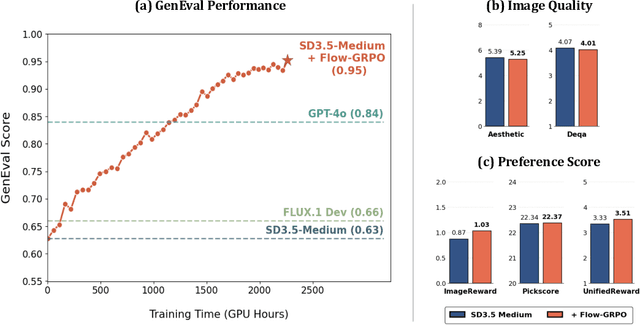
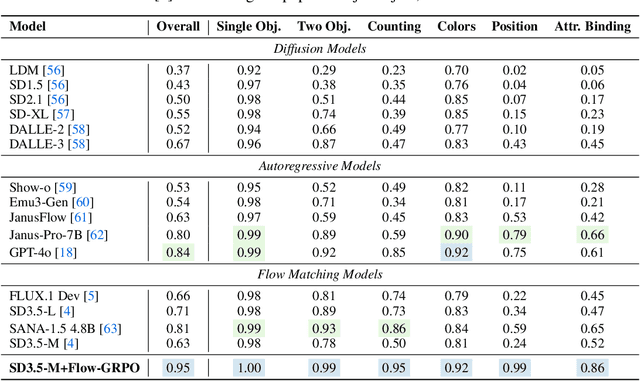
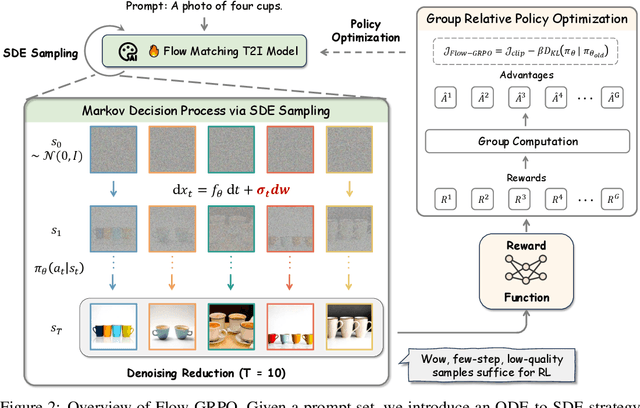
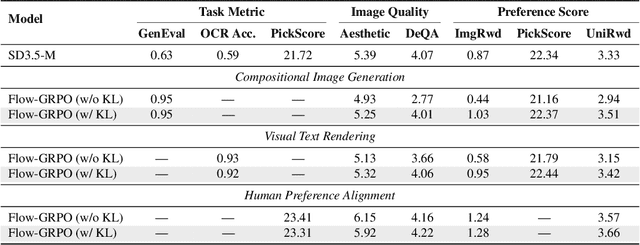
We propose Flow-GRPO, the first method integrating online reinforcement learning (RL) into flow matching models. Our approach uses two key strategies: (1) an ODE-to-SDE conversion that transforms a deterministic Ordinary Differential Equation (ODE) into an equivalent Stochastic Differential Equation (SDE) that matches the original model's marginal distribution at all timesteps, enabling statistical sampling for RL exploration; and (2) a Denoising Reduction strategy that reduces training denoising steps while retaining the original inference timestep number, significantly improving sampling efficiency without performance degradation. Empirically, Flow-GRPO is effective across multiple text-to-image tasks. For complex compositions, RL-tuned SD3.5 generates nearly perfect object counts, spatial relations, and fine-grained attributes, boosting GenEval accuracy from $63\%$ to $95\%$. In visual text rendering, its accuracy improves from $59\%$ to $92\%$, significantly enhancing text generation. Flow-GRPO also achieves substantial gains in human preference alignment. Notably, little to no reward hacking occurred, meaning rewards did not increase at the cost of image quality or diversity, and both remained stable in our experiments.
RAIL: Region-Aware Instructive Learning for Semi-Supervised Tooth Segmentation in CBCT
May 06, 2025Semi-supervised learning has become a compelling approach for 3D tooth segmentation from CBCT scans, where labeled data is minimal. However, existing methods still face two persistent challenges: limited corrective supervision in structurally ambiguous or mislabeled regions during supervised training and performance degradation caused by unreliable pseudo-labels on unlabeled data. To address these problems, we propose Region-Aware Instructive Learning (RAIL), a dual-group dual-student, semi-supervised framework. Each group contains two student models guided by a shared teacher network. By alternating training between the two groups, RAIL promotes intergroup knowledge transfer and collaborative region-aware instruction while reducing overfitting to the characteristics of any single model. Specifically, RAIL introduces two instructive mechanisms. Disagreement-Focused Supervision (DFS) Controller improves supervised learning by instructing predictions only within areas where student outputs diverge from both ground truth and the best student, thereby concentrating supervision on structurally ambiguous or mislabeled areas. In the unsupervised phase, Confidence-Aware Learning (CAL) Modulator reinforces agreement in regions with high model certainty while reducing the effect of low-confidence predictions during training. This helps prevent our model from learning unstable patterns and improves the overall reliability of pseudo-labels. Extensive experiments on four CBCT tooth segmentation datasets show that RAIL surpasses state-of-the-art methods under limited annotation. Our code will be available at https://github.com/Tournesol-Saturday/RAIL.
Probabilistic Interactive 3D Segmentation with Hierarchical Neural Processes
May 03, 2025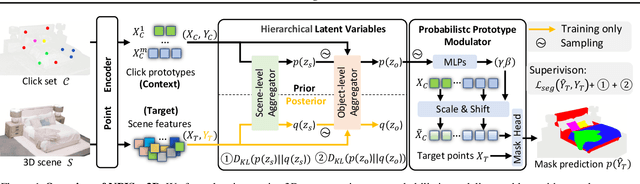
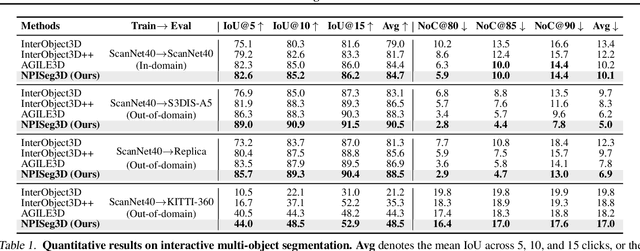
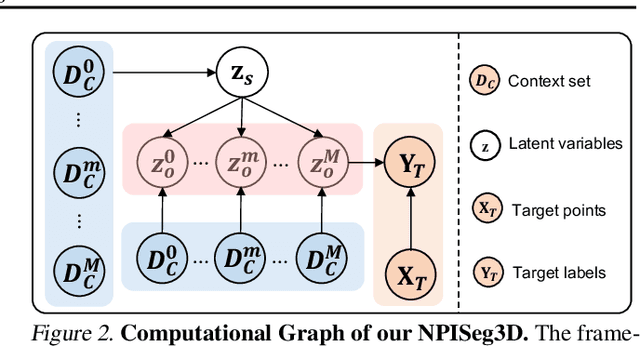
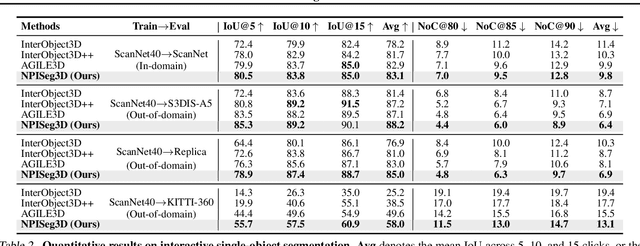
Interactive 3D segmentation has emerged as a promising solution for generating accurate object masks in complex 3D scenes by incorporating user-provided clicks. However, two critical challenges remain underexplored: (1) effectively generalizing from sparse user clicks to produce accurate segmentation, and (2) quantifying predictive uncertainty to help users identify unreliable regions. In this work, we propose NPISeg3D, a novel probabilistic framework that builds upon Neural Processes (NPs) to address these challenges. Specifically, NPISeg3D introduces a hierarchical latent variable structure with scene-specific and object-specific latent variables to enhance few-shot generalization by capturing both global context and object-specific characteristics. Additionally, we design a probabilistic prototype modulator that adaptively modulates click prototypes with object-specific latent variables, improving the model's ability to capture object-aware context and quantify predictive uncertainty. Experiments on four 3D point cloud datasets demonstrate that NPISeg3D achieves superior segmentation performance with fewer clicks while providing reliable uncertainty estimations.
Anti-Intercept OFDM Waveform Design with Secure Coding for Satellite Networks
Apr 30, 2025Low Earth Orbit (LEO) satellite networks are integral to next-generation communication systems, providing global coverage, low latency, and minimal signal loss. However, their unique characteristics, such as constrained onboard resources, Line-of-Sight (LoS) propagation, and vulnerability to eavesdropping over wide coverage areas, present significant challenges to physical layer security. To address these challenges, this paper focuses on the design of anti-intercept waveforms for satellite-ground links within Orthogonal Frequency Division Multiplexing (OFDM) systems, aiming to enhance security against eavesdropping threats. We formulate a secrecy rate maximization problem that aims to balance secrecy performance and communication reliability under eavesdropping constraints and sub-carrier power limitations. To solve this non-convex optimization problem, we propose a bisection search-activated neural network (BSA-Net) that integrates unsupervised learning for secure coding optimization and bisection search for dynamic power allocation. The proposed method is structured in two stages: the first optimizes secure coding under power constraints, while the second allocates power across sub-carriers under eavesdropping constraints. Extensive simulation results demonstrate the efficacy of our approach, showcasing significant improvements in secrecy rate performance.
NTIRE 2025 Challenge on Image Super-Resolution ($\times$4): Methods and Results
Apr 20, 2025This paper presents the NTIRE 2025 image super-resolution ($\times$4) challenge, one of the associated competitions of the 10th NTIRE Workshop at CVPR 2025. The challenge aims to recover high-resolution (HR) images from low-resolution (LR) counterparts generated through bicubic downsampling with a $\times$4 scaling factor. The objective is to develop effective network designs or solutions that achieve state-of-the-art SR performance. To reflect the dual objectives of image SR research, the challenge includes two sub-tracks: (1) a restoration track, emphasizes pixel-wise accuracy and ranks submissions based on PSNR; (2) a perceptual track, focuses on visual realism and ranks results by a perceptual score. A total of 286 participants registered for the competition, with 25 teams submitting valid entries. This report summarizes the challenge design, datasets, evaluation protocol, the main results, and methods of each team. The challenge serves as a benchmark to advance the state of the art and foster progress in image SR.
AnomalyR1: A GRPO-based End-to-end MLLM for Industrial Anomaly Detection
Apr 16, 2025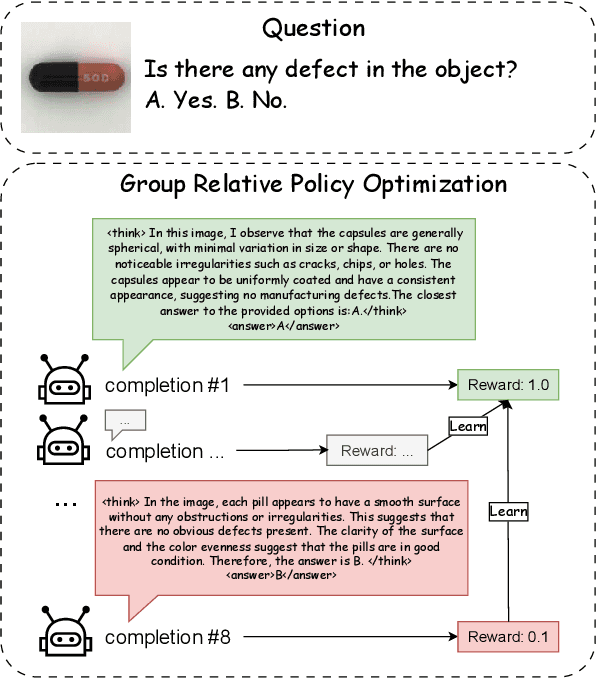
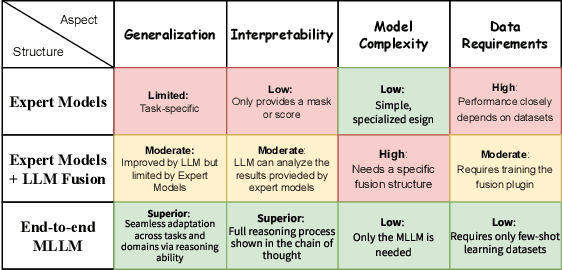
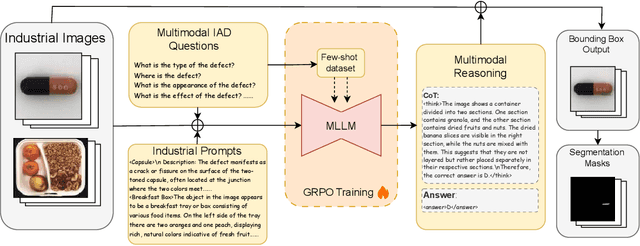
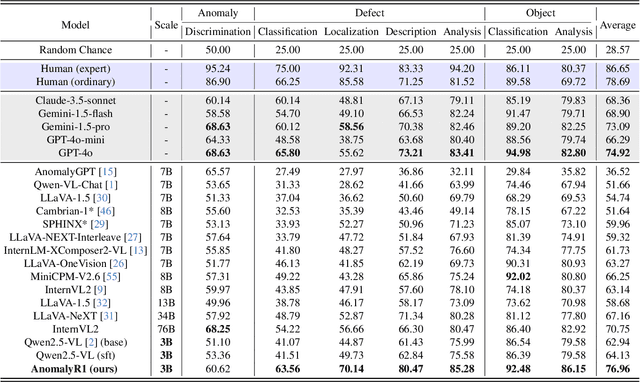
Industrial Anomaly Detection (IAD) poses a formidable challenge due to the scarcity of defective samples, making it imperative to deploy models capable of robust generalization to detect unseen anomalies effectively. Traditional approaches, often constrained by hand-crafted features or domain-specific expert models, struggle to address this limitation, underscoring the need for a paradigm shift. We introduce AnomalyR1, a pioneering framework that leverages VLM-R1, a Multimodal Large Language Model (MLLM) renowned for its exceptional generalization and interpretability, to revolutionize IAD. By integrating MLLM with Group Relative Policy Optimization (GRPO), enhanced by our novel Reasoned Outcome Alignment Metric (ROAM), AnomalyR1 achieves a fully end-to-end solution that autonomously processes inputs of image and domain knowledge, reasons through analysis, and generates precise anomaly localizations and masks. Based on the latest multimodal IAD benchmark, our compact 3-billion-parameter model outperforms existing methods, establishing state-of-the-art results. As MLLM capabilities continue to advance, this study is the first to deliver an end-to-end VLM-based IAD solution that demonstrates the transformative potential of ROAM-enhanced GRPO, positioning our framework as a forward-looking cornerstone for next-generation intelligent anomaly detection systems in industrial applications with limited defective data.
Detecting Credit Card Fraud via Heterogeneous Graph Neural Networks with Graph Attention
Apr 11, 2025This study proposes a credit card fraud detection method based on Heterogeneous Graph Neural Network (HGNN) to address fraud in complex transaction networks. Unlike traditional machine learning methods that rely solely on numerical features of transaction records, this approach constructs heterogeneous transaction graphs. These graphs incorporate multiple node types, including users, merchants, and transactions. By leveraging graph neural networks, the model captures higher-order transaction relationships. A Graph Attention Mechanism is employed to dynamically assign weights to different transaction relationships. Additionally, a Temporal Decay Mechanism is integrated to enhance the model's sensitivity to time-related fraud patterns. To address the scarcity of fraudulent transaction samples, this study applies SMOTE oversampling and Cost-sensitive Learning. These techniques strengthen the model's ability to identify fraudulent transactions. Experimental results demonstrate that the proposed method outperforms existing GNN models, including GCN, GAT, and GraphSAGE, on the IEEE-CIS Fraud Detection dataset. The model achieves notable improvements in both accuracy and OC-ROC. Future research may explore the integration of dynamic graph neural networks and reinforcement learning. Such advancements could enhance the real-time adaptability of fraud detection systems and provide more intelligent solutions for financial risk control.
Addressing Class Imbalance with Probabilistic Graphical Models and Variational Inference
Apr 08, 2025This study proposes a method for imbalanced data classification based on deep probabilistic graphical models (DPGMs) to solve the problem that traditional methods have insufficient learning ability for minority class samples. To address the classification bias caused by class imbalance, we introduce variational inference optimization probability modeling, which enables the model to adaptively adjust the representation ability of minority classes and combines the class-aware weight adjustment strategy to enhance the classifier's sensitivity to minority classes. In addition, we combine the adversarial learning mechanism to generate minority class samples in the latent space so that the model can better characterize the category boundary in the high-dimensional feature space. The experiment is evaluated on the Kaggle "Credit Card Fraud Detection" dataset and compared with a variety of advanced imbalanced classification methods (such as GAN-based sampling, BRF, XGBoost-Cost Sensitive, SAAD, HAN). The results show that the method in this study has achieved the best performance in AUC, Precision, Recall and F1-score indicators, effectively improving the recognition rate of minority classes and reducing the false alarm rate. This method can be widely used in imbalanced classification tasks such as financial fraud detection, medical diagnosis, and anomaly detection, providing a new solution for related research.