 Add to Chrome
 Add to Firefox
 Add to Edge
R&D-Agent-Quant: A Multi-Agent Framework for Data-Centric Factors and Model Joint Optimization
May 21, 2025
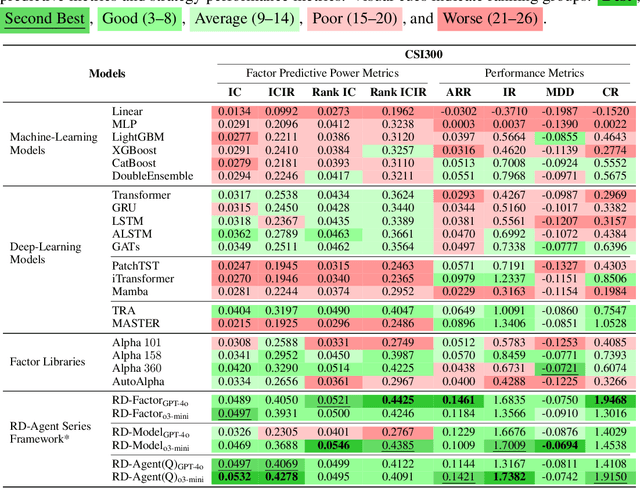
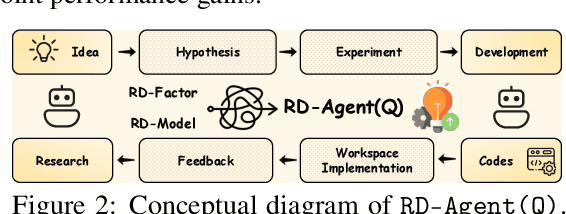

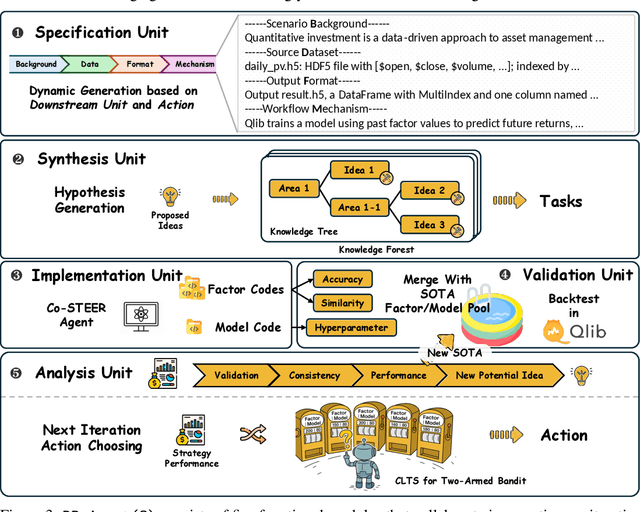
Financial markets pose fundamental challenges for asset return prediction due to their high dimensionality, non-stationarity, and persistent volatility. Despite advances in large language models and multi-agent systems, current quantitative research pipelines suffer from limited automation, weak interpretability, and fragmented coordination across key components such as factor mining and model innovation. In this paper, we propose R&D-Agent for Quantitative Finance, in short RD-Agent(Q), the first data-centric multi-agent framework designed to automate the full-stack research and development of quantitative strategies via coordinated factor-model co-optimization. RD-Agent(Q) decomposes the quant process into two iterative stages: a Research stage that dynamically sets goal-aligned prompts, formulates hypotheses based on domain priors, and maps them to concrete tasks, and a Development stage that employs a code-generation agent, Co-STEER, to implement task-specific code, which is then executed in real-market backtests. The two stages are connected through a feedback stage that thoroughly evaluates experimental outcomes and informs subsequent iterations, with a multi-armed bandit scheduler for adaptive direction selection. Empirically, RD-Agent(Q) achieves up to 2X higher annualized returns than classical factor libraries using 70% fewer factors, and outperforms state-of-the-art deep time-series models on real markets. Its joint factor-model optimization delivers a strong balance between predictive accuracy and strategy robustness. Our code is available at: https://github.com/microsoft/RD-Agent.

R&D-Agent: Automating Data-Driven AI Solution Building Through LLM-Powered Automated Research, Development, and Evolution
May 20, 2025Recent advances in AI and ML have transformed data science, yet increasing complexity and expertise requirements continue to hinder progress. While crowdsourcing platforms alleviate some challenges, high-level data science tasks remain labor-intensive and iterative. To overcome these limitations, we introduce R&D-Agent, a dual-agent framework for iterative exploration. The Researcher agent uses performance feedback to generate ideas, while the Developer agent refines code based on error feedback. By enabling multiple parallel exploration traces that merge and enhance one another, R&D-Agent narrows the gap between automated solutions and expert-level performance. Evaluated on MLE-Bench, R&D-Agent emerges as the top-performing machine learning engineering agent, demonstrating its potential to accelerate innovation and improve precision across diverse data science applications. We have open-sourced R&D-Agent on GitHub: https://github.com/microsoft/RD-Agent.
Generating Full-field Evolution of Physical Dynamics from Irregular Sparse Observations
May 14, 2025Modeling and reconstructing multidimensional physical dynamics from sparse and off-grid observations presents a fundamental challenge in scientific research. Recently, diffusion-based generative modeling shows promising potential for physical simulation. However, current approaches typically operate on on-grid data with preset spatiotemporal resolution, but struggle with the sparsely observed and continuous nature of real-world physical dynamics. To fill the gaps, we present SDIFT, Sequential DIffusion in Functional Tucker space, a novel framework that generates full-field evolution of physical dynamics from irregular sparse observations. SDIFT leverages the functional Tucker model as the latent space representer with proven universal approximation property, and represents observations as latent functions and Tucker core sequences. We then construct a sequential diffusion model with temporally augmented UNet in the functional Tucker space, denoising noise drawn from a Gaussian process to generate the sequence of core tensors. At the posterior sampling stage, we propose a Message-Passing Posterior Sampling mechanism, enabling conditional generation of the entire sequence guided by observations at limited time steps. We validate SDIFT on three physical systems spanning astronomical (supernova explosions, light-year scale), environmental (ocean sound speed fields, kilometer scale), and molecular (organic liquid, millimeter scale) domains, demonstrating significant improvements in both reconstruction accuracy and computational efficiency compared to state-of-the-art approaches.
OMGM: Orchestrate Multiple Granularities and Modalities for Efficient Multimodal Retrieval
May 10, 2025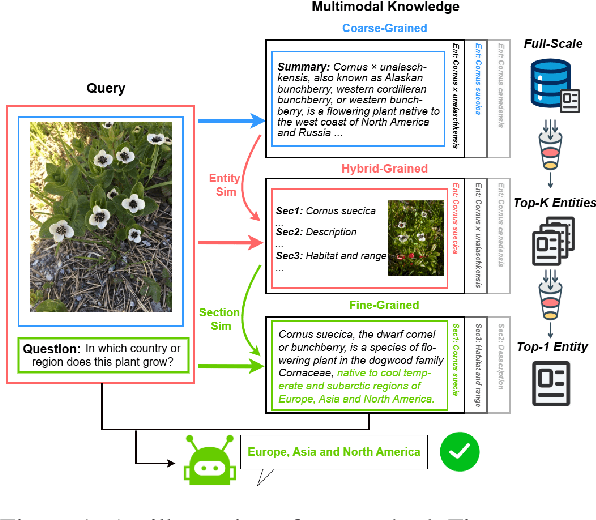
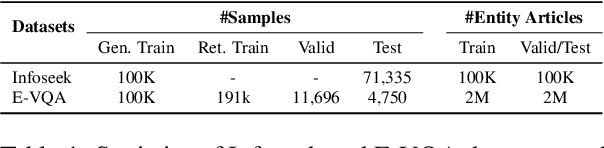
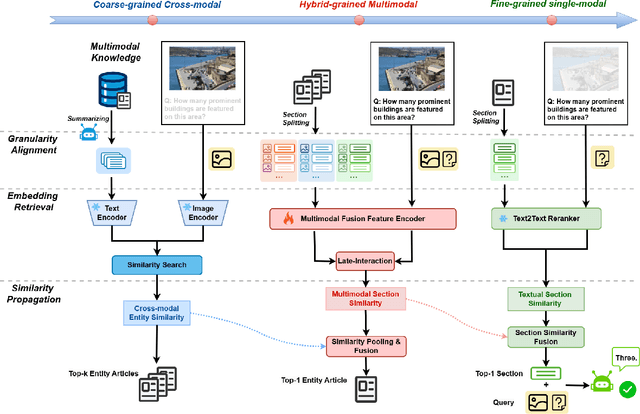
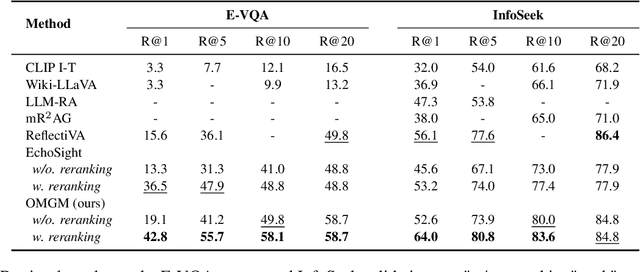
Vision-language retrieval-augmented generation (RAG) has become an effective approach for tackling Knowledge-Based Visual Question Answering (KB-VQA), which requires external knowledge beyond the visual content presented in images. The effectiveness of Vision-language RAG systems hinges on multimodal retrieval, which is inherently challenging due to the diverse modalities and knowledge granularities in both queries and knowledge bases. Existing methods have not fully tapped into the potential interplay between these elements. We propose a multimodal RAG system featuring a coarse-to-fine, multi-step retrieval that harmonizes multiple granularities and modalities to enhance efficacy. Our system begins with a broad initial search aligning knowledge granularity for cross-modal retrieval, followed by a multimodal fusion reranking to capture the nuanced multimodal information for top entity selection. A text reranker then filters out the most relevant fine-grained section for augmented generation. Extensive experiments on the InfoSeek and Encyclopedic-VQA benchmarks show our method achieves state-of-the-art retrieval performance and highly competitive answering results, underscoring its effectiveness in advancing KB-VQA systems.
TarDiff: Target-Oriented Diffusion Guidance for Synthetic Electronic Health Record Time Series Generation
Apr 24, 2025Synthetic Electronic Health Record (EHR) time-series generation is crucial for advancing clinical machine learning models, as it helps address data scarcity by providing more training data. However, most existing approaches focus primarily on replicating statistical distributions and temporal dependencies of real-world data. We argue that fidelity to observed data alone does not guarantee better model performance, as common patterns may dominate, limiting the representation of rare but important conditions. This highlights the need for generate synthetic samples to improve performance of specific clinical models to fulfill their target outcomes. To address this, we propose TarDiff, a novel target-oriented diffusion framework that integrates task-specific influence guidance into the synthetic data generation process. Unlike conventional approaches that mimic training data distributions, TarDiff optimizes synthetic samples by quantifying their expected contribution to improving downstream model performance through influence functions. Specifically, we measure the reduction in task-specific loss induced by synthetic samples and embed this influence gradient into the reverse diffusion process, thereby steering the generation towards utility-optimized data. Evaluated on six publicly available EHR datasets, TarDiff achieves state-of-the-art performance, outperforming existing methods by up to 20.4% in AUPRC and 18.4% in AUROC. Our results demonstrate that TarDiff not only preserves temporal fidelity but also enhances downstream model performance, offering a robust solution to data scarcity and class imbalance in healthcare analytics.
MineWorld: a Real-Time and Open-Source Interactive World Model on Minecraft
Apr 11, 2025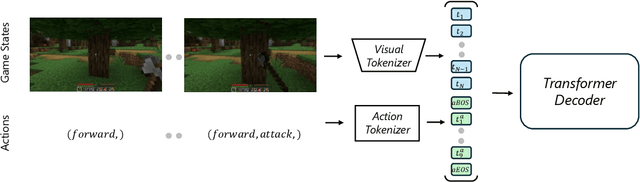

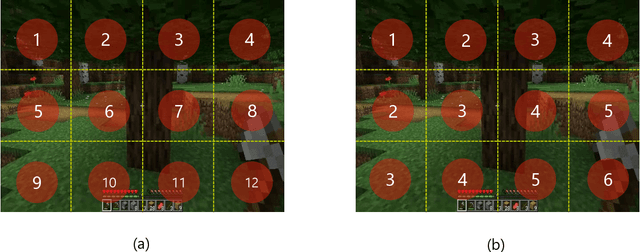
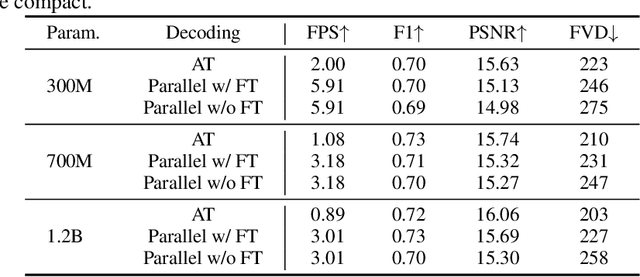
World modeling is a crucial task for enabling intelligent agents to effectively interact with humans and operate in dynamic environments. In this work, we propose MineWorld, a real-time interactive world model on Minecraft, an open-ended sandbox game which has been utilized as a common testbed for world modeling. MineWorld is driven by a visual-action autoregressive Transformer, which takes paired game scenes and corresponding actions as input, and generates consequent new scenes following the actions. Specifically, by transforming visual game scenes and actions into discrete token ids with an image tokenizer and an action tokenizer correspondingly, we consist the model input with the concatenation of the two kinds of ids interleaved. The model is then trained with next token prediction to learn rich representations of game states as well as the conditions between states and actions simultaneously. In inference, we develop a novel parallel decoding algorithm that predicts the spatial redundant tokens in each frame at the same time, letting models in different scales generate $4$ to $7$ frames per second and enabling real-time interactions with game players. In evaluation, we propose new metrics to assess not only visual quality but also the action following capacity when generating new scenes, which is crucial for a world model. Our comprehensive evaluation shows the efficacy of MineWorld, outperforming SoTA open-sourced diffusion based world models significantly. The code and model have been released.
Evaluating LLM-based Agents for Multi-Turn Conversations: A Survey
Mar 28, 2025This survey examines evaluation methods for large language model (LLM)-based agents in multi-turn conversational settings. Using a PRISMA-inspired framework, we systematically reviewed nearly 250 scholarly sources, capturing the state of the art from various venues of publication, and establishing a solid foundation for our analysis. Our study offers a structured approach by developing two interrelated taxonomy systems: one that defines \emph{what to evaluate} and another that explains \emph{how to evaluate}. The first taxonomy identifies key components of LLM-based agents for multi-turn conversations and their evaluation dimensions, including task completion, response quality, user experience, memory and context retention, as well as planning and tool integration. These components ensure that the performance of conversational agents is assessed in a holistic and meaningful manner. The second taxonomy system focuses on the evaluation methodologies. It categorizes approaches into annotation-based evaluations, automated metrics, hybrid strategies that combine human assessments with quantitative measures, and self-judging methods utilizing LLMs. This framework not only captures traditional metrics derived from language understanding, such as BLEU and ROUGE scores, but also incorporates advanced techniques that reflect the dynamic, interactive nature of multi-turn dialogues.
Chain of Functions: A Programmatic Pipeline for Fine-Grained Chart Reasoning Data
Mar 20, 2025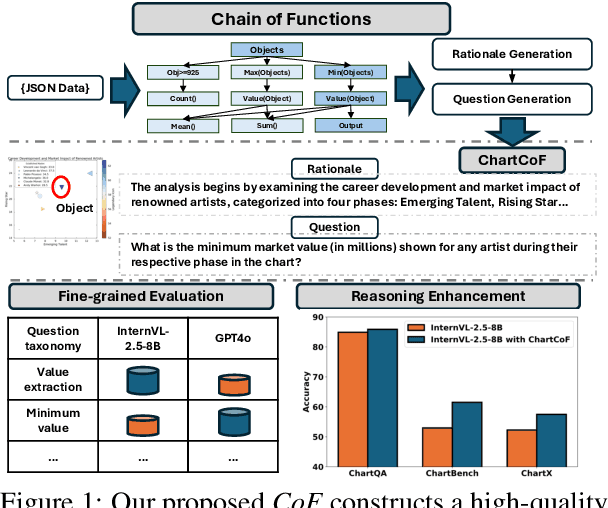

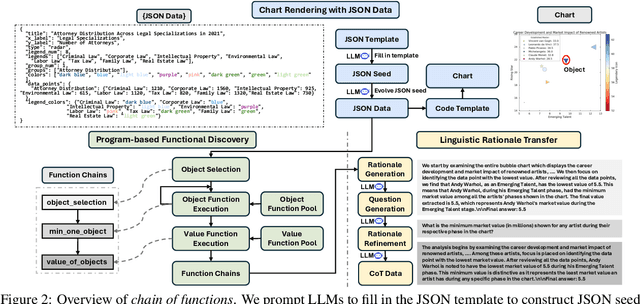
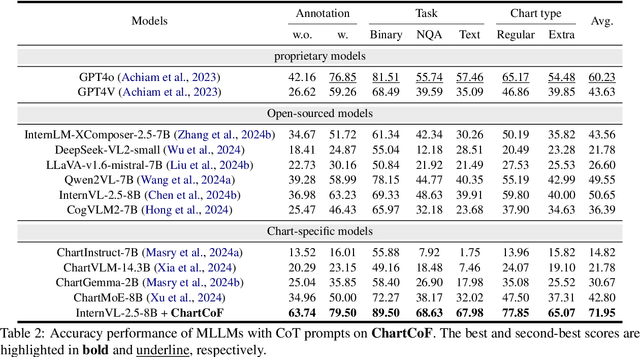
Visual reasoning is crucial for multimodal large language models (MLLMs) to address complex chart queries, yet high-quality rationale data remains scarce. Existing methods leveraged (M)LLMs for data generation, but direct prompting often yields limited precision and diversity. In this paper, we propose \textit{Chain of Functions (CoF)}, a novel programmatic reasoning data generation pipeline that utilizes freely-explored reasoning paths as supervision to ensure data precision and diversity. Specifically, it starts with human-free exploration among the atomic functions (e.g., maximum data and arithmetic operations) to generate diverse function chains, which are then translated into linguistic rationales and questions with only a moderate open-sourced LLM. \textit{CoF} provides multiple benefits: 1) Precision: function-governed generation reduces hallucinations compared to freeform generation; 2) Diversity: enumerating function chains enables varied question taxonomies; 3) Explainability: function chains serve as built-in rationales, allowing fine-grained evaluation beyond overall accuracy; 4) Practicality: eliminating reliance on extremely large models. Employing \textit{CoF}, we construct the \textit{ChartCoF} dataset, with 1.4k complex reasoning Q\&A for fine-grained analysis and 50k Q\&A for reasoning enhancement. The fine-grained evaluation on \textit{ChartCoF} reveals varying performance across question taxonomies for each MLLM, and the experiments also show that finetuning with \textit{ChartCoF} achieves state-of-the-art performance among same-scale MLLMs on widely used benchmarks. Furthermore, the novel paradigm of function-governed rationale generation in \textit{CoF} could inspire broader applications beyond charts.
Fast Autoregressive Video Generation with Diagonal Decoding
Mar 18, 2025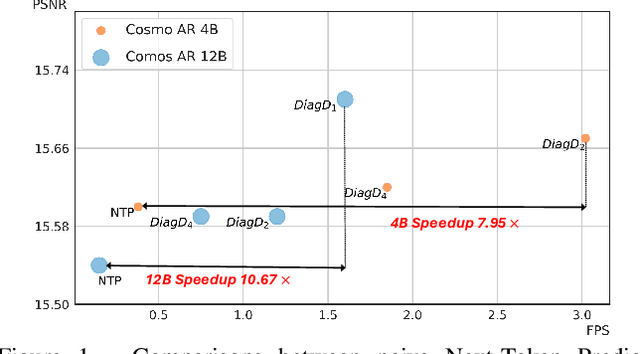
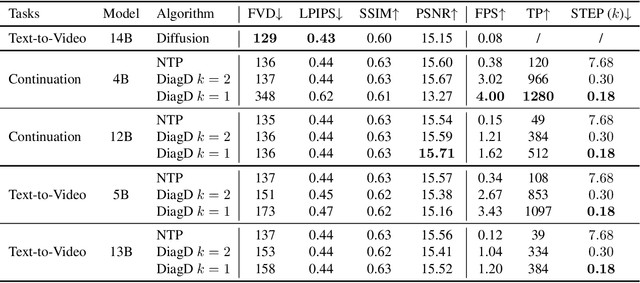
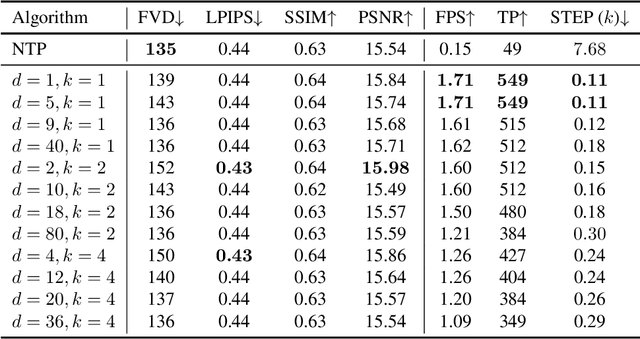
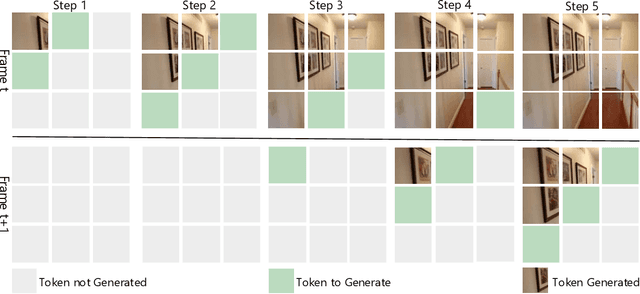
Autoregressive Transformer models have demonstrated impressive performance in video generation, but their sequential token-by-token decoding process poses a major bottleneck, particularly for long videos represented by tens of thousands of tokens. In this paper, we propose Diagonal Decoding (DiagD), a training-free inference acceleration algorithm for autoregressively pre-trained models that exploits spatial and temporal correlations in videos. Our method generates tokens along diagonal paths in the spatial-temporal token grid, enabling parallel decoding within each frame as well as partially overlapping across consecutive frames. The proposed algorithm is versatile and adaptive to various generative models and tasks, while providing flexible control over the trade-off between inference speed and visual quality. Furthermore, we propose a cost-effective finetuning strategy that aligns the attention patterns of the model with our decoding order, further mitigating the training-inference gap on small-scale models. Experiments on multiple autoregressive video generation models and datasets demonstrate that DiagD achieves up to $10\times$ speedup compared to naive sequential decoding, while maintaining comparable visual fidelity.
BRIDGE: Bootstrapping Text to Control Time-Series Generation via Multi-Agent Iterative Optimization and Diffusion Modelling
Mar 05, 2025


Time-series Generation (TSG) is a prominent research area with broad applications in simulations, data augmentation, and counterfactual analysis. While existing methods have shown promise in unconditional single-domain TSG, real-world applications demand for cross-domain approaches capable of controlled generation tailored to domain-specific constraints and instance-level requirements. In this paper, we argue that text can provide semantic insights, domain information and instance-specific temporal patterns, to guide and improve TSG. We introduce ``Text-Controlled TSG'', a task focused on generating realistic time series by incorporating textual descriptions. To address data scarcity in this setting, we propose a novel LLM-based Multi-Agent framework that synthesizes diverse, realistic text-to-TS datasets. Furthermore, we introduce BRIDGE, a hybrid text-controlled TSG framework that integrates semantic prototypes with text description for supporting domain-level guidance. This approach achieves state-of-the-art generation fidelity on 11 of 12 datasets, and improves controllability by 12.52% on MSE and 6.34% MAE compared to no text input generation, highlighting its potential for generating tailored time-series data.