 Add to Chrome
 Add to Firefox
 Add to Edge
Visual and Semantic Prompt Collaboration for Generalized Zero-Shot Learning
Mar 29, 2025
Generalized zero-shot learning aims to recognize both seen and unseen classes with the help of semantic information that is shared among different classes. It inevitably requires consistent visual-semantic alignment. Existing approaches fine-tune the visual backbone by seen-class data to obtain semantic-related visual features, which may cause overfitting on seen classes with a limited number of training images. This paper proposes a novel visual and semantic prompt collaboration framework, which utilizes prompt tuning techniques for efficient feature adaptation. Specifically, we design a visual prompt to integrate the visual information for discriminative feature learning and a semantic prompt to integrate the semantic formation for visualsemantic alignment. To achieve effective prompt information integration, we further design a weak prompt fusion mechanism for the shallow layers and a strong prompt fusion mechanism for the deep layers in the network. Through the collaboration of visual and semantic prompts, we can obtain discriminative semantic-related features for generalized zero-shot image recognition. Extensive experiments demonstrate that our framework consistently achieves favorable performance in both conventional zero-shot learning and generalized zero-shot learning benchmarks compared to other state-of-the-art methods.

Follow Your Motion: A Generic Temporal Consistency Portrait Editing Framework with Trajectory Guidance
Mar 28, 2025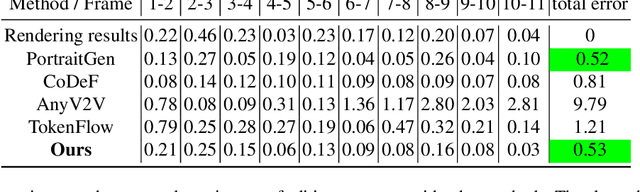
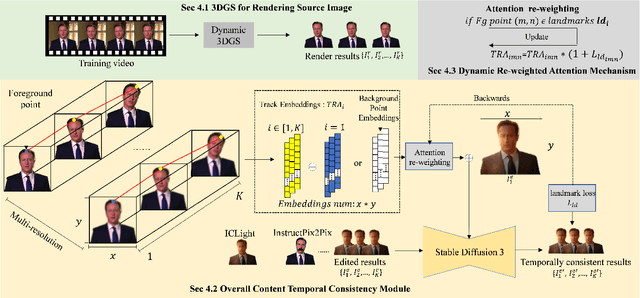
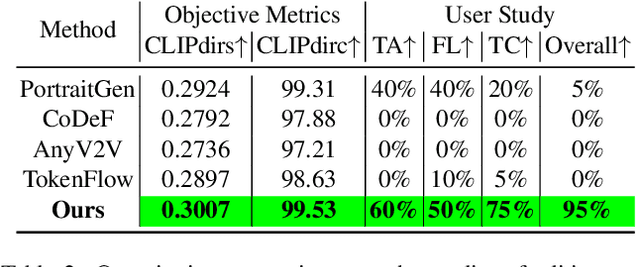
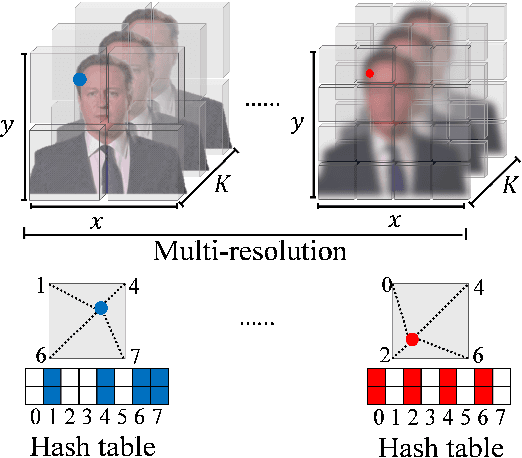
Pre-trained conditional diffusion models have demonstrated remarkable potential in image editing. However, they often face challenges with temporal consistency, particularly in the talking head domain, where continuous changes in facial expressions intensify the level of difficulty. These issues stem from the independent editing of individual images and the inherent loss of temporal continuity during the editing process. In this paper, we introduce Follow Your Motion (FYM), a generic framework for maintaining temporal consistency in portrait editing. Specifically, given portrait images rendered by a pre-trained 3D Gaussian Splatting model, we first develop a diffusion model that intuitively and inherently learns motion trajectory changes at different scales and pixel coordinates, from the first frame to each subsequent frame. This approach ensures that temporally inconsistent edited avatars inherit the motion information from the rendered avatars. Secondly, to maintain fine-grained expression temporal consistency in talking head editing, we propose a dynamic re-weighted attention mechanism. This mechanism assigns higher weight coefficients to landmark points in space and dynamically updates these weights based on landmark loss, achieving more consistent and refined facial expressions. Extensive experiments demonstrate that our method outperforms existing approaches in terms of temporal consistency and can be used to optimize and compensate for temporally inconsistent outputs in a range of applications, such as text-driven editing, relighting, and various other applications.
Learning Class Prototypes for Unified Sparse Supervised 3D Object Detection
Mar 27, 2025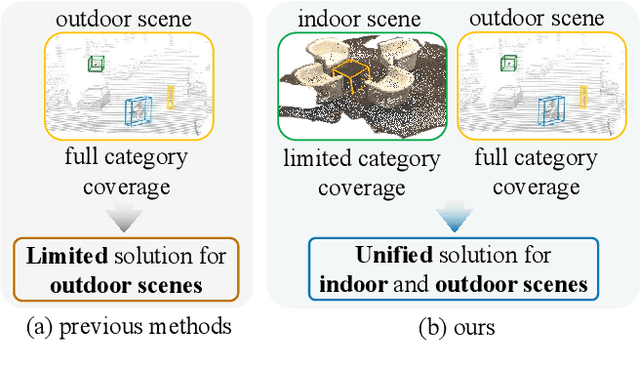
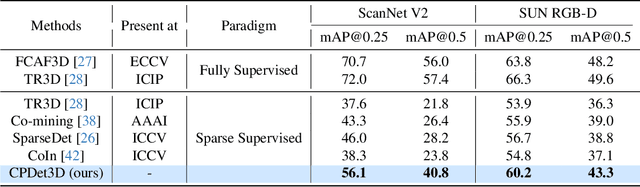
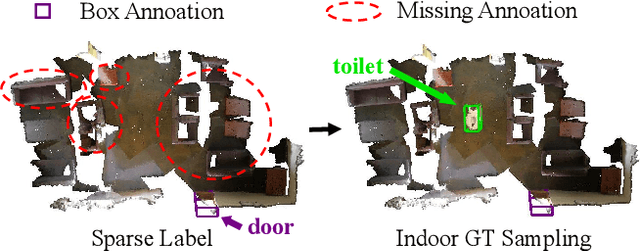
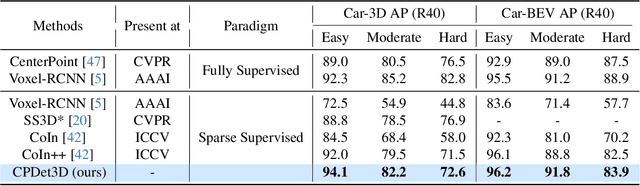
Both indoor and outdoor scene perceptions are essential for embodied intelligence. However, current sparse supervised 3D object detection methods focus solely on outdoor scenes without considering indoor settings. To this end, we propose a unified sparse supervised 3D object detection method for both indoor and outdoor scenes through learning class prototypes to effectively utilize unlabeled objects. Specifically, we first propose a prototype-based object mining module that converts the unlabeled object mining into a matching problem between class prototypes and unlabeled features. By using optimal transport matching results, we assign prototype labels to high-confidence features, thereby achieving the mining of unlabeled objects. We then present a multi-label cooperative refinement module to effectively recover missed detections through pseudo label quality control and prototype label cooperation. Experiments show that our method achieves state-of-the-art performance under the one object per scene sparse supervised setting across indoor and outdoor datasets. With only one labeled object per scene, our method achieves about 78%, 90%, and 96% performance compared to the fully supervised detector on ScanNet V2, SUN RGB-D, and KITTI, respectively, highlighting the scalability of our method. Code is available at https://github.com/zyrant/CPDet3D.
Principal Component Maximization: A Novel Method for SAR Image Formation from Raw Data without System Parameters
Mar 18, 2025Synthetic aperture radar (SAR) imaging traditionally requires precise knowledge of system parameters to implement focusing algorithms that transform raw data into high-resolution images. These algorithms require knowledge of SAR system parameters, such as wavelength, center slant range, fast time sampling rate, pulse repetition interval (PRI), waveform parameters (e.g., frequency modulation rate), and platform speed. This paper presents a novel framework for recovering SAR images from raw data without the requirement of any SAR system parameters. Firstly, we introduce an approximate matched filtering model that leverages the inherent shift-invariance properties of SAR echoes, enabling image formation through an adaptive reference echo estimation. To estimate this unknown reference echo, we develop a principal component maximization (PCM) technique that exploits the low-dimensional structure of the SAR signal. The PCM method employs a three-stage procedure: 1) data block segmentation, 2) energy normalization, and 3) principal component energy maximization across blocks, effectively handling non-stationary clutter environments. Secondly, we present a range-varying azimuth reference signal estimation method that compensates for the quadratic phase errors. For cases where PRI is unknown, we propose a two-step PRI estimation scheme that enables robust reconstruction of 2-D images from 1-D data streams. Experimental results on various SAR datasets demonstrate that our method can effectively recover SAR images from raw data without any prior system parameters.
From Zero to Detail: Deconstructing Ultra-High-Definition Image Restoration from Progressive Spectral Perspective
Mar 17, 2025Ultra-high-definition (UHD) image restoration faces significant challenges due to its high resolution, complex content, and intricate details. To cope with these challenges, we analyze the restoration process in depth through a progressive spectral perspective, and deconstruct the complex UHD restoration problem into three progressive stages: zero-frequency enhancement, low-frequency restoration, and high-frequency refinement. Building on this insight, we propose a novel framework, ERR, which comprises three collaborative sub-networks: the zero-frequency enhancer (ZFE), the low-frequency restorer (LFR), and the high-frequency refiner (HFR). Specifically, the ZFE integrates global priors to learn global mapping, while the LFR restores low-frequency information, emphasizing reconstruction of coarse-grained content. Finally, the HFR employs our designed frequency-windowed kolmogorov-arnold networks (FW-KAN) to refine textures and details, producing high-quality image restoration. Our approach significantly outperforms previous UHD methods across various tasks, with extensive ablation studies validating the effectiveness of each component. The code is available at \href{https://github.com/NJU-PCALab/ERR}{here}.
Remote Photoplethysmography in Real-World and Extreme Lighting Scenarios
Mar 14, 2025Physiological activities can be manifested by the sensitive changes in facial imaging. While they are barely observable to our eyes, computer vision manners can, and the derived remote photoplethysmography (rPPG) has shown considerable promise. However, existing studies mainly rely on spatial skin recognition and temporal rhythmic interactions, so they focus on identifying explicit features under ideal light conditions, but perform poorly in-the-wild with intricate obstacles and extreme illumination exposure. In this paper, we propose an end-to-end video transformer model for rPPG. It strives to eliminate complex and unknown external time-varying interferences, whether they are sufficient to occupy subtle biosignal amplitudes or exist as periodic perturbations that hinder network training. In the specific implementation, we utilize global interference sharing, subject background reference, and self-supervised disentanglement to eliminate interference, and further guide learning based on spatiotemporal filtering, reconstruction guidance, and frequency domain and biological prior constraints to achieve effective rPPG. To the best of our knowledge, this is the first robust rPPG model for real outdoor scenarios based on natural face videos, and is lightweight to deploy. Extensive experiments show the competitiveness and performance of our model in rPPG prediction across datasets and scenes.
Learning Cascade Ranking as One Network
Mar 12, 2025Cascade Ranking is a prevalent architecture in large-scale top-k selection systems like recommendation and advertising platforms. Traditional training methods focus on single-stage optimization, neglecting interactions between stages. Recent advances such as RankFlow and FS-LTR have introduced interaction-aware training paradigms but still struggle to 1) align training objectives with the goal of the entire cascade ranking (i.e., end-to-end recall) and 2) learn effective collaboration patterns for different stages. To address these challenges, we propose LCRON, which introduces a novel surrogate loss function derived from the lower bound probability that ground truth items are selected by cascade ranking, ensuring alignment with the overall objective of the system. According to the properties of the derived bound, we further design an auxiliary loss for each stage to drive the reduction of this bound, leading to a more robust and effective top-k selection. LCRON enables end-to-end training of the entire cascade ranking system as a unified network. Experimental results demonstrate that LCRON achieves significant improvement over existing methods on public benchmarks and industrial applications, addressing key limitations in cascade ranking training and significantly enhancing system performance.
YuE: Scaling Open Foundation Models for Long-Form Music Generation
Mar 11, 2025We tackle the task of long-form music generation--particularly the challenging \textbf{lyrics-to-song} problem--by introducing YuE, a family of open foundation models based on the LLaMA2 architecture. Specifically, YuE scales to trillions of tokens and generates up to five minutes of music while maintaining lyrical alignment, coherent musical structure, and engaging vocal melodies with appropriate accompaniment. It achieves this through (1) track-decoupled next-token prediction to overcome dense mixture signals, (2) structural progressive conditioning for long-context lyrical alignment, and (3) a multitask, multiphase pre-training recipe to converge and generalize. In addition, we redesign the in-context learning technique for music generation, enabling versatile style transfer (e.g., converting Japanese city pop into an English rap while preserving the original accompaniment) and bidirectional generation. Through extensive evaluation, we demonstrate that YuE matches or even surpasses some of the proprietary systems in musicality and vocal agility. In addition, fine-tuning YuE enables additional controls and enhanced support for tail languages. Furthermore, beyond generation, we show that YuE's learned representations can perform well on music understanding tasks, where the results of YuE match or exceed state-of-the-art methods on the MARBLE benchmark. Keywords: lyrics2song, song generation, long-form, foundation model, music generation
KiteRunner: Language-Driven Cooperative Local-Global Navigation Policy with UAV Mapping in Outdoor Environments
Mar 11, 2025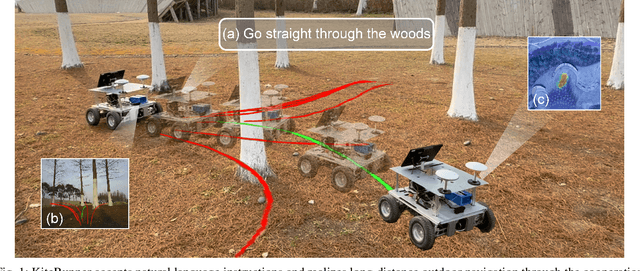
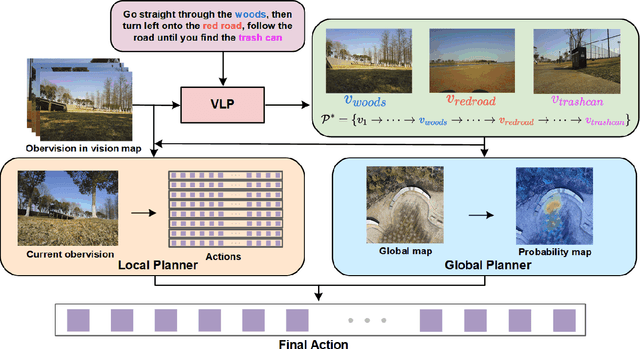
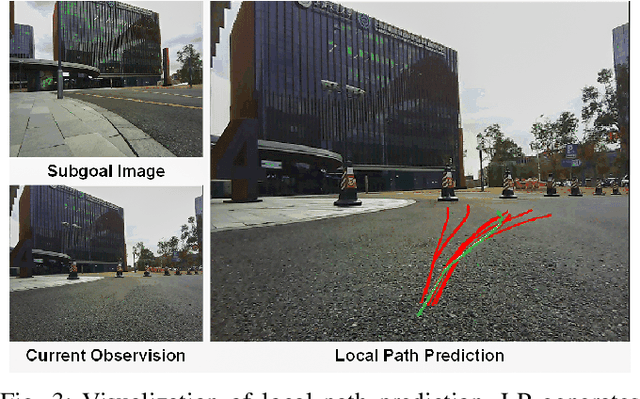
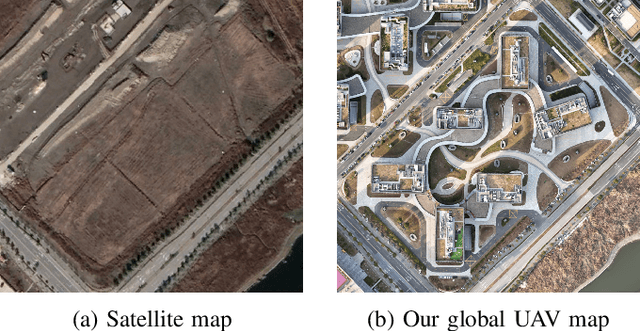
Autonomous navigation in open-world outdoor environments faces challenges in integrating dynamic conditions, long-distance spatial reasoning, and semantic understanding. Traditional methods struggle to balance local planning, global planning, and semantic task execution, while existing large language models (LLMs) enhance semantic comprehension but lack spatial reasoning capabilities. Although diffusion models excel in local optimization, they fall short in large-scale long-distance navigation. To address these gaps, this paper proposes KiteRunner, a language-driven cooperative local-global navigation strategy that combines UAV orthophoto-based global planning with diffusion model-driven local path generation for long-distance navigation in open-world scenarios. Our method innovatively leverages real-time UAV orthophotography to construct a global probability map, providing traversability guidance for the local planner, while integrating large models like CLIP and GPT to interpret natural language instructions. Experiments demonstrate that KiteRunner achieves 5.6% and 12.8% improvements in path efficiency over state-of-the-art methods in structured and unstructured environments, respectively, with significant reductions in human interventions and execution time.
GigaSLAM: Large-Scale Monocular SLAM with Hierachical Gaussian Splats
Mar 11, 2025Tracking and mapping in large-scale, unbounded outdoor environments using only monocular RGB input presents substantial challenges for existing SLAM systems. Traditional Neural Radiance Fields (NeRF) and 3D Gaussian Splatting (3DGS) SLAM methods are typically limited to small, bounded indoor settings. To overcome these challenges, we introduce GigaSLAM, the first NeRF/3DGS-based SLAM framework for kilometer-scale outdoor environments, as demonstrated on the KITTI and KITTI 360 datasets. Our approach employs a hierarchical sparse voxel map representation, where Gaussians are decoded by neural networks at multiple levels of detail. This design enables efficient, scalable mapping and high-fidelity viewpoint rendering across expansive, unbounded scenes. For front-end tracking, GigaSLAM utilizes a metric depth model combined with epipolar geometry and PnP algorithms to accurately estimate poses, while incorporating a Bag-of-Words-based loop closure mechanism to maintain robust alignment over long trajectories. Consequently, GigaSLAM delivers high-precision tracking and visually faithful rendering on urban outdoor benchmarks, establishing a robust SLAM solution for large-scale, long-term scenarios, and significantly extending the applicability of Gaussian Splatting SLAM systems to unbounded outdoor environments.