 Add to Chrome
 Add to Firefox
 Add to Edge
Unveiling the Backdoor Mechanism Hidden Behind Catastrophic Overfitting in Fast Adversarial Training
Apr 27, 2026
Fast Adversarial Training (FAT) has attracted significant attention due to its efficiency in enhancing neural network robustness against adversarial attacks. However, FAT is prone to catastrophic overfitting (CO), wherein models overfit to the specific attack used during training and fail to generalize to others. While existing methods introduce diverse hypotheses and propose various strategies to mitigate CO, a systematic and intuitive explanation of CO remains absent. In this work, we innovatively interpret CO through the lens of backdoor. Through validations on pathway division, diverse feature predictions, and universal class distinguishable triggers in CO, we conceptualize CO as a weak trigger variant of unlearnable tasks, unifying CO, backdoor attacks, and unlearnable tasks under a common theoretical framework. Guided by this, we leverage several backdoor inspired strategies to mitigate CO: (i) Recalibrate CO affected model parameters using vanilla fine tuning, linear probing, or reinitialization-based techniques; (ii) Introduce a weight outlier suppression constraint to regulate abnormal deviations in model weights. Extensive experiments support our interpretation of CO and show the efficacy of the proposed mitigation strategies.

AnchorRefine: Synergy-Manipulation Based on Trajectory Anchor and Residual Refinement for Vision-Language-Action Models
Apr 20, 2026Precision-critical manipulation requires both global trajectory organization and local execution correction, yet most vision-language-action (VLA) policies generate actions within a single unified space. This monolithic formulation forces macro-level transport and micro-level refinement to be optimized under the same objective, causing large motions to dominate learning while suppressing small but failure-critical corrective signals. In contrast, human manipulation is structured by global movement planning together with continuous local adjustment during execution. Motivated by this principle, we propose AnchorRefine, a hierarchical framework that factorizes VLA action modeling into trajectory anchor and residual refinement. The anchor planner predicts a coarse motion scaffold, while the refinement module corrects execution-level deviations to improve geometric and contact precision. We further introduce a decision-aware gripper refinement mechanism to better capture the discrete and boundary-sensitive nature of gripper control. Experiments on LIBERO, CALVIN, and real-robot tasks demonstrate that AnchorRefine consistently improves both regression-based and diffusion-based VLA backbones, yielding gains of up to 7.8% in simulation success rate and 18% in real-world success rate.
Modality-Agnostic Prompt Learning for Multi-Modal Camouflaged Object Detection
Apr 14, 2026Camouflaged Object Detection (COD) aims to segment objects that blend seamlessly into complex backgrounds, with growing interest in exploiting additional visual modalities to enhance robustness through complementary information. However, most existing approaches generally rely on modality-specific architectures or customized fusion strategies, which limit scalability and cross-modal generalization. To address this, we propose a novel framework that generates modality-agnostic multi-modal prompts for the Segment Anything Model (SAM), enabling parameter-efficient adaptation to arbitrary auxiliary modalities and significantly improving overall performance on COD tasks. Specifically, we model multi-modal learning through interactions between a data-driven content domain and a knowledge-driven prompt domain, distilling task-relevant cues into unified prompts for SAM decoding. We further introduce a lightweight Mask Refine Module to calibrate coarse predictions by incorporating fine-grained prompt cues, leading to more accurate camouflaged object boundaries. Extensive experiments on RGB-Depth, RGB-Thermal, and RGB-Polarization benchmarks validate the effectiveness and generalization of our modality-agnostic framework.
TDATR: Improving End-to-End Table Recognition via Table Detail-Aware Learning and Cell-Level Visual Alignment
Mar 24, 2026Tables are pervasive in diverse documents, making table recognition (TR) a fundamental task in document analysis. Existing modular TR pipelines separately model table structure and content, leading to suboptimal integration and complex workflows. End-to-end approaches rely heavily on large-scale TR data and struggle in data-constrained scenarios. To address these issues, we propose TDATR (Table Detail-Aware Table Recognition) improves end-to-end TR through table detail-aware learning and cell-level visual alignment. TDATR adopts a ``perceive-then-fuse'' strategy. The model first performs table detail-aware learning to jointly perceive table structure and content through multiple structure understanding and content recognition tasks designed under a language modeling paradigm. These tasks can naturally leverage document data from diverse scenarios to enhance model robustness. The model then integrates implicit table details to generate structured HTML outputs, enabling more efficient TR modeling when trained with limited data. Furthermore, we design a structure-guided cell localization module integrated into the end-to-end TR framework, which efficiently locates cell and strengthens vision-language alignment. It enhances the interpretability and accuracy of TR. We achieve state-of-the-art or highly competitive performance on seven benchmarks without dataset-specific fine-tuning.
TagaVLM: Topology-Aware Global Action Reasoning for Vision-Language Navigation
Mar 03, 2026Vision-Language Navigation (VLN) presents a unique challenge for Large Vision-Language Models (VLMs) due to their inherent architectural mismatch: VLMs are primarily pretrained on static, disembodied vision-language tasks, which fundamentally clash with the dynamic, embodied, and spatially-structured nature of navigation. Existing large-model-based methods often resort to converting rich visual and spatial information into text, forcing models to implicitly infer complex visual-topological relationships or limiting their global action capabilities. To bridge this gap, we propose TagaVLM (Topology-Aware Global Action reasoning), an end-to-end framework that explicitly injects topological structures into the VLM backbone. To introduce topological edge information, Spatial Topology Aware Residual Attention (STAR-Att) directly integrates it into the VLM's self-attention mechanism, enabling intrinsic spatial reasoning while preserving pretrained knowledge. To enhance topological node information, an Interleaved Navigation Prompt strengthens node-level visual-text alignment. Finally, with the embedded topological graph, the model is capable of global action reasoning, allowing for robust path correction. On the R2R benchmark, TagaVLM achieves state-of-the-art performance among large-model-based methods, with a Success Rate (SR) of 51.09% and SPL of 47.18 in unseen environments, outperforming prior work by 3.39% in SR and 9.08 in SPL. This demonstrates that, for embodied spatial reasoning, targeted enhancements on smaller open-source VLMs can be more effective than brute-force model scaling. The code will be released upon publication.Project page: https://apex-bjut.github.io/Taga-VLM
CompEvent: Complex-valued Event-RGB Fusion for Low-light Video Enhancement and Deblurring
Nov 18, 2025Low-light video deblurring poses significant challenges in applications like nighttime surveillance and autonomous driving due to dim lighting and long exposures. While event cameras offer potential solutions with superior low-light sensitivity and high temporal resolution, existing fusion methods typically employ staged strategies, limiting their effectiveness against combined low-light and motion blur degradations. To overcome this, we propose CompEvent, a complex neural network framework enabling holistic full-process fusion of event data and RGB frames for enhanced joint restoration. CompEvent features two core components: 1) Complex Temporal Alignment GRU, which utilizes complex-valued convolutions and processes video and event streams iteratively via GRU to achieve temporal alignment and continuous fusion; and 2) Complex Space-Frequency Learning module, which performs unified complex-valued signal processing in both spatial and frequency domains, facilitating deep fusion through spatial structures and system-level characteristics. By leveraging the holistic representation capability of complex-valued neural networks, CompEvent achieves full-process spatiotemporal fusion, maximizes complementary learning between modalities, and significantly strengthens low-light video deblurring capability. Extensive experiments demonstrate that CompEvent outperforms SOTA methods in addressing this challenging task. The code is available at https://github.com/YuXie1/CompEvent.
Visual and Semantic Prompt Collaboration for Generalized Zero-Shot Learning
Mar 29, 2025Generalized zero-shot learning aims to recognize both seen and unseen classes with the help of semantic information that is shared among different classes. It inevitably requires consistent visual-semantic alignment. Existing approaches fine-tune the visual backbone by seen-class data to obtain semantic-related visual features, which may cause overfitting on seen classes with a limited number of training images. This paper proposes a novel visual and semantic prompt collaboration framework, which utilizes prompt tuning techniques for efficient feature adaptation. Specifically, we design a visual prompt to integrate the visual information for discriminative feature learning and a semantic prompt to integrate the semantic formation for visualsemantic alignment. To achieve effective prompt information integration, we further design a weak prompt fusion mechanism for the shallow layers and a strong prompt fusion mechanism for the deep layers in the network. Through the collaboration of visual and semantic prompts, we can obtain discriminative semantic-related features for generalized zero-shot image recognition. Extensive experiments demonstrate that our framework consistently achieves favorable performance in both conventional zero-shot learning and generalized zero-shot learning benchmarks compared to other state-of-the-art methods.
Col-OLHTR: A Novel Framework for Multimodal Online Handwritten Text Recognition
Feb 10, 2025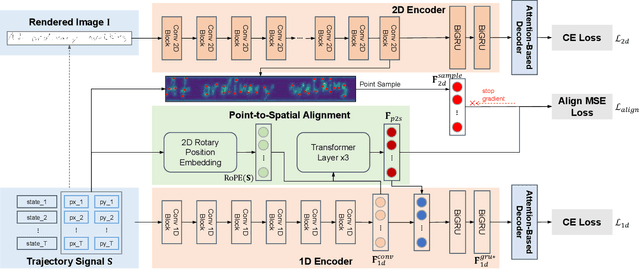
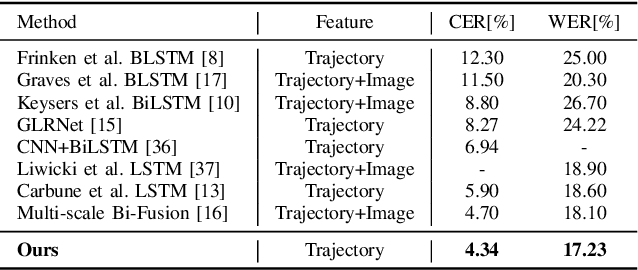
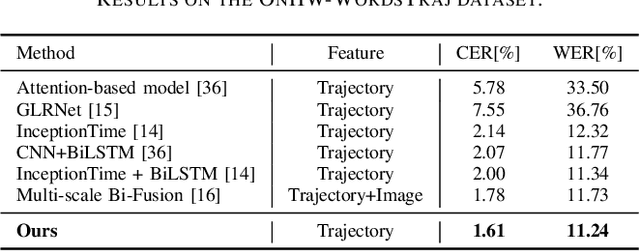
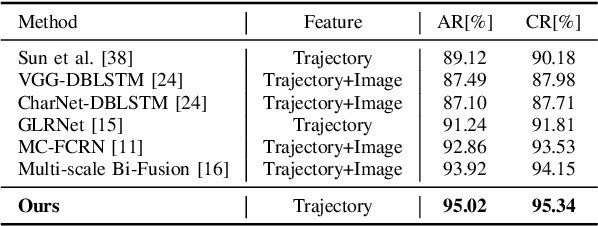
Online Handwritten Text Recognition (OLHTR) has gained considerable attention for its diverse range of applications. Current approaches usually treat OLHTR as a sequence recognition task, employing either a single trajectory or image encoder, or multi-stream encoders, combined with a CTC or attention-based recognition decoder. However, these approaches face several drawbacks: 1) single encoders typically focus on either local trajectories or visual regions, lacking the ability to dynamically capture relevant global features in challenging cases; 2) multi-stream encoders, while more comprehensive, suffer from complex structures and increased inference costs. To tackle this, we propose a Collaborative learning-based OLHTR framework, called Col-OLHTR, that learns multimodal features during training while maintaining a single-stream inference process. Col-OLHTR consists of a trajectory encoder, a Point-to-Spatial Alignment (P2SA) module, and an attention-based decoder. The P2SA module is designed to learn image-level spatial features through trajectory-encoded features and 2D rotary position embeddings. During training, an additional image-stream encoder-decoder is collaboratively trained to provide supervision for P2SA features. At inference, the extra streams are discarded, and only the P2SA module is used and merged before the decoder, simplifying the process while preserving high performance. Extensive experimental results on several OLHTR benchmarks demonstrate the state-of-the-art (SOTA) performance, proving the effectiveness and robustness of our design.
AdvAnchor: Enhancing Diffusion Model Unlearning with Adversarial Anchors
Dec 28, 2024Security concerns surrounding text-to-image diffusion models have driven researchers to unlearn inappropriate concepts through fine-tuning. Recent fine-tuning methods typically align the prediction distributions of unsafe prompts with those of predefined text anchors. However, these techniques exhibit a considerable performance trade-off between eliminating undesirable concepts and preserving other concepts. In this paper, we systematically analyze the impact of diverse text anchors on unlearning performance. Guided by this analysis, we propose AdvAnchor, a novel approach that generates adversarial anchors to alleviate the trade-off issue. These adversarial anchors are crafted to closely resemble the embeddings of undesirable concepts to maintain overall model performance, while selectively excluding defining attributes of these concepts for effective erasure. Extensive experiments demonstrate that AdvAnchor outperforms state-of-the-art methods. Our code is publicly available at https://anonymous.4open.science/r/AdvAnchor.
HC-LLM: Historical-Constrained Large Language Models for Radiology Report Generation
Dec 15, 2024


Radiology report generation (RRG) models typically focus on individual exams, often overlooking the integration of historical visual or textual data, which is crucial for patient follow-ups. Traditional methods usually struggle with long sequence dependencies when incorporating historical information, but large language models (LLMs) excel at in-context learning, making them well-suited for analyzing longitudinal medical data. In light of this, we propose a novel Historical-Constrained Large Language Models (HC-LLM) framework for RRG, empowering LLMs with longitudinal report generation capabilities by constraining the consistency and differences between longitudinal images and their corresponding reports. Specifically, our approach extracts both time-shared and time-specific features from longitudinal chest X-rays and diagnostic reports to capture disease progression. Then, we ensure consistent representation by applying intra-modality similarity constraints and aligning various features across modalities with multimodal contrastive and structural constraints. These combined constraints effectively guide the LLMs in generating diagnostic reports that accurately reflect the progression of the disease, achieving state-of-the-art results on the Longitudinal-MIMIC dataset. Notably, our approach performs well even without historical data during testing and can be easily adapted to other multimodal large models, enhancing its versatility.