 Add to Chrome
 Add to Firefox
 Add to Edge
Temporal Separation with Entropy Regularization for Knowledge Distillation in Spiking Neural Networks
Mar 05, 2025
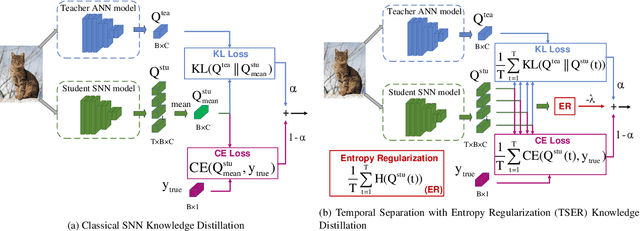
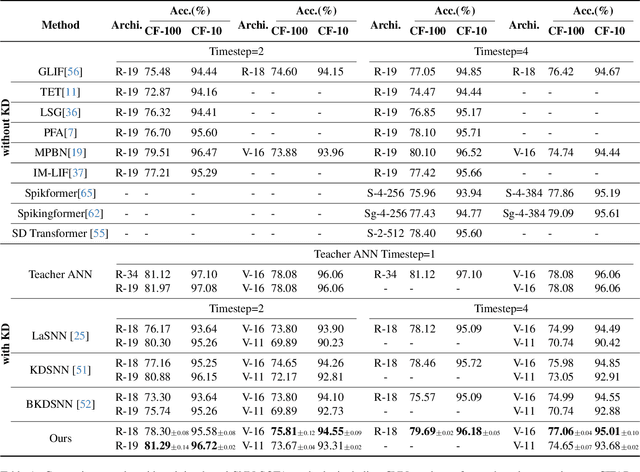
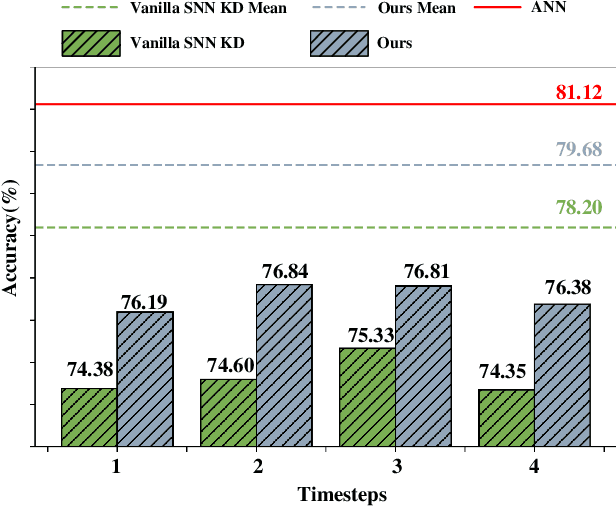
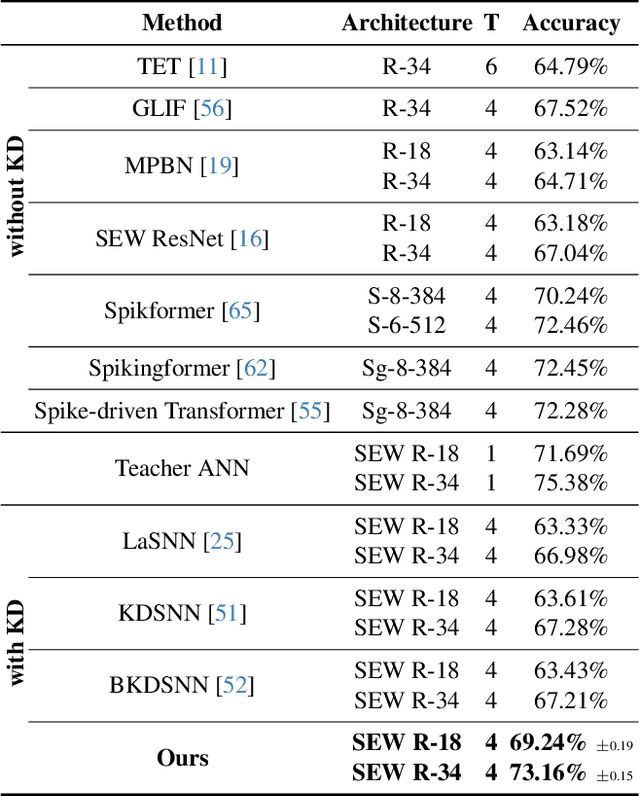
Spiking Neural Networks (SNNs), inspired by the human brain, offer significant computational efficiency through discrete spike-based information transfer. Despite their potential to reduce inference energy consumption, a performance gap persists between SNNs and Artificial Neural Networks (ANNs), primarily due to current training methods and inherent model limitations. While recent research has aimed to enhance SNN learning by employing knowledge distillation (KD) from ANN teacher networks, traditional distillation techniques often overlook the distinctive spatiotemporal properties of SNNs, thus failing to fully leverage their advantages. To overcome these challenge, we propose a novel logit distillation method characterized by temporal separation and entropy regularization. This approach improves existing SNN distillation techniques by performing distillation learning on logits across different time steps, rather than merely on aggregated output features. Furthermore, the integration of entropy regularization stabilizes model optimization and further boosts the performance. Extensive experimental results indicate that our method surpasses prior SNN distillation strategies, whether based on logit distillation, feature distillation, or a combination of both. The code will be available on GitHub.

STAA-SNN: Spatial-Temporal Attention Aggregator for Spiking Neural Networks
Mar 05, 2025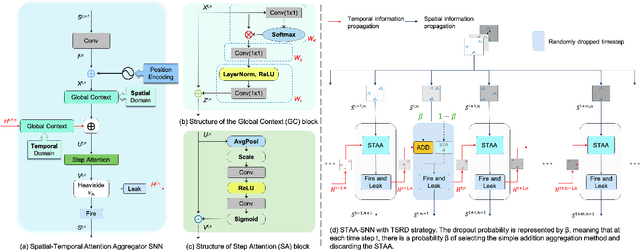
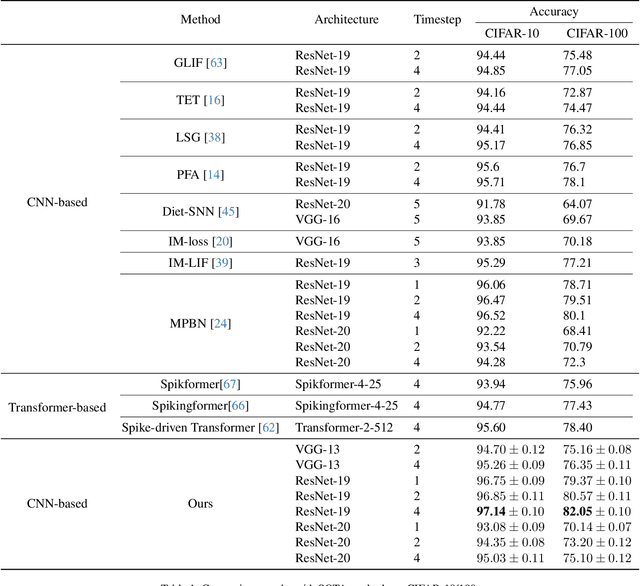
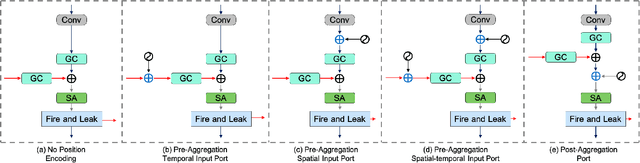
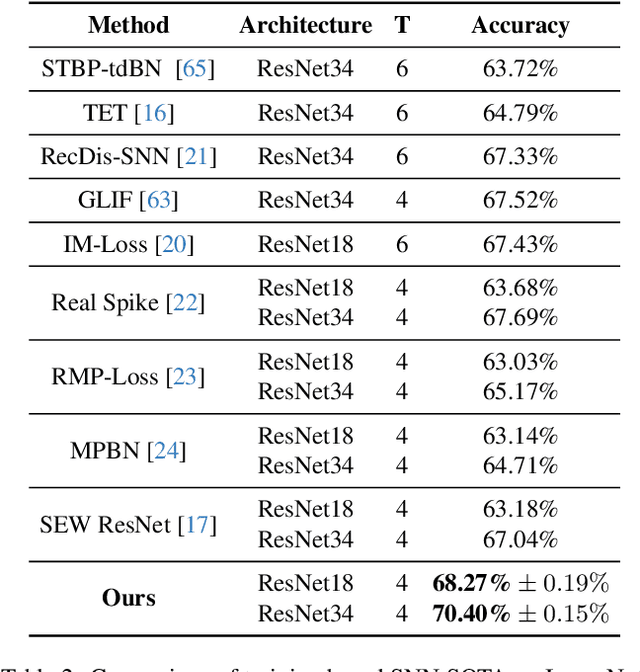
Spiking Neural Networks (SNNs) have gained significant attention due to their biological plausibility and energy efficiency, making them promising alternatives to Artificial Neural Networks (ANNs). However, the performance gap between SNNs and ANNs remains a substantial challenge hindering the widespread adoption of SNNs. In this paper, we propose a Spatial-Temporal Attention Aggregator SNN (STAA-SNN) framework, which dynamically focuses on and captures both spatial and temporal dependencies. First, we introduce a spike-driven self-attention mechanism specifically designed for SNNs. Additionally, we pioneeringly incorporate position encoding to integrate latent temporal relationships into the incoming features. For spatial-temporal information aggregation, we employ step attention to selectively amplify relevant features at different steps. Finally, we implement a time-step random dropout strategy to avoid local optima. As a result, STAA-SNN effectively captures both spatial and temporal dependencies, enabling the model to analyze complex patterns and make accurate predictions. The framework demonstrates exceptional performance across diverse datasets and exhibits strong generalization capabilities. Notably, STAA-SNN achieves state-of-the-art results on neuromorphic datasets CIFAR10-DVS, with remarkable performances of 97.14%, 82.05% and 70.40% on the static datasets CIFAR-10, CIFAR-100 and ImageNet, respectively. Furthermore, our model exhibits improved performance ranging from 0.33\% to 2.80\% with fewer time steps. The code for the model is available on GitHub.
RDG-GS: Relative Depth Guidance with Gaussian Splatting for Real-time Sparse-View 3D Rendering
Jan 19, 2025Efficiently synthesizing novel views from sparse inputs while maintaining accuracy remains a critical challenge in 3D reconstruction. While advanced techniques like radiance fields and 3D Gaussian Splatting achieve rendering quality and impressive efficiency with dense view inputs, they suffer from significant geometric reconstruction errors when applied to sparse input views. Moreover, although recent methods leverage monocular depth estimation to enhance geometric learning, their dependence on single-view estimated depth often leads to view inconsistency issues across different viewpoints. Consequently, this reliance on absolute depth can introduce inaccuracies in geometric information, ultimately compromising the quality of scene reconstruction with Gaussian splats. In this paper, we present RDG-GS, a novel sparse-view 3D rendering framework with Relative Depth Guidance based on 3D Gaussian Splatting. The core innovation lies in utilizing relative depth guidance to refine the Gaussian field, steering it towards view-consistent spatial geometric representations, thereby enabling the reconstruction of accurate geometric structures and capturing intricate textures. First, we devise refined depth priors to rectify the coarse estimated depth and insert global and fine-grained scene information to regular Gaussians. Building on this, to address spatial geometric inaccuracies from absolute depth, we propose relative depth guidance by optimizing the similarity between spatially correlated patches of depth and images. Additionally, we also directly deal with the sparse areas challenging to converge by the adaptive sampling for quick densification. Across extensive experiments on Mip-NeRF360, LLFF, DTU, and Blender, RDG-GS demonstrates state-of-the-art rendering quality and efficiency, making a significant advancement for real-world application.
Class Incremental Fault Diagnosis under Limited Fault Data via Supervised Contrastive Knowledge Distillation
Jan 16, 2025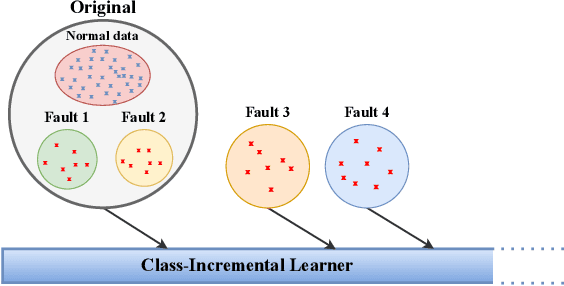
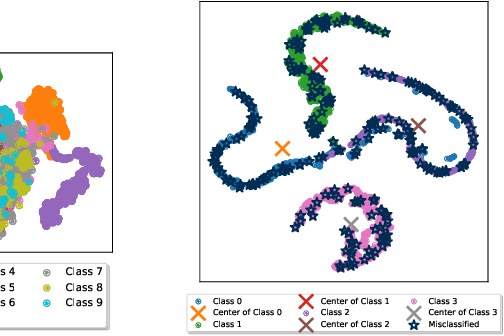
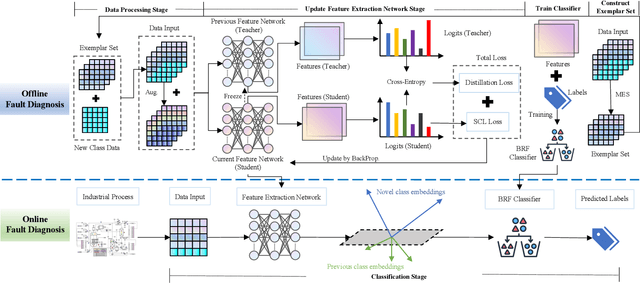
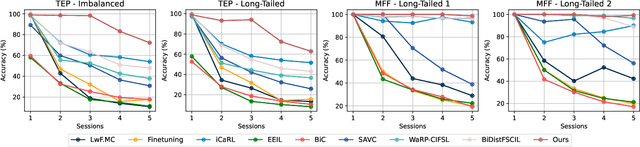
Class-incremental fault diagnosis requires a model to adapt to new fault classes while retaining previous knowledge. However, limited research exists for imbalanced and long-tailed data. Extracting discriminative features from few-shot fault data is challenging, and adding new fault classes often demands costly model retraining. Moreover, incremental training of existing methods risks catastrophic forgetting, and severe class imbalance can bias the model's decisions toward normal classes. To tackle these issues, we introduce a Supervised Contrastive knowledge distiLlation for class Incremental Fault Diagnosis (SCLIFD) framework proposing supervised contrastive knowledge distillation for improved representation learning capability and less forgetting, a novel prioritized exemplar selection method for sample replay to alleviate catastrophic forgetting, and the Random Forest Classifier to address the class imbalance. Extensive experimentation on simulated and real-world industrial datasets across various imbalance ratios demonstrates the superiority of SCLIFD over existing approaches. Our code can be found at https://github.com/Zhang-Henry/SCLIFD_TII.
M-MAD: Multidimensional Multi-Agent Debate Framework for Fine-grained Machine Translation Evaluation
Dec 28, 2024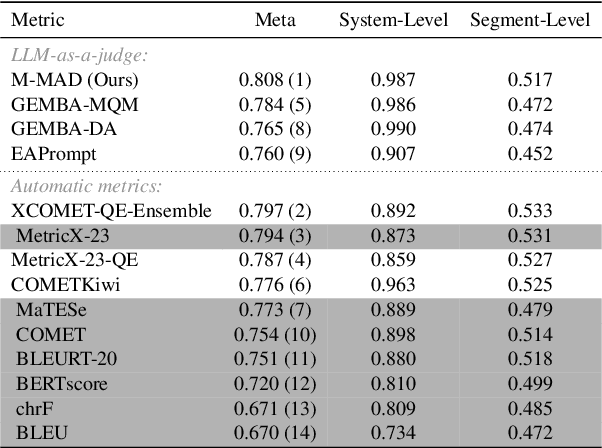

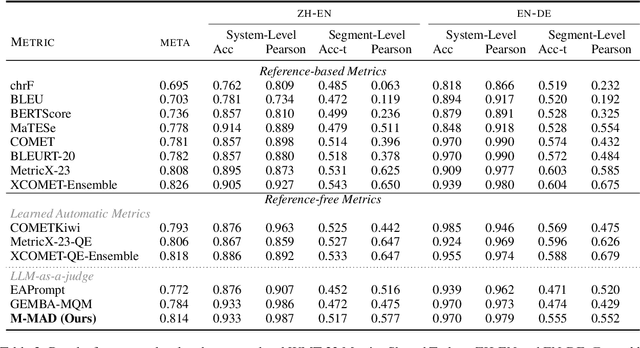

Recent advancements in large language models (LLMs) have given rise to the LLM-as-a-judge paradigm, showcasing their potential to deliver human-like judgments. However, in the field of machine translation (MT) evaluation, current LLM-as-a-judge methods fall short of learned automatic metrics. In this paper, we propose Multidimensional Multi-Agent Debate (M-MAD), a systematic LLM-based multi-agent framework for advanced LLM-as-a-judge MT evaluation. Our findings demonstrate that M-MAD achieves significant advancements by (1) decoupling heuristic MQM criteria into distinct evaluation dimensions for fine-grained assessments; (2) employing multi-agent debates to harness the collaborative reasoning capabilities of LLMs; (3) synthesizing dimension-specific results into a final evaluation judgment to ensure robust and reliable outcomes. Comprehensive experiments show that M-MAD not only outperforms all existing LLM-as-a-judge methods but also competes with state-of-the-art reference-based automatic metrics, even when powered by a suboptimal model like GPT-4o mini. Detailed ablations and analysis highlight the superiority of our framework design, offering a fresh perspective for LLM-as-a-judge paradigm. Our code and data are publicly available at https://github.com/SU-JIAYUAN/M-MAD.
MICAS: Multi-grained In-Context Adaptive Sampling for 3D Point Cloud Processing
Nov 25, 2024
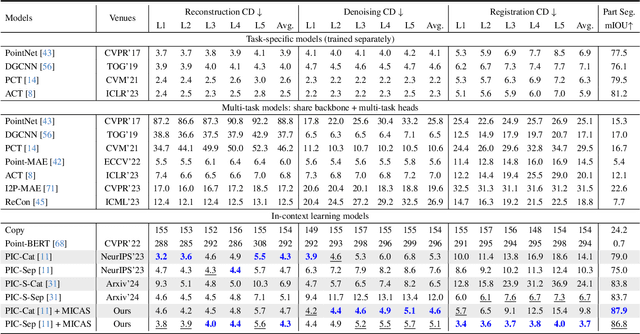


Point cloud processing (PCP) encompasses tasks like reconstruction, denoising, registration, and segmentation, each often requiring specialized models to address unique task characteristics. While in-context learning (ICL) has shown promise across tasks by using a single model with task-specific demonstration prompts, its application to PCP reveals significant limitations. We identify inter-task and intra-task sensitivity issues in current ICL methods for PCP, which we attribute to inflexible sampling strategies lacking context adaptation at the point and prompt levels. To address these challenges, we propose MICAS, an advanced ICL framework featuring a multi-grained adaptive sampling mechanism tailored for PCP. MICAS introduces two core components: task-adaptive point sampling, which leverages inter-task cues for point-level sampling, and query-specific prompt sampling, which selects optimal prompts per query to mitigate intra-task sensitivity. To our knowledge, this is the first approach to introduce adaptive sampling tailored to the unique requirements of point clouds within an ICL framework. Extensive experiments show that MICAS not only efficiently handles various PCP tasks but also significantly outperforms existing methods. Notably, it achieves a remarkable $4.1\%$ improvement in the part segmentation task and delivers consistent gains across various PCP applications.
TSINR: Capturing Temporal Continuity via Implicit Neural Representations for Time Series Anomaly Detection
Nov 20, 2024


Time series anomaly detection aims to identify unusual patterns in data or deviations from systems' expected behavior. The reconstruction-based methods are the mainstream in this task, which learn point-wise representation via unsupervised learning. However, the unlabeled anomaly points in training data may cause these reconstruction-based methods to learn and reconstruct anomalous data, resulting in the challenge of capturing normal patterns. In this paper, we propose a time series anomaly detection method based on implicit neural representation (INR) reconstruction, named TSINR, to address this challenge. Due to the property of spectral bias, TSINR enables prioritizing low-frequency signals and exhibiting poorer performance on high-frequency abnormal data. Specifically, we adopt INR to parameterize time series data as a continuous function and employ a transformer-based architecture to predict the INR of given data. As a result, the proposed TSINR method achieves the advantage of capturing the temporal continuity and thus is more sensitive to discontinuous anomaly data. In addition, we further design a novel form of INR continuous function to learn inter- and intra-channel information, and leverage a pre-trained large language model to amplify the intense fluctuations in anomalies. Extensive experiments demonstrate that TSINR achieves superior overall performance on both univariate and multivariate time series anomaly detection benchmarks compared to other state-of-the-art reconstruction-based methods. Our codes are available.
Probabilistic Prior Driven Attention Mechanism Based on Diffusion Model for Imaging Through Atmospheric Turbulence
Nov 15, 2024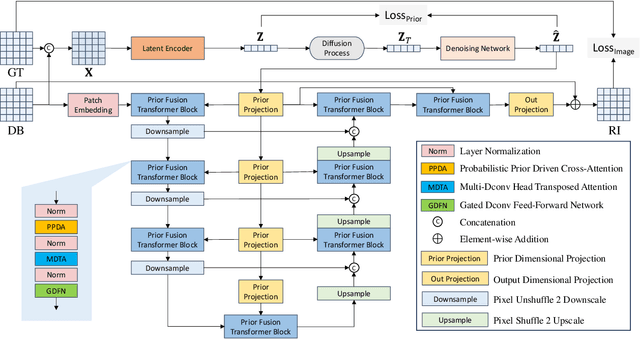
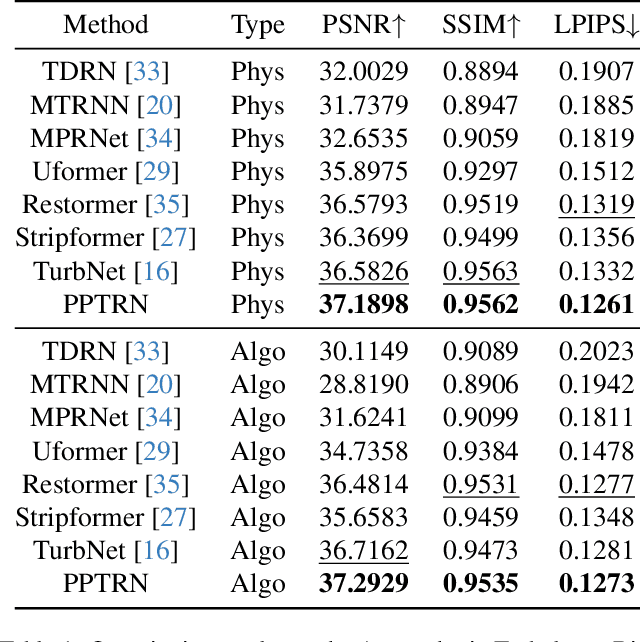
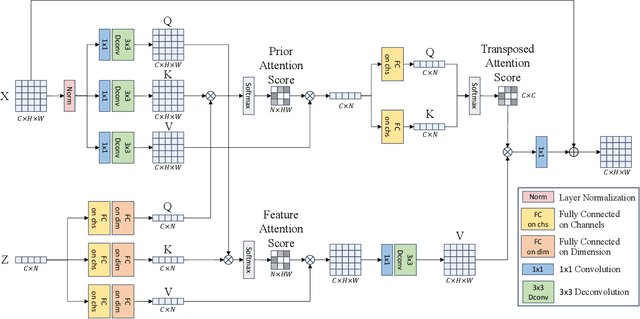
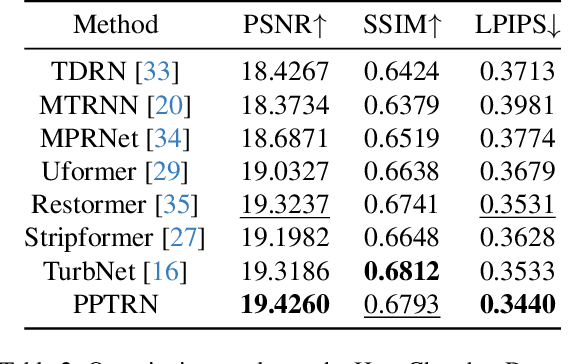
Atmospheric turbulence introduces severe spatial and geometric distortions, challenging traditional image restoration methods. We propose the Probabilistic Prior Turbulence Removal Network (PPTRN), which combines probabilistic diffusion-based prior modeling with Transformer-driven feature extraction to address this issue. PPTRN employs a two-stage approach: first, a latent encoder and Transformer are jointly trained on clear images to establish robust feature representations. Then, a Denoising Diffusion Probabilistic Model (DDPM) models prior distributions over latent vectors, guiding the Transformer in capturing diverse feature variations essential for restoration. A key innovation in PPTRN is the Probabilistic Prior Driven Cross Attention mechanism, which integrates the DDPM-generated prior with feature embeddings to reduce artifacts and enhance spatial coherence. Extensive experiments validate that PPTRN significantly improves restoration quality on turbulence-degraded images, setting a new benchmark in clarity and structural fidelity.
Graph Pre-Training Models Are Strong Anomaly Detectors
Oct 24, 2024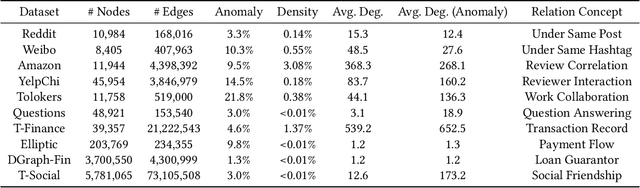
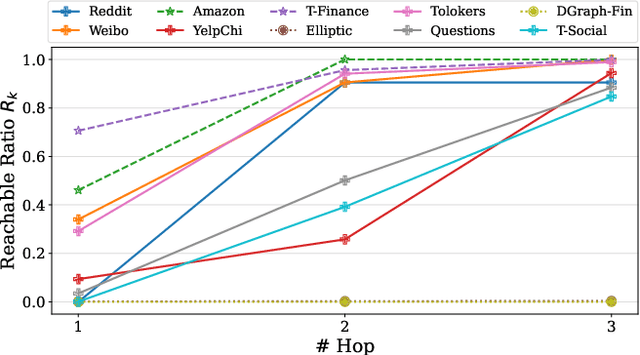
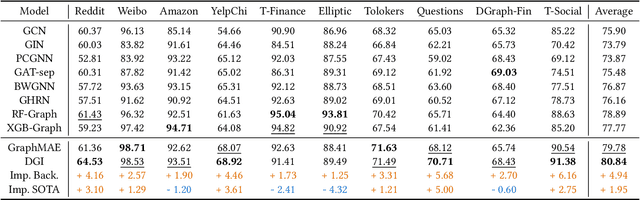

Graph Anomaly Detection (GAD) is a challenging and practical research topic where Graph Neural Networks (GNNs) have recently shown promising results. The effectiveness of existing GNNs in GAD has been mainly attributed to the simultaneous learning of node representations and the classifier in an end-to-end manner. Meanwhile, graph pre-training, the two-stage learning paradigm such as DGI and GraphMAE, has shown potential in leveraging unlabeled graph data to enhance downstream tasks, yet its impact on GAD remains under-explored. In this work, we show that graph pre-training models are strong graph anomaly detectors. Specifically, we demonstrate that pre-training is highly competitive, markedly outperforming the state-of-the-art end-to-end training models when faced with limited supervision. To understand this phenomenon, we further uncover pre-training enhances the detection of distant, under-represented, unlabeled anomalies that go beyond 2-hop neighborhoods of known anomalies, shedding light on its superior performance against end-to-end models. Moreover, we extend our examination to the potential of pre-training in graph-level anomaly detection. We envision this work to stimulate a re-evaluation of pre-training's role in GAD and offer valuable insights for future research.
LongMemEval: Benchmarking Chat Assistants on Long-Term Interactive Memory
Oct 14, 2024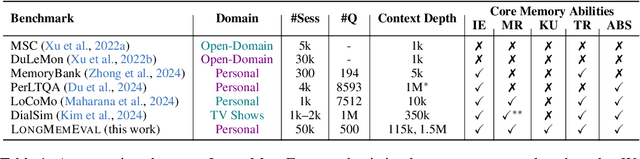
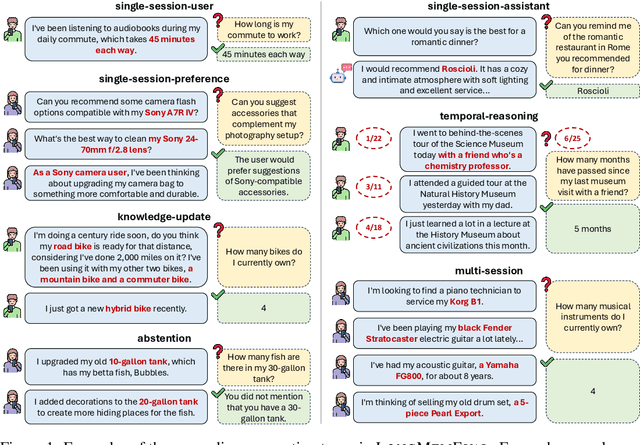
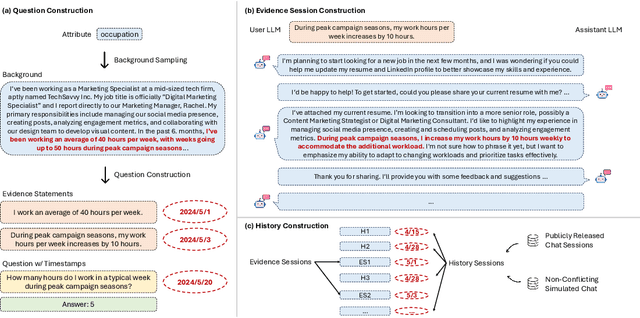
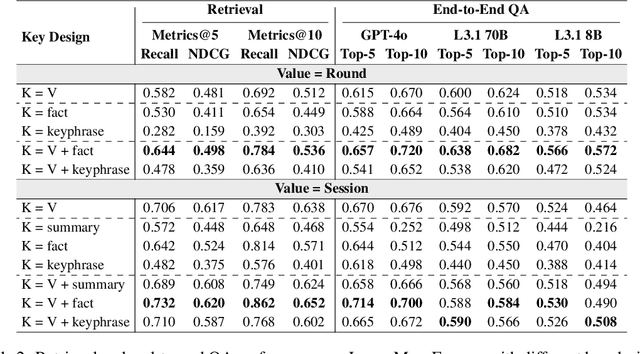
Recent large language model (LLM)-driven chat assistant systems have integrated memory components to track user-assistant chat histories, enabling more accurate and personalized responses. However, their long-term memory capabilities in sustained interactions remain underexplored. This paper introduces LongMemEval, a comprehensive benchmark designed to evaluate five core long-term memory abilities of chat assistants: information extraction, multi-session reasoning, temporal reasoning, knowledge updates, and abstention. With 500 meticulously curated questions embedded within freely scalable user-assistant chat histories, LongMemEval presents a significant challenge to existing long-term memory systems, with commercial chat assistants and long-context LLMs showing 30% accuracy drop on memorizing information across sustained interactions. We then present a unified framework that breaks down the long-term memory design into four design choices across the indexing, retrieval, and reading stages. Built upon key experimental insights, we propose several memory designs including session decomposition for optimizing value granularity, fact-augmented key expansion for enhancing the index structure, and time-aware query expansion for refining the search scope. Experiment results show that these optimizations greatly improve both memory recall and downstream question answering on LongMemEval. Overall, our study provides valuable resources and guidance for advancing the long-term memory capabilities of LLM-based chat assistants, paving the way toward more personalized and reliable conversational AI.