 Add to Chrome
 Add to Firefox
 Add to Edge
Keep the Needle, Prune the Haystack: Defect-Preserving Token Pruning for Efficient Zero-Shot Anomaly Detection
Aug 06, 2026
Zero-shot visual anomaly detection has achieved remarkable progress, with recent vision-only approaches further improving performance while simplifying the inference pipeline. However, existing methods typically perform dense computation over all images and spatial tokens, despite the fact that normal samples dominate real-world scenarios and anomalies usually occupy only small regions. Token pruning offers a promising solution, but introduces an asymmetric pruning risk in anomaly detection: retaining normal tokens mainly incurs redundant computation, whereas removing anomalous tokens may eliminate the only evidence for detection and localization. This risk is particularly severe in early layers, where pruning provides the greatest computational benefit but anomaly semantics remain unreliable. We propose KeepAD, a defect-preserving token pruning framework that formulates token selection as high-recall, anomaly-aware routing. In shallow layers, KeepAD combines coverage-preserving selection over local $2\times2$ patch neighborhoods with deterministic anomaly rescue to reduce the risk of discarding subtle defects. In deeper layers, frozen normal and abnormal prototypes guide pruning under an image-adaptive token budget, aggressively removing low-risk normal tokens while preserving local anomaly evidence. Dense-to-sparse self-distillation further supervises early token routing without introducing additional inference overhead. Experiments on six industrial and seven medical zero-shot anomaly detection benchmarks show that KeepAD reduces the token retention ratio to below $20\%$, while limiting the average degradation in image-level and pixel-level AUROC to within $2.7$ percentage points. At the most aggressive operating point, KeepAD achieves a $7.9\times$ speedup over the strongest CLIP-based baseline.

GAIR: GUI Automation via Information-Joint Reasoning and Group Reflection
Dec 10, 2025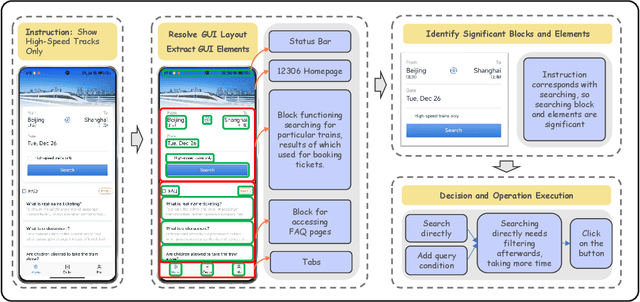
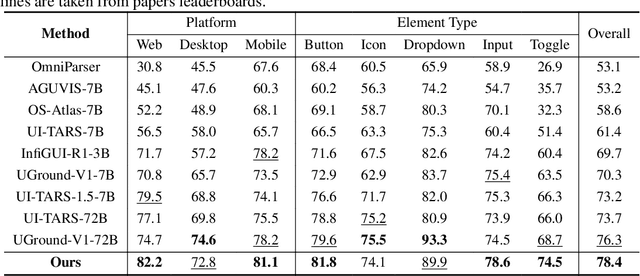
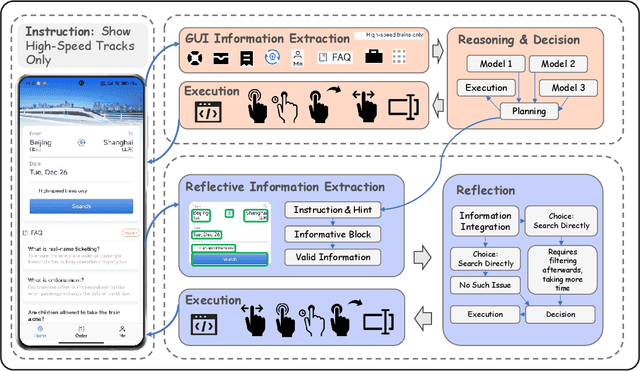
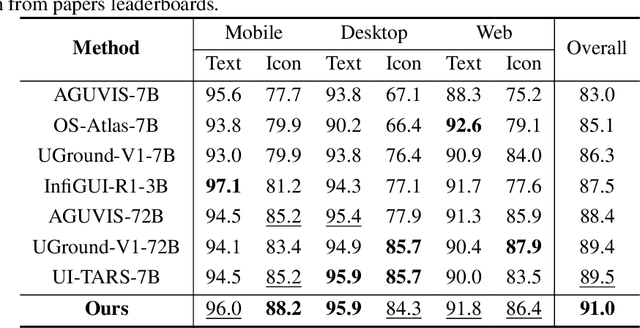
Building AI systems for GUI automation task has attracted remarkable research efforts, where MLLMs are leveraged for processing user requirements and give operations. However, GUI automation includes a wide range of tasks, from document processing to online shopping, from CAD to video editing. Diversity between particular tasks requires MLLMs for GUI automation to have heterogeneous capabilities and master multidimensional expertise, raising problems on constructing such a model. To address such challenge, we propose GAIR: GUI Automation via Information-Joint Reasoning and Group Reflection, a novel MLLM-based GUI automation agent framework designed for integrating knowledge and combining capabilities from heterogeneous models to build GUI automation agent systems with higher performance. Since different GUI-specific MLLMs are trained on different dataset and thus have different strengths, GAIR introduced a general-purpose MLLM for jointly processing the information from multiple GUI-specific models, further enhancing performance of the agent framework. The general-purpose MLLM also serves as decision maker, trying to execute a reasonable operation based on previously gathered information. When the general-purpose model thinks that there isn't sufficient information for a reasonable decision, GAIR would transit into group reflection status, where the general-purpose model would provide GUI-specific models with different instructions and hints based on their strengths and weaknesses, driving them to gather information with more significance and accuracy that can support deeper reasoning and decision. We evaluated the effectiveness and reliability of GAIR through extensive experiments on GUI benchmarks.
Probabilistic Prior Driven Attention Mechanism Based on Diffusion Model for Imaging Through Atmospheric Turbulence
Nov 15, 2024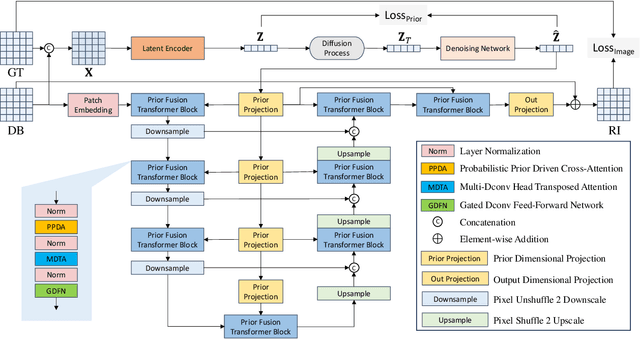
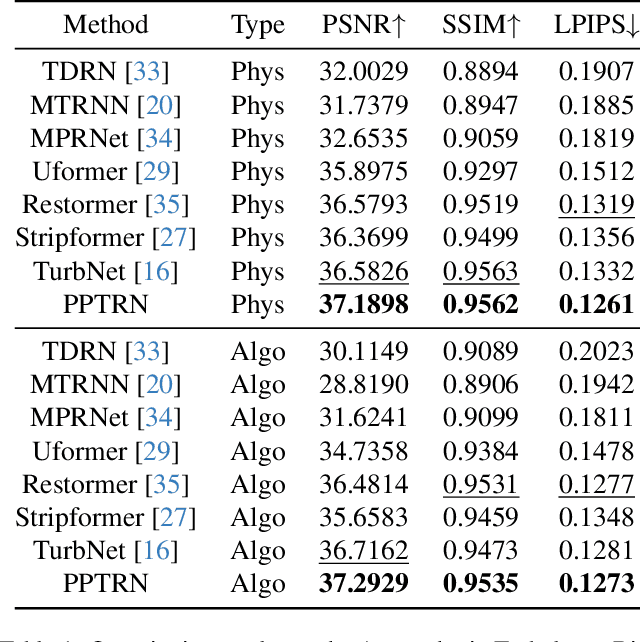
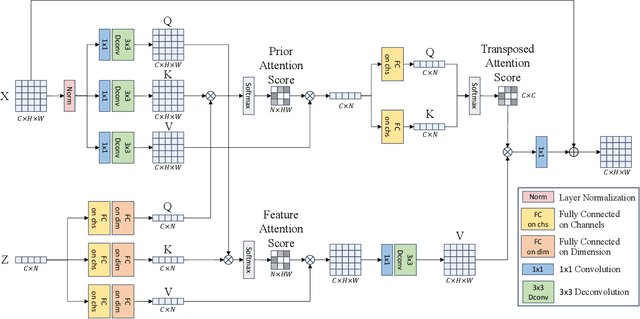
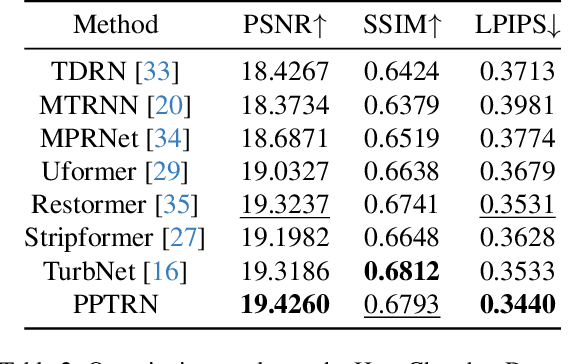
Atmospheric turbulence introduces severe spatial and geometric distortions, challenging traditional image restoration methods. We propose the Probabilistic Prior Turbulence Removal Network (PPTRN), which combines probabilistic diffusion-based prior modeling with Transformer-driven feature extraction to address this issue. PPTRN employs a two-stage approach: first, a latent encoder and Transformer are jointly trained on clear images to establish robust feature representations. Then, a Denoising Diffusion Probabilistic Model (DDPM) models prior distributions over latent vectors, guiding the Transformer in capturing diverse feature variations essential for restoration. A key innovation in PPTRN is the Probabilistic Prior Driven Cross Attention mechanism, which integrates the DDPM-generated prior with feature embeddings to reduce artifacts and enhance spatial coherence. Extensive experiments validate that PPTRN significantly improves restoration quality on turbulence-degraded images, setting a new benchmark in clarity and structural fidelity.
Beyond Strong labels: Weakly-supervised Learning Based on Gaussian Pseudo Labels for The Segmentation of Ellipse-like Vascular Structures in Non-contrast CTs
Feb 05, 2024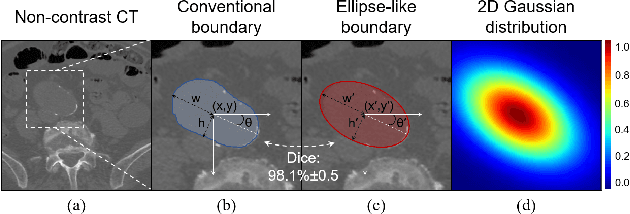
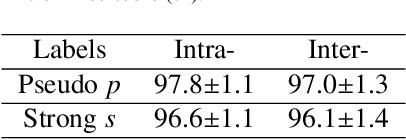
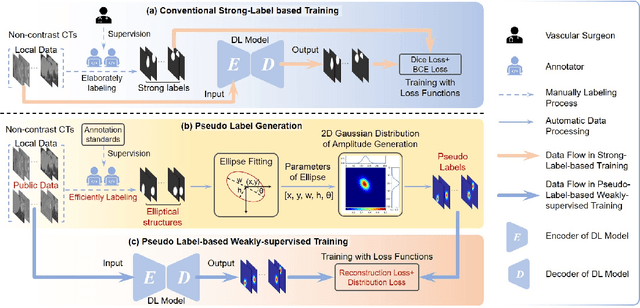
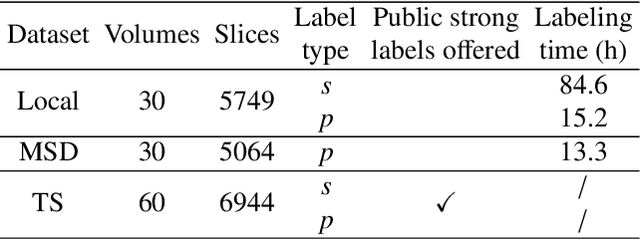
Deep-learning-based automated segmentation of vascular structures in preoperative CT scans contributes to computer-assisted diagnosis and intervention procedure in vascular diseases. While CT angiography (CTA) is the common standard, non-contrast CT imaging is significant as a contrast-risk-free alternative, avoiding complications associated with contrast agents. However, the challenges of labor-intensive labeling and high labeling variability due to the ambiguity of vascular boundaries hinder conventional strong-label-based, fully-supervised learning in non-contrast CTs. This paper introduces a weakly-supervised framework using ellipses' topology in slices, including 1) an efficient annotation process based on predefined standards, 2) ellipse-fitting processing, 3) the generation of 2D Gaussian heatmaps serving as pseudo labels, 4) a training process through a combination of voxel reconstruction loss and distribution loss with the pseudo labels. We assess the effectiveness of the proposed method on one local and two public datasets comprising non-contrast CT scans, particularly focusing on the abdominal aorta. On the local dataset, our weakly-supervised learning approach based on pseudo labels outperforms strong-label-based fully-supervised learning (1.54\% of Dice score on average), reducing labeling time by around 82.0\%. The efficiency in generating pseudo labels allows the inclusion of label-agnostic external data in the training set, leading to an additional improvement in performance (2.74\% of Dice score on average) with a reduction of 66.3\% labeling time, where the labeling time remains considerably less than that of strong labels. On the public dataset, the pseudo labels achieve an overall improvement of 1.95\% in Dice score for 2D models while a reduction of 11.65 voxel spacing in Hausdorff distance for 3D model.
Deep Supervision by Gaussian Pseudo-label-based Morphological Attention for Abdominal Aorta Segmentation in Non-Contrast CTs
Feb 04, 2024The segmentation of the abdominal aorta in non-contrast CT images is a non-trivial task for computer-assisted endovascular navigation, particularly in scenarios where contrast agents are unsuitable. While state-of-the-art deep learning segmentation models have been proposed recently for this task, they are trained on manually annotated strong labels. However, the inherent ambiguity in the boundary of the aorta in non-contrast CT may undermine the reliability of strong labels, leading to potential overfitting risks. This paper introduces a Gaussian-based pseudo label, integrated into conventional deep learning models through deep supervision, to achieve Morphological Attention (MA) enhancement. As the Gaussian pseudo label retains the morphological features of the aorta without explicitly representing its boundary distribution, we suggest that it preserves aortic morphology during training while mitigating the negative impact of ambiguous boundaries, reducing the risk of overfitting. It is introduced in various 2D/3D deep learning models and validated on our local data set of 30 non-contrast CT volumes comprising 5749 CT slices. The results underscore the effectiveness of MA in preserving the morphological characteristics of the aorta and addressing overfitting concerns, thereby enhancing the performance of the models.