 Add to Chrome
 Add to Firefox
 Add to Edge
MemFlow: Flowing Adaptive Memory for Consistent and Efficient Long Video Narratives
Dec 16, 2025
The core challenge for streaming video generation is maintaining the content consistency in long context, which poses high requirement for the memory design. Most existing solutions maintain the memory by compressing historical frames with predefined strategies. However, different to-generate video chunks should refer to different historical cues, which is hard to satisfy with fixed strategies. In this work, we propose MemFlow to address this problem. Specifically, before generating the coming chunk, we dynamically update the memory bank by retrieving the most relevant historical frames with the text prompt of this chunk. This design enables narrative coherence even if new event happens or scenario switches in future frames. In addition, during generation, we only activate the most relevant tokens in the memory bank for each query in the attention layers, which effectively guarantees the generation efficiency. In this way, MemFlow achieves outstanding long-context consistency with negligible computation burden (7.9% speed reduction compared with the memory-free baseline) and keeps the compatibility with any streaming video generation model with KV cache.

DrivePI: Spatial-aware 4D MLLM for Unified Autonomous Driving Understanding, Perception, Prediction and Planning
Dec 14, 2025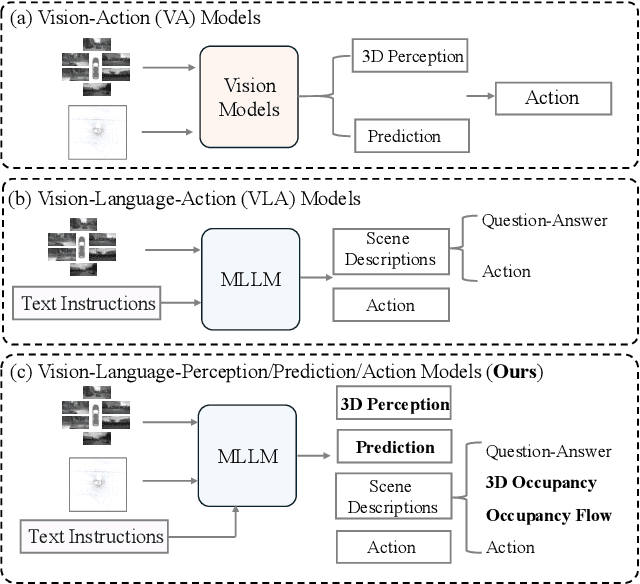
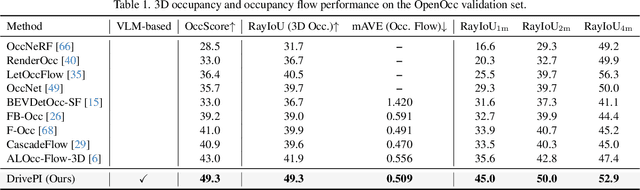
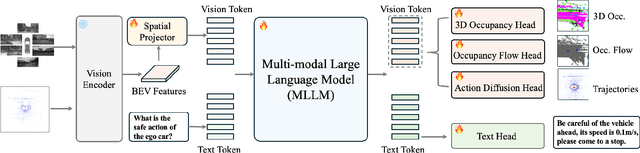
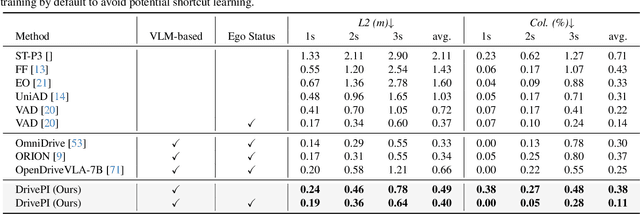
Although multi-modal large language models (MLLMs) have shown strong capabilities across diverse domains, their application in generating fine-grained 3D perception and prediction outputs in autonomous driving remains underexplored. In this paper, we propose DrivePI, a novel spatial-aware 4D MLLM that serves as a unified Vision-Language-Action (VLA) framework that is also compatible with vision-action (VA) models. Our method jointly performs spatial understanding, 3D perception (i.e., 3D occupancy), prediction (i.e., occupancy flow), and planning (i.e., action outputs) in parallel through end-to-end optimization. To obtain both precise geometric information and rich visual appearance, our approach integrates point clouds, multi-view images, and language instructions within a unified MLLM architecture. We further develop a data engine to generate text-occupancy and text-flow QA pairs for 4D spatial understanding. Remarkably, with only a 0.5B Qwen2.5 model as MLLM backbone, DrivePI as a single unified model matches or exceeds both existing VLA models and specialized VA models. Specifically, compared to VLA models, DrivePI outperforms OpenDriveVLA-7B by 2.5% mean accuracy on nuScenes-QA and reduces collision rate by 70% over ORION (from 0.37% to 0.11%) on nuScenes. Against specialized VA models, DrivePI surpasses FB-OCC by 10.3 RayIoU for 3D occupancy on OpenOcc, reduces the mAVE from 0.591 to 0.509 for occupancy flow on OpenOcc, and achieves 32% lower L2 error than VAD (from 0.72m to 0.49m) for planning on nuScenes. Code will be available at https://github.com/happinesslz/DrivePI
GenieDrive: Towards Physics-Aware Driving World Model with 4D Occupancy Guided Video Generation
Dec 14, 2025Physics-aware driving world model is essential for drive planning, out-of-distribution data synthesis, and closed-loop evaluation. However, existing methods often rely on a single diffusion model to directly map driving actions to videos, which makes learning difficult and leads to physically inconsistent outputs. To overcome these challenges, we propose GenieDrive, a novel framework designed for physics-aware driving video generation. Our approach starts by generating 4D occupancy, which serves as a physics-informed foundation for subsequent video generation. 4D occupancy contains rich physical information, including high-resolution 3D structures and dynamics. To facilitate effective compression of such high-resolution occupancy, we propose a VAE that encodes occupancy into a latent tri-plane representation, reducing the latent size to only 58% of that used in previous methods. We further introduce Mutual Control Attention (MCA) to accurately model the influence of control on occupancy evolution, and we jointly train the VAE and the subsequent prediction module in an end-to-end manner to maximize forecasting accuracy. Together, these designs yield a 7.2% improvement in forecasting mIoU at an inference speed of 41 FPS, while using only 3.47 M parameters. Additionally, a Normalized Multi-View Attention is introduced in the video generation model to generate multi-view driving videos with guidance from our 4D occupancy, significantly improving video quality with a 20.7% reduction in FVD. Experiments demonstrate that GenieDrive enables highly controllable, multi-view consistent, and physics-aware driving video generation.
Wan-Move: Motion-controllable Video Generation via Latent Trajectory Guidance
Dec 09, 2025We present Wan-Move, a simple and scalable framework that brings motion control to video generative models. Existing motion-controllable methods typically suffer from coarse control granularity and limited scalability, leaving their outputs insufficient for practical use. We narrow this gap by achieving precise and high-quality motion control. Our core idea is to directly make the original condition features motion-aware for guiding video synthesis. To this end, we first represent object motions with dense point trajectories, allowing fine-grained control over the scene. We then project these trajectories into latent space and propagate the first frame's features along each trajectory, producing an aligned spatiotemporal feature map that tells how each scene element should move. This feature map serves as the updated latent condition, which is naturally integrated into the off-the-shelf image-to-video model, e.g., Wan-I2V-14B, as motion guidance without any architecture change. It removes the need for auxiliary motion encoders and makes fine-tuning base models easily scalable. Through scaled training, Wan-Move generates 5-second, 480p videos whose motion controllability rivals Kling 1.5 Pro's commercial Motion Brush, as indicated by user studies. To support comprehensive evaluation, we further design MoveBench, a rigorously curated benchmark featuring diverse content categories and hybrid-verified annotations. It is distinguished by larger data volume, longer video durations, and high-quality motion annotations. Extensive experiments on MoveBench and the public dataset consistently show Wan-Move's superior motion quality. Code, models, and benchmark data are made publicly available.
Seg-VAR: Image Segmentation with Visual Autoregressive Modeling
Nov 16, 2025While visual autoregressive modeling (VAR) strategies have shed light on image generation with the autoregressive models, their potential for segmentation, a task that requires precise low-level spatial perception, remains unexplored. Inspired by the multi-scale modeling of classic Mask2Former-based models, we propose Seg-VAR, a novel framework that rethinks segmentation as a conditional autoregressive mask generation problem. This is achieved by replacing the discriminative learning with the latent learning process. Specifically, our method incorporates three core components: (1) an image encoder generating latent priors from input images, (2) a spatial-aware seglat (a latent expression of segmentation mask) encoder that maps segmentation masks into discrete latent tokens using a location-sensitive color mapping to distinguish instances, and (3) a decoder reconstructing masks from these latents. A multi-stage training strategy is introduced: first learning seglat representations via image-seglat joint training, then refining latent transformations, and finally aligning image-encoder-derived latents with seglat distributions. Experiments show Seg-VAR outperforms previous discriminative and generative methods on various segmentation tasks and validation benchmarks. By framing segmentation as a sequential hierarchical prediction task, Seg-VAR opens new avenues for integrating autoregressive reasoning into spatial-aware vision systems. Code will be available at https://github.com/rkzheng99/Seg-VAR.
Visual Spatial Tuning
Nov 07, 2025Capturing spatial relationships from visual inputs is a cornerstone of human-like general intelligence. Several previous studies have tried to enhance the spatial awareness of Vision-Language Models (VLMs) by adding extra expert encoders, which brings extra overhead and usually harms general capabilities. To enhance the spatial ability in general architectures, we introduce Visual Spatial Tuning (VST), a comprehensive framework to cultivate VLMs with human-like visuospatial abilities, from spatial perception to reasoning. We first attempt to enhance spatial perception in VLMs by constructing a large-scale dataset termed VST-P, which comprises 4.1 million samples spanning 19 skills across single views, multiple images, and videos. Then, we present VST-R, a curated dataset with 135K samples that instruct models to reason in space. In particular, we adopt a progressive training pipeline: supervised fine-tuning to build foundational spatial knowledge, followed by reinforcement learning to further improve spatial reasoning abilities. Without the side-effect to general capabilities, the proposed VST consistently achieves state-of-the-art results on several spatial benchmarks, including $34.8\%$ on MMSI-Bench and $61.2\%$ on VSIBench. It turns out that the Vision-Language-Action models can be significantly enhanced with the proposed spatial tuning paradigm, paving the way for more physically grounded AI.
From Noisy Traces to Stable Gradients: Bias-Variance Optimized Preference Optimization for Aligning Large Reasoning Models
Oct 06, 2025Large reasoning models (LRMs) generate intermediate reasoning traces before producing final answers, yielding strong gains on multi-step and mathematical tasks. Yet aligning LRMs with human preferences, a crucial prerequisite for model deployment, remains underexplored. The statistically correct objective for preference alignment requires marginalizing over reasoning traces, but this computation is intractable in practice. A common workaround optimizes a single sampled trajectory, which introduces substantial gradient variance from stochastic trace sampling. To address this challenge, we frame preference optimization for LRMs through the lens of the bias--variance trade-off and propose Bias--Variance Optimized Preference Optimization (BVPO), a simple, drop-in method that mixes two gradient estimators: a high-variance trace-based estimator and a low-variance empty-trace estimator obtained by disabling reasoning trace generation. Our theory shows that BVPO strictly reduces trace-induced variance for any nontrivial mixture, provides a closed-form choice of the mixing weight that minimizes mean-squared error relative to the true marginal gradient, and under standard smoothness and step-size conditions, tightens classical convergence bounds for stochastic gradient descent. Empirically, BVPO improves alignment over the best baseline by up to 7.8 points on AlpacaEval~2 and 6.8 points on Arena-Hard. Despite being trained only on general conversational data, BVPO also boosts reasoning performance for base models by up to 4.0 points on the average of six math reasoning benchmarks. These results identify variance from trace sampling as a key bottleneck and demonstrate that directly optimizing the bias--variance trade-off yields more stable training and stronger overall performance.
DiffCamera: Arbitrary Refocusing on Images
Sep 30, 2025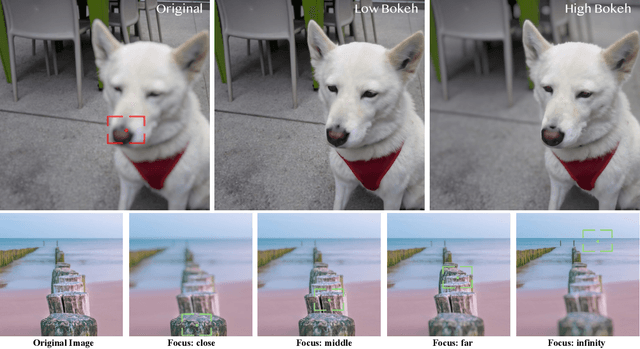
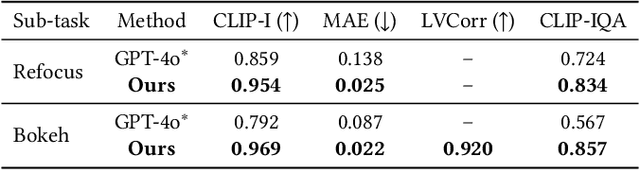
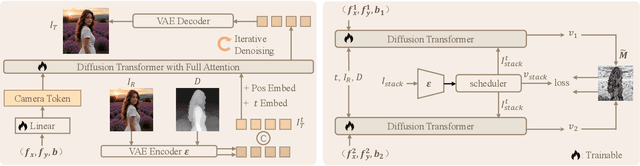

The depth-of-field (DoF) effect, which introduces aesthetically pleasing blur, enhances photographic quality but is fixed and difficult to modify once the image has been created. This becomes problematic when the applied blur is undesirable~(e.g., the subject is out of focus). To address this, we propose DiffCamera, a model that enables flexible refocusing of a created image conditioned on an arbitrary new focus point and a blur level. Specifically, we design a diffusion transformer framework for refocusing learning. However, the training requires pairs of data with different focus planes and bokeh levels in the same scene, which are hard to acquire. To overcome this limitation, we develop a simulation-based pipeline to generate large-scale image pairs with varying focus planes and bokeh levels. With the simulated data, we find that training with only a vanilla diffusion objective often leads to incorrect DoF behaviors due to the complexity of the task. This requires a stronger constraint during training. Inspired by the photographic principle that photos of different focus planes can be linearly blended into a multi-focus image, we propose a stacking constraint during training to enforce precise DoF manipulation. This constraint enhances model training by imposing physically grounded refocusing behavior that the focusing results should be faithfully aligned with the scene structure and the camera conditions so that they can be combined into the correct multi-focus image. We also construct a benchmark to evaluate the effectiveness of our refocusing model. Extensive experiments demonstrate that DiffCamera supports stable refocusing across a wide range of scenes, providing unprecedented control over DoF adjustments for photography and generative AI applications.
Mini-o3: Scaling Up Reasoning Patterns and Interaction Turns for Visual Search
Sep 09, 2025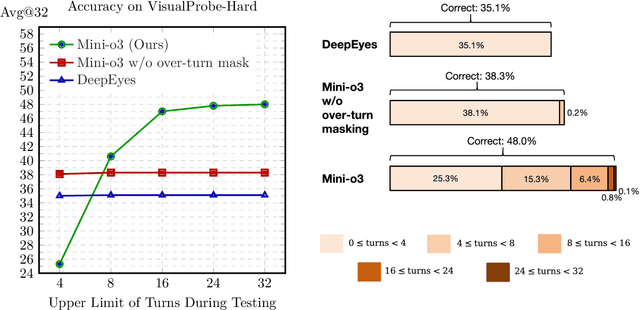
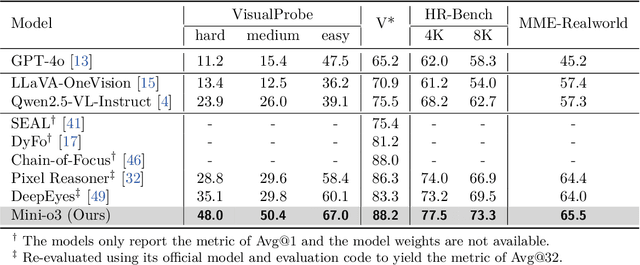
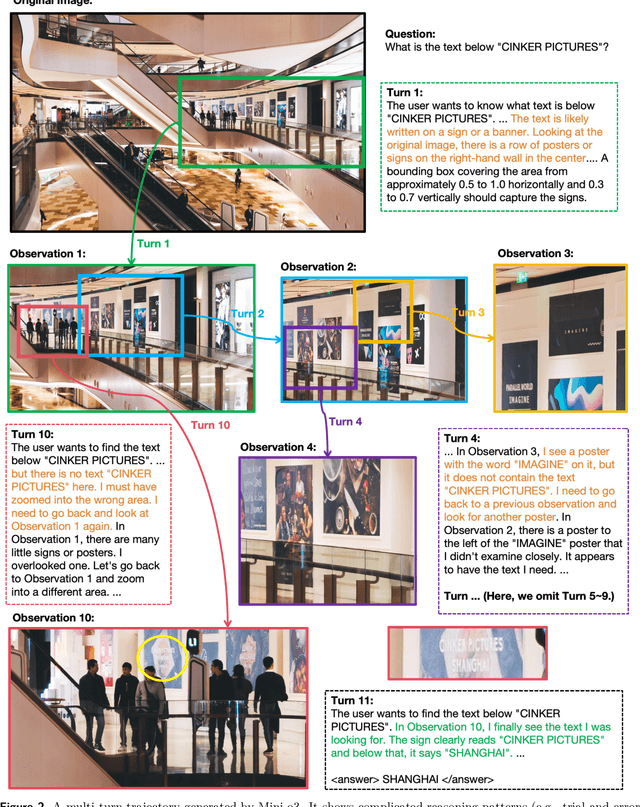

Recent advances in large multimodal models have leveraged image-based tools with reinforcement learning to tackle visual problems. However, existing open-source approaches often exhibit monotonous reasoning patterns and allow only a limited number of interaction turns, making them inadequate for difficult tasks that require trial-and-error exploration. In this work, we address this limitation by scaling up tool-based interactions and introduce Mini-o3, a system that executes deep, multi-turn reasoning -- spanning tens of steps -- and achieves state-of-the-art performance on challenging visual search tasks. Our recipe for reproducing OpenAI o3-style behaviors comprises three key components. First, we construct the Visual Probe Dataset, a collection of thousands of challenging visual search problems designed for exploratory reasoning. Second, we develop an iterative data collection pipeline to obtain cold-start trajectories that exhibit diverse reasoning patterns, including depth-first search, trial-and-error, and goal maintenance. Third, we propose an over-turn masking strategy that prevents penalization of over-turn responses (those that hit the maximum number of turns) during reinforcement learning, thereby balancing training-time efficiency with test-time scalability. Despite training with an upper bound of only six interaction turns, our model generates trajectories that naturally scale to tens of turns at inference time, with accuracy improving as the number of turns increases. Extensive experiments demonstrate that Mini-o3 produces rich reasoning patterns and deep thinking paths, effectively solving challenging visual search problems.
ROSE: Remove Objects with Side Effects in Videos
Aug 26, 2025Video object removal has achieved advanced performance due to the recent success of video generative models. However, when addressing the side effects of objects, e.g., their shadows and reflections, existing works struggle to eliminate these effects for the scarcity of paired video data as supervision. This paper presents ROSE, termed Remove Objects with Side Effects, a framework that systematically studies the object's effects on environment, which can be categorized into five common cases: shadows, reflections, light, translucency and mirror. Given the challenges of curating paired videos exhibiting the aforementioned effects, we leverage a 3D rendering engine for synthetic data generation. We carefully construct a fully-automatic pipeline for data preparation, which simulates a large-scale paired dataset with diverse scenes, objects, shooting angles, and camera trajectories. ROSE is implemented as an video inpainting model built on diffusion transformer. To localize all object-correlated areas, the entire video is fed into the model for reference-based erasing. Moreover, additional supervision is introduced to explicitly predict the areas affected by side effects, which can be revealed through the differential mask between the paired videos. To fully investigate the model performance on various side effect removal, we presents a new benchmark, dubbed ROSE-Bench, incorporating both common scenarios and the five special side effects for comprehensive evaluation. Experimental results demonstrate that ROSE achieves superior performance compared to existing video object erasing models and generalizes well to real-world video scenarios. The project page is https://rose2025-inpaint.github.io/.