 Add to Chrome
 Add to Firefox
 Add to Edge
aDSL: Agentic 3D Creation via Joint Agent-Program Design
Aug 18, 2026
Programmatic representations provide a compelling paradigm for 3D content creation, enabling fine-grained edits, interpretability, and explicit structural control. Yet, agentic workflows that rely on large language models (LLMs) to author 3D programs remain brittle, often failing to translate high-level intent into consistent low-level geometry. We attribute this fragility to a mismatch between existing programmatic interfaces and the reasoning strengths of LLMs, which favor semantic structure and spatial relations over fragile numeric choices. In this paper, we jointly design an Agent-centric Domain-Specific Language (aDSL) and a role-specialized multi-agent system to close this gap. aDSL bridges semantic logic and geometric constraints by emphasizing composability and spatial reasoning; it enables agents to manipulate geometry through relational operators instead of brittle absolute coordinates. Building on aDSL, our training-free multi-agent system follows a Plan-Execute-Critic loop to decompose requests, synthesize code, and iteratively repair errors and constraint violations using execution feedback. Experiments show that this co-design improves robustness, controllability, and faithfulness to user intent. Our method outperforms prior LLM-based baselines on text-to-shape and image-to-shape tasks while preserving explicit structure, editability, and interpretability. It also enables downstream applications such as articulated object creation and structured scene composition. Our code is available at https://github.com/sig-pku/aDSL.

StateFlow: Building, Evolving, and Accessing 3D World States for Previsualization
Aug 12, 2026Previsualization is an intermediate layer between ideas and production in film, games, architecture, and urban design. It lets creators iteratively refine scenes, actions, cameras, and spatial-temporal dynamics. Yet existing generative methods rely on simple prompts to jointly control all of these factors through one-shot image or video synthesis, offering weak controllability and limited support for iterative editing. Fundamentally, a world comprises multiple elements with geometry, appearance, and other attributes, together with cameras. Different frames are produced through local modifications or recombinations of this shared state, which is otherwise largely reused. Therefore, we argue that the missing component is an explicit and persistent working state. To address this, we present StateFlow, a state-centric framework for generative previsualization. Rather than generating videos in one shot, StateFlow uses an editable 3D world to organize scene structure, evolution, and cameras, while off-the-shelf video models enhance visual quality when higher fidelity is desired. This world is maintained as a persistent structured 3D state of scene elements and camera configurations, serving as the core working representation for previsualization. Built on this insight, StateFlow has three stages to construct, evolve, and access the world state. State construction lifts generated 2D content into a coherent 3D world through prior-guided, conflict-aware dual-view initialization, while State evolution translates user intent into structured state transitions while preserving world memory, avoiding full-scene regeneration for each edit. State access uses render-feedback reflection to refine camera plans into visually feasible trajectories, avoiding reliance on VLM semantics alone. Experiments show that StateFlow produces high-quality 3D worlds for video creation and game-like prototyping.
OctGPT: Octree-based Multiscale Autoregressive Models for 3D Shape Generation
Apr 15, 2025Autoregressive models have achieved remarkable success across various domains, yet their performance in 3D shape generation lags significantly behind that of diffusion models. In this paper, we introduce OctGPT, a novel multiscale autoregressive model for 3D shape generation that dramatically improves the efficiency and performance of prior 3D autoregressive approaches, while rivaling or surpassing state-of-the-art diffusion models. Our method employs a serialized octree representation to efficiently capture the hierarchical and spatial structures of 3D shapes. Coarse geometry is encoded via octree structures, while fine-grained details are represented by binary tokens generated using a vector quantized variational autoencoder (VQVAE), transforming 3D shapes into compact multiscale binary sequences suitable for autoregressive prediction. To address the computational challenges of handling long sequences, we incorporate octree-based transformers enhanced with 3D rotary positional encodings, scale-specific embeddings, and token-parallel generation schemes. These innovations reduce training time by 13 folds and generation time by 69 folds, enabling the efficient training of high-resolution 3D shapes, e.g.,$1024^3$, on just four NVIDIA 4090 GPUs only within days. OctGPT showcases exceptional versatility across various tasks, including text-, sketch-, and image-conditioned generation, as well as scene-level synthesis involving multiple objects. Extensive experiments demonstrate that OctGPT accelerates convergence and improves generation quality over prior autoregressive methods, offering a new paradigm for high-quality, scalable 3D content creation. Our code and trained models are available at https://github.com/octree-nn/octgpt.
Joint Point Cloud Upsampling and Cleaning with Octree-based CNNs
Oct 22, 2024Recovering dense and uniformly distributed point clouds from sparse or noisy data remains a significant challenge. Recently, great progress has been made on these tasks, but usually at the cost of increasingly intricate modules or complicated network architectures, leading to long inference time and huge resource consumption. Instead, we embrace simplicity and present a simple yet efficient method for jointly upsampling and cleaning point clouds. Our method leverages an off-the-shelf octree-based 3D U-Net (OUNet) with minor modifications, enabling the upsampling and cleaning tasks within a single network. Our network directly processes each input point cloud as a whole instead of processing each point cloud patch as in previous works, which significantly eases the implementation and brings at least 47 times faster inference. Extensive experiments demonstrate that our method achieves state-of-the-art performances under huge efficiency advantages on a series of benchmarks. We expect our method to serve simple baselines and inspire researchers to rethink the method design on point cloud upsampling and cleaning.
Neural Laplacian Operator for 3D Point Clouds
Sep 10, 2024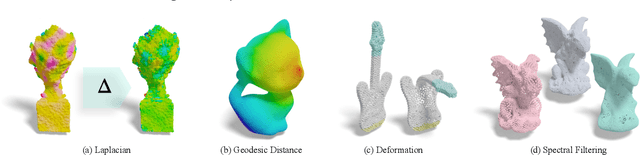


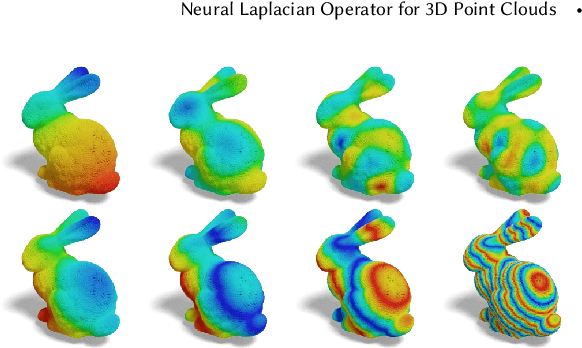
The discrete Laplacian operator holds a crucial role in 3D geometry processing, yet it is still challenging to define it on point clouds. Previous works mainly focused on constructing a local triangulation around each point to approximate the underlying manifold for defining the Laplacian operator, which may not be robust or accurate. In contrast, we simply use the K-nearest neighbors (KNN) graph constructed from the input point cloud and learn the Laplacian operator on the KNN graph with graph neural networks (GNNs). However, the ground-truth Laplacian operator is defined on a manifold mesh with a different connectivity from the KNN graph and thus cannot be directly used for training. To train the GNN, we propose a novel training scheme by imitating the behavior of the ground-truth Laplacian operator on a set of probe functions so that the learned Laplacian operator behaves similarly to the ground-truth Laplacian operator. We train our network on a subset of ShapeNet and evaluate it across a variety of point clouds. Compared with previous methods, our method reduces the error by an order of magnitude and excels in handling sparse point clouds with thin structures or sharp features. Our method also demonstrates a strong generalization ability to unseen shapes. With our learned Laplacian operator, we further apply a series of Laplacian-based geometry processing algorithms directly to point clouds and achieve accurate results, enabling many exciting possibilities for geometry processing on point clouds. The code and trained models are available at https://github.com/IntelligentGeometry/NeLo.
OctFusion: Octree-based Diffusion Models for 3D Shape Generation
Aug 27, 2024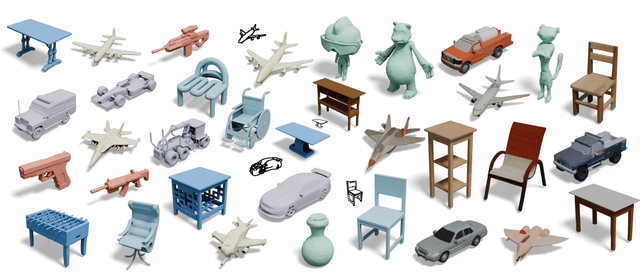
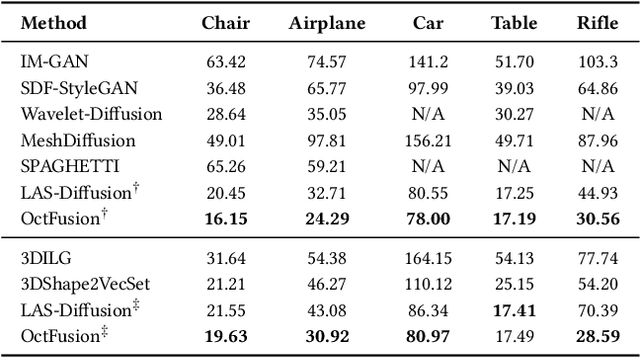


Diffusion models have emerged as a popular method for 3D generation. However, it is still challenging for diffusion models to efficiently generate diverse and high-quality 3D shapes. In this paper, we introduce OctFusion, which can generate 3D shapes with arbitrary resolutions in 2.5 seconds on a single Nvidia 4090 GPU, and the extracted meshes are guaranteed to be continuous and manifold. The key components of OctFusion are the octree-based latent representation and the accompanying diffusion models. The representation combines the benefits of both implicit neural representations and explicit spatial octrees and is learned with an octree-based variational autoencoder. The proposed diffusion model is a unified multi-scale U-Net that enables weights and computation sharing across different octree levels and avoids the complexity of widely used cascaded diffusion schemes. We verify the effectiveness of OctFusion on the ShapeNet and Objaverse datasets and achieve state-of-the-art performances on shape generation tasks. We demonstrate that OctFusion is extendable and flexible by generating high-quality color fields for textured mesh generation and high-quality 3D shapes conditioned on text prompts, sketches, or category labels. Our code and pre-trained models are available at \url{https://github.com/octree-nn/octfusion}.
SinMPI: Novel View Synthesis from a Single Image with Expanded Multiplane Images
Dec 18, 2023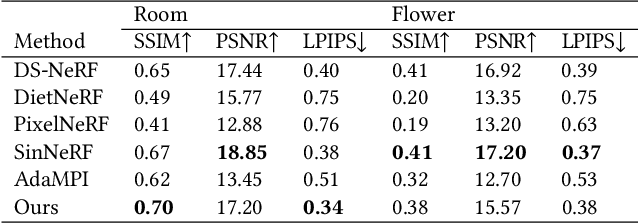
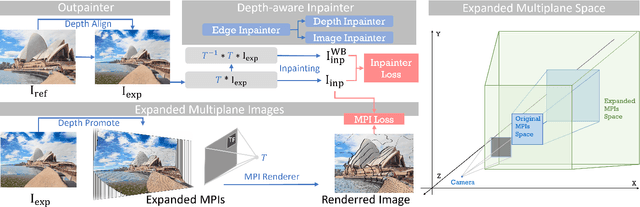
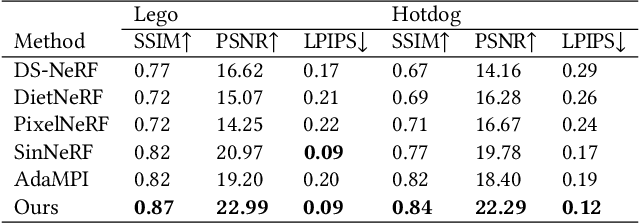
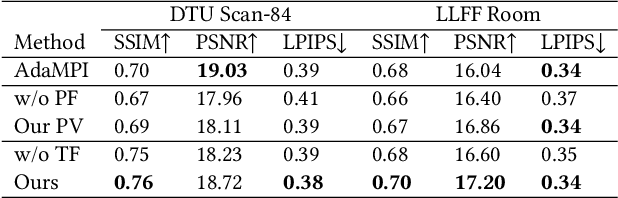
Single-image novel view synthesis is a challenging and ongoing problem that aims to generate an infinite number of consistent views from a single input image. Although significant efforts have been made to advance the quality of generated novel views, less attention has been paid to the expansion of the underlying scene representation, which is crucial to the generation of realistic novel view images. This paper proposes SinMPI, a novel method that uses an expanded multiplane image (MPI) as the 3D scene representation to significantly expand the perspective range of MPI and generate high-quality novel views from a large multiplane space. The key idea of our method is to use Stable Diffusion to generate out-of-view contents, project all scene contents into an expanded multiplane image according to depths predicted by monocular depth estimators, and then optimize the multiplane image under the supervision of pseudo multi-view data generated by a depth-aware warping and inpainting module. Both qualitative and quantitative experiments have been conducted to validate the superiority of our method to the state of the art. Our code and data are available at https://github.com/TrickyGo/SinMPI.
Point Transformer V3: Simpler, Faster, Stronger
Dec 15, 2023


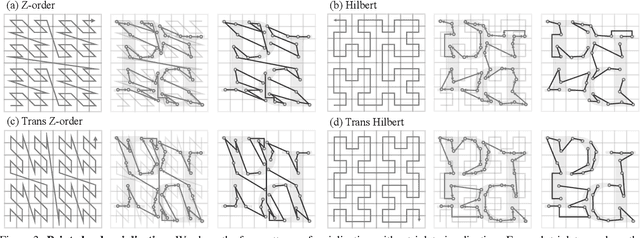
This paper is not motivated to seek innovation within the attention mechanism. Instead, it focuses on overcoming the existing trade-offs between accuracy and efficiency within the context of point cloud processing, leveraging the power of scale. Drawing inspiration from recent advances in 3D large-scale representation learning, we recognize that model performance is more influenced by scale than by intricate design. Therefore, we present Point Transformer V3 (PTv3), which prioritizes simplicity and efficiency over the accuracy of certain mechanisms that are minor to the overall performance after scaling, such as replacing the precise neighbor search by KNN with an efficient serialized neighbor mapping of point clouds organized with specific patterns. This principle enables significant scaling, expanding the receptive field from 16 to 1024 points while remaining efficient (a 3x increase in processing speed and a 10x improvement in memory efficiency compared with its predecessor, PTv2). PTv3 attains state-of-the-art results on over 20 downstream tasks that span both indoor and outdoor scenarios. Further enhanced with multi-dataset joint training, PTv3 pushes these results to a higher level.
Learning the Geodesic Embedding with Graph Neural Networks
Sep 11, 2023We present GeGnn, a learning-based method for computing the approximate geodesic distance between two arbitrary points on discrete polyhedra surfaces with constant time complexity after fast precomputation. Previous relevant methods either focus on computing the geodesic distance between a single source and all destinations, which has linear complexity at least or require a long precomputation time. Our key idea is to train a graph neural network to embed an input mesh into a high-dimensional embedding space and compute the geodesic distance between a pair of points using the corresponding embedding vectors and a lightweight decoding function. To facilitate the learning of the embedding, we propose novel graph convolution and graph pooling modules that incorporate local geodesic information and are verified to be much more effective than previous designs. After training, our method requires only one forward pass of the network per mesh as precomputation. Then, we can compute the geodesic distance between a pair of points using our decoding function, which requires only several matrix multiplications and can be massively parallelized on GPUs. We verify the efficiency and effectiveness of our method on ShapeNet and demonstrate that our method is faster than existing methods by orders of magnitude while achieving comparable or better accuracy. Additionally, our method exhibits robustness on noisy and incomplete meshes and strong generalization ability on out-of-distribution meshes. The code and pretrained model can be found on https://github.com/IntelligentGeometry/GeGnn.
Locally Attentional SDF Diffusion for Controllable 3D Shape Generation
May 09, 2023Although the recent rapid evolution of 3D generative neural networks greatly improves 3D shape generation, it is still not convenient for ordinary users to create 3D shapes and control the local geometry of generated shapes. To address these challenges, we propose a diffusion-based 3D generation framework -- locally attentional SDF diffusion, to model plausible 3D shapes, via 2D sketch image input. Our method is built on a two-stage diffusion model. The first stage, named occupancy-diffusion, aims to generate a low-resolution occupancy field to approximate the shape shell. The second stage, named SDF-diffusion, synthesizes a high-resolution signed distance field within the occupied voxels determined by the first stage to extract fine geometry. Our model is empowered by a novel view-aware local attention mechanism for image-conditioned shape generation, which takes advantage of 2D image patch features to guide 3D voxel feature learning, greatly improving local controllability and model generalizability. Through extensive experiments in sketch-conditioned and category-conditioned 3D shape generation tasks, we validate and demonstrate the ability of our method to provide plausible and diverse 3D shapes, as well as its superior controllability and generalizability over existing work. Our code and trained models are available at https://zhengxinyang.github.io/projects/LAS-Diffusion.html
* Accepted to SIGGRAPH 2023 (Journal version)