 Add to Chrome
 Add to Firefox
 Add to Edge
CalibratedRubric: Task-Adaptive Rubric Banks for Open-Ended LLM Evaluation
Jul 31, 2026
Reliable evaluation of open-ended LLM outputs requires fine-grained rubrics, yet expert curation is costly and difficult to scale. Existing automated pipelines rely on strict judge unanimity and binary variance filters, which cannot distinguish measurable rubrics from informative ones. We introduce CalibratedRubric, a task-adaptive framework that combines type-specific scoring, Bayesian rubric-measurability filtering, and item response theory (IRT)-based bank assembly. CalibratedRubric estimates each rubric's measurability with a Beta--Bernoulli agreement posterior and uses a submodular information-coverage objective to construct compact rubric banks over the observed capability range. Across financial, healthcare, general, and legal benchmarks, measurability filtering improves human-gold agreement on JudgmentBench from $κ=0.604$ to $0.743$. IRT-based greedy selection improves cross-fitted rank fidelity over random selection across all six evaluated response blocks and requires only 49 rather than 131 rubrics to reach the target correlation on FinResearchBench decision-support tasks. Task-label perturbations further reduce system separation, confirming the practical relevance of task-adaptive scoring. These results support CalibratedRubric as an efficient, uncertainty-aware approach to open-ended LLM evaluation, with calibration gains depending on sufficient judge redundancy.

ExpertVerse: A General-Purpose Benchmark for Expert-Level Reasoning in Knowledge-Intensive Visual Synthesis
Jul 21, 2026Recent advances in multimodal generative models have enabled instruction-based image generation to move beyond semantic manipulation to knowledge-driven visual reasoning. However, these methods focus on explicit commonsense reasoning, shallow causal understanding, and direct knowledge recall, failing at knowledge-intensive generation. We develop \textbf{ExpertVerse}, a capability-centric benchmark to evaluate generative models via knowledge-intensive lens. ExpertVerse stratifies reasoning generation across an orthogonal taxonomy of \textit{9 cognitive capabilities} and \textit{8 expert disciplines}, yielding \textit{58 sub-disciplines}. We curate 1,611 expert-annotated instances covering single-image editing, multi-image composition, and text-to-image generation. We further develop an automated workflow to produce \textbf{ExpertVerse-100K}, a large-scale dataset with reasoning traces and knowledge-anchored rationale annotations. Based on this, we train \textbf{KnowThinker} with RL fine-tuning, a VLM reasoning engine with world knowledge that jointly generates thinking processes and refined instructions. Towards the cross-modal credit misalignment and multi-objective gradient conflicts in multi-reward optimization, we propose a tailored Bootstrapped Pareto Policy Optimization (BPPO), which synergizes Bootstrapping Reward Rectification (BRR) and Conflict-Aware Pareto Advantage Fusion (CPAF). Extensive results of both open-source and proprietary models exposes critical reasoning deficits, highlighting imperative for knowledge-intensive benchmarks towards next-generation visual generation.
TryOnCrafter: Unleashing Camera Trajectories for Realistic Video Virtual Try-on via a Renderable 4D Try-on Proxy
Jun 24, 2026While Video Virtual Try-on (VVT) has achieved remarkable progress in synthesizing realistic garment overlays on dynamic subjects, existing paradigms remains fundamentally constrained by a passive dependency on source camera trajectories, failing to accommodate the requisite interactive freedom for omnidirectional viewpoint exploration. To address this limitation, we define a pioneering research frontier: Camera-controllable Video Virtual Try-on (CaM-VVT). Unlike conventional VVT, CaM-VVT not only necessitates viewpoint-agnostic texture hallucination but also strict structural synchronization between non-rigid human dynamics and background contexts under arbitrary, unconstrained camera movements. To tackle these challenges, we present TryOnCrafter, the first unified DiT-based framework specifically architected for the CaM-VVT task. Departing from implicit pixel-space manipulation, we introduce a Renderable 4D Try-on Proxy that explicitly decouples the human subject from the environment. This is achieved by distilling high-fidelity 2D try-on priors into a clothed 3DGS-based avatar, which is subsequently animated via SMPL-X sequences and metric-aligned into a reconstructed background point cloud. This proxy establishes a robust structural foundation with superior texture density and motion integrity. Our Proxy-Anchored Video DiT leverages this robust structural foundation as a primary geometric anchor, ensuring that the synthesized photorealistic videos are strictly constrained by prescribed trajectories and physically plausible deformations. Benefiting from the inherent editability of the 4D proxy, TryOnCrafter facilitates diverse downstream applications, including human relocalization, ``bullet time'' effects, and $360$-degree orbital viewing.
iTryOn: Mastering Interactive Video Virtual Try-On with Spatial-Semantic Guidance
May 20, 2026Video Virtual Try-On (VVT) aims to seamlessly replace a garment on a person in a video with a new one. While existing methods have made significant strides in maintaining temporal consistency, they are predominantly confined to non-interactive scenarios where models merely showcase garments. This limitation overlooks a crucial aspect of real-world apparel presentation: active human-garment interaction. To bridge this gap, we introduce and formalize a new challenging task: Interactive Video Virtual Try-On (Interactive VVT), where subjects in the video actively engage with their clothing. This task introduces unique challenges beyond simple texture preservation, including: (1) resolving the semantic ambiguity of interactions from standard pose information, and (2) learning complex garment deformations from video where interactive moments are sparse and brief. To address these challenges, we propose iTryOn, a novel framework built upon a large-scale video diffusion Transformer. iTryOn pioneers a multi-level interaction injection mechanism to guide the generation of complex dynamics. At the spatial level, we introduce a garment-agnostic 3D hand prior to provide fine-grained guidance for precise hand-garment contact, effectively resolving spatial ambiguity. At the semantic level, iTryOn leverages global captions for overall context and time-stamped action captions for localized interactions, synchronized via our novel Action-aware Rotational Position Embedding (A-RoPE). Extensive experiments demonstrate that iTryOn not only achieves state-of-the-art performance on traditional VVT benchmarks but also establishes a commanding lead in the new interactive setting, marking a significant step towards more dynamic and controllable virtual try-on experiences.
Improving Human Image Animation via Semantic Representation Alignment
May 11, 2026The field of image-to-video generation has made remarkable progress. However, challenges such as human limb twisting and facial distortion persist, especially when generating long videos or modeling intensive motions. Existing human image animation works address these issues by incorporating human-specific semantic representations, e.g., dense poses or ID embeddings, as additional conditions. However, conditioning on these representations could decrease the generation flexibility. Moreover, their reliance on RGB pixel supervision also lacks emphasis on learning necessary 3D geometric relationships and temporal coherence. In contrast, we introduce a novel approach named SemanticREPA that leverages these semantic representations as supervision signals through representation alignment. Specifically, we begin by training a structure alignment module that aligns the structure representations obtained from video latents with video depth estimation features. We then fix the pretrained module, and utilize it to provide additional supervision on the structure representations of the diffusion models, achieving structure rectification to generate coherent and stable human structures. Simultaneously, we develop an ID alignment module to align the ID representations of the generated videos to face recognition features. We further propose to use the predicted structure representations to refine identity restoration in relevant regions. With structure and ID alignment, our method demonstrates superior quality on extended character motions and enhanced character consistency.
Continuous-Time Distribution Matching for Few-Step Diffusion Distillation
May 07, 2026Step distillation has become a leading technique for accelerating diffusion models, among which Distribution Matching Distillation (DMD) and Consistency Distillation are two representative paradigms. While consistency methods enforce self-consistency along the full PF-ODE trajectory to steer it toward the clean data manifold, vanilla DMD relies on sparse supervision at a few predefined discrete timesteps. This restricted discrete-time formulation and mode-seeking nature of the reverse KL divergence tends to exhibit visual artifacts and over-smoothed outputs, often necessitating complex auxiliary modules -- such as GANs or reward models -- to restore visual fidelity. In this work, we introduce Continuous-Time Distribution Matching (CDM), migrating the DMD framework from discrete anchoring to continuous optimization for the first time. CDM achieves this through two continuous-time designs. First, we replace the fixed discrete schedule with a dynamic continuous schedule of random length, so that distribution matching is enforced at arbitrary points along sampling trajectories rather than only at a few fixed anchors. Second, we propose a continuous-time alignment objective that performs active off-trajectory matching on latents extrapolated via the student's velocity field, improving generalization and preserving fine visual details. Extensive experiments on different architectures, including SD3-Medium and Longcat-Image, demonstrate that CDM provides highly competitive visual fidelity for few-step image generation without relying on complex auxiliary objectives. Code is available at https://github.com/byliutao/cdm.
Tstars-Tryon 1.0: Robust and Realistic Virtual Try-On for Diverse Fashion Items
Apr 22, 2026Recent advances in image generation and editing have opened new opportunities for virtual try-on. However, existing methods still struggle to meet complex real-world demands. We present Tstars-Tryon 1.0, a commercial-scale virtual try-on system that is robust, realistic, versatile, and highly efficient. First, our system maintains a high success rate across challenging cases like extreme poses, severe illumination variations, motion blur, and other in-the-wild conditions. Second, it delivers highly photorealistic results with fine-grained details, faithfully preserving garment texture, material properties, and structural characteristics, while largely avoiding common AI-generated artifacts. Third, beyond apparel try-on, our model supports flexible multi-image composition (up to 6 reference images) across 8 fashion categories, with coordinated control over person identity and background. Fourth, to overcome the latency bottlenecks of commercial deployment, our system is heavily optimized for inference speed, delivering near real-time generation for a seamless user experience. These capabilities are enabled by an integrated system design spanning end-to-end model architecture, a scalable data engine, robust infrastructure, and a multi-stage training paradigm. Extensive evaluation and large-scale product deployment demonstrate that Tstars-Tryon1.0 achieves leading overall performance. To support future research, we also release a comprehensive benchmark. The model has been deployed at an industrial scale on the Taobao App, serving millions of users with tens of millions of requests.
Squeeze Out Tokens from Sample for Finer-Grained Data Governance
Mar 18, 2025Widely observed data scaling laws, in which error falls off as a power of the training size, demonstrate the diminishing returns of unselective data expansion. Hence, data governance is proposed to downsize datasets through pruning non-informative samples. Yet, isolating the impact of a specific sample on overall model performance is challenging, due to the vast computation required for tryout all sample combinations. Current data governors circumvent this complexity by estimating sample contributions through heuristic-derived scalar scores, thereby discarding low-value ones. Despite thorough sample sieving, retained samples contain substantial undesired tokens intrinsically, underscoring the potential for further compression and purification. In this work, we upgrade data governance from a 'sieving' approach to a 'juicing' one. Instead of scanning for least-flawed samples, our dual-branch DataJuicer applies finer-grained intra-sample governance. It squeezes out informative tokens and boosts image-text alignments. Specifically, the vision branch retains salient image patches and extracts relevant object classes, while the text branch incorporates these classes to enhance captions. Consequently, DataJuicer yields more refined datasets through finer-grained governance. Extensive experiments across datasets demonstrate that DataJuicer significantly outperforms existing DataSieve in image-text retrieval, classification, and dense visual reasoning.
Advancing Myopia To Holism: Fully Contrastive Language-Image Pre-training
Nov 30, 2024
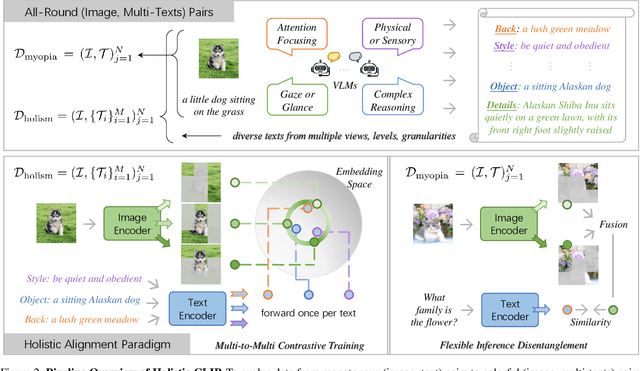


In rapidly evolving field of vision-language models (VLMs), contrastive language-image pre-training (CLIP) has made significant strides, becoming foundation for various downstream tasks. However, relying on one-to-one (image, text) contrastive paradigm to learn alignment from large-scale messy web data, CLIP faces a serious myopic dilemma, resulting in biases towards monotonous short texts and shallow visual expressivity. To overcome these issues, this paper advances CLIP into one novel holistic paradigm, by updating both diverse data and alignment optimization. To obtain colorful data with low cost, we use image-to-text captioning to generate multi-texts for each image, from multiple perspectives, granularities, and hierarchies. Two gadgets are proposed to encourage textual diversity. To match such (image, multi-texts) pairs, we modify the CLIP image encoder into multi-branch, and propose multi-to-multi contrastive optimization for image-text part-to-part matching. As a result, diverse visual embeddings are learned for each image, bringing good interpretability and generalization. Extensive experiments and ablations across over ten benchmarks indicate that our holistic CLIP significantly outperforms existing myopic CLIP, including image-text retrieval, open-vocabulary classification, and dense visual tasks.
Zero-shot Image Editing with Reference Imitation
Jun 11, 2024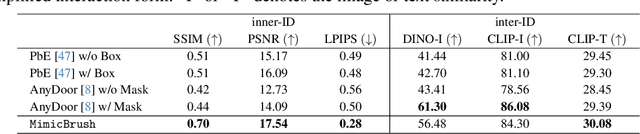
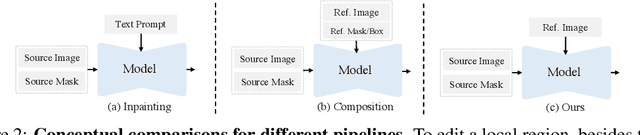

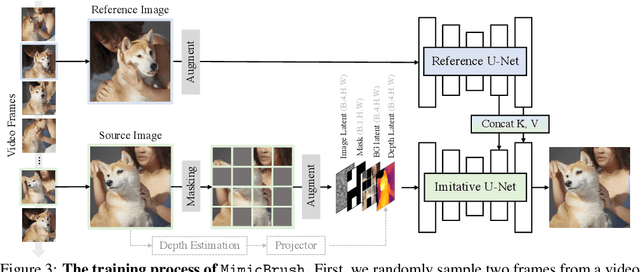
Image editing serves as a practical yet challenging task considering the diverse demands from users, where one of the hardest parts is to precisely describe how the edited image should look like. In this work, we present a new form of editing, termed imitative editing, to help users exercise their creativity more conveniently. Concretely, to edit an image region of interest, users are free to directly draw inspiration from some in-the-wild references (e.g., some relative pictures come across online), without having to cope with the fit between the reference and the source. Such a design requires the system to automatically figure out what to expect from the reference to perform the editing. For this purpose, we propose a generative training framework, dubbed MimicBrush, which randomly selects two frames from a video clip, masks some regions of one frame, and learns to recover the masked regions using the information from the other frame. That way, our model, developed from a diffusion prior, is able to capture the semantic correspondence between separate images in a self-supervised manner. We experimentally show the effectiveness of our method under various test cases as well as its superiority over existing alternatives. We also construct a benchmark to facilitate further research.