 Add to Chrome
 Add to Firefox
 Add to Edge
High-fidelity 3D multi-slab diffusion MRI using Slab-shifting for Harmonized 3D Acquisition and Reconstruction with Profile Encoding Networks (SHARPEN)
Feb 06, 2026
Three-dimensional (3D) multi-slab imaging is a promising approach for high-resolution in vivo diffusion MRI (dMRI) due to its compatibility with short TR (1-2 s), providing optimal signal-to-noise ratio (SNR) efficiency. A major challenge, however, is slab boundary artifacts arising from non-ideal slab-selective RF excitation. Non-rectangular slab profiles reduce signal intensity at slab boundaries, while profile overlap across adjacent slabs introduces inter-slab crosstalk, where repeated excitation shortens the local TR and limits T1 recovery. To mitigate slab boundary artifacts without increasing scan time, we build on slab profile encoding and propose Slab-shifting for Harmonized 3D Acquisition and Reconstruction with Profile Encoding Networks (SHARPEN). For different diffusion directions, SHARPEN applies inter-volume field-of-view shifts along the slice direction to provide complementary slab profile encoding without prolonging acquisition. Slab profiles are estimated using a lightweight self-supervised neural network that exploits consistency across shifted acquisitions and known physical properties of slab profiles and diffusion images, and corrected images are reconstructed accordingly. SHARPEN was validated using simulated and prospectively acquired high-resolution in vivo data and demonstrates accurate slab profile estimation and robust boundary artifact correction, even in the presence of inter-volume motion. SHARPEN does not require high-quality reference training data and supports subject-specific training. Its efficient GPU-based implementation delivers faster and more accurate correction than NPEN, yielding slice-wise quantitative profiles that closely match those from reference 2D acquisitions. SHARPEN enables high-quality dMRI at 0.7 mm isotropic resolution on a 3T clinical scanner, highlighting its potential to advance submillimeter dMRI for neuroscience research.

Enhance the Image: Super Resolution using Artificial Intelligence in MRI
Jun 19, 2024
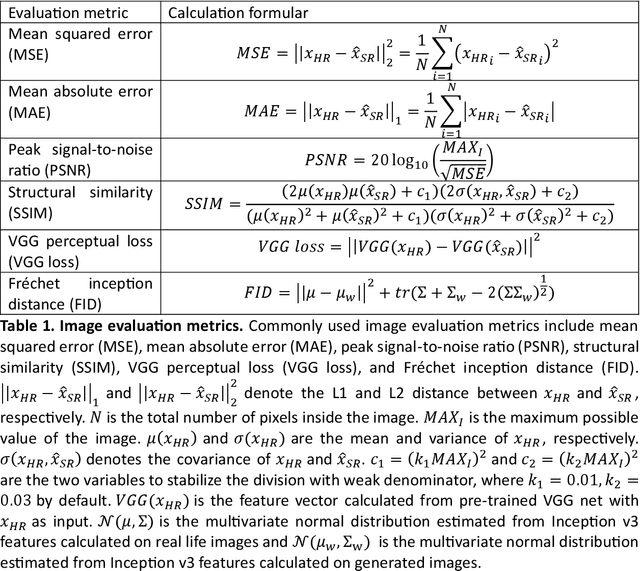
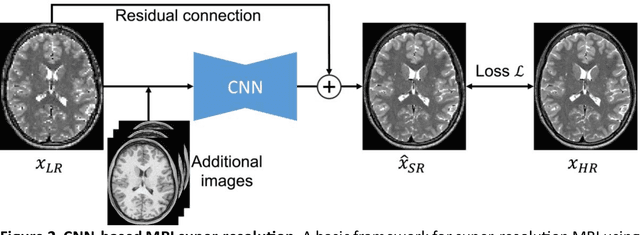
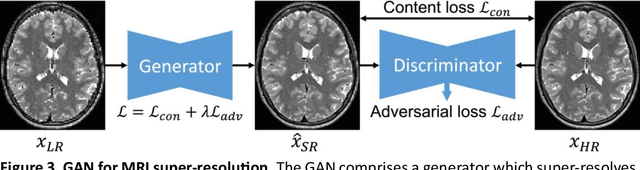
This chapter provides an overview of deep learning techniques for improving the spatial resolution of MRI, ranging from convolutional neural networks, generative adversarial networks, to more advanced models including transformers, diffusion models, and implicit neural representations. Our exploration extends beyond the methodologies to scrutinize the impact of super-resolved images on clinical and neuroscientific assessments. We also cover various practical topics such as network architectures, image evaluation metrics, network loss functions, and training data specifics, including downsampling methods for simulating low-resolution images and dataset selection. Finally, we discuss existing challenges and potential future directions regarding the feasibility and reliability of deep learning-based MRI super-resolution, with the aim to facilitate its wider adoption to benefit various clinical and neuroscientific applications.
Self-navigated 3D diffusion MRI using an optimized CAIPI sampling and structured low-rank reconstruction
Jan 11, 2024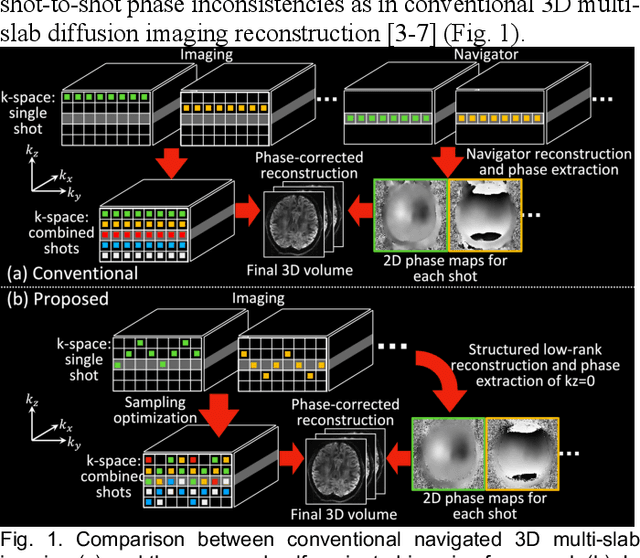
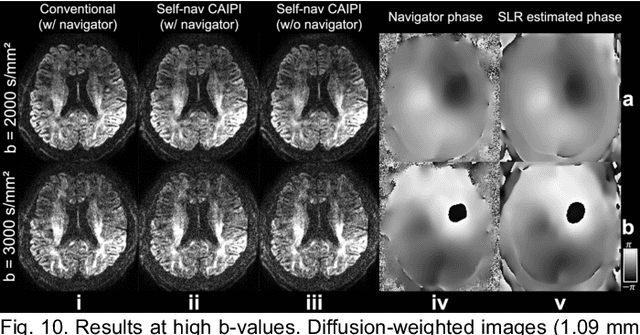
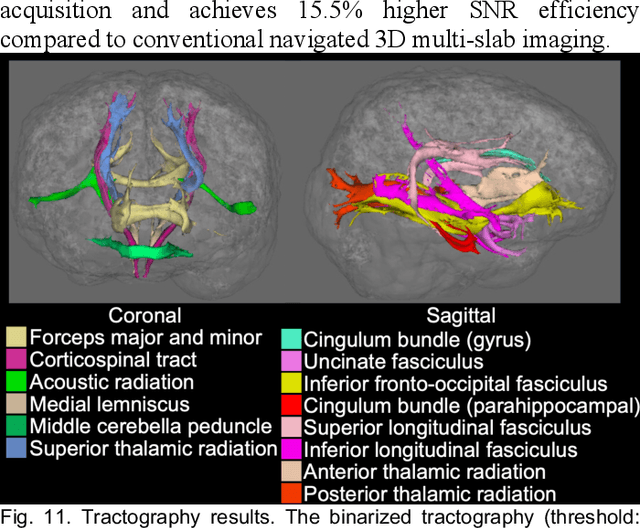

3D multi-slab acquisitions are an appealing approach for diffusion MRI because they are compatible with the imaging regime delivering optimal SNR efficiency. In conventional 3D multi-slab imaging, shot-to-shot phase variations caused by motion pose challenges due to the use of multi-shot k-space acquisition. Navigator acquisition after each imaging echo is typically employed to correct phase variations, which prolongs scan time and increases the specific absorption rate (SAR). The aim of this study is to develop a highly efficient, self-navigated method to correct for phase variations in 3D multi-slab diffusion MRI without explicitly acquiring navigators. The sampling of each shot is carefully designed to intersect with the central kz plane of each slab, and the multi-shot sampling is optimized for self-navigation performance while retaining decent reconstruction quality. The central kz intersections from all shots are jointly used to reconstruct a 2D phase map for each shot using a structured low-rank constrained reconstruction that leverages the redundancy in shot and coil dimensions. The phase maps are used to eliminate the shot-to-shot phase inconsistency in the final 3D multi-shot reconstruction. We demonstrate the method's efficacy using retrospective simulations and prospectively acquired in-vivo experiments at 1.22 mm and 1.09 mm isotropic resolutions. Compared to conventional navigated 3D multi-slab imaging, the proposed self-navigated method achieves comparable image quality while shortening the scan time by 31.7% and improving the SNR efficiency by 15.5%. The proposed method produces comparable quality of DTI and white matter tractography to conventional navigated 3D multi-slab acquisition with a much shorter scan time.