 Add to Chrome
 Add to Firefox
 Add to Edge
ComBodied Agents: a New Paradigm of Human-Centric Agentic AI
Aug 12, 2026
After an older adult misses a medication dose, a software agent can send another reminder and an embodied agent can bring the medication. Yet neither explains whether the person forgot, is confused, has side effects, or deliberately refused, nor what support is appropriate. This reveals a structural gap in Agentic AI: Digital Agents primarily transform software states, while Embodied Agents transform physical states; neither makes a person's evolving state and agency the primary object of modeling, intervention, and evaluation. We introduce Combodied Agents, a human-centered paradigm that perceives, models, predicts, and supports individual human-state trajectories over time, using software tools, sensors, wearables, robots, and human services as action channels rather than end goals. We unify fragmented capabilities across personal assistants, health agents, AI companions, and adaptive human--AI systems into a closed loop: event-based multimodal perception reconstructs meaningful personal events; longitudinal, correctable memory provides temporal context; Personal World Models estimate future personal states and outcomes under alternative decisions and interventions; and an admissible intervention policy selects proportionate support under consent, uncertainty, safety, reversibility, and user control. Feedback from the person and environment updates the loop. Rather than requiring an exhaustive Human Digital Twin, the framework uses purpose-bounded, uncertainty-aware, user-correctable representations. We organize the design space by human-state targets, relational contexts, and agent roles, and propose scenario-centered evaluation, agency-preservation metrics, benchmark requirements, edge-native personal models, and governance directions. Combodied Agents shift Agentic AI from external task completion toward sustained human benefit.

Physics Transformer: Tailoring Transformer for General PDE Prediction
Jul 27, 2026Transformer architectures have attracted increasing attention for solving partial differential equations (PDEs), owing to their flexibility in handling irregular discretizations and their ability to capture long-range physical dependencies. However, unlike discrete language tokens or fixed-resolution image patches, observed physical fields are finite samples of underlying infinite-dimensional functions. Consequently, effectively applying Transformers to PDEs requires a tokenizer that respects the functional nature of physical fields and constructs physically expressive tokens from arbitrary discretizations.To this end, we propose \methodname{Physics Transformer}, a function-projection-based Transformer architecture for physical field prediction. Physics Transformer treats a physical field as a continuous function and partitions its discretization into locality-preserving spatial patches. Within each patch, it dynamically learns a set of adaptive local basis functions and projects the sampled field onto these bases to obtain compact physics tokens. The resulting tokens capture diverse latent physical states while preserving fine-scale spatial structures, enabling efficient global interaction through factorized attention across space and physical states. The projected representation further supports efficient decoding at arbitrary query locations. Extensive experiments on diverse benchmarks, ranging from two-dimensional PDE dynamics to industrial-scale three-dimensional CFD simulations, demonstrate that Physics Transformer accurately captures fine-grained physical structures and achieves state-of-the-art predictive performance. These results establish function projection as a practical and effective foundation for designing Transformer architectures for PDE solving.
Non-Contact Health Monitoring During Daily Personal Care Routines
Jun 11, 2025Remote photoplethysmography (rPPG) enables non-contact, continuous monitoring of physiological signals and offers a practical alternative to traditional health sensing methods. Although rPPG is promising for daily health monitoring, its application in long-term personal care scenarios, such as mirror-facing routines in high-altitude environments, remains challenging due to ambient lighting variations, frequent occlusions from hand movements, and dynamic facial postures. To address these challenges, we present LADH (Long-term Altitude Daily Health), the first long-term rPPG dataset containing 240 synchronized RGB and infrared (IR) facial videos from 21 participants across five common personal care scenarios, along with ground-truth PPG, respiration, and blood oxygen signals. Our experiments demonstrate that combining RGB and IR video inputs improves the accuracy and robustness of non-contact physiological monitoring, achieving a mean absolute error (MAE) of 4.99 BPM in heart rate estimation. Furthermore, we find that multi-task learning enhances performance across multiple physiological indicators simultaneously. Dataset and code are open at https://github.com/McJackTang/FusionVitals.
A Dataset and Toolkit for Multiparameter Cardiovascular Physiology Sensing on Rings
May 08, 2025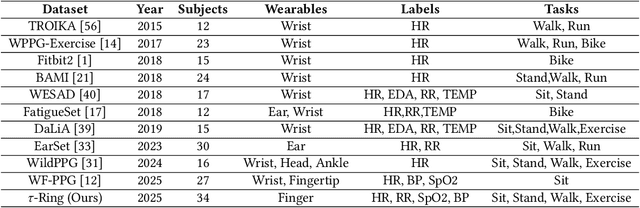
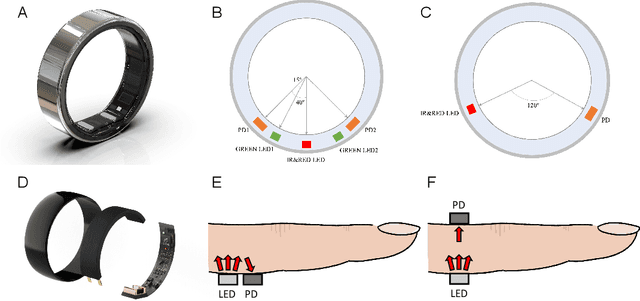
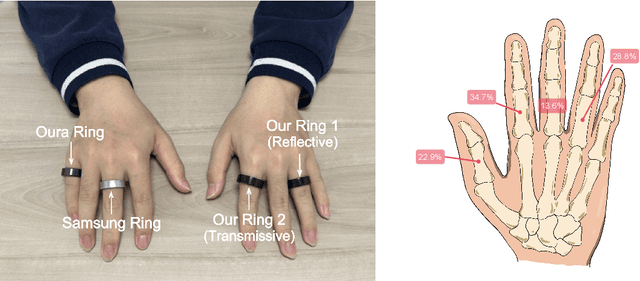
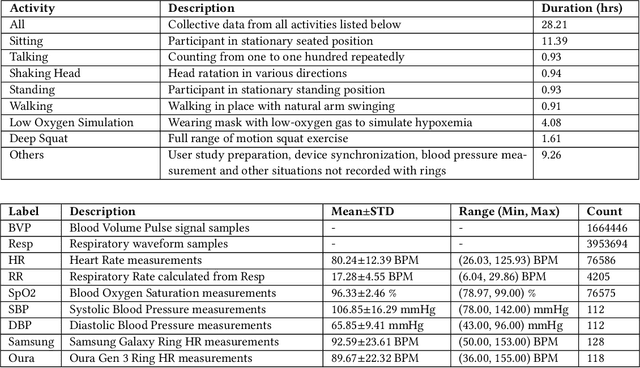
Smart rings offer a convenient way to continuously and unobtrusively monitor cardiovascular physiological signals. However, a gap remains between the ring hardware and reliable methods for estimating cardiovascular parameters, partly due to the lack of publicly available datasets and standardized analysis tools. In this work, we present $\tau$-Ring, the first open-source ring-based dataset designed for cardiovascular physiological sensing. The dataset comprises photoplethysmography signals (infrared and red channels) and 3-axis accelerometer data collected from two rings (reflective and transmissive optical paths), with 28.21 hours of raw data from 34 subjects across seven activities. $\tau$-Ring encompasses both stationary and motion scenarios, as well as stimulus-evoked abnormal physiological states, annotated with four ground-truth labels: heart rate, respiratory rate, oxygen saturation, and blood pressure. Using our proposed RingTool toolkit, we evaluated three widely-used physics-based methods and four cutting-edge deep learning approaches. Our results show superior performance compared to commercial rings, achieving best MAE values of 5.18 BPM for heart rate, 2.98 BPM for respiratory rate, 3.22\% for oxygen saturation, and 13.33/7.56 mmHg for systolic/diastolic blood pressure estimation. The open-sourced dataset and toolkit aim to foster further research and community-driven advances in ring-based cardiovascular health sensing.
Memory-efficient Low-latency Remote Photoplethysmography through Temporal-Spatial State Space Duality
Apr 02, 2025Remote photoplethysmography (rPPG), enabling non-contact physiological monitoring through facial light reflection analysis, faces critical computational bottlenecks as deep learning introduces performance gains at the cost of prohibitive resource demands. This paper proposes ME-rPPG, a memory-efficient algorithm built on temporal-spatial state space duality, which resolves the trilemma of model scalability, cross-dataset generalization, and real-time constraints. Leveraging a transferable state space, ME-rPPG efficiently captures subtle periodic variations across facial frames while maintaining minimal computational overhead, enabling training on extended video sequences and supporting low-latency inference. Achieving cross-dataset MAEs of 5.38 (MMPD), 0.70 (VitalVideo), and 0.25 (PURE), ME-rPPG outperforms all baselines with improvements ranging from 21.3% to 60.2%. Our solution enables real-time inference with only 3.6 MB memory usage and 9.46 ms latency -- surpassing existing methods by 19.5%-49.7% accuracy and 43.2% user satisfaction gains in real-world deployments. The code and demos are released for reproducibility on https://github.com/Health-HCI-Group/ME-rPPG-demo.
Exploring Reliable PPG Authentication on Smartwatches in Daily Scenarios
Mar 31, 2025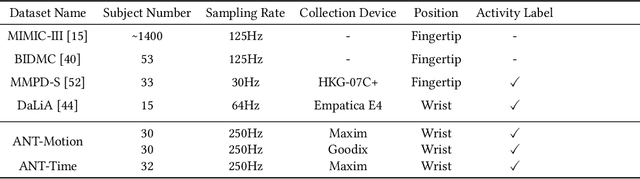
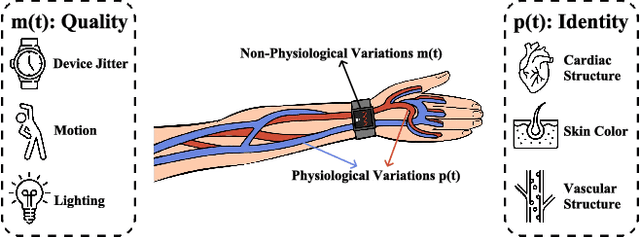
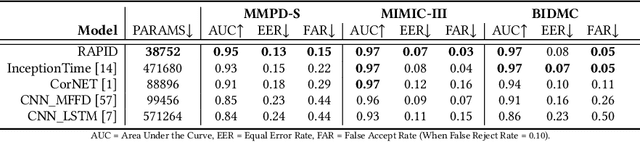
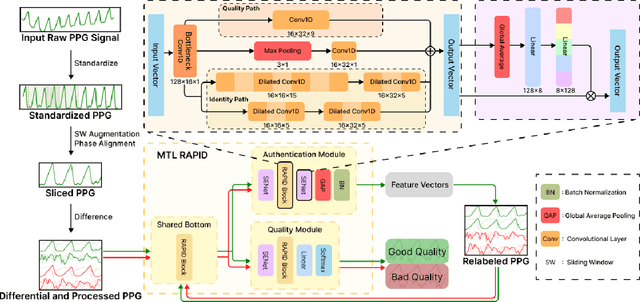
Photoplethysmography (PPG) Sensors, widely deployed in smartwatches, offer a simple and non-invasive authentication approach for daily use. However, PPG authentication faces reliability issues due to motion artifacts from physical activity and physiological variability over time. To address these challenges, we propose MTL-RAPID, an efficient and reliable PPG authentication model, that employs a multitask joint training strategy, simultaneously assessing signal quality and verifying user identity. The joint optimization of these two tasks in MTL-RAPID results in a structure that outperforms models trained on individual tasks separately, achieving stronger performance with fewer parameters. In our comprehensive user studies regarding motion artifacts (N = 30), time variations (N = 32), and user preferences (N = 16), MTL-RAPID achieves a best AUC of 99.2\% and an EER of 3.5\%, outperforming existing baselines. We opensource our PPG authentication dataset along with the MTL-RAPID model to facilitate future research on GitHub.
A Plug-and-Play Temporal Normalization Module for Robust Remote Photoplethysmography
Nov 22, 2024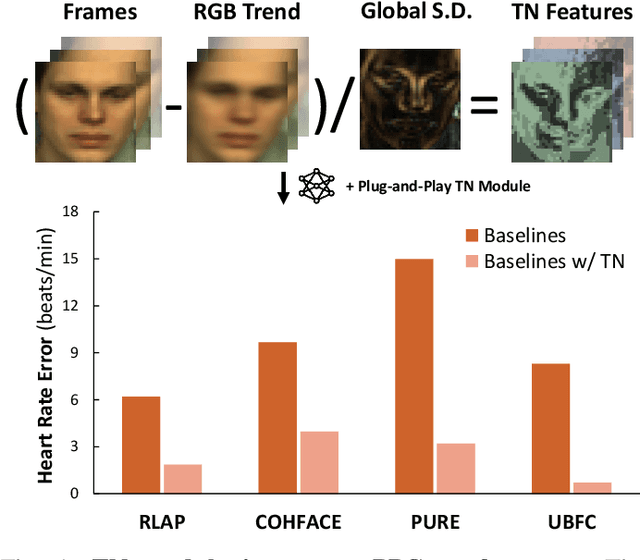
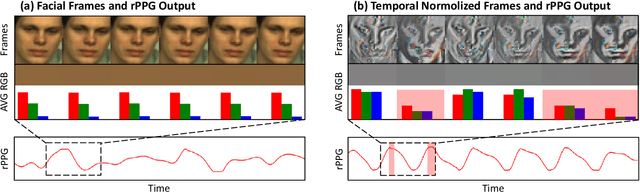
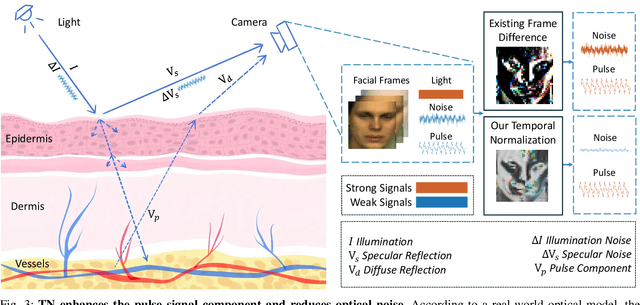
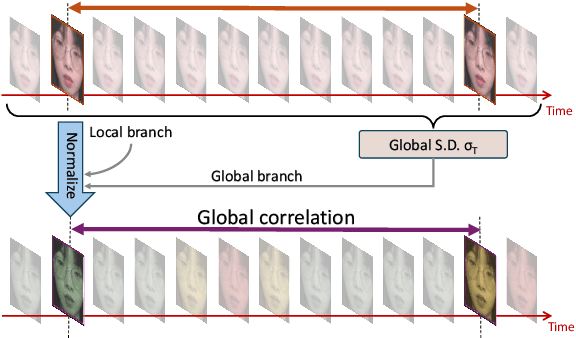
Remote photoplethysmography (rPPG) extracts PPG signals from subtle color changes in facial videos, showing strong potential for health applications. However, most rPPG methods rely on intensity differences between consecutive frames, missing long-term signal variations affected by motion or lighting artifacts, which reduces accuracy. This paper introduces Temporal Normalization (TN), a flexible plug-and-play module compatible with any end-to-end rPPG network architecture. By capturing long-term temporally normalized features following detrending, TN effectively mitigates motion and lighting artifacts, significantly boosting the rPPG prediction performance. When integrated into four state-of-the-art rPPG methods, TN delivered performance improvements ranging from 34.3% to 94.2% in heart rate measurement tasks across four widely-used datasets. Notably, TN showed even greater performance gains in smaller models. We further discuss and provide insights into the mechanisms behind TN's effectiveness.
Summit Vitals: Multi-Camera and Multi-Signal Biosensing at High Altitudes
Sep 28, 2024Video photoplethysmography (vPPG) is an emerging method for non-invasive and convenient measurement of physiological signals, utilizing two primary approaches: remote video PPG (rPPG) and contact video PPG (cPPG). Monitoring vitals in high-altitude environments, where heart rates tend to increase and blood oxygen levels often decrease, presents significant challenges. To address these issues, we introduce the SUMS dataset comprising 80 synchronized non-contact facial and contact finger videos from 10 subjects during exercise and oxygen recovery scenarios, capturing PPG, respiration rate (RR), and SpO2. This dataset is designed to validate video vitals estimation algorithms and compare facial rPPG with finger cPPG. Additionally, fusing videos from different positions (i.e., face and finger) reduces the mean absolute error (MAE) of SpO2 predictions by 7.6\% and 10.6\% compared to only face and only finger, respectively. In cross-subject evaluation, we achieve an MAE of less than 0.5 BPM for HR estimation and 2.5\% for SpO2 estimation, demonstrating the precision of our multi-camera fusion techniques. Our findings suggest that simultaneous training on multiple indicators, such as PPG and blood oxygen, can reduce MAE in SpO2 estimation by 17.8\%.
Camera-Based Remote Physiology Sensing for Hundreds of Subjects Across Skin Tones
Apr 07, 2024
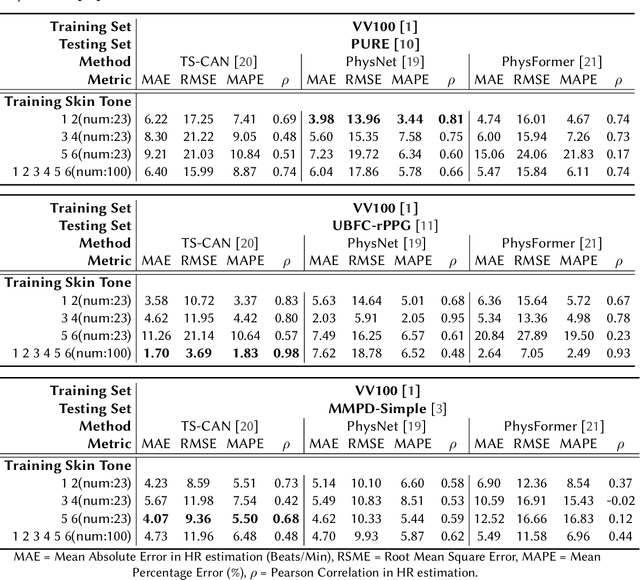
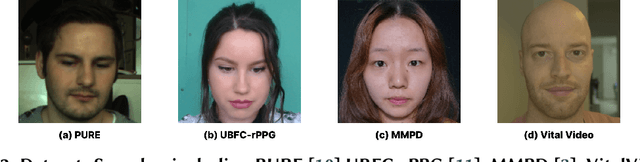
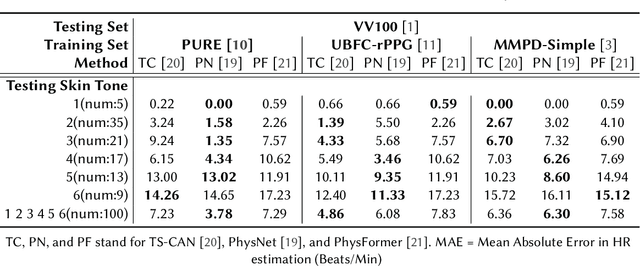
Remote photoplethysmography (rPPG) emerges as a promising method for non-invasive, convenient measurement of vital signs, utilizing the widespread presence of cameras. Despite advancements, existing datasets fall short in terms of size and diversity, limiting comprehensive evaluation under diverse conditions. This paper presents an in-depth analysis of the VitalVideo dataset, the largest real-world rPPG dataset to date, encompassing 893 subjects and 6 Fitzpatrick skin tones. Our experimentation with six unsupervised methods and three supervised models demonstrates that datasets comprising a few hundred subjects(i.e., 300 for UBFC-rPPG, 500 for PURE, and 700 for MMPD-Simple) are sufficient for effective rPPG model training. Our findings highlight the importance of diversity and consistency in skin tones for precise performance evaluation across different datasets.
Spiking-PhysFormer: Camera-Based Remote Photoplethysmography with Parallel Spike-driven Transformer
Feb 09, 2024Artificial neural networks (ANNs) can help camera-based remote photoplethysmography (rPPG) in measuring cardiac activity and physiological signals from facial videos, such as pulse wave, heart rate and respiration rate with better accuracy. However, most existing ANN-based methods require substantial computing resources, which poses challenges for effective deployment on mobile devices. Spiking neural networks (SNNs), on the other hand, hold immense potential for energy-efficient deep learning owing to their binary and event-driven architecture. To the best of our knowledge, we are the first to introduce SNNs into the realm of rPPG, proposing a hybrid neural network (HNN) model, the Spiking-PhysFormer, aimed at reducing power consumption. Specifically, the proposed Spiking-PhyFormer consists of an ANN-based patch embedding block, SNN-based transformer blocks, and an ANN-based predictor head. First, to simplify the transformer block while preserving its capacity to aggregate local and global spatio-temporal features, we design a parallel spike transformer block to replace sequential sub-blocks. Additionally, we propose a simplified spiking self-attention mechanism that omits the value parameter without compromising the model's performance. Experiments conducted on four datasets-PURE, UBFC-rPPG, UBFC-Phys, and MMPD demonstrate that the proposed model achieves a 12.4\% reduction in power consumption compared to PhysFormer. Additionally, the power consumption of the transformer block is reduced by a factor of 12.2, while maintaining decent performance as PhysFormer and other ANN-based models.