 Add to Chrome
 Add to Firefox
 Add to Edge
Understanding and Stabilizing Deep Q-Learning via Controlled Bootstrapping and Regulated Value Dynamics
Aug 17, 2026
Deep Q-learning (DQL) has achieved remarkable empirical success in reinforcement learning, yet its training process remains notoriously unstable. Existing studies often attribute instability to isolated factors such as overestimation bias or representation learning issues, lacking a unified understanding of how different sources of instability interact during recursive value estimation. In this work, we provide a systematic analysis of instability in deep Q-learning from three complementary perspectives: operator-level bias in Bellman bootstrapping, estimator-level sensitivity of greedy action selection to regression noise, and parameter-dynamics imbalance under aggressive data reuse. We identify a reward-triggered self-reinforcing trap and characteristic parameter spike dynamics, then derive stabilization principles for controlled bootstrapping, ensemble quantile estimation, and spike-based parameter regulation. Experiments on Atari-100K and Procgen demonstrate competitive performance and improved training stability.

ALKEMIE Agent: an autonomous platform for computational materials design
Aug 16, 2026Despite the powerful multi-scale modeling methods and high-throughput infrastructures established in the materials community, real material computation workflows remain fragmented and heavily manual, requiring researchers to constantly bridge software tools, data analysis, and intermediate decisions. This growing gap between methodological capability and practical execution highlights the need for a new kind of autonomous computational framework, one that can coordinate tools, knowledge, and workflows in a more unified and adaptive way. Here, we introduce ALKEMIE Agent, an agentic platform in which retrieval-augmented generation, a materials-computation knowledge base, registered skills, database-supported provenance, AI-assisted structure modeling, bounded task execution, tool-calling iteration, and error-diagnostic assistance are integrated within a traceable control loop. The capabilities of ALKEMIE Agent are demonstrated through applications including materials recommendation, structure modeling, phonon calculations, machine-learned interatomic potential training, LAMMPS simulations, Ab Initio Monte Carlo (AIMC) sampling, and active-learning-based materials screening. Finally, we outline the future directions and challenges for the development of agentic platforms for computational materials design.
Beyond Autoregressive RTG: Conditioning via Injection Outside Sequential Modeling in Decision Transformer
May 07, 2026Decision Transformer (DT) formulates offline reinforcement learning as autoregressive sequence modeling, achieving promising results by predicting actions from a sequence of Return-to-Go (RTG), state, and action tokens. However, RTG is a scalar that summarizes future rewards, containing far less information than typical state or action vectors, yet it consumes the same computational budget per token. Worse, the self-attention cost of Transformers grows quadratically with sequence length, so including RTG as a separate token adds unnecessary overhead. We propose SlimDT, which removes RTG from the autoregressive sequence. Instead, we inject RTG information into the state representations before the sequential modeling step, allowing the Transformer to process only a compact (state, action) sequence. This reduces the sequence length by one-third, directly improving inference efficiency. On the D4RL benchmark, SlimDT surpasses standard DT across various tasks and achieves performance comparable to existing state-of-the-art methods. Decoupling a sparse conditioning signal from an information-rich sequence thus yields both computational gains and higher task performance.
Decoupling Return-to-Go for Efficient Decision Transformer
Jan 22, 2026The Decision Transformer (DT) has established a powerful sequence modeling approach to offline reinforcement learning. It conditions its action predictions on Return-to-Go (RTG), using it both to distinguish trajectory quality during training and to guide action generation at inference. In this work, we identify a critical redundancy in this design: feeding the entire sequence of RTGs into the Transformer is theoretically unnecessary, as only the most recent RTG affects action prediction. We show that this redundancy can impair DT's performance through experiments. To resolve this, we propose the Decoupled DT (DDT). DDT simplifies the architecture by processing only observation and action sequences through the Transformer, using the latest RTG to guide the action prediction. This streamlined approach not only improves performance but also reduces computational cost. Our experiments show that DDT significantly outperforms DT and establishes competitive performance against state-of-the-art DT variants across multiple offline RL tasks.
FOD-Diff: 3D Multi-Channel Patch Diffusion Model for Fiber Orientation Distribution
Dec 18, 2025Diffusion MRI (dMRI) is a critical non-invasive technique to estimate fiber orientation distribution (FOD) for characterizing white matter integrity. Estimating FOD from single-shell low angular resolution dMRI (LAR-FOD) is limited by accuracy, whereas estimating FOD from multi-shell high angular resolution dMRI (HAR-FOD) requires a long scanning time, which limits its applicability. Diffusion models have shown promise in estimating HAR-FOD based on LAR-FOD. However, using diffusion models to efficiently generate HAR-FOD is challenging due to the large number of spherical harmonic (SH) coefficients in FOD. Here, we propose a 3D multi-channel patch diffusion model to predict HAR-FOD from LAR-FOD. We design the FOD-patch adapter by introducing the prior brain anatomy for more efficient patch-based learning. Furthermore, we introduce a voxel-level conditional coordinating module to enhance the global understanding of the model. We design the SH attention module to effectively learn the complex correlations of the SH coefficients. Our experimental results show that our method achieves the best performance in HAR-FOD prediction and outperforms other state-of-the-art methods.
Motus: A Unified Latent Action World Model
Dec 15, 2025While a general embodied agent must function as a unified system, current methods are built on isolated models for understanding, world modeling, and control. This fragmentation prevents unifying multimodal generative capabilities and hinders learning from large-scale, heterogeneous data. In this paper, we propose Motus, a unified latent action world model that leverages existing general pretrained models and rich, sharable motion information. Motus introduces a Mixture-of-Transformer (MoT) architecture to integrate three experts (i.e., understanding, video generation, and action) and adopts a UniDiffuser-style scheduler to enable flexible switching between different modeling modes (i.e., world models, vision-language-action models, inverse dynamics models, video generation models, and video-action joint prediction models). Motus further leverages the optical flow to learn latent actions and adopts a recipe with three-phase training pipeline and six-layer data pyramid, thereby extracting pixel-level "delta action" and enabling large-scale action pretraining. Experiments show that Motus achieves superior performance against state-of-the-art methods in both simulation (a +15% improvement over X-VLA and a +45% improvement over Pi0.5) and real-world scenarios(improved by +11~48%), demonstrating unified modeling of all functionalities and priors significantly benefits downstream robotic tasks.
Generative AI Meets Wireless Sensing: Towards Wireless Foundation Model
Sep 18, 2025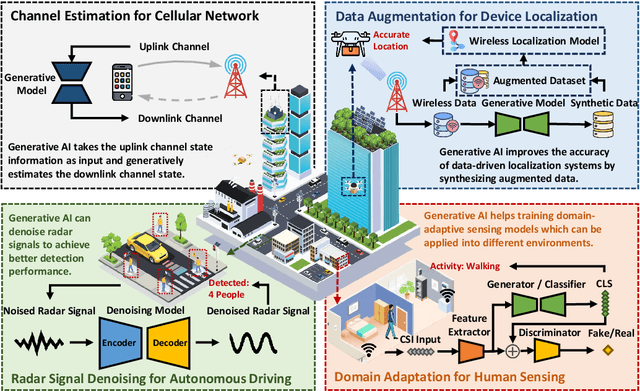
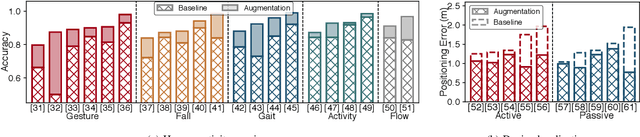
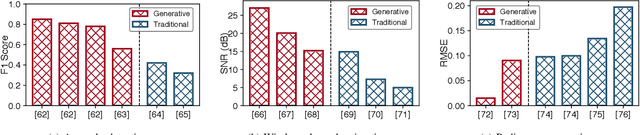
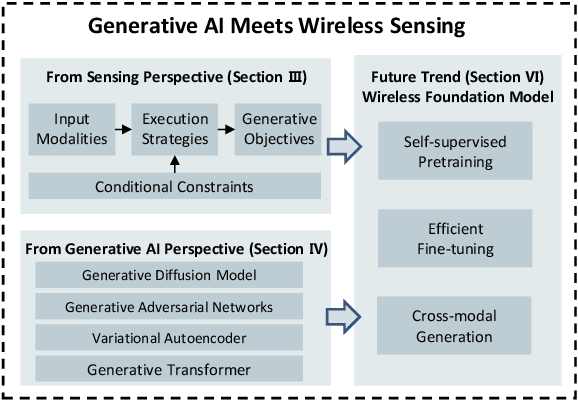
Generative Artificial Intelligence (GenAI) has made significant advancements in fields such as computer vision (CV) and natural language processing (NLP), demonstrating its capability to synthesize high-fidelity data and improve generalization. Recently, there has been growing interest in integrating GenAI into wireless sensing systems. By leveraging generative techniques such as data augmentation, domain adaptation, and denoising, wireless sensing applications, including device localization, human activity recognition, and environmental monitoring, can be significantly improved. This survey investigates the convergence of GenAI and wireless sensing from two complementary perspectives. First, we explore how GenAI can be integrated into wireless sensing pipelines, focusing on two modes of integration: as a plugin to augment task-specific models and as a solver to directly address sensing tasks. Second, we analyze the characteristics of mainstream generative models, such as Generative Adversarial Networks (GANs), Variational Autoencoders (VAEs), and diffusion models, and discuss their applicability and unique advantages across various wireless sensing tasks. We further identify key challenges in applying GenAI to wireless sensing and outline a future direction toward a wireless foundation model: a unified, pre-trained design capable of scalable, adaptable, and efficient signal understanding across diverse sensing tasks.
RoboMatch: A Mobile-Manipulation Teleoperation Platform with Auto-Matching Network Architecture for Long-Horizon Manipulation
Sep 10, 2025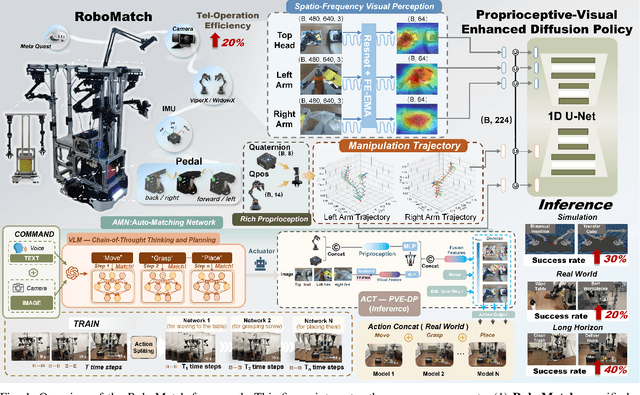
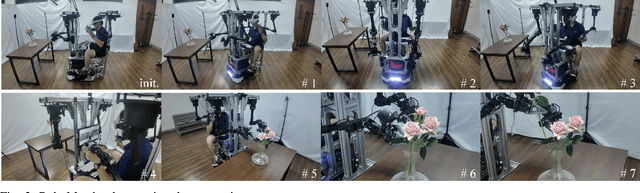
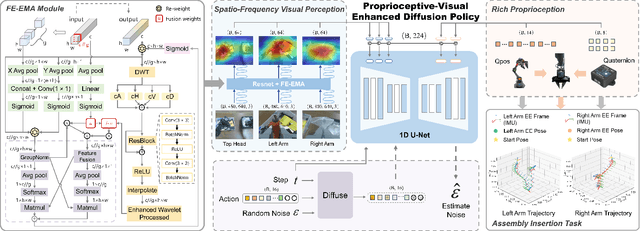
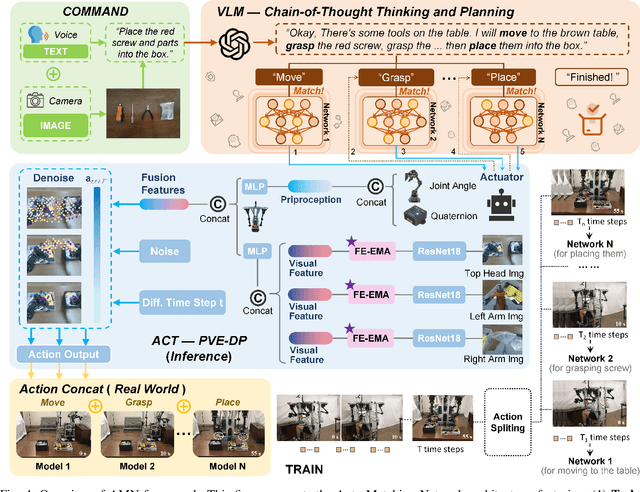
This paper presents RoboMatch, a novel unified teleoperation platform for mobile manipulation with an auto-matching network architecture, designed to tackle long-horizon tasks in dynamic environments. Our system enhances teleoperation performance, data collection efficiency, task accuracy, and operational stability. The core of RoboMatch is a cockpit-style control interface that enables synchronous operation of the mobile base and dual arms, significantly improving control precision and data collection. Moreover, we introduce the Proprioceptive-Visual Enhanced Diffusion Policy (PVE-DP), which leverages Discrete Wavelet Transform (DWT) for multi-scale visual feature extraction and integrates high-precision IMUs at the end-effector to enrich proprioceptive feedback, substantially boosting fine manipulation performance. Furthermore, we propose an Auto-Matching Network (AMN) architecture that decomposes long-horizon tasks into logical sequences and dynamically assigns lightweight pre-trained models for distributed inference. Experimental results demonstrate that our approach improves data collection efficiency by over 20%, increases task success rates by 20-30% with PVE-DP, and enhances long-horizon inference performance by approximately 40% with AMN, offering a robust solution for complex manipulation tasks.
HaDM-ST: Histology-Assisted Differential Modeling for Spatial Transcriptomics Generation
Aug 10, 2025Spatial transcriptomics (ST) reveals spatial heterogeneity of gene expression, yet its resolution is limited by current platforms. Recent methods enhance resolution via H&E-stained histology, but three major challenges persist: (1) isolating expression-relevant features from visually complex H&E images; (2) achieving spatially precise multimodal alignment in diffusion-based frameworks; and (3) modeling gene-specific variation across expression channels. We propose HaDM-ST (Histology-assisted Differential Modeling for ST Generation), a high-resolution ST generation framework conditioned on H&E images and low-resolution ST. HaDM-ST includes: (i) a semantic distillation network to extract predictive cues from H&E; (ii) a spatial alignment module enforcing pixel-wise correspondence with low-resolution ST; and (iii) a channel-aware adversarial learner for fine-grained gene-level modeling. Experiments on 200 genes across diverse tissues and species show HaDM-ST consistently outperforms prior methods, enhancing spatial fidelity and gene-level coherence in high-resolution ST predictions.
Confidence-driven Gradient Modulation for Multimodal Human Activity Recognition: A Dynamic Contrastive Dual-Path Learning Approach
Jul 03, 2025Sensor-based Human Activity Recognition (HAR) is a core technology that enables intelligent systems to perceive and interact with their environment. However, multimodal HAR systems still encounter key challenges, such as difficulties in cross-modal feature alignment and imbalanced modality contributions. To address these issues, we propose a novel framework called the Dynamic Contrastive Dual-Path Network (DCDP-HAR). The framework comprises three key components. First, a dual-path feature extraction architecture is employed, where ResNet and DenseNet branches collaboratively process multimodal sensor data. Second, a multi-stage contrastive learning mechanism is introduced to achieve progressive alignment from local perception to semantic abstraction. Third, we present a confidence-driven gradient modulation strategy that dynamically monitors and adjusts the learning intensity of each modality branch during backpropagation, effectively alleviating modality competition. In addition, a momentum-based gradient accumulation strategy is adopted to enhance training stability. We conduct ablation studies to validate the effectiveness of each component and perform extensive comparative experiments on four public benchmark datasets.