 Add to Chrome
 Add to Firefox
 Add to Edge
Understanding and Stabilizing Deep Q-Learning via Controlled Bootstrapping and Regulated Value Dynamics
Aug 17, 2026
Deep Q-learning (DQL) has achieved remarkable empirical success in reinforcement learning, yet its training process remains notoriously unstable. Existing studies often attribute instability to isolated factors such as overestimation bias or representation learning issues, lacking a unified understanding of how different sources of instability interact during recursive value estimation. In this work, we provide a systematic analysis of instability in deep Q-learning from three complementary perspectives: operator-level bias in Bellman bootstrapping, estimator-level sensitivity of greedy action selection to regression noise, and parameter-dynamics imbalance under aggressive data reuse. We identify a reward-triggered self-reinforcing trap and characteristic parameter spike dynamics, then derive stabilization principles for controlled bootstrapping, ensemble quantile estimation, and spike-based parameter regulation. Experiments on Atari-100K and Procgen demonstrate competitive performance and improved training stability.

First Deployable Dynamic-CoM: A Unified Policy and Method-Agnostic Benchmark for Humanoid Single-Leg Balance
Aug 01, 2026Unified humanoid policies handle agile whole-body motion, yet stumble on a simple demand: staying balanced on one leg. On our single-leg-balance benchmark, eight released state-of-the-art general policies hold a clean single-leg stance on 0 of 90 test motions; they stay up only by stepping or hopping, recovering from imbalance rather than preventing it. Prevention needs the capture point (xCoM), the center of mass (CoM) extrapolated by its velocity, which has never driven a hardware policy because it requires a base linear velocity no on-board sensor provides; expressed relative to the support foot, that velocity cancels exactly, leaving an observation reconstructible from encoders and IMU alone. We put this first deployable dynamic-CoM observation directly into the actor that runs on hardware, and pair it with a reward library translated term by term from human postural control, under one principle: prevention over repair. Trained by asymmetric FastSAC with a privileged critic and no distillation, the resulting policy, FDDC (First Deployable Dynamic-CoM), holds clean single-leg balance on 86 of 90 held-out motions across nine stratified pose classes and transfers to a real Unitree G1; in ablation, the dynamic-CoM observation is the single largest driver: removing it alone costs 40 points of clean single-leg balance. We release the full stack with the first method-agnostic, reproducible sim2sim benchmark for humanoid single-leg balance, scoring each policy in a simulator distinct from its training one, a step toward turning balance from a per-task trick into a capability the field can measure.
Beyond Autoregressive RTG: Conditioning via Injection Outside Sequential Modeling in Decision Transformer
May 07, 2026Decision Transformer (DT) formulates offline reinforcement learning as autoregressive sequence modeling, achieving promising results by predicting actions from a sequence of Return-to-Go (RTG), state, and action tokens. However, RTG is a scalar that summarizes future rewards, containing far less information than typical state or action vectors, yet it consumes the same computational budget per token. Worse, the self-attention cost of Transformers grows quadratically with sequence length, so including RTG as a separate token adds unnecessary overhead. We propose SlimDT, which removes RTG from the autoregressive sequence. Instead, we inject RTG information into the state representations before the sequential modeling step, allowing the Transformer to process only a compact (state, action) sequence. This reduces the sequence length by one-third, directly improving inference efficiency. On the D4RL benchmark, SlimDT surpasses standard DT across various tasks and achieves performance comparable to existing state-of-the-art methods. Decoupling a sparse conditioning signal from an information-rich sequence thus yields both computational gains and higher task performance.
ShuttleEnv: An Interactive Data-Driven RL Environment for Badminton Strategy Modeling
Mar 18, 2026We present ShuttleEnv, an interactive and data-driven simulation environment for badminton, designed to support reinforcement learning and strategic behavior analysis in fast-paced adversarial sports. The environment is grounded in elite-player match data and employs explicit probabilistic models to simulate rally-level dynamics, enabling realistic and interpretable agent-opponent interactions without relying on physics-based simulation. In this demonstration, we showcase multiple trained agents within ShuttleEnv and provide live, step-by-step visualization of badminton rallies, allowing attendees to explore different play styles, observe emergent strategies, and interactively analyze decision-making behaviors. ShuttleEnv serves as a reusable platform for research, visualization, and demonstration of intelligent agents in sports AI. Our ShuttleEnv demo video URL: https://drive.google.com/file/d/1hTR4P16U27H2O0-w316bR73pxE2ucczX/view
Pareto-guided Pipeline for Distilling Featherweight AI Agents in Mobile MOBA Games
Feb 07, 2026Recent advances in game AI have demonstrated the feasibility of training agents that surpass top-tier human professionals in complex environments such as Honor of Kings (HoK), a leading mobile multiplayer online battle arena (MOBA) game. However, deploying such powerful agents on mobile devices remains a major challenge. On one hand, the intricate multi-modal state representation and hierarchical action space of HoK demand large, sophisticated policy networks that are inherently difficult to compress into lightweight forms. On the other hand, production deployment requires high-frequency inference under strict energy and latency constraints on mobile platform. To the best of our knowledge, bridging large-scale game AI and practical on-device deployment has not been systematically studied. In this work, we propose a Pareto optimality guided pipeline and design a high-efficiency student architecture search space tailored for mobile execution, enabling systematic exploration of the trade-off between performance and efficiency. Experimental results demonstrate that the distilled model achieves remarkable efficiency, including an $12.4\times$ faster inference speed (under 0.5ms per frame) and a $15.6\times$ improvement in energy efficiency (under 0.5mAh per game), while retaining a 40.32% win rate against the original teacher model.
Decoupling Return-to-Go for Efficient Decision Transformer
Jan 22, 2026The Decision Transformer (DT) has established a powerful sequence modeling approach to offline reinforcement learning. It conditions its action predictions on Return-to-Go (RTG), using it both to distinguish trajectory quality during training and to guide action generation at inference. In this work, we identify a critical redundancy in this design: feeding the entire sequence of RTGs into the Transformer is theoretically unnecessary, as only the most recent RTG affects action prediction. We show that this redundancy can impair DT's performance through experiments. To resolve this, we propose the Decoupled DT (DDT). DDT simplifies the architecture by processing only observation and action sequences through the Transformer, using the latest RTG to guide the action prediction. This streamlined approach not only improves performance but also reduces computational cost. Our experiments show that DDT significantly outperforms DT and establishes competitive performance against state-of-the-art DT variants across multiple offline RL tasks.
Differentiable Self-Adaptive Learning Rate
Oct 19, 2022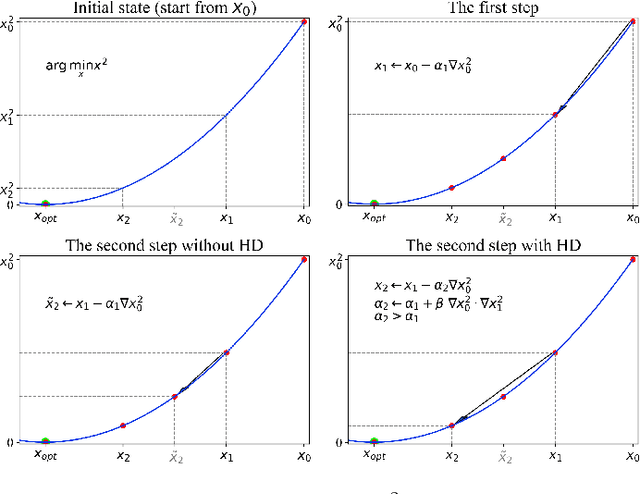
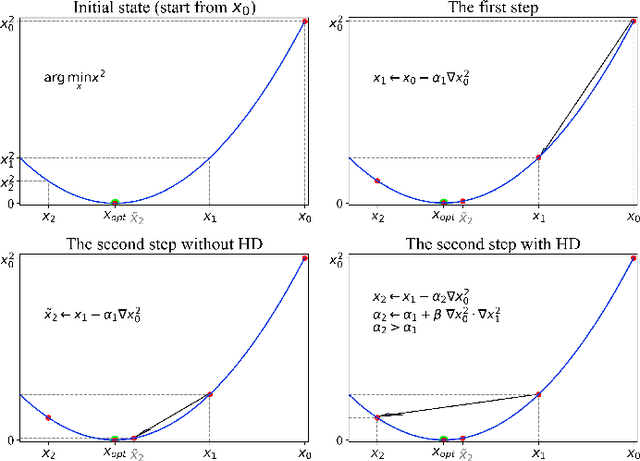
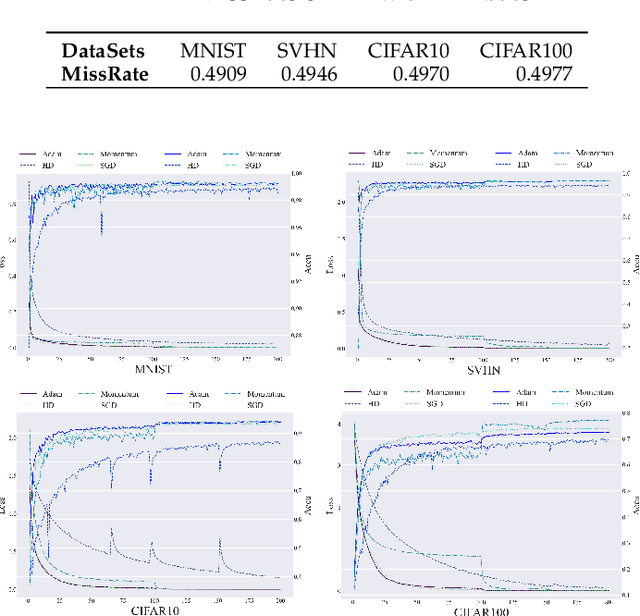
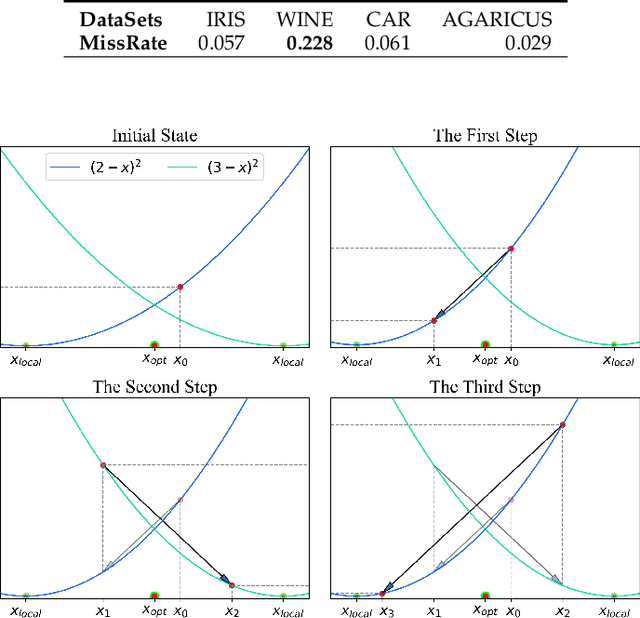
Learning rate adaptation is a popular topic in machine learning. Gradient Descent trains neural nerwork with a fixed learning rate. Learning rate adaptation is proposed to accelerate the training process through adjusting the step size in the training session. Famous works include Momentum, Adam and Hypergradient. Hypergradient is the most special one. Hypergradient achieved adaptation by calculating the derivative of learning rate with respect to cost function and utilizing gradient descent for learning rate. However, Hypergradient is still not perfect. In practice, Hypergradient fail to decrease training loss after learning rate adaptation with a large probability. Apart from that, evidence has been found that Hypergradient are not suitable for dealing with large datesets in the form of minibatch training. Most unfortunately, Hypergradient always fails to get a good accuracy on the validation dataset although it could reduce training loss to a very tiny value. To solve Hypergradient's problems, we propose a novel adaptation algorithm, where learning rate is parameter specific and internal structured. We conduct extensive experiments on multiple network models and datasets compared with various benchmark optimizers. It is shown that our algorithm can achieve faster and higher qualified convergence than those state-of-art optimizers.
FL-AGCNS: Federated Learning Framework for Automatic Graph Convolutional Network Search
Apr 09, 2021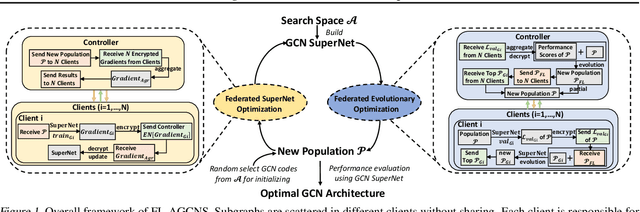
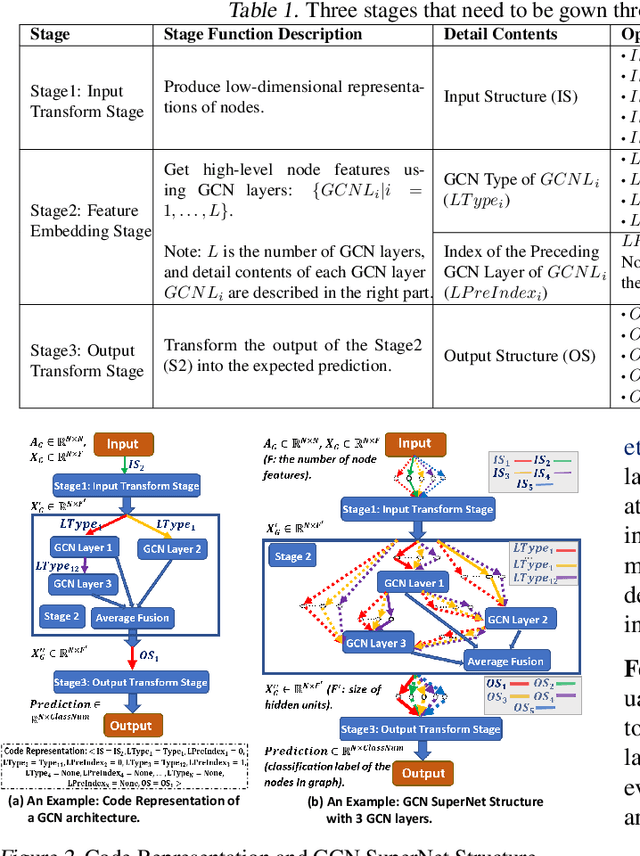
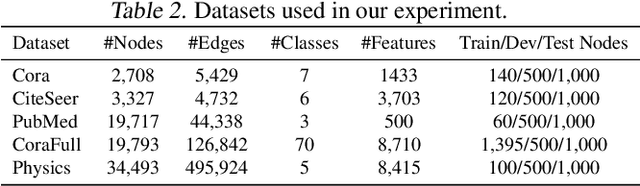
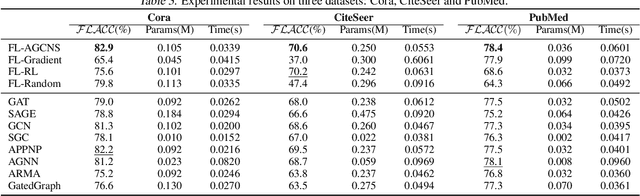
Recently, some Neural Architecture Search (NAS) techniques are proposed for the automatic design of Graph Convolutional Network (GCN) architectures. They bring great convenience to the use of GCN, but could hardly apply to the Federated Learning (FL) scenarios with distributed and private datasets, which limit their applications. Moreover, they need to train many candidate GCN models from scratch, which is inefficient for FL. To address these challenges, we propose FL-AGCNS, an efficient GCN NAS algorithm suitable for FL scenarios. FL-AGCNS designs a federated evolutionary optimization strategy to enable distributed agents to cooperatively design powerful GCN models while keeping personal information on local devices. Besides, it applies the GCN SuperNet and a weight sharing strategy to speed up the evaluation of GCN models. Experimental results show that FL-AGCNS can find better GCN models in short time under the FL framework, surpassing the state-of-the-arts NAS methods and GCN models.
Auto-STGCN: Autonomous Spatial-Temporal Graph Convolutional Network Search Based on Reinforcement Learning and Existing Research Results
Oct 15, 2020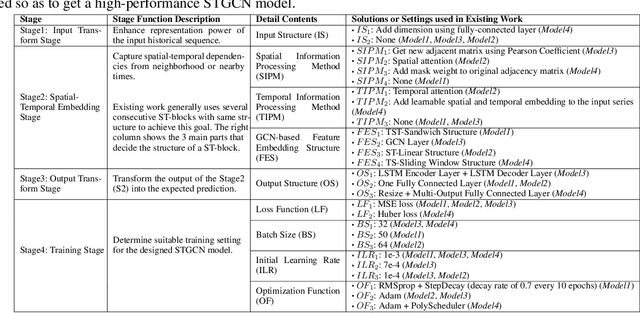
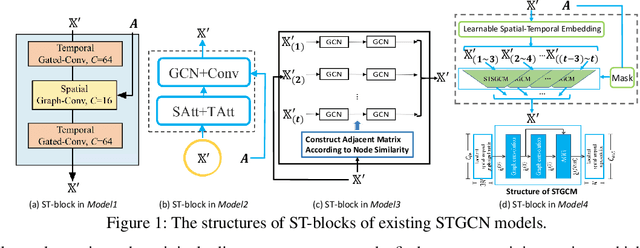
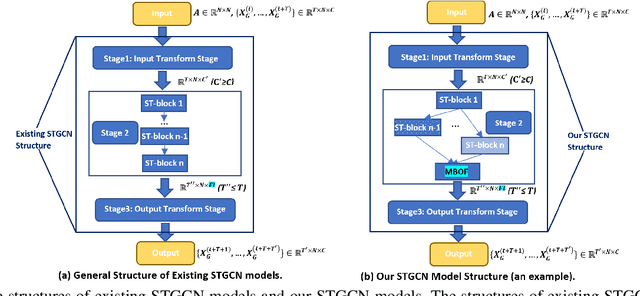
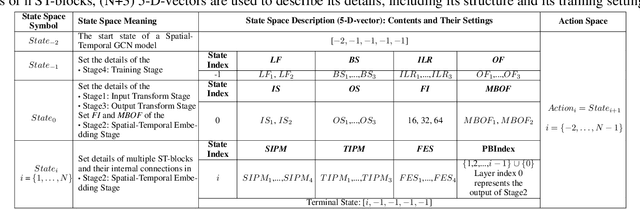
In recent years, many spatial-temporal graph convolutional network (STGCN) models are proposed to deal with the spatial-temporal network data forecasting problem. These STGCN models have their own advantages, i.e., each of them puts forward many effective operations and achieves good prediction results in the real applications. If users can effectively utilize and combine these excellent operations integrating the advantages of existing models, then they may obtain more effective STGCN models thus create greater value using existing work. However, they fail to do so due to the lack of domain knowledge, and there is lack of automated system to help users to achieve this goal. In this paper, we fill this gap and propose Auto-STGCN algorithm, which makes use of existing models to automatically explore high-performance STGCN model for specific scenarios. Specifically, we design Unified-STGCN framework, which summarizes the operations of existing architectures, and use parameters to control the usage and characteristic attributes of each operation, so as to realize the parameterized representation of the STGCN architecture and the reorganization and fusion of advantages. Then, we present Auto-STGCN, an optimization method based on reinforcement learning, to quickly search the parameter search space provided by Unified-STGCN, and generate optimal STGCN models automatically. Extensive experiments on real-world benchmark datasets show that our Auto-STGCN can find STGCN models superior to existing STGCN models with heuristic parameters, which demonstrates the effectiveness of our proposed method.
EM-RBR: a reinforced framework for knowledge graph completion from reasoning perspective
Oct 11, 2020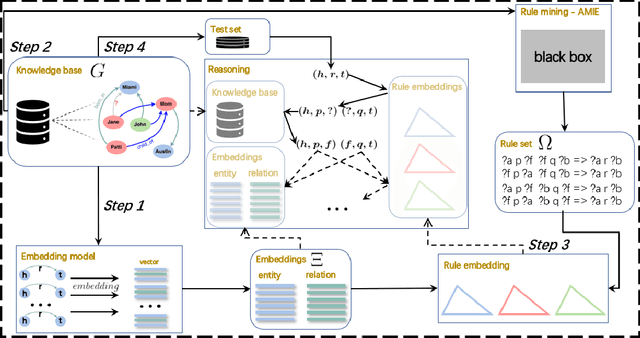
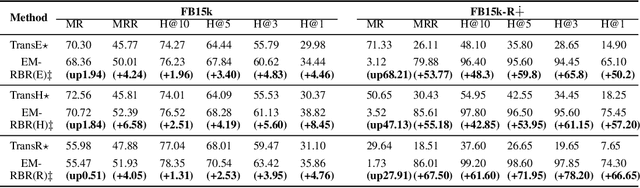
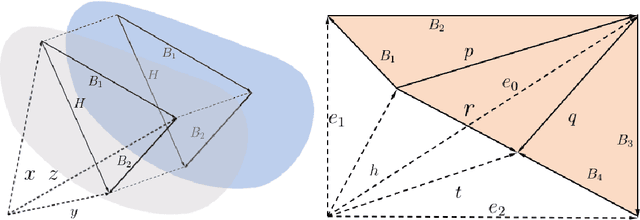
Knowledge graph completion aims to predict the new links in given entities among the knowledge graph (KG). Most mainstream embedding methods focus on fact triplets contained in the given KG, however, ignoring the rich background information provided by logic rules driven from knowledge base implicitly. To solve this problem, in this paper, we propose a general framework, named EM-RBR(embedding and rule-based reasoning), capable of combining the advantages of reasoning based on rules and the state-of-the-art models of embedding. EM-RBR aims to utilize relational background knowledge contained in rules to conduct multi-relation reasoning link prediction rather than superficial vector triangle linkage in embedding models. By this way, we can explore relation between two entities in deeper context to achieve higher accuracy. In experiments, we demonstrate that EM-RBR achieves better performance compared with previous models on FB15k, WN18 and our new dataset FB15k-R, especially the new dataset where our model perform futher better than those state-of-the-arts. We make the implementation of EM-RBR available at https://github.com/1173710224/link-prediction-with-rule-based-reasoning.