 Add to Chrome
 Add to Firefox
 Add to Edge
Multimodal Priors-Augmented Text-Driven 3D Human-Object Interaction Generation
Feb 11, 2026
We address the challenging task of text-driven 3D human-object interaction (HOI) motion generation. Existing methods primarily rely on a direct text-to-HOI mapping, which suffers from three key limitations due to the significant cross-modality gap: (Q1) sub-optimal human motion, (Q2) unnatural object motion, and (Q3) weak interaction between humans and objects. To address these challenges, we propose MP-HOI, a novel framework grounded in four core insights: (1) Multimodal Data Priors: We leverage multimodal data (text, image, pose/object) from large multimodal models as priors to guide HOI generation, which tackles Q1 and Q2 in data modeling. (2) Enhanced Object Representation: We improve existing object representations by incorporating geometric keypoints, contact features, and dynamic properties, enabling expressive object representations, which tackles Q2 in data representation. (3) Multimodal-Aware Mixture-of-Experts (MoE) Model: We propose a modality-aware MoE model for effective multimodal feature fusion paradigm, which tackles Q1 and Q2 in feature fusion. (4) Cascaded Diffusion with Interaction Supervision: We design a cascaded diffusion framework that progressively refines human-object interaction features under dedicated supervision, which tackles Q3 in interaction refinement. Comprehensive experiments demonstrate that MP-HOI outperforms existing approaches in generating high-fidelity and fine-grained HOI motions.

Dynamic Worlds, Dynamic Humans: Generating Virtual Human-Scene Interaction Motion in Dynamic Scenes
Jan 27, 2026Scenes are continuously undergoing dynamic changes in the real world. However, existing human-scene interaction generation methods typically treat the scene as static, which deviates from reality. Inspired by world models, we introduce Dyn-HSI, the first cognitive architecture for dynamic human-scene interaction, which endows virtual humans with three humanoid components. (1)Vision (human eyes): we equip the virtual human with a Dynamic Scene-Aware Navigation, which continuously perceives changes in the surrounding environment and adaptively predicts the next waypoint. (2)Memory (human brain): we equip the virtual human with a Hierarchical Experience Memory, which stores and updates experiential data accumulated during training. This allows the model to leverage prior knowledge during inference for context-aware motion priming, thereby enhancing both motion quality and generalization. (3) Control (human body): we equip the virtual human with Human-Scene Interaction Diffusion Model, which generates high-fidelity interaction motions conditioned on multimodal inputs. To evaluate performance in dynamic scenes, we extend the existing static human-scene interaction datasets to construct a dynamic benchmark, Dyn-Scenes. We conduct extensive qualitative and quantitative experiments to validate Dyn-HSI, showing that our method consistently outperforms existing approaches and generates high-quality human-scene interaction motions in both static and dynamic settings.
Vidarc: Embodied Video Diffusion Model for Closed-loop Control
Dec 19, 2025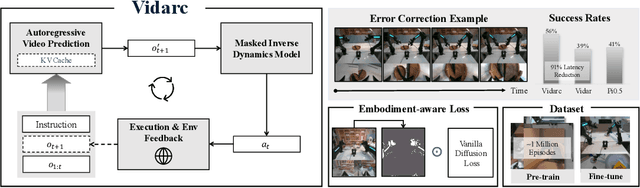
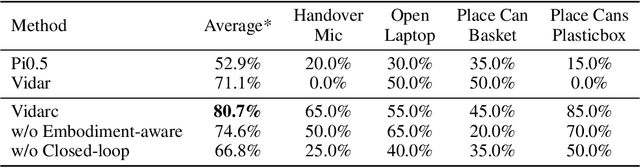
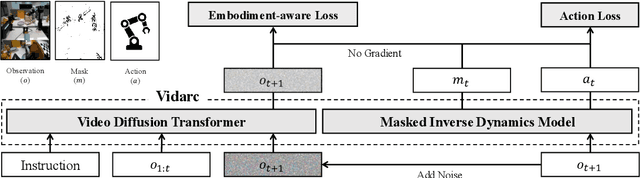
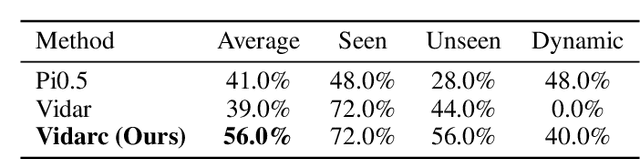
Robotic arm manipulation in data-scarce settings is a highly challenging task due to the complex embodiment dynamics and diverse contexts. Recent video-based approaches have shown great promise in capturing and transferring the temporal and physical interactions by pre-training on Internet-scale video data. However, such methods are often not optimized for the embodiment-specific closed-loop control, typically suffering from high latency and insufficient grounding. In this paper, we present Vidarc (Video Diffusion for Action Reasoning and Closed-loop Control), a novel autoregressive embodied video diffusion approach augmented by a masked inverse dynamics model. By grounding video predictions with action-relevant masks and incorporating real-time feedback through cached autoregressive generation, Vidarc achieves fast, accurate closed-loop control. Pre-trained on one million cross-embodiment episodes, Vidarc surpasses state-of-the-art baselines, achieving at least a 15% higher success rate in real-world deployment and a 91% reduction in latency. We also highlight its robust generalization and error correction capabilities across previously unseen robotic platforms.
Motus: A Unified Latent Action World Model
Dec 15, 2025While a general embodied agent must function as a unified system, current methods are built on isolated models for understanding, world modeling, and control. This fragmentation prevents unifying multimodal generative capabilities and hinders learning from large-scale, heterogeneous data. In this paper, we propose Motus, a unified latent action world model that leverages existing general pretrained models and rich, sharable motion information. Motus introduces a Mixture-of-Transformer (MoT) architecture to integrate three experts (i.e., understanding, video generation, and action) and adopts a UniDiffuser-style scheduler to enable flexible switching between different modeling modes (i.e., world models, vision-language-action models, inverse dynamics models, video generation models, and video-action joint prediction models). Motus further leverages the optical flow to learn latent actions and adopts a recipe with three-phase training pipeline and six-layer data pyramid, thereby extracting pixel-level "delta action" and enabling large-scale action pretraining. Experiments show that Motus achieves superior performance against state-of-the-art methods in both simulation (a +15% improvement over X-VLA and a +45% improvement over Pi0.5) and real-world scenarios(improved by +11~48%), demonstrating unified modeling of all functionalities and priors significantly benefits downstream robotic tasks.
ClinicalLab: Aligning Agents for Multi-Departmental Clinical Diagnostics in the Real World
Jun 19, 2024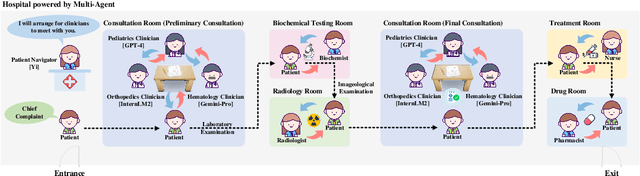

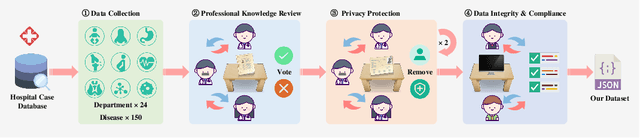
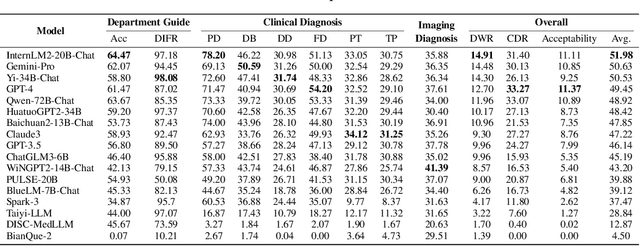
LLMs have achieved significant performance progress in various NLP applications. However, LLMs still struggle to meet the strict requirements for accuracy and reliability in the medical field and face many challenges in clinical applications. Existing clinical diagnostic evaluation benchmarks for evaluating medical agents powered by LLMs have severe limitations. Firstly, most existing medical evaluation benchmarks face the risk of data leakage or contamination. Secondly, existing benchmarks often neglect the characteristics of multiple departments and specializations in modern medical practice. Thirdly, existing evaluation methods are limited to multiple-choice questions, which do not align with the real-world diagnostic scenarios. Lastly, existing evaluation methods lack comprehensive evaluations of end-to-end real clinical scenarios. These limitations in benchmarks in turn obstruct advancements of LLMs and agents for medicine. To address these limitations, we introduce ClinicalLab, a comprehensive clinical diagnosis agent alignment suite. ClinicalLab includes ClinicalBench, an end-to-end multi-departmental clinical diagnostic evaluation benchmark for evaluating medical agents and LLMs. ClinicalBench is based on real cases that cover 24 departments and 150 diseases. ClinicalLab also includes four novel metrics (ClinicalMetrics) for evaluating the effectiveness of LLMs in clinical diagnostic tasks. We evaluate 17 LLMs and find that their performance varies significantly across different departments. Based on these findings, in ClinicalLab, we propose ClinicalAgent, an end-to-end clinical agent that aligns with real-world clinical diagnostic practices. We systematically investigate the performance and applicable scenarios of variants of ClinicalAgent on ClinicalBench. Our findings demonstrate the importance of aligning with modern medical practices in designing medical agents.
CodeScope: An Execution-based Multilingual Multitask Multidimensional Benchmark for Evaluating LLMs on Code Understanding and Generation
Nov 14, 2023


Large Language Models (LLMs) have demonstrated remarkable performance on coding related tasks, particularly on assisting humans in programming and facilitating programming automation. However, existing benchmarks for evaluating the code understanding and generation capacities of LLMs suffer from severe limitations. First, most benchmarks are deficient as they focus on a narrow range of popular programming languages and specific tasks, whereas the real-world software development scenarios show dire need to implement systems with multilingual programming environments to satisfy diverse requirements. Practical programming practices also strongly expect multi-task settings for testing coding capabilities of LLMs comprehensively and robustly. Second, most benchmarks also fail to consider the actual executability and the consistency of execution results of the generated code. To bridge these gaps between existing benchmarks and expectations from practical applications, we introduce CodeScope, an execution-based, multilingual, multi-task, multi-dimensional evaluation benchmark for comprehensively gauging LLM capabilities on coding tasks. CodeScope covers 43 programming languages and 8 coding tasks. It evaluates the coding performance of LLMs from three dimensions (perspectives): difficulty, efficiency, and length. To facilitate execution-based evaluations of code generation, we develop MultiCodeEngine, an automated code execution engine that supports 14 programming languages. Finally, we systematically evaluate and analyze 8 mainstream LLMs on CodeScope tasks and demonstrate the superior breadth and challenges of CodeScope for evaluating LLMs on code understanding and generation tasks compared to other benchmarks. The CodeScope benchmark and datasets are publicly available at https://github.com/WeixiangYAN/CodeScope.