 Add to Chrome
 Add to Firefox
 Add to Edge
ProSAC-CT: Progressive Spectral-Anatomical Co-Guided Multi-Stage Diffusion Model for Low-Dose CT Denoising
Jul 02, 2026
Low-dose computed tomography (LDCT) reduces radiation exposure but introduces stronger quantum noise, streak artifacts, and local texture degradation, which can obscure anatomical boundaries and weaken low-contrast structures. Diffusion models are promising for LDCT denoising by progressively recovering normal-dose CT (NDCT) images from degraded LDCT inputs, but existing methods often suffer from insufficient anatomical guidance, uncertain frequency-dependent recovery, and uniform reverse-process modeling. We propose ProSAC-CT, a progressive spectral-anatomical co-guided multi-stage diffusion model for image-domain LDCT denoising. ProSAC-CT integrates an anatomical-prior-guided conditioning (APGC) module, a residual frequency-domain decoupling stage (RFDDS), and a time-step-decoupling denoising decoder (TD3). APGC extracts LDCT-derived structural guidance, RFDDS enhances frequency-aware representations, and TD3 assigns them to different reverse-diffusion stages for anatomical stabilization, boundary refinement, and fine-detail recovery. Experiments on four LDCT degradation benchmarks show that ProSAC-CT improves image fidelity, structural similarity, perceptual quality, and information preservation over representative methods while better preserving boundary-sensitive anatomical details. Downstream anatomical-region classification on Mayo-2020 further indicates that ProSAC-CT retains task-relevant anatomical information, supporting its practical use for low-dose CT denoising.

AnF-DiffPET: Anatomy- and Frequency-Guided Diffusion for PET/CT Denoising
Jul 01, 2026Positron emission tomography (PET) provides essential functional information for disease assessment, however reducing injected activity or acquisition time produces low-dose (LD) PET with stronger count dependent noise and less reliable uptake quantification. Diffusion models offer a promising solution for PET denoising by progressively recovering high-dose (HD) PET images from LD inputs. However, LD-to-HD PET denoising is still challenging due to insufficient anatomical guidance, unstable multi-scale feature propagation, and uncertain frequency domain uptake recovery. We propose AnF-DiffPET, an anatomy- and frequency-guided diffusion framework for computed tomography (CT) conditioned LD PET denoising. The framework integrates Anatomical-Frequency Guidance (AFG), Multi-Scale Cross-Transformer Reconstruction (MSCTR), and Frequency-Contrastive Hard Mining (FCHM) to enhance anatomy aware feature modulation and frequency domain consistency during denoising. Experimental results across four PET/CT datasets show that the proposed method improves image fidelity, anatomical consistency, and quantitative fidelity over representative CNN-based, GAN-based, transformer-based, and diffusion-based methods. The code and trained models will be publicly released upon acceptance.
ShopSimulator: Evaluating and Exploring RL-Driven LLM Agent for Shopping Assistants
Jan 26, 2026Large language model (LLM)-based agents are increasingly deployed in e-commerce shopping. To perform thorough, user-tailored product searches, agents should interpret personal preferences, engage in multi-turn dialogues, and ultimately retrieve and discriminate among highly similar products. However, existing research has yet to provide a unified simulation environment that consistently captures all of these aspects, and always focuses solely on evaluation benchmarks without training support. In this paper, we introduce ShopSimulator, a large-scale and challenging Chinese shopping environment. Leveraging ShopSimulator, we evaluate LLMs across diverse scenarios, finding that even the best-performing models achieve less than 40% full-success rate. Error analysis reveals that agents struggle with deep search and product selection in long trajectories, fail to balance the use of personalization cues, and to effectively engage with users. Further training exploration provides practical guidance for overcoming these weaknesses, with the combination of supervised fine-tuning (SFT) and reinforcement learning (RL) yielding significant performance improvements. Code and data will be released at https://github.com/ShopAgent-Team/ShopSimulator.
HaDM-ST: Histology-Assisted Differential Modeling for Spatial Transcriptomics Generation
Aug 10, 2025Spatial transcriptomics (ST) reveals spatial heterogeneity of gene expression, yet its resolution is limited by current platforms. Recent methods enhance resolution via H&E-stained histology, but three major challenges persist: (1) isolating expression-relevant features from visually complex H&E images; (2) achieving spatially precise multimodal alignment in diffusion-based frameworks; and (3) modeling gene-specific variation across expression channels. We propose HaDM-ST (Histology-assisted Differential Modeling for ST Generation), a high-resolution ST generation framework conditioned on H&E images and low-resolution ST. HaDM-ST includes: (i) a semantic distillation network to extract predictive cues from H&E; (ii) a spatial alignment module enforcing pixel-wise correspondence with low-resolution ST; and (iii) a channel-aware adversarial learner for fine-grained gene-level modeling. Experiments on 200 genes across diverse tissues and species show HaDM-ST consistently outperforms prior methods, enhancing spatial fidelity and gene-level coherence in high-resolution ST predictions.
Chinese SimpleQA: A Chinese Factuality Evaluation for Large Language Models
Nov 13, 2024


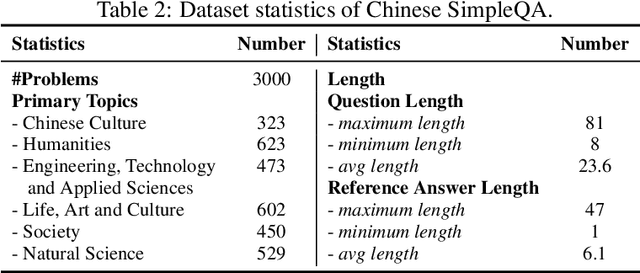
New LLM evaluation benchmarks are important to align with the rapid development of Large Language Models (LLMs). In this work, we present Chinese SimpleQA, the first comprehensive Chinese benchmark to evaluate the factuality ability of language models to answer short questions, and Chinese SimpleQA mainly has five properties (i.e., Chinese, Diverse, High-quality, Static, Easy-to-evaluate). Specifically, first, we focus on the Chinese language over 6 major topics with 99 diverse subtopics. Second, we conduct a comprehensive quality control process to achieve high-quality questions and answers, where the reference answers are static and cannot be changed over time. Third, following SimpleQA, the questions and answers are very short, and the grading process is easy-to-evaluate based on OpenAI API. Based on Chinese SimpleQA, we perform a comprehensive evaluation on the factuality abilities of existing LLMs. Finally, we hope that Chinese SimpleQA could guide the developers to better understand the Chinese factuality abilities of their models and facilitate the growth of foundation models.