 Add to Chrome
 Add to Firefox
 Add to Edge
EFIM: Efficient Serving of LLMs for Infilling Tasks with Improved KV Cache Reuse
May 29, 2025
Large language models (LLMs) are often used for infilling tasks, which involve predicting or generating missing information in a given text. These tasks typically require multiple interactions with similar context. To reduce the computation of repeated historical tokens, cross-request key-value (KV) cache reuse, a technique that stores and reuses intermediate computations, has become a crucial method in multi-round interactive services. However, in infilling tasks, the KV cache reuse is often hindered by the structure of the prompt format, which typically consists of a prefix and suffix relative to the insertion point. Specifically, the KV cache of the prefix or suffix part is frequently invalidated as the other part (suffix or prefix) is incrementally generated. To address the issue, we propose EFIM, a transformed prompt format of FIM to unleash the performance potential of KV cache reuse. Although the transformed prompt can solve the inefficiency, it exposes subtoken generation problems in current LLMs, where they have difficulty generating partial words accurately. Therefore, we introduce a fragment tokenization training method which splits text into multiple fragments before tokenization during data processing. Experiments on two representative LLMs show that LLM serving with EFIM can lower the latency by 52% and improve the throughput by 98% while maintaining the original infilling capability. EFIM's source code is publicly available at https://github.com/gty111/EFIM.

OmniEarth-Bench: Towards Holistic Evaluation of Earth's Six Spheres and Cross-Spheres Interactions with Multimodal Observational Earth Data
May 29, 2025Existing benchmarks for Earth science multimodal learning exhibit critical limitations in systematic coverage of geosystem components and cross-sphere interactions, often constrained to isolated subsystems (only in Human-activities sphere or atmosphere) with limited evaluation dimensions (less than 16 tasks). To address these gaps, we introduce OmniEarth-Bench, the first comprehensive multimodal benchmark spanning all six Earth science spheres (atmosphere, lithosphere, Oceansphere, cryosphere, biosphere and Human-activities sphere) and cross-spheres with one hundred expert-curated evaluation dimensions. Leveraging observational data from satellite sensors and in-situ measurements, OmniEarth-Bench integrates 29,779 annotations across four tiers: perception, general reasoning, scientific knowledge reasoning and chain-of-thought (CoT) reasoning. This involves the efforts of 2-5 experts per sphere to establish authoritative evaluation dimensions and curate relevant observational datasets, 40 crowd-sourcing annotators to assist experts for annotations, and finally, OmniEarth-Bench is validated via hybrid expert-crowd workflows to reduce label ambiguity. Experiments on 9 state-of-the-art MLLMs reveal that even the most advanced models struggle with our benchmarks, where none of them reach 35\% accuracy. Especially, in some cross-spheres tasks, the performance of leading models like GPT-4o drops to 0.0\%. OmniEarth-Bench sets a new standard for geosystem-aware AI, advancing both scientific discovery and practical applications in environmental monitoring and disaster prediction. The dataset, source code, and trained models were released.
Bridging the Gap: Self-Optimized Fine-Tuning for LLM-based Recommender Systems
May 27, 2025Recent years have witnessed extensive exploration of Large Language Models (LLMs) on the field of Recommender Systems (RS). There are currently two commonly used strategies to enable LLMs to have recommendation capabilities: 1) The "Guidance-Only" strategy uses in-context learning to exploit and amplify the inherent semantic understanding and item recommendation capabilities of LLMs; 2) The "Tuning-Only" strategy uses supervised fine-tuning (SFT) to fine-tune LLMs with the aim of fitting them to real recommendation data. However, neither of these strategies can effectively bridge the gap between the knowledge space of LLMs and recommendation, and their performance do not meet our expectations. To better enable LLMs to learn recommendation knowledge, we combine the advantages of the above two strategies and proposed a novel "Guidance+Tuning" method called Self-Optimized Fine-Tuning (SOFT), which adopts the idea of curriculum learning. It first employs self-distillation to construct an auxiliary easy-to-learn but meaningful dataset from a fine-tuned LLM. Then it further utilizes a self-adaptive curriculum scheduler to enable LLMs to gradually learn from simpler data (self-distilled data) to more challenging data (real RS data). Extensive experiments demonstrate that SOFT significantly enhances the recommendation accuracy (37.59\% on average) of LLM-based methods. The code is available via https://anonymous.4open.science/r/Self-Optimized-Fine-Tuning-264E
No Black Boxes: Interpretable and Interactable Predictive Healthcare with Knowledge-Enhanced Agentic Causal Discovery
May 22, 2025Deep learning models trained on extensive Electronic Health Records (EHR) data have achieved high accuracy in diagnosis prediction, offering the potential to assist clinicians in decision-making and treatment planning. However, these models lack two crucial features that clinicians highly value: interpretability and interactivity. The ``black-box'' nature of these models makes it difficult for clinicians to understand the reasoning behind predictions, limiting their ability to make informed decisions. Additionally, the absence of interactive mechanisms prevents clinicians from incorporating their own knowledge and experience into the decision-making process. To address these limitations, we propose II-KEA, a knowledge-enhanced agent-driven causal discovery framework that integrates personalized knowledge databases and agentic LLMs. II-KEA enhances interpretability through explicit reasoning and causal analysis, while also improving interactivity by allowing clinicians to inject their knowledge and experience through customized knowledge bases and prompts. II-KEA is evaluated on both MIMIC-III and MIMIC-IV, demonstrating superior performance along with enhanced interpretability and interactivity, as evidenced by its strong results from extensive case studies.
Flow Matching based Sequential Recommender Model
May 22, 2025Generative models, particularly diffusion model, have emerged as powerful tools for sequential recommendation. However, accurately modeling user preferences remains challenging due to the noise perturbations inherent in the forward and reverse processes of diffusion-based methods. Towards this end, this study introduces FMRec, a Flow Matching based model that employs a straight flow trajectory and a modified loss tailored for the recommendation task. Additionally, from the diffusion-model perspective, we integrate a reconstruction loss to improve robustness against noise perturbations, thereby retaining user preferences during the forward process. In the reverse process, we employ a deterministic reverse sampler, specifically an ODE-based updating function, to eliminate unnecessary randomness, thereby ensuring that the generated recommendations closely align with user needs. Extensive evaluations on four benchmark datasets reveal that FMRec achieves an average improvement of 6.53% over state-of-the-art methods. The replication code is available at https://github.com/FengLiu-1/FMRec.
Temporal and Spatial Feature Fusion Framework for Dynamic Micro Expression Recognition
May 22, 2025When emotions are repressed, an individual's true feelings may be revealed through micro-expressions. Consequently, micro-expressions are regarded as a genuine source of insight into an individual's authentic emotions. However, the transient and highly localised nature of micro-expressions poses a significant challenge to their accurate recognition, with the accuracy rate of micro-expression recognition being as low as 50%, even for professionals. In order to address these challenges, it is necessary to explore the field of dynamic micro expression recognition (DMER) using multimodal fusion techniques, with special attention to the diverse fusion of temporal and spatial modal features. In this paper, we propose a novel Temporal and Spatial feature Fusion framework for DMER (TSFmicro). This framework integrates a Retention Network (RetNet) and a transformer-based DMER network, with the objective of efficient micro-expression recognition through the capture and fusion of temporal and spatial relations. Meanwhile, we propose a novel parallel time-space fusion method from the perspective of modal fusion, which fuses spatio-temporal information in high-dimensional feature space, resulting in complementary "where-how" relationships at the semantic level and providing richer semantic information for the model. The experimental results demonstrate the superior performance of the TSFmicro method in comparison to other contemporary state-of-the-art methods. This is evidenced by its effectiveness on three well-recognised micro-expression datasets.
Field Matters: A lightweight LLM-enhanced Method for CTR Prediction
May 20, 2025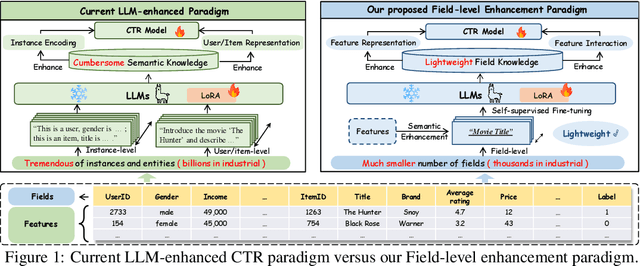
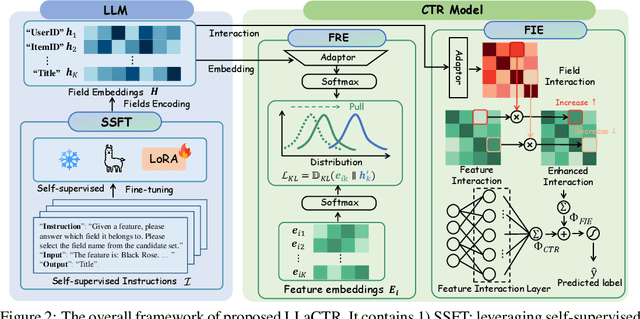
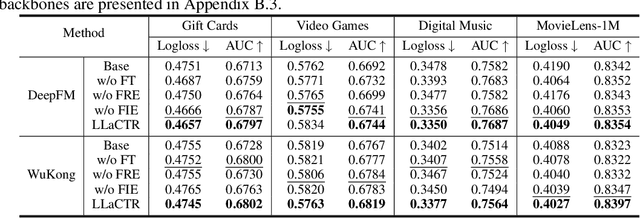
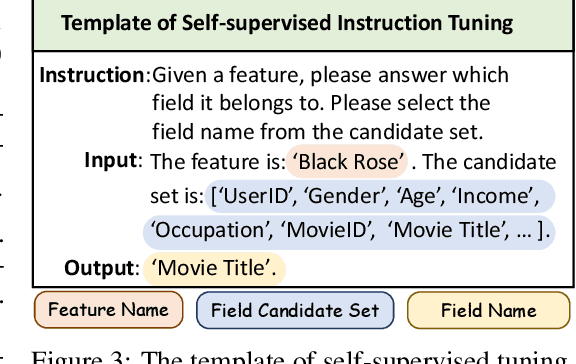
Click-through rate (CTR) prediction is a fundamental task in modern recommender systems. In recent years, the integration of large language models (LLMs) has been shown to effectively enhance the performance of traditional CTR methods. However, existing LLM-enhanced methods often require extensive processing of detailed textual descriptions for large-scale instances or user/item entities, leading to substantial computational overhead. To address this challenge, this work introduces LLaCTR, a novel and lightweight LLM-enhanced CTR method that employs a field-level enhancement paradigm. Specifically, LLaCTR first utilizes LLMs to distill crucial and lightweight semantic knowledge from small-scale feature fields through self-supervised field-feature fine-tuning. Subsequently, it leverages this field-level semantic knowledge to enhance both feature representation and feature interactions. In our experiments, we integrate LLaCTR with six representative CTR models across four datasets, demonstrating its superior performance in terms of both effectiveness and efficiency compared to existing LLM-enhanced methods. Our code is available at https://anonymous.4open.science/r/LLaCTR-EC46.
Structure-Aware Corpus Construction and User-Perception-Aligned Metrics for Large-Language-Model Code Completion
May 19, 2025Code completion technology based on large language model has significantly improved the development efficiency of programmers. However, in practical applications, there remains a gap between current commonly used code completion evaluation metrics and users' actual perception. To address this issue, we propose two evaluation metrics for code completion tasks--LCP and ROUGE-LCP, from the perspective of probabilistic modeling. Furthermore, to tackle the lack of effective structural semantic modeling and cross-module dependency information in LLMs for repository-level code completion scenarios, we propose a data processing method based on a Structure-Preserving and Semantically-Reordered Code Graph (SPSR-Graph). Through theoretical analysis and experimental validation, we demonstrate the superiority of the proposed evaluation metrics in terms of user perception consistency, as well as the effectiveness of the data processing method in enhancing model performance.
Temporal-Spectral-Spatial Unified Remote Sensing Dense Prediction
May 18, 2025The proliferation of diverse remote sensing data has spurred advancements in dense prediction tasks, yet significant challenges remain in handling data heterogeneity. Remote sensing imagery exhibits substantial variability across temporal, spectral, and spatial (TSS) dimensions, complicating unified data processing. Current deep learning models for dense prediction tasks, such as semantic segmentation and change detection, are typically tailored to specific input-output configurations. Consequently, variations in data dimensionality or task requirements often lead to significant performance degradation or model incompatibility, necessitating costly retraining or fine-tuning efforts for different application scenarios. This paper introduces the Temporal-Spectral-Spatial Unified Network (TSSUN), a novel architecture designed for unified representation and modeling of remote sensing data across diverse TSS characteristics and task types. TSSUN employs a Temporal-Spectral-Spatial Unified Strategy that leverages meta-information to decouple and standardize input representations from varied temporal, spectral, and spatial configurations, and similarly unifies output structures for different dense prediction tasks and class numbers. Furthermore, a Local-Global Window Attention mechanism is proposed to efficiently capture both local contextual details and global dependencies, enhancing the model's adaptability and feature extraction capabilities. Extensive experiments on multiple datasets demonstrate that a single TSSUN model effectively adapts to heterogeneous inputs and unifies various dense prediction tasks. The proposed approach consistently achieves or surpasses state-of-the-art performance, highlighting its robustness and generalizability for complex remote sensing applications without requiring task-specific modifications.
Highly Undersampled MRI Reconstruction via a Single Posterior Sampling of Diffusion Models
May 13, 2025Incoherent k-space under-sampling and deep learning-based reconstruction methods have shown great success in accelerating MRI. However, the performance of most previous methods will degrade dramatically under high acceleration factors, e.g., 8$\times$ or higher. Recently, denoising diffusion models (DM) have demonstrated promising results in solving this issue; however, one major drawback of the DM methods is the long inference time due to a dramatic number of iterative reverse posterior sampling steps. In this work, a Single Step Diffusion Model-based reconstruction framework, namely SSDM-MRI, is proposed for restoring MRI images from highly undersampled k-space. The proposed method achieves one-step reconstruction by first training a conditional DM and then iteratively distilling this model. Comprehensive experiments were conducted on both publicly available fastMRI images and an in-house multi-echo GRE (QSM) subject. Overall, the results showed that SSDM-MRI outperformed other methods in terms of numerical metrics (PSNR and SSIM), qualitative error maps, image fine details, and latent susceptibility information hidden in MRI phase images. In addition, the reconstruction time for a 320*320 brain slice of SSDM-MRI is only 0.45 second, which is only comparable to that of a simple U-net, making it a highly effective solution for MRI reconstruction tasks.