 Add to Chrome
 Add to Firefox
 Add to Edge
AutoSupervision: Closing the Feedback Loop in Scientific Workflows with Grounded Revision Verification
Jul 30, 2026
Recent advances in large language models (LLMs) have enabled AI systems to assist scientific research and peer review. However, an essential capability for reliable AI-assisted scientific workflows remains underexplored: verifying whether reviewer feedback leads to meaningful and evidence-supported manuscript improvements. We introduce AutoSupervision, which evaluates whether scientific manuscript revisions genuinely address reviewer concerns through grounded evidence. AutoSupervision leverages transparent peer-review records as a natural source of supervision, where reviewer comments specify scientific concerns, author responses describe claimed resolutions, and revised manuscripts provide evidence of changes. Given reviewer comments, author responses, and revised manuscripts, models must characterize reviewer concerns, determine whether concerns have been addressed, and identify supporting manuscript evidence. We construct AutoSupervision from 56,000 Nature Communications articles and corresponding review records. Then we conducted experiments on LLMs, the ablation study, and the case study. Our results show that while LLMs perform well in characterizing reviewer concerns, with GPT-5.5 achieving a score of 0.754, evidence-based verification remains the primary bottleneck, with the best-performing model reaching only 0.501.

Agents-K1: Towards Agent-native Knowledge Orchestration
Jun 11, 2026Current LLM-based research agents have advanced through agent orchestration, yet largely overlook scientific knowledge orchestration. Existing works often reduce papers to abstracts, surface mentions, and flat \texttt{cites} edges, omitting key entities, claims, evidence, mechanisms, and method lineages essential for scientific reasoning. To this end, we introduce \textbf{Agents-K1}, an end-to-end knowledge orchestration pipeline that converts raw documents into agent-native scientific knowledge graphs. Agents-K1 integrates three components under a unifying theoretical foundation: a multimodal parser whose five-module schema captures entities, multimodal evidence, citations, and typed inter-entity relations across the full paper rather than abstracts alone; a 4B information-extraction backbone trained with GRPO under a rule-based reward; and a graphanything CLI, a tri-source agent interface that unifies web search, multimodal graph retrieval, and cross-document traversal. On top of this, we process 2.46 million scientific papers across six subjects to produce \textbf{Scholar-KG}, of which we release a one-million-paper subset, and the full Scholar-KG is accessible via the SCP link below. The same pipeline can be extended to general-domain corpora and to schema-conformant data synthesis. Extensive experiments demonstrate that Agents-K1 achieves superior performance in scientific information extraction, knowledge graph construction, and multi-hop scientific reasoning.
TRACE: A Multi-Agent System for Autonomous Physical Reasoning in Seismological Science
Mar 22, 2026Inferring the physical mechanisms that govern earthquake sequences from indirect geophysical observations remains difficult, particularly across tectonically distinct environments where similar seismic patterns can reflect different underlying processes. Current interpretations rely heavily on the expert synthesis of catalogs, spatiotemporal statistics, and candidate physical models, limiting reproducibility and the systematic transfer of insight across settings. Here we present TRACE (Trans-perspective Reasoning and Automated Comprehensive Evaluator), a multi-agent system that combines large language model planning with formal seismological constraints to derive auditable, physically grounded mechanistic inference from raw observations. Applied to the 2019 Ridgecrest sequence, TRACE autonomously identifies stress-perturbation-induced delayed triggering, resolving the cascading interaction between the Mw 6.4 and Mw 7.1 mainshocks; in the Santorini-Kolumbo case, the system identifies a structurally guided intrusion model, distinguishing fault-channeled episodic migration from the continuous propagation expected in homogeneous crustal failure. By providing a generalizable logical infrastructure for interpreting heterogeneous seismic phenomena, TRACE advances the field from expert-dependent analysis toward knowledge-guided autonomous discovery in Earth sciences.
Structure-aware Prompt Adaptation from Seen to Unseen for Open-Vocabulary Compositional Zero-Shot Learning
Mar 04, 2026The goal of Open-Vocabulary Compositional Zero-Shot Learning (OV-CZSL) is to recognize attribute-object compositions in the open-vocabulary setting, where compositions of both seen and unseen attributes and objects are evaluated. Recently, prompt tuning methods have demonstrated strong generalization capabilities in the closed setting, where only compositions of seen attributes and objects are evaluated, i.e., Compositional Zero-Shot Learning (CZSL). However, directly applying these methods to OV-CZSL may not be sufficient to generalize to unseen attributes, objects and their compositions, as it is limited to seen attributes and objects. Normally, when faced with unseen concepts, humans adopt analogies with seen concepts that have the similar semantics thereby inferring their meaning (e.g., "wet" and "damp", "shirt" and "jacket"). In this paper, we experimentally show that the distribution of semantically related attributes or objects tends to form consistent local structures in the embedding space. Based on the above structures, we propose Structure-aware Prompt Adaptation (SPA) method, which enables models to generalize from seen to unseen attributes and objects. Specifically, in the training stage, we design a Structure-aware Consistency Loss (SCL) that encourages the local structure's consistency of seen attributes and objects in each iteration. In the inference stage, we devise a Structure-guided Adaptation Strategy (SAS) that adaptively aligns the structures of unseen attributes and objects with those of trained seen attributes and objects with similar semantics. Notably, SPA is a plug-and-play method that can be seamlessly integrated into existing CZSL prompt tuning methods. Extensive experiments on OV-CZSL benchmarks demonstrate that SPA achieves competitive closed-set performance while significantly improving open-vocabulary results.
InternAgent-1.5: A Unified Agentic Framework for Long-Horizon Autonomous Scientific Discovery
Feb 09, 2026We introduce InternAgent-1.5, a unified system designed for end-to-end scientific discovery across computational and empirical domains. The system is built on a structured architecture composed of three coordinated subsystems for generation, verification, and evolution. These subsystems are supported by foundational capabilities for deep research, solution optimization, and long horizon memory. The architecture allows InternAgent-1.5 to operate continuously across extended discovery cycles while maintaining coherent and improving behavior. It also enables the system to coordinate computational modeling and laboratory experimentation within a single unified system. We evaluate InternAgent-1.5 on scientific reasoning benchmarks such as GAIA, HLE, GPQA, and FrontierScience, and the system achieves leading performance that demonstrates strong foundational capabilities. Beyond these benchmarks, we further assess two categories of discovery tasks. In algorithm discovery tasks, InternAgent-1.5 autonomously designs competitive methods for core machine learning problems. In empirical discovery tasks, it executes complete computational or wet lab experiments and produces scientific findings in earth, life, biological, and physical domains. Overall, these results show that InternAgent-1.5 provides a general and scalable framework for autonomous scientific discovery.
DQEN: Dual Query Enhancement Network for DETR-based HOI Detection
Aug 26, 2025Human-Object Interaction (HOI) detection focuses on localizing human-object pairs and recognizing their interactions. Recently, the DETR-based framework has been widely adopted in HOI detection. In DETR-based HOI models, queries with clear meaning are crucial for accurately detecting HOIs. However, prior works have typically relied on randomly initialized queries, leading to vague representations that limit the model's effectiveness. Meanwhile, humans in the HOI categories are fixed, while objects and their interactions are variable. Therefore, we propose a Dual Query Enhancement Network (DQEN) to enhance object and interaction queries. Specifically, object queries are enhanced with object-aware encoder features, enabling the model to focus more effectively on humans interacting with objects in an object-aware way. On the other hand, we design a novel Interaction Semantic Fusion module to exploit the HOI candidates that are promoted by the CLIP model. Semantic features are extracted to enhance the initialization of interaction queries, thereby improving the model's ability to understand interactions. Furthermore, we introduce an Auxiliary Prediction Unit aimed at improving the representation of interaction features. Our proposed method achieves competitive performance on both the HICO-Det and the V-COCO datasets. The source code is available at https://github.com/lzzhhh1019/DQEN.
EarthLink: A Self-Evolving AI Agent for Climate Science
Jul 24, 2025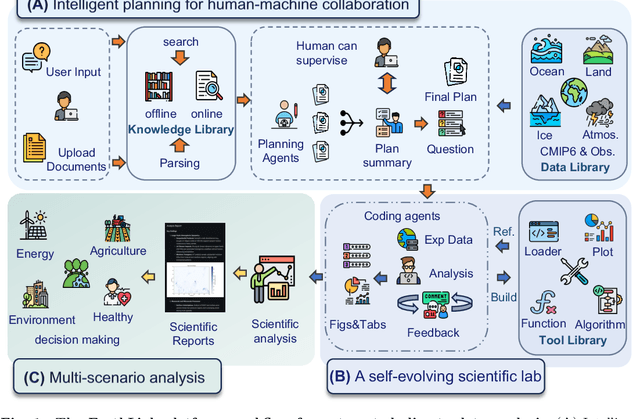
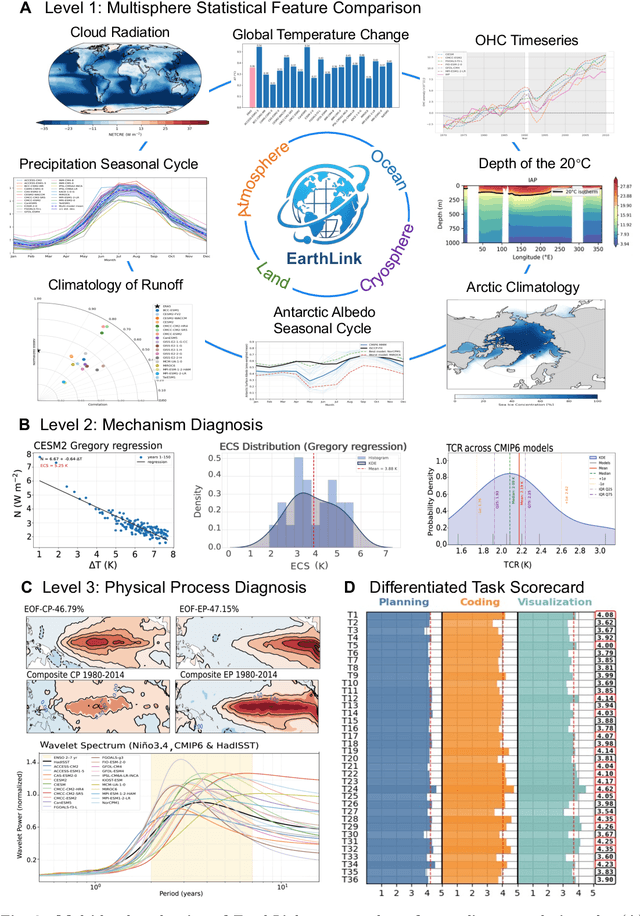
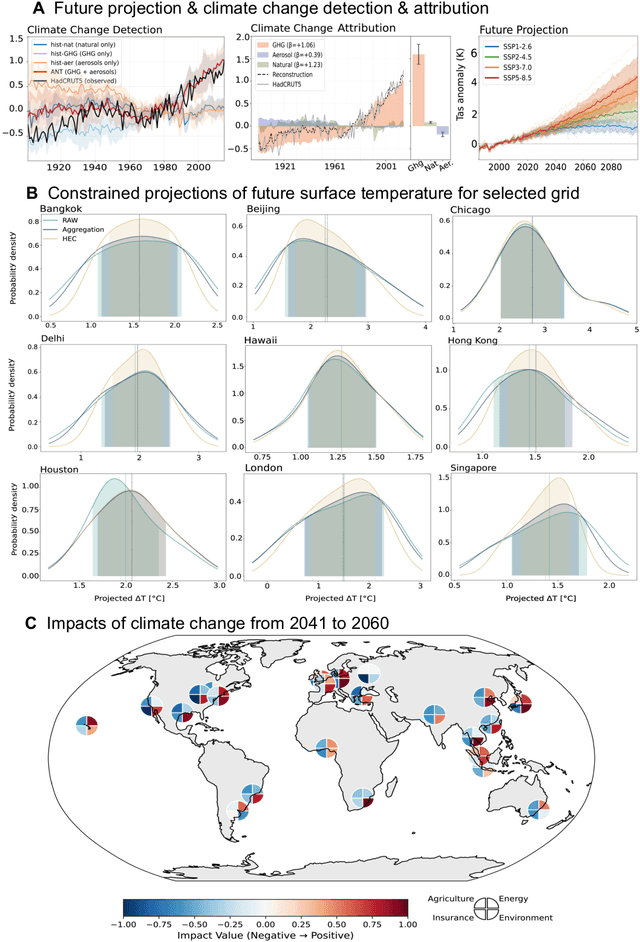
Modern Earth science is at an inflection point. The vast, fragmented, and complex nature of Earth system data, coupled with increasingly sophisticated analytical demands, creates a significant bottleneck for rapid scientific discovery. Here we introduce EarthLink, the first AI agent designed as an interactive copilot for Earth scientists. It automates the end-to-end research workflow, from planning and code generation to multi-scenario analysis. Unlike static diagnostic tools, EarthLink can learn from user interaction, continuously refining its capabilities through a dynamic feedback loop. We validated its performance on a number of core scientific tasks of climate change, ranging from model-observation comparisons to the diagnosis of complex phenomena. In a multi-expert evaluation, EarthLink produced scientifically sound analyses and demonstrated an analytical competency that was rated as comparable to specific aspects of a human junior researcher's workflow. Additionally, its transparent, auditable workflows and natural language interface empower scientists to shift from laborious manual execution to strategic oversight and hypothesis generation. EarthLink marks a pivotal step towards an efficient, trustworthy, and collaborative paradigm for Earth system research in an era of accelerating global change. The system is accessible at our website https://earthlink.intern-ai.org.cn.
OmniEarth-Bench: Towards Holistic Evaluation of Earth's Six Spheres and Cross-Spheres Interactions with Multimodal Observational Earth Data
May 29, 2025Existing benchmarks for Earth science multimodal learning exhibit critical limitations in systematic coverage of geosystem components and cross-sphere interactions, often constrained to isolated subsystems (only in Human-activities sphere or atmosphere) with limited evaluation dimensions (less than 16 tasks). To address these gaps, we introduce OmniEarth-Bench, the first comprehensive multimodal benchmark spanning all six Earth science spheres (atmosphere, lithosphere, Oceansphere, cryosphere, biosphere and Human-activities sphere) and cross-spheres with one hundred expert-curated evaluation dimensions. Leveraging observational data from satellite sensors and in-situ measurements, OmniEarth-Bench integrates 29,779 annotations across four tiers: perception, general reasoning, scientific knowledge reasoning and chain-of-thought (CoT) reasoning. This involves the efforts of 2-5 experts per sphere to establish authoritative evaluation dimensions and curate relevant observational datasets, 40 crowd-sourcing annotators to assist experts for annotations, and finally, OmniEarth-Bench is validated via hybrid expert-crowd workflows to reduce label ambiguity. Experiments on 9 state-of-the-art MLLMs reveal that even the most advanced models struggle with our benchmarks, where none of them reach 35\% accuracy. Especially, in some cross-spheres tasks, the performance of leading models like GPT-4o drops to 0.0\%. OmniEarth-Bench sets a new standard for geosystem-aware AI, advancing both scientific discovery and practical applications in environmental monitoring and disaster prediction. The dataset, source code, and trained models were released.
Molly: Making Large Language Model Agents Solve Python Problem More Logically
Dec 24, 2024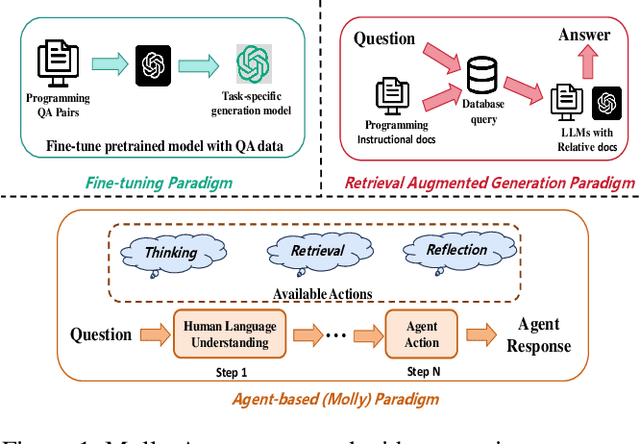
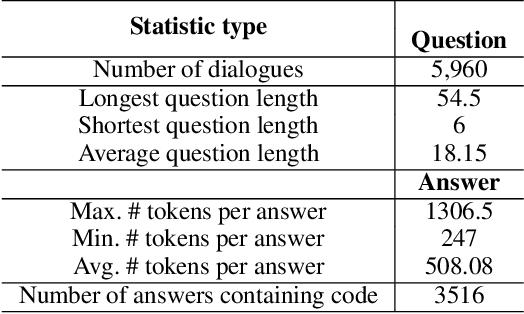
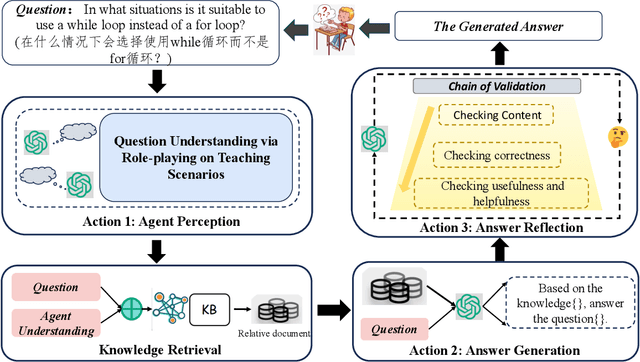
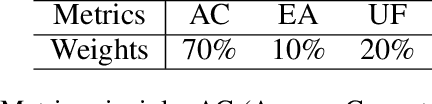
Applying large language models (LLMs) as teaching assists has attracted much attention as an integral part of intelligent education, particularly in computing courses. To reduce the gap between the LLMs and the computer programming education expert, fine-tuning and retrieval augmented generation (RAG) are the two mainstream methods in existing researches. However, fine-tuning for specific tasks is resource-intensive and may diminish the model`s generalization capabilities. RAG can perform well on reducing the illusion of LLMs, but the generation of irrelevant factual content during reasoning can cause significant confusion for learners. To address these problems, we introduce the Molly agent, focusing on solving the proposed problem encountered by learners when learning Python programming language. Our agent automatically parse the learners' questioning intent through a scenario-based interaction, enabling precise retrieval of relevant documents from the constructed knowledge base. At generation stage, the agent reflect on the generated responses to ensure that they not only align with factual content but also effectively answer the user's queries. Extensive experimentation on a constructed Chinese Python QA dataset shows the effectiveness of the Molly agent, indicating an enhancement in its performance for providing useful responses to Python questions.
DualMamba: A Lightweight Spectral-Spatial Mamba-Convolution Network for Hyperspectral Image Classification
Jun 11, 2024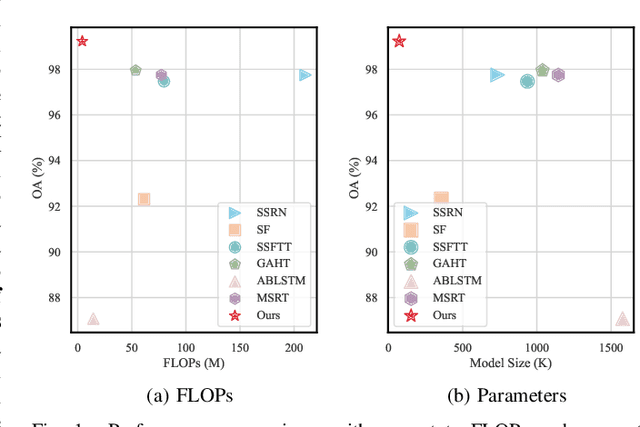
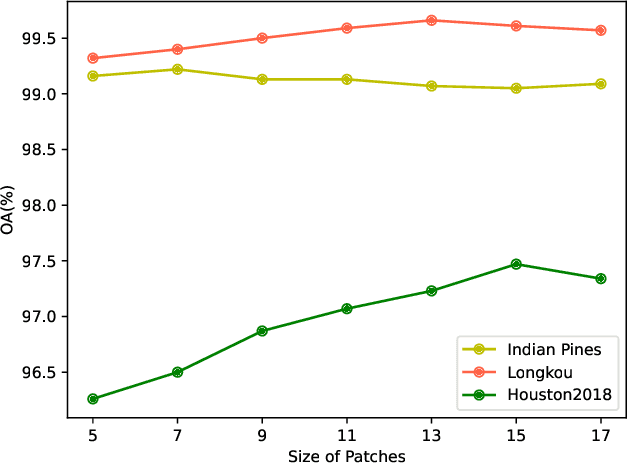
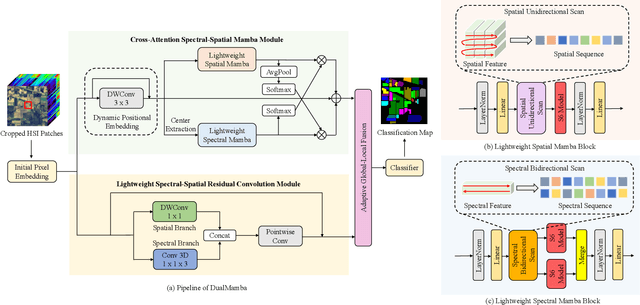
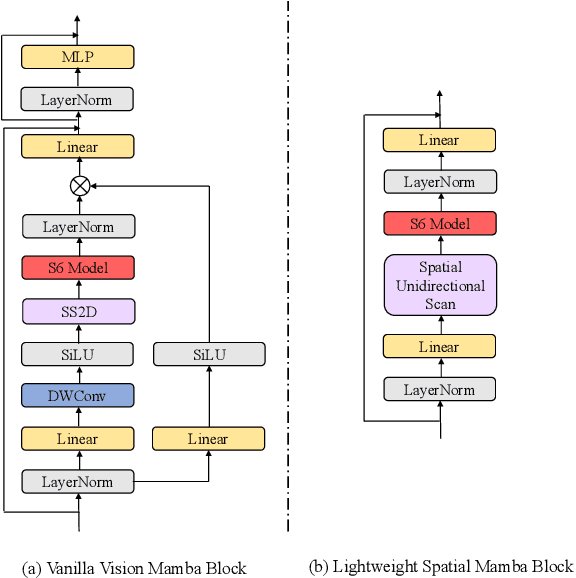
The effectiveness and efficiency of modeling complex spectral-spatial relations are both crucial for Hyperspectral image (HSI) classification. Most existing methods based on CNNs and transformers still suffer from heavy computational burdens and have room for improvement in capturing the global-local spectral-spatial feature representation. To this end, we propose a novel lightweight parallel design called lightweight dual-stream Mamba-convolution network (DualMamba) for HSI classification. Specifically, a parallel lightweight Mamba and CNN block are first developed to extract global and local spectral-spatial features. First, the cross-attention spectral-spatial Mamba module is proposed to leverage the global modeling of Mamba at linear complexity. Within this module, dynamic positional embedding is designed to enhance the spatial location information of visual sequences. The lightweight spectral/spatial Mamba blocks comprise an efficient scanning strategy and a lightweight Mamba design to efficiently extract global spectral-spatial features. And the cross-attention spectral-spatial fusion is designed to learn cross-correlation and fuse spectral-spatial features. Second, the lightweight spectral-spatial residual convolution module is proposed with lightweight spectral and spatial branches to extract local spectral-spatial features through residual learning. Finally, the adaptive global-local fusion is proposed to dynamically combine global Mamba features and local convolution features for a global-local spectral-spatial representation. Compared with state-of-the-art HSI classification methods, experimental results demonstrate that DualMamba achieves significant classification accuracy on three public HSI datasets and a superior reduction in model parameters and floating point operations (FLOPs).