 Add to Chrome
 Add to Firefox
 Add to Edge
Generative Reasoning Re-ranker
Feb 08, 2026
Recent studies increasingly explore Large Language Models (LLMs) as a new paradigm for recommendation systems due to their scalability and world knowledge. However, existing work has three key limitations: (1) most efforts focus on retrieval and ranking, while the reranking phase, critical for refining final recommendations, is largely overlooked; (2) LLMs are typically used in zero-shot or supervised fine-tuning settings, leaving their reasoning abilities, especially those enhanced through reinforcement learning (RL) and high-quality reasoning data, underexploited; (3) items are commonly represented by non-semantic IDs, creating major scalability challenges in industrial systems with billions of identifiers. To address these gaps, we propose the Generative Reasoning Reranker (GR2), an end-to-end framework with a three-stage training pipeline tailored for reranking. First, a pretrained LLM is mid-trained on semantic IDs encoded from non-semantic IDs via a tokenizer achieving $\ge$99% uniqueness. Next, a stronger larger-scale LLM generates high-quality reasoning traces through carefully designed prompting and rejection sampling, which are used for supervised fine-tuning to impart foundational reasoning skills. Finally, we apply Decoupled Clip and Dynamic sAmpling Policy Optimization (DAPO), enabling scalable RL supervision with verifiable rewards designed specifically for reranking. Experiments on two real-world datasets demonstrate GR2's effectiveness: it surpasses the state-of-the-art OneRec-Think by 2.4% in Recall@5 and 1.3% in NDCG@5. Ablations confirm that advanced reasoning traces yield substantial gains across metrics. We further find that RL reward design is crucial in reranking: LLMs tend to exploit reward hacking by preserving item order, motivating conditional verifiable rewards to mitigate this behavior and optimize reranking performance.

Step-Audio-EditX Technical Report
Nov 05, 2025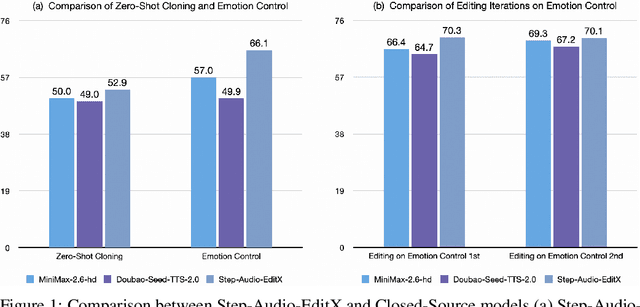
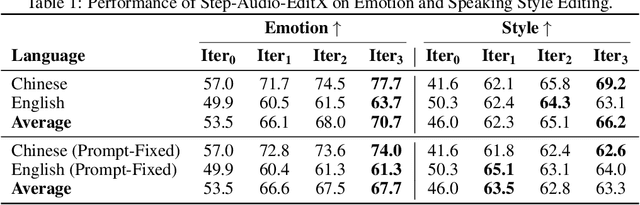

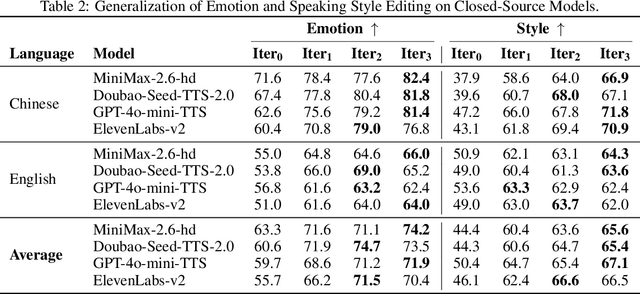
We present Step-Audio-EditX, the first open-source LLM-based audio model excelling at expressive and iterative audio editing encompassing emotion, speaking style, and paralinguistics alongside robust zero-shot text-to-speech (TTS) capabilities.Our core innovation lies in leveraging only large-margin synthetic data, which circumvents the need for embedding-based priors or auxiliary modules. This large-margin learning approach enables both iterative control and high expressivity across voices, and represents a fundamental pivot from the conventional focus on representation-level disentanglement. Evaluation results demonstrate that Step-Audio-EditX surpasses both MiniMax-2.6-hd and Doubao-Seed-TTS-2.0 in emotion editing and other fine-grained control tasks.
Mind-Paced Speaking: A Dual-Brain Approach to Real-Time Reasoning in Spoken Language Models
Oct 10, 2025Real-time Spoken Language Models (SLMs) struggle to leverage Chain-of-Thought (CoT) reasoning due to the prohibitive latency of generating the entire thought process sequentially. Enabling SLMs to think while speaking, similar to humans, is attracting increasing attention. We present, for the first time, Mind-Paced Speaking (MPS), a brain-inspired framework that enables high-fidelity, real-time reasoning. Similar to how humans utilize distinct brain regions for thinking and responding, we propose a novel dual-brain approach, employing a "Formulation Brain" for high-level reasoning to pace and guide a separate "Articulation Brain" for fluent speech generation. This division of labor eliminates mode-switching, preserving the integrity of the reasoning process. Experiments show that MPS significantly outperforms existing think-while-speaking methods and achieves reasoning performance comparable to models that pre-compute the full CoT before speaking, while drastically reducing latency. Under a zero-latency configuration, the proposed method achieves an accuracy of 92.8% on the mathematical reasoning task Spoken-MQA and attains a score of 82.5 on the speech conversation task URO-Bench. Our work effectively bridges the gap between high-quality reasoning and real-time interaction.
Step-Audio 2 Technical Report
Jul 24, 2025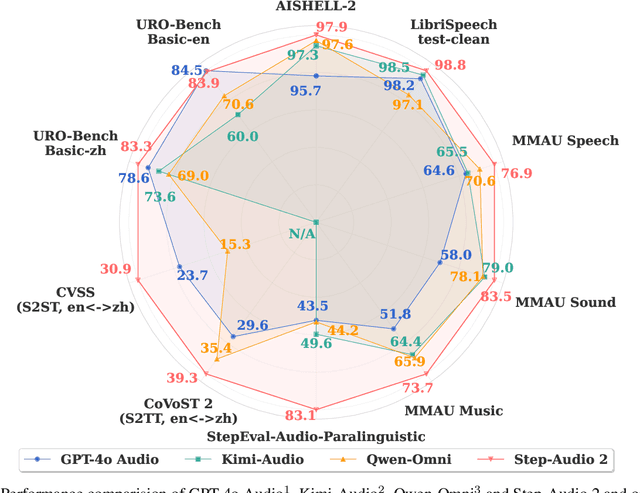
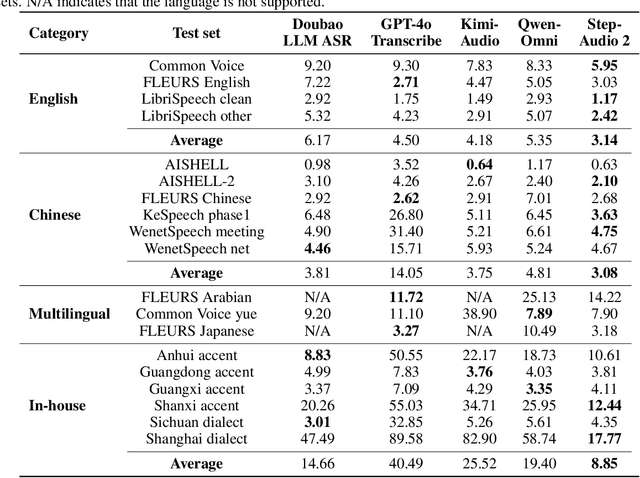
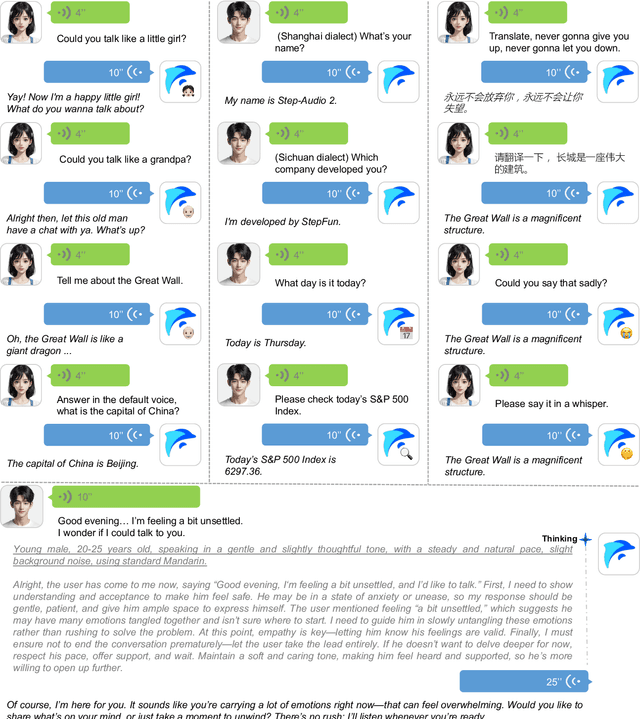
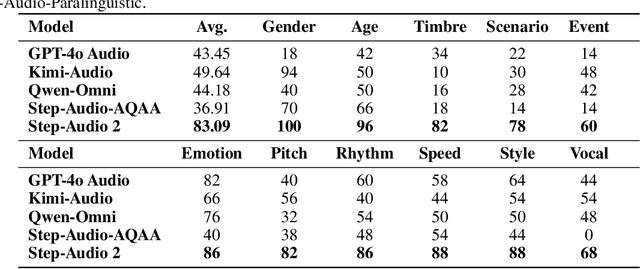
This paper presents Step-Audio 2, an end-to-end multi-modal large language model designed for industry-strength audio understanding and speech conversation. By integrating a latent audio encoder and reasoning-centric reinforcement learning (RL), Step-Audio 2 achieves promising performance in automatic speech recognition (ASR) and audio understanding. To facilitate genuine end-to-end speech conversation, Step-Audio 2 incorporates the generation of discrete audio tokens into language modeling, significantly enhancing its responsiveness to paralinguistic information such as speaking styles and emotions. To effectively leverage the rich textual and acoustic knowledge in real-world data, Step-Audio 2 integrates retrieval-augmented generation (RAG) and is able to call external tools such as web search to mitigate hallucination and audio search to switch timbres. Trained on millions of hours of speech and audio data, Step-Audio 2 delivers intelligence and expressiveness across diverse conversational scenarios. Evaluation results demonstrate that Step-Audio 2 achieves state-of-the-art performance on various audio understanding and conversational benchmarks compared to other open-source and commercial solutions. Please visit https://github.com/stepfun-ai/Step-Audio2 for more information.
Step-Audio: Unified Understanding and Generation in Intelligent Speech Interaction
Feb 18, 2025Real-time speech interaction, serving as a fundamental interface for human-machine collaboration, holds immense potential. However, current open-source models face limitations such as high costs in voice data collection, weakness in dynamic control, and limited intelligence. To address these challenges, this paper introduces Step-Audio, the first production-ready open-source solution. Key contributions include: 1) a 130B-parameter unified speech-text multi-modal model that achieves unified understanding and generation, with the Step-Audio-Chat version open-sourced; 2) a generative speech data engine that establishes an affordable voice cloning framework and produces the open-sourced lightweight Step-Audio-TTS-3B model through distillation; 3) an instruction-driven fine control system enabling dynamic adjustments across dialects, emotions, singing, and RAP; 4) an enhanced cognitive architecture augmented with tool calling and role-playing abilities to manage complex tasks effectively. Based on our new StepEval-Audio-360 evaluation benchmark, Step-Audio achieves state-of-the-art performance in human evaluations, especially in terms of instruction following. On open-source benchmarks like LLaMA Question, shows 9.3% average performance improvement, demonstrating our commitment to advancing the development of open-source multi-modal language technologies. Our code and models are available at https://github.com/stepfun-ai/Step-Audio.
Microsoft Research Asia's Systems for WMT19
Nov 07, 2019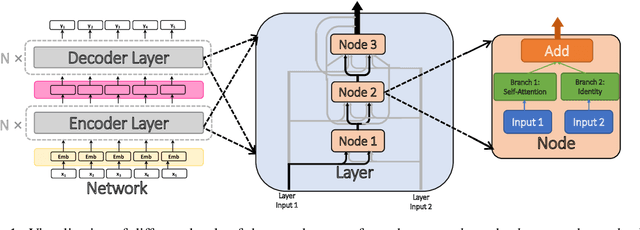
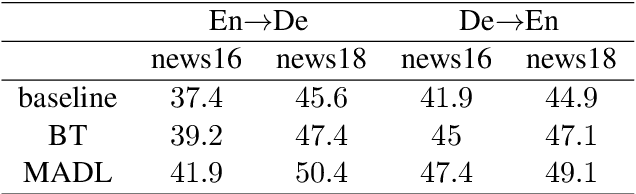
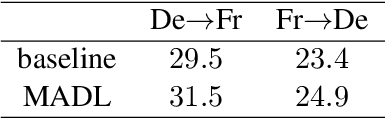
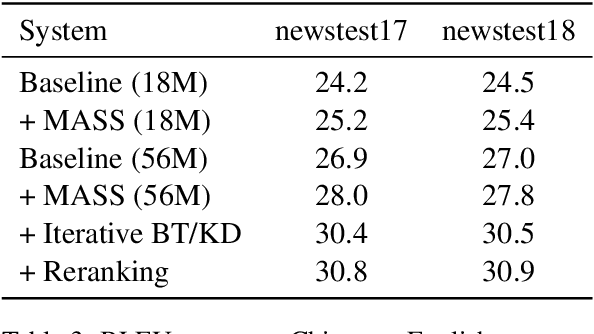
We Microsoft Research Asia made submissions to 11 language directions in the WMT19 news translation tasks. We won the first place for 8 of the 11 directions and the second place for the other three. Our basic systems are built on Transformer, back translation and knowledge distillation. We integrate several of our rececent techniques to enhance the baseline systems: multi-agent dual learning (MADL), masked sequence-to-sequence pre-training (MASS), neural architecture optimization (NAO), and soft contextual data augmentation (SCA).
Hint-Based Training for Non-Autoregressive Machine Translation
Sep 15, 2019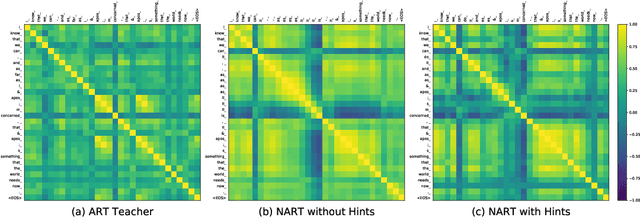
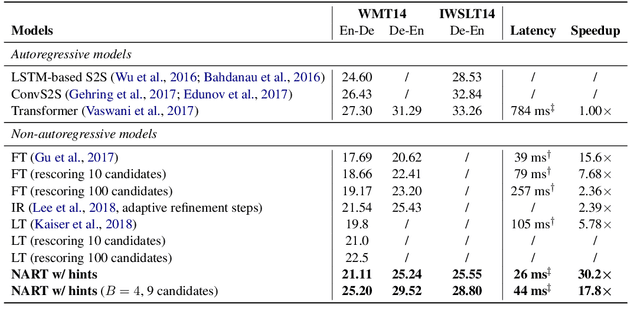
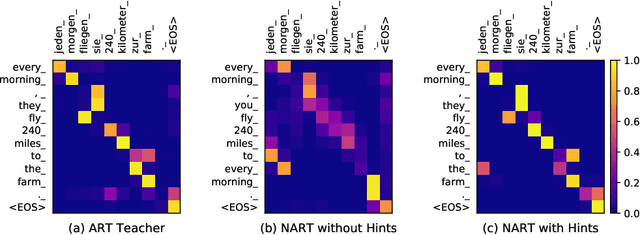
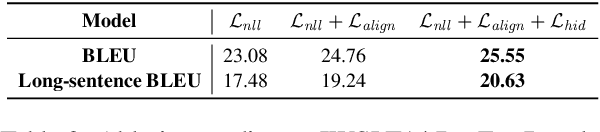
Due to the unparallelizable nature of the autoregressive factorization, AutoRegressive Translation (ART) models have to generate tokens sequentially during decoding and thus suffer from high inference latency. Non-AutoRegressive Translation (NART) models were proposed to reduce the inference time, but could only achieve inferior translation accuracy. In this paper, we proposed a novel approach to leveraging the hints from hidden states and word alignments to help the training of NART models. The results achieve significant improvement over previous NART models for the WMT14 En-De and De-En datasets and are even comparable to a strong LSTM-based ART baseline but one order of magnitude faster in inference.
Depth Growing for Neural Machine Translation
Jul 03, 2019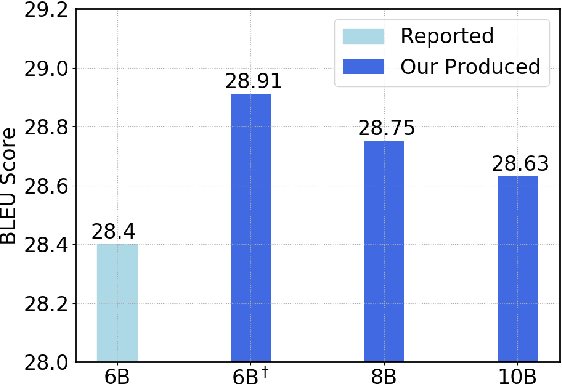
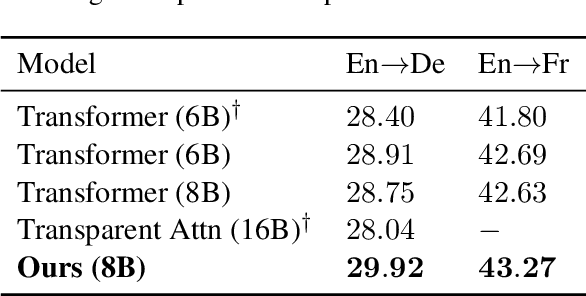
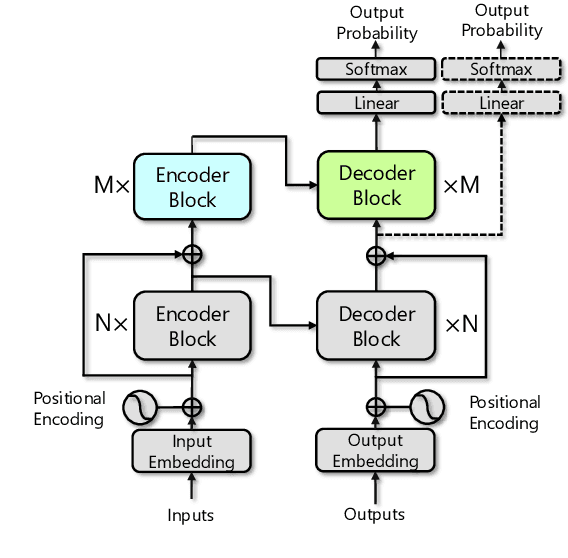
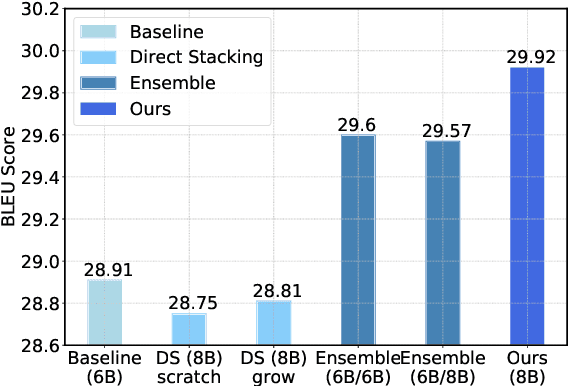
While very deep neural networks have shown effectiveness for computer vision and text classification applications, how to increase the network depth of neural machine translation (NMT) models for better translation quality remains a challenging problem. Directly stacking more blocks to the NMT model results in no improvement and even reduces performance. In this work, we propose an effective two-stage approach with three specially designed components to construct deeper NMT models, which result in significant improvements over the strong Transformer baselines on WMT$14$ English$\to$German and English$\to$French translation tasks\footnote{Our code is available at \url{https://github.com/apeterswu/Depth_Growing_NMT}}.
Non-Autoregressive Machine Translation with Auxiliary Regularization
Feb 22, 2019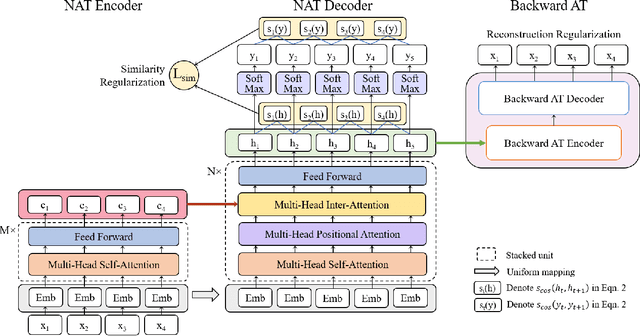
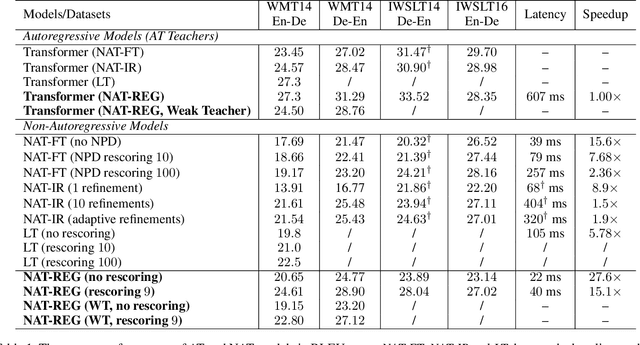
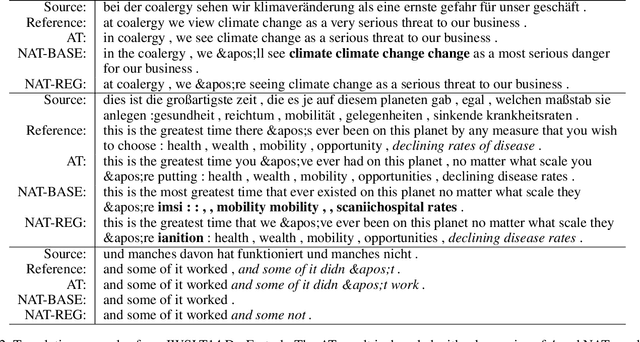
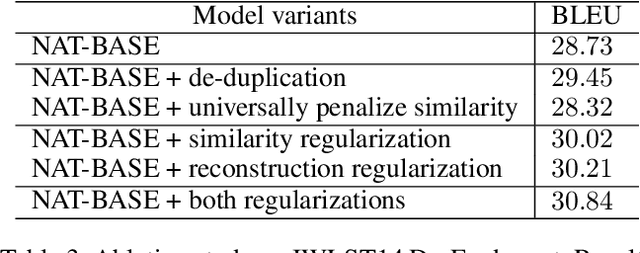
As a new neural machine translation approach, Non-Autoregressive machine Translation (NAT) has attracted attention recently due to its high efficiency in inference. However, the high efficiency has come at the cost of not capturing the sequential dependency on the target side of translation, which causes NAT to suffer from two kinds of translation errors: 1) repeated translations (due to indistinguishable adjacent decoder hidden states), and 2) incomplete translations (due to incomplete transfer of source side information via the decoder hidden states). In this paper, we propose to address these two problems by improving the quality of decoder hidden representations via two auxiliary regularization terms in the training process of an NAT model. First, to make the hidden states more distinguishable, we regularize the similarity between consecutive hidden states based on the corresponding target tokens. Second, to force the hidden states to contain all the information in the source sentence, we leverage the dual nature of translation tasks (e.g., English to German and German to English) and minimize a backward reconstruction error to ensure that the hidden states of the NAT decoder are able to recover the source side sentence. Extensive experiments conducted on several benchmark datasets show that both regularization strategies are effective and can alleviate the issues of repeated translations and incomplete translations in NAT models. The accuracy of NAT models is therefore improved significantly over the state-of-the-art NAT models with even better efficiency for inference.
Neural Architecture Optimization
Oct 31, 2018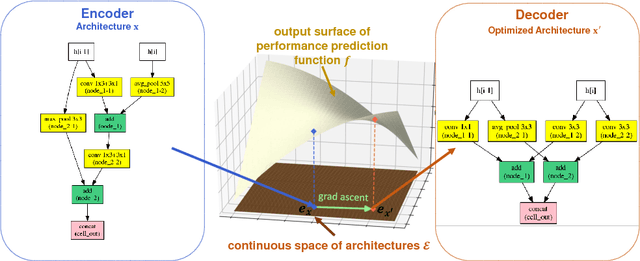
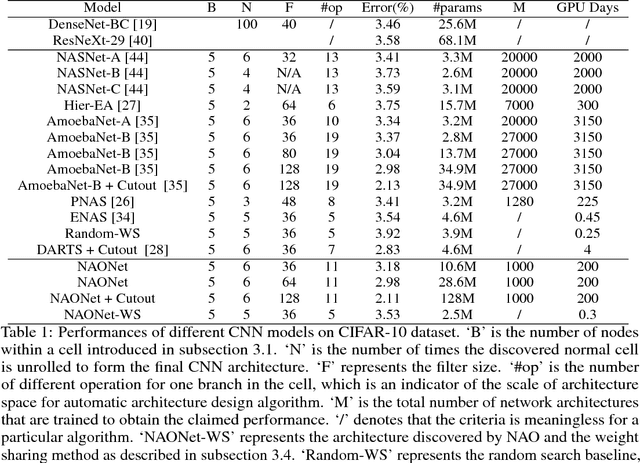
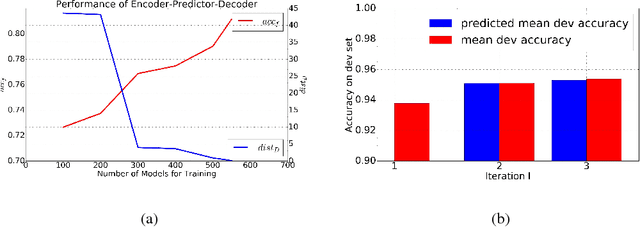
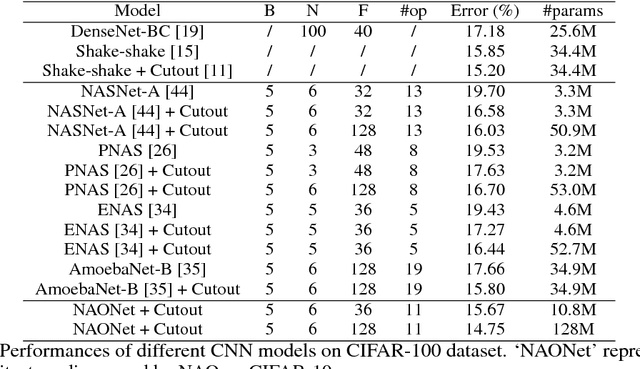
Automatic neural architecture design has shown its potential in discovering powerful neural network architectures. Existing methods, no matter based on reinforcement learning or evolutionary algorithms (EA), conduct architecture search in a discrete space, which is highly inefficient. In this paper, we propose a simple and efficient method to automatic neural architecture design based on continuous optimization. We call this new approach neural architecture optimization (NAO). There are three key components in our proposed approach: (1) An encoder embeds/maps neural network architectures into a continuous space. (2) A predictor takes the continuous representation of a network as input and predicts its accuracy. (3) A decoder maps a continuous representation of a network back to its architecture. The performance predictor and the encoder enable us to perform gradient based optimization in the continuous space to find the embedding of a new architecture with potentially better accuracy. Such a better embedding is then decoded to a network by the decoder. Experiments show that the architecture discovered by our method is very competitive for image classification task on CIFAR-10 and language modeling task on PTB, outperforming or on par with the best results of previous architecture search methods with a significantly reduction of computational resources. Specifically we obtain $2.11\%$ test set error rate for CIFAR-10 image classification task and $56.0$ test set perplexity of PTB language modeling task. Furthermore, combined with the recent proposed weight sharing mechanism, we discover powerful architecture on CIFAR-10 (with error rate $3.53\%$) and on PTB (with test set perplexity $56.6$), with very limited computational resources (less than $10$ GPU hours) for both tasks.