 Add to Chrome
 Add to Firefox
 Add to Edge
The Case Against Generation for Retrieval: Discriminative Language Models as Effective Retrievers
Jul 28, 2026
Large Language Models (LLMs) have emerged as powerful assets for recommender systems. However, deploying them as generative recommenders or zero-shot rankers at web-scale remains bottlenecked by prohibitive computational overhead and grounding challenges. In this paper, we revitalize the classic, highly efficient two-tower retrieval architecture by adapting LLMs as semantic representation backbones rather than generative engines. We introduce an LLM-native two-tower framework engineered for high-throughput, large-scale retrieval. Our architecture introduces several key innovations: a shared LLM encoder for joint user-item modeling, End-Of-Sentence (EOS) token pooling for compact sequence embedding, cross-dataset transfer learning, knowledge distillation from powerful cross-encoder teachers, and latent reasoning within the user tower. Extensive evaluation across three public benchmarks demonstrates that cross-encoder architecture outperforms current state-of-the-art (SoTA) models, while the efficient two-tower student achieves SoTA-comparable retrieval performance. Furthermore, experiments on internal large-scale production systems yield substantial topline retrieval improvements along with high resilience to model staleness and superior data scaling. Our findings demonstrate that when augmented with modern representation learning, the traditional two-tower paradigm remains an exceptionally competitive and practical solution for industrial retrieval systems.

Self-Guided Test-Time Training for Long-Context LLMs
Jul 10, 2026Long-context processing has become increasingly important for large language models (LLMs), but simply extending the context window does not guarantee effective utilization of long inputs. As input length grows, accuracy often degrades, indicating that models still struggle to identify and use the evidence most relevant to a question. A promising way to improve long-context utilization is test-time training (TTT), which treats the test context as a training example for instance-specific parameter adaptation. However, applying TTT to the entire long context is prohibitively expensive, while adapting on randomly sampled spans introduces severe noise. Because most spans in a long context are irrelevant to the specific question, training on them may even degrade the base model's performance. Our preliminary study shows that TTT is highly sensitive to training-span quality: on LongBench-v2, TTT on randomly sampled spans hurts performance, whereas TTT on oracle spans substantially improves it. Motivated by this, we propose a simple method, Self-Guided TTT (S-TTT): before adaptation, the model identifies the evidence spans it should learn from, and the standard language-modeling training objective is applied only to those selected spans. On two challenging long-context reasoning benchmarks, LongBench-v2 and LongBench-Pro, S-TTT improves accuracy for both Qwen3-4B-Thinking-2507 and Llama-3.1-8B-Instruct, achieving up to a 15% relative improvement.
SCOReD: Student-Aware CoT Optimization for Recommendation Distillation
Jul 07, 2026Chain-of-thought (CoT) distillation in the recommendation domain is a necessary precursor to RL training, but raw teacher traces are ill-suited to this task. Large teachers approach the recommendation task with unusually high reasoning uncertainty, repeatedly rechecking their answers without revising them; supervised fine-tuning on such traces produces verbose students that never revise their initial guess. Furthermore, due to the novelty of the recommendation domain, the teacher's reasoning traces are highly out-of-distribution for the small student LLM. We propose Student-Aware CoT Optimization for Recommendation Distillation (SCOReD), a CoT optimization framework tailored to recommendation that first parses each teacher trace into typed segments and uses the student LLM's attention to score the importance of each segment. Then SCOReD dynamically selects a per-segment edit (KEEP / REWRITE / FUSE / PRUNE) based on the output length and comparative log probability lift of the answer given the edit as per the student. Therefore, SCOReD prunes redundant sections of the reasoning trace while preserving information-dense sections and adapts raw teacher traces to the student's output distribution. Training on SCOReD-optimized CoTs provides a cleaner learning signal to the student model and improves over baseline SFT by 1.56% NDCG and 1.9% Recall@5, while reducing reasoning length by 27.3%.
Diffusion-GR2: Diffusion Generative Reasoning Re-ranker
Jul 01, 2026Generative reasoning re-rankers achieve strong recommendation accuracy by emitting a chain-of-thought before re-ordering a candidate list, but they are slow at inference: an autoregressive (AR) decoder spends one sequential forward pass per reasoning token, and the reasoning trace far exceeds the ranking it produces. To reduce this cost, block-diffusion language models decode many positions in parallel over a few denoising steps and are substantially faster, yet naively converting an AR re-ranker into one opens two accuracy gaps: (1) a structural gap: answer positions are denoised in parallel and scored independently, so the decoder emits invalid rankings (duplicated, dropped, or out-of-set identifiers) that AR avoids through left-to-right masking; and (2) a distributional gap: fine-tuning the converted model on fixed teacher trajectories is off-policy relative to its own decoding at inference, leaving a residual accuracy gap. To close both gaps while keeping the speedup, we propose \textbf{Diffusion-GR2}, a recipe that converts our AR reasoning re-ranker (GR2) into a block-diffusion re-ranker. First, conversion fine-tuning (CFT) adapts the AR-initialized diffusion model to denoise the answer into a valid permutation on its own, without an external constrained decoder. Next, on-policy distillation (OPD) then supervises the model on its own decoded trajectories with dense per-token targets from the AR teacher. Finally, we apply a reinforcement-learning (RL) stage against a re-ranking reward on top of OPD's on-policy policy. Experiments on Amazon Beauty demonstrate that Diffusion-GR2 recovers to near-parity with the AR re-ranker, while block-parallel decoding raises decode throughput by $2.4$--$3.5\times$ at the model's reasoning output length. Ablations show that CFT recovers most of the conversion gap, and that on-policy distillation further closes it to the AR reference.
GR2 Technical Report
Jun 30, 2026Industrial recommendation systems serve billions of users through a multi-stage funnel -- retrieval, early-stage ranking, and re-ranking -- where the final re-ranking step disproportionately shapes user engagement and downstream performance, particularly for carousel and grid display formats. Despite growing enthusiasm for Large Language Models (LLMs) in recommendation, three gaps hinder industrial adoption: (1) most efforts target retrieval and ranking, leaving re-ranking -- the stage closest to the final user experience -- largely underexplored; (2) LLMs are typically deployed zero-shot or via supervised fine-tuning, underutilizing the reasoning capabilities unlocked by reinforcement learning (RL) on verifiable rewards; (3) deployed catalogs index billions of items with non-semantic identifiers that lie outside any base-LLM vocabulary. We present GR2 (Generative Reasoning Re-Ranker), an end-to-end framework that combines (i) mid-training on semantic IDs produced by a tokenizer with >=99% uniqueness, (ii) reasoning-trace distilled from a stronger teacher via targeted prompting and rejection sampling, and (iii) RL with verifiable rewards purpose-built for re-ranking. To make GR2 resource-viable, we further (iv) introduce a context compressor that amortizes training cost, On-Policy Distillation (OPD) as a scalable alternative to SFT -- which we find collapses at industrial scale -- and reasoning distillation for low-latency serving. GR2 delivers +18.7% R@1, +7.1% R@3, and +9.6% N@3 over legacy baselines on industrial-scale traffic. We further find that reward design is critical in re-ranking: LLMs often hack rewards by preserving the incoming order or exploiting position bias, motivating conditional verifiable rewards as essential industrial components.
Bifocal Diffusion Language Models: Asymmetric Bidirectional Context for Parallel Generation
Jun 26, 2026Discrete diffusion language models (dLLMs) recover masked tokens in parallel, offering significant speedups over autoregressive (AR) generation. However, such promising frameworks face a fundamental architectural design dilemma: \ding{182} Adopting bidirectional attention achieves strong generation quality by allowing each position to access the full context, but is inherently incompatible with KV caching, limiting inference throughput in batch-serving scenarios; \ding{183} Conversely, causal attention enables efficient cached inference but loses all right-side context, substantially degrading generation quality. This paper introduces Bifocal dLLMs, a new paradigm that resolves this dilemma through \emph{asymmetric bidirectional context}. Analogous to bifocal lenses, we instantiate the paradigm as \textbf{R2LM} (Right-to-Left Mamba), which combines two complementary mechanisms: $a$) standard causal attention providing precise left-context with full KV cache compatibility, while $b$) a lightweight reverse Mamba SSM sidecar supplying compressed right-side context without breaking cacheability. Comprehensive experiments on continued pretraining of Qwen3-1.7B with 60B tokens demonstrate that R2LM achieves $2.4\times$ to $12.9\times$ higher throughput than bidirectional dLLMs and $1.9\times$ to $2.9\times$ speedup over AR baselines in batch serving through parallel decoding with KV caching, while exceeding the causal baseline on most benchmarks and surpassing the bidirectional dLLM on average.
End-to-End Dynamic Sparsity for Resource-Adaptive LLM Inference
Jun 26, 2026Large Language Models (LLMs) inference is typically deployed under a static resource assumption, where models execute a fixed computational graph regardless of the runtime environment. However, real-world cloud infrastructure is inherently dynamic, characterized by fluctuating availability (e.g., spot instance preemption) and tiered Quality-of-Service requirements. In such volatile settings, static models are inflexible: they either crash under resource constraints or waste compute on redundant operations. To bridge this gap, we propose Learning to Allocate (L2A), an end-to-end framework for resource-adaptive inference. Unlike prior methods that condition only on input difficulty, we formulate inference as a constrained allocation problem conditioned on both the input and the runtime resource budget itself. We introduce lightweight, budget-conditioned and input-aware gating networks integrated into the LLM. These gates are trained via a unified objective that jointly optimizes task performance, logical consistency, and resource costs along three axes matching how real-world dynamics manifest: layer skipping for memory and depth pressure, head pruning for throughput contention, and reasoning-token reduction for latency tightening. This lets the model learn a budget-aware policy beyond input difficulty alone: it adaptively configures its computational footprint with respect to real-time resource dynamics, maximizing reasoning depth when resources permit while enforcing strict frugality when budgets tighten. A single L2A model traces the entire compute-accuracy Pareto frontier on Llama-3-8B and Qwen-3-4B: at up to 34% realized layer sparsity, it stays within 0.6% of the dense baseline on GSM8K, with the same gap holding zero-shot on out-of-distribution tasks, while every static or heuristic baseline requires a separately tuned model and still drops by 5-10% at comparable inference time.
Learning Evidence Highlighting for Frozen LLMs
Apr 24, 2026Large Language Models (LLMs) can reason well, yet often miss decisive evidence when it is buried in long, noisy contexts. We introduce HiLight, an Evidence Emphasis framework that decouples evidence selection from reasoning for frozen LLM solvers. HiLight avoids compressing or rewriting the input, which can discard or distort evidence, by training a lightweight Emphasis Actor to insert minimal highlight tags around pivotal spans in the unaltered context. A frozen Solver then performs downstream reasoning on the emphasized input. We cast highlighting as a weakly supervised decision-making problem and optimize the Actor with reinforcement learning using only the Solver's task reward, requiring no evidence labels and no access to or modification of the Solver. Across sequential recommendation and long-context question answering, HiLight consistently improves performance over strong prompt-based and automated prompt-optimization baselines. The learned emphasis policy transfers zero-shot to both smaller and larger unseen Solver families, including an API-based Solver, suggesting that the Actor captures genuine, reusable evidence structure rather than overfitting to a single backbone.
Generative Reasoning Re-ranker
Feb 08, 2026Recent studies increasingly explore Large Language Models (LLMs) as a new paradigm for recommendation systems due to their scalability and world knowledge. However, existing work has three key limitations: (1) most efforts focus on retrieval and ranking, while the reranking phase, critical for refining final recommendations, is largely overlooked; (2) LLMs are typically used in zero-shot or supervised fine-tuning settings, leaving their reasoning abilities, especially those enhanced through reinforcement learning (RL) and high-quality reasoning data, underexploited; (3) items are commonly represented by non-semantic IDs, creating major scalability challenges in industrial systems with billions of identifiers. To address these gaps, we propose the Generative Reasoning Reranker (GR2), an end-to-end framework with a three-stage training pipeline tailored for reranking. First, a pretrained LLM is mid-trained on semantic IDs encoded from non-semantic IDs via a tokenizer achieving $\ge$99% uniqueness. Next, a stronger larger-scale LLM generates high-quality reasoning traces through carefully designed prompting and rejection sampling, which are used for supervised fine-tuning to impart foundational reasoning skills. Finally, we apply Decoupled Clip and Dynamic sAmpling Policy Optimization (DAPO), enabling scalable RL supervision with verifiable rewards designed specifically for reranking. Experiments on two real-world datasets demonstrate GR2's effectiveness: it surpasses the state-of-the-art OneRec-Think by 2.4% in Recall@5 and 1.3% in NDCG@5. Ablations confirm that advanced reasoning traces yield substantial gains across metrics. We further find that RL reward design is crucial in reranking: LLMs tend to exploit reward hacking by preserving item order, motivating conditional verifiable rewards to mitigate this behavior and optimize reranking performance.
Order-Preserving Abstractive Summarization for Spoken Content Based on Connectionist Temporal Classification
Nov 16, 2017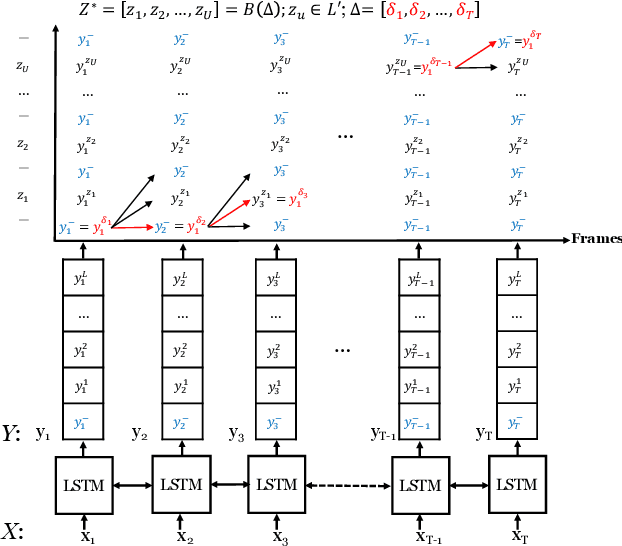

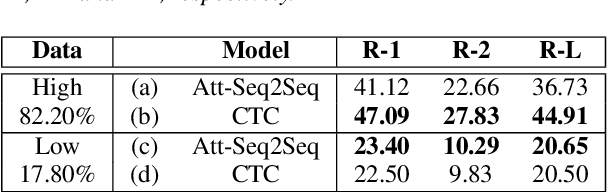

Connectionist temporal classification (CTC) is a powerful approach for sequence-to-sequence learning, and has been popularly used in speech recognition. The central ideas of CTC include adding a label "blank" during training. With this mechanism, CTC eliminates the need of segment alignment, and hence has been applied to various sequence-to-sequence learning problems. In this work, we applied CTC to abstractive summarization for spoken content. The "blank" in this case implies the corresponding input data are less important or noisy; thus it can be ignored. This approach was shown to outperform the existing methods in term of ROUGE scores over Chinese Gigaword and MATBN corpora. This approach also has the nice property that the ordering of words or characters in the input documents can be better preserved in the generated summaries.