 Add to Chrome
 Add to Firefox
 Add to Edge
RedFlow: Redirect Failure into Action-Level Corrections for Flow-matching VLA Policy
Jul 30, 2026
Flow-matching Vision-Language-Action (VLA) policies have shown strong potential for robotic manipulation but often suffer from compounding errors caused by distribution shifts during deployment. While offline reinforcement learning (RL) provides a practical way to improve deployed policies using rollout data, existing methods either ignore failure data or exploit it only at the trajectory level, resulting in low learning efficiency and persistent errors. We propose **RedFlow**, a fine-grained offline RL framework that redirects failure experiences into action-level corrective supervision for flow-matching VLA policies. RedFlow consists of two key components: (1) a **Context-Aware Corrective Matching** mechanism that identifies failure-inducing actions and retrieves successful alternatives from similar contexts as corrective targets, and (2) an **Adaptive Redirection Objective** that jointly reinforces successful actions, suppresses undesirable ones, and redirects recoverable failures toward corrective targets. By converting both successful and failed experiences into dense supervision, RedFlow enables robust recovery learning from mixed-quality data. Experiments on the LIBERO benchmark and three real-world manipulation tasks show that RedFlow consistently outperforms state-of-the-art offline RL baselines, improving the real-world success rate from 56.7% to 74.7%. It also matches strong on-policy methods (PPO, GRPO, and DDPO) while requiring roughly an order of magnitude fewer training samples.

AdaTok: Self-Budgeting Image Tokenization with Quality-Preserving Dynamic Tokens
Jun 05, 2026Image tokenizers, from 2D grids to recent 1D sequences, typically encode every image with the same fixed number of tokens. Yet visual complexity is highly heterogeneous, so a uniform budget overspends on simple inputs and underserves complex ones. Existing elastic tokenizers expose variable-length reconstructions, but often leave token length as a deployment-time operating point, a search target, or an external prediction rather than an output of the tokenizer itself. In this work, we ask whether a discrete visual tokenizer can budget itself in one pass. Our central finding is that actionable elasticity requires a representation--allocation co-design: prefixes must remain decodable across budgets, and the tokenizer must learn which prefix each image needs. We propose AdaTok, a self-budgeting discrete 1D tokenizer. AdaTok combines Prioritized Representation Learning, which orders tokens with nested tail masking and resolves budget-dependent semantic shift through Multi-Head LoRA decoder heads, with Adaptive Token Allocation, which trains a lightweight deterministic-group GRPO policy over candidate budgets. Dynamic Pareto Weighting balances fidelity and efficiency during policy training without manual trade-off sweeps. On ImageNet-1K, AdaTok-Full reaches rFID 1.31 at 256 tokens, while AdaTok-Adaptive attains rFID 1.50 using only ~118 tokens on average, outperforming discrete 1D baselines at comparable budgets. In autoregressive image generation, the shorter adaptive representation yields ~2.1x throughput over a fixed 256-token decode, suggesting that visual token count can be learned as a content-conditioned output rather than set as a fixed hyperparameter.
Dynamic Spectral Denoising with Global-Context Attention for Multi-Behavior Recommendation
Jun 01, 2026Multi-behavior recommendation improves target-behavior prediction by exploiting heterogeneous auxiliary feedback (e.g., view, collect, and cart), yet its robustness is undermined by behavior-dependent noise and inconsistency. We argue that the key bottleneck is a representation-level failure caused by two coupled heterogeneities. First, intra-behavior representation entanglement arises when multi-hop propagation blends incidental signals with true preferences in the embedding space, making coarse spatial denoising unable to suppress noise without sacrificing informative niche signals. Second, inter-behavior reliability heterogeneity complicates cross-behavior fusion because the predictive value of auxiliary behaviors varies across users and contexts. Without reliability calibration, frequent yet unreliable signals may dominate aggregation and cause target-intent drift. To address this bottleneck, we propose Dynamic Spectral Denoising with Global-Context Attention for Multi-Behavior Recommendation (SpectraMB), a target-oriented model that performs representation purification before reliability-aware fusion. SpectraMB introduces Dynamic Feature-Level Spectral Filtering, which re-parameterizes embeddings along the feature dimension into a feature-frequency space and learns view-adaptive spectral modulation under target supervision, enabling component-wise purification without hand-crafted frequency assumptions. It further proposes Global-Context Attention Fusion, which uses a purified global representation as a context anchor to assess view compatibility and perform reliability-aware aggregation, while a residual global backbone preserves collaborative structure. Extensive experiments on three real-world datasets show that SpectraMB achieves the best results in most evaluation settings and exhibits improved robustness under noisy interactions.
Learning Spatiotemporal Sensitivity in Video LLMs via Counterfactual Reinforcement Learning
May 21, 2026Video large language models (Video LLMs) achieve strong benchmark accuracy, yet often answer video questions through shortcuts such as single-frame cues and language priors rather than by tracking spatiotemporal dynamics. This issue is exacerbated in RL post-training, where correctness-only rewards can further reinforce shortcut policies that obtain high reward without tracking video dynamics. We address this by asking a controlled counterfactual question: if the visual world changed while the question remained fixed, should the answer change or stay the same? Based on this view, we propose \textbf{Counterfactual Relational Policy Optimization (CRPO)}, a dual-branch RL framework for improving \emph{spatiotemporal sensitivity}. CRPO constructs counterfactual videos through horizontal flips and temporal reversals, trains on both original and counterfactual branches, and introduces a \textbf{Counterfactual Relation Reward (CRR)} between their answers. CRR encourages answers to change for dynamic questions and remain unchanged for static questions. This cross-branch constraint makes it difficult for shortcut policies to be consistently rewarded across both branches. To evaluate this property, we introduce \textbf{DyBench}, a paired counterfactual video benchmark with 3,014 videos covering reversible dynamics, moving direction, and event sequence, together with a strict pair-accuracy metric that prevents fixed-answer shortcuts from inflating scores. Experiments show that CRPO outperforms prior RL methods on spatiotemporal-sensitive evaluations while maintaining competitive general video performance. On Qwen3-VL-8B, CRPO improves DyBench P-Acc by +7.7 and TimeBlind I-Acc by +8.2 over the base model, indicating improved spatiotemporal sensitivity rather than stronger reliance on static shortcuts. The project website can be found at https://ddz16.github.io/crpo.github.io/ .
Context Unrolling in Omni Models
Apr 23, 2026We present Omni, a unified multimodal model natively trained on diverse modalities, including text, images, videos, 3D geometry, and hidden representations. We find that such training enables Context Unrolling, where the model explicitly reasons across multiple modal representations before producing predictions. This process enables the model to aggregate complementary information across heterogeneous modalities, facilitating a more faithful approximation of the shared multimodal knowledge manifold and improving downstream reasoning fidelity. As a result, Omni achieves strong performance on both multimodal generation and understanding benchmarks, while demonstrating advanced multimodal reasoning capabilities, including in-context generation of text, image, video, and 3D geometry.
HALO: A Unified Vision-Language-Action Model for Embodied Multimodal Chain-of-Thought Reasoning
Feb 24, 2026Vision-Language-Action (VLA) models have shown strong performance in robotic manipulation, but often struggle in long-horizon or out-of-distribution scenarios due to the lack of explicit mechanisms for multimodal reasoning and anticipating how the world will evolve under action. Recent works introduce textual chain-of-thought or visual subgoal prediction within VLA models to reason, but still fail to offer a unified human-like reasoning framework for joint textual reasoning, visual foresight, and action prediction. To this end, we propose HALO, a unified VLA model that enables embodied multimodal chain-of-thought (EM-CoT) reasoning through a sequential process of textual task reasoning, visual subgoal prediction for fine-grained guidance, and EM-CoT-augmented action prediction. We instantiate HALO with a Mixture-of-Transformers (MoT) architecture that decouples semantic reasoning, visual foresight, and action prediction into specialized experts while allowing seamless cross-expert collaboration. To enable HALO learning at scale, we introduce an automated pipeline to synthesize EM-CoT training data along with a carefully crafted training recipe. Extensive experiments demonstrate that: (1) HALO achieves superior performance in both simulated and real-world environments, surpassing baseline policy pi_0 by 34.1% on RoboTwin benchmark; (2) all proposed components of the training recipe and EM-CoT design help improve task success rate; and (3) HALO exhibits strong generalization capabilities under aggressive unseen environmental randomization with our proposed EM-CoT reasoning.
WMPO: World Model-based Policy Optimization for Vision-Language-Action Models
Nov 12, 2025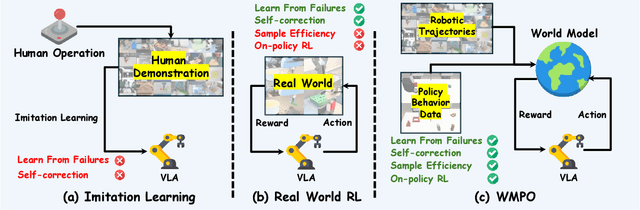
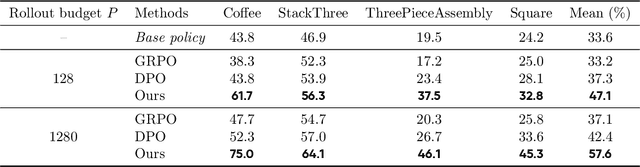
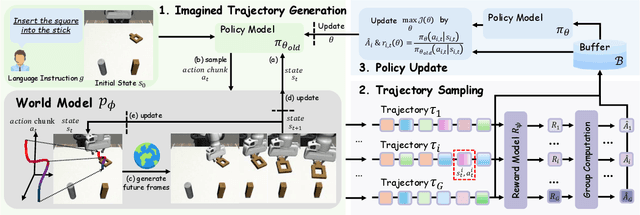
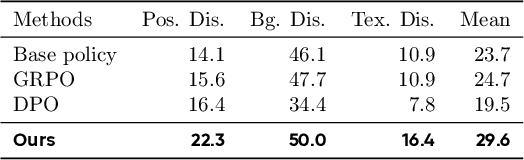
Vision-Language-Action (VLA) models have shown strong potential for general-purpose robotic manipulation, but their reliance on expert demonstrations limits their ability to learn from failures and perform self-corrections. Reinforcement learning (RL) addresses these through self-improving interactions with the physical environment, but suffers from high sample complexity on real robots. We introduce World-Model-based Policy Optimization (WMPO), a principled framework for on-policy VLA RL without interacting with the real environment. In contrast to widely used latent world models, WMPO focuses on pixel-based predictions that align the "imagined" trajectories with the VLA features pretrained with web-scale images. Crucially, WMPO enables the policy to perform on-policy GRPO that provides stronger performance than the often-used off-policy methods. Extensive experiments in both simulation and real-robot settings demonstrate that WMPO (i) substantially improves sample efficiency, (ii) achieves stronger overall performance, (iii) exhibits emergent behaviors such as self-correction, and (iv) demonstrates robust generalization and lifelong learning capabilities.
Mesh-RFT: Enhancing Mesh Generation via Fine-grained Reinforcement Fine-Tuning
May 22, 2025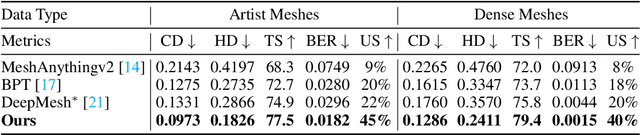
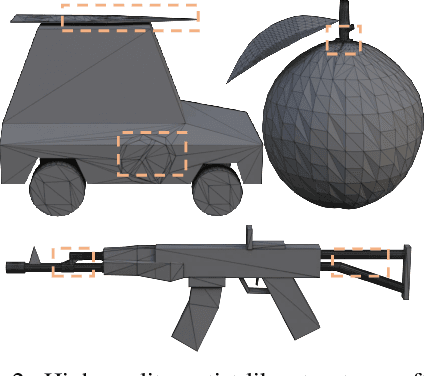
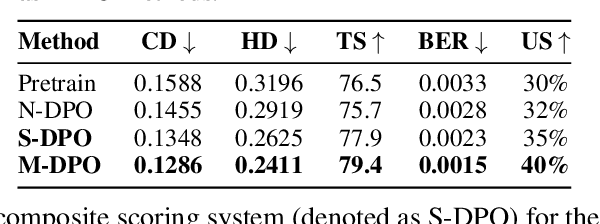
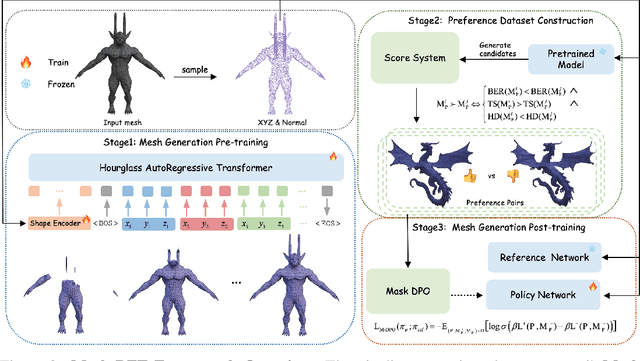
Existing pretrained models for 3D mesh generation often suffer from data biases and produce low-quality results, while global reinforcement learning (RL) methods rely on object-level rewards that struggle to capture local structure details. To address these challenges, we present \textbf{Mesh-RFT}, a novel fine-grained reinforcement fine-tuning framework that employs Masked Direct Preference Optimization (M-DPO) to enable localized refinement via quality-aware face masking. To facilitate efficient quality evaluation, we introduce an objective topology-aware scoring system to evaluate geometric integrity and topological regularity at both object and face levels through two metrics: Boundary Edge Ratio (BER) and Topology Score (TS). By integrating these metrics into a fine-grained RL strategy, Mesh-RFT becomes the first method to optimize mesh quality at the granularity of individual faces, resolving localized errors while preserving global coherence. Experiment results show that our M-DPO approach reduces Hausdorff Distance (HD) by 24.6\% and improves Topology Score (TS) by 3.8\% over pre-trained models, while outperforming global DPO methods with a 17.4\% HD reduction and 4.9\% TS gain. These results demonstrate Mesh-RFT's ability to improve geometric integrity and topological regularity, achieving new state-of-the-art performance in production-ready mesh generation. Project Page: \href{https://hitcslj.github.io/mesh-rft/}{this https URL}.
IRASim: Learning Interactive Real-Robot Action Simulators
Jun 20, 2024


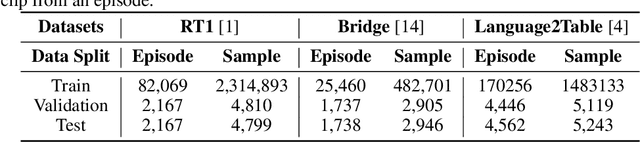
Scalable robot learning in the real world is limited by the cost and safety issues of real robots. In addition, rolling out robot trajectories in the real world can be time-consuming and labor-intensive. In this paper, we propose to learn an interactive real-robot action simulator as an alternative. We introduce a novel method, IRASim, which leverages the power of generative models to generate extremely realistic videos of a robot arm that executes a given action trajectory, starting from an initial given frame. To validate the effectiveness of our method, we create a new benchmark, IRASim Benchmark, based on three real-robot datasets and perform extensive experiments on the benchmark. Results show that IRASim outperforms all the baseline methods and is more preferable in human evaluations. We hope that IRASim can serve as an effective and scalable approach to enhance robot learning in the real world. To promote research for generative real-robot action simulators, we open-source code, benchmark, and checkpoints at https: //gen-irasim.github.io.
Learning to Describe for Predicting Zero-shot Drug-Drug Interactions
Mar 13, 2024Adverse drug-drug interactions~(DDIs) can compromise the effectiveness of concurrent drug administration, posing a significant challenge in healthcare. As the development of new drugs continues, the potential for unknown adverse effects resulting from DDIs becomes a growing concern. Traditional computational methods for DDI prediction may fail to capture interactions for new drugs due to the lack of knowledge. In this paper, we introduce a new problem setup as zero-shot DDI prediction that deals with the case of new drugs. Leveraging textual information from online databases like DrugBank and PubChem, we propose an innovative approach TextDDI with a language model-based DDI predictor and a reinforcement learning~(RL)-based information selector, enabling the selection of concise and pertinent text for accurate DDI prediction on new drugs. Empirical results show the benefits of the proposed approach on several settings including zero-shot and few-shot DDI prediction, and the selected texts are semantically relevant. Our code and data are available at \url{https://github.com/zhufq00/DDIs-Prediction}.