 Add to Chrome
 Add to Firefox
 Add to Edge
World-to-Wrist: Task-Conditioned Future Wrist Modeling for Fine-Grained Robot Manipulation
Aug 05, 2026
Vision-language-action (VLA) models often treat main-view and wrist-view observations as parallel visual inputs, overlooking their distinct roles in robot manipulation. Fine-grained manipulation, however, benefits from anticipating how wrist-local interactions may evolve under the global task context. To address this limitation, we present World-to-Wrist VLA (W2-VLA), a VLA model for fine-grained robot manipulation with task-conditioned future wrist modeling. Given current multi-view observations and a task instruction, W2-VLA contextualizes a set of latent modeling tokens as a compact interface between the vision-language model and the wrist predictor. Conditioned on this interface and the observed wrist history, the predictor forecasts future wrist latents, which are transformed into future-aware context for action prediction. In addition, we introduce W2-CoT, a synthesis pipeline that produces structured annotations describing manipulation progress, physical transition cues, and wrist-local evidence. These annotations provide auxiliary supervision that shapes the task-conditioned latent interface. Experiments on LIBERO, RoboTwin 2.0, and real-world manipulation tasks demonstrate improved fine-grained and contact-sensitive manipulation across both single-arm and bimanual settings, while maintaining action-generation rates above 80 Hz.

RedFlow: Redirect Failure into Action-Level Corrections for Flow-matching VLA Policy
Jul 30, 2026Flow-matching Vision-Language-Action (VLA) policies have shown strong potential for robotic manipulation but often suffer from compounding errors caused by distribution shifts during deployment. While offline reinforcement learning (RL) provides a practical way to improve deployed policies using rollout data, existing methods either ignore failure data or exploit it only at the trajectory level, resulting in low learning efficiency and persistent errors. We propose **RedFlow**, a fine-grained offline RL framework that redirects failure experiences into action-level corrective supervision for flow-matching VLA policies. RedFlow consists of two key components: (1) a **Context-Aware Corrective Matching** mechanism that identifies failure-inducing actions and retrieves successful alternatives from similar contexts as corrective targets, and (2) an **Adaptive Redirection Objective** that jointly reinforces successful actions, suppresses undesirable ones, and redirects recoverable failures toward corrective targets. By converting both successful and failed experiences into dense supervision, RedFlow enables robust recovery learning from mixed-quality data. Experiments on the LIBERO benchmark and three real-world manipulation tasks show that RedFlow consistently outperforms state-of-the-art offline RL baselines, improving the real-world success rate from 56.7% to 74.7%. It also matches strong on-policy methods (PPO, GRPO, and DDPO) while requiring roughly an order of magnitude fewer training samples.
HALO: A Unified Vision-Language-Action Model for Embodied Multimodal Chain-of-Thought Reasoning
Feb 24, 2026Vision-Language-Action (VLA) models have shown strong performance in robotic manipulation, but often struggle in long-horizon or out-of-distribution scenarios due to the lack of explicit mechanisms for multimodal reasoning and anticipating how the world will evolve under action. Recent works introduce textual chain-of-thought or visual subgoal prediction within VLA models to reason, but still fail to offer a unified human-like reasoning framework for joint textual reasoning, visual foresight, and action prediction. To this end, we propose HALO, a unified VLA model that enables embodied multimodal chain-of-thought (EM-CoT) reasoning through a sequential process of textual task reasoning, visual subgoal prediction for fine-grained guidance, and EM-CoT-augmented action prediction. We instantiate HALO with a Mixture-of-Transformers (MoT) architecture that decouples semantic reasoning, visual foresight, and action prediction into specialized experts while allowing seamless cross-expert collaboration. To enable HALO learning at scale, we introduce an automated pipeline to synthesize EM-CoT training data along with a carefully crafted training recipe. Extensive experiments demonstrate that: (1) HALO achieves superior performance in both simulated and real-world environments, surpassing baseline policy pi_0 by 34.1% on RoboTwin benchmark; (2) all proposed components of the training recipe and EM-CoT design help improve task success rate; and (3) HALO exhibits strong generalization capabilities under aggressive unseen environmental randomization with our proposed EM-CoT reasoning.
WMPO: World Model-based Policy Optimization for Vision-Language-Action Models
Nov 12, 2025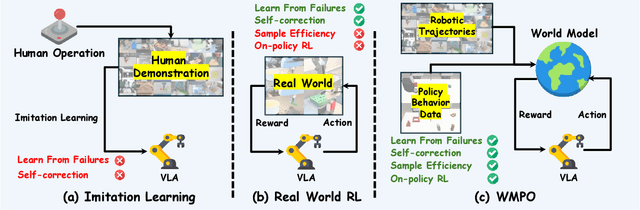
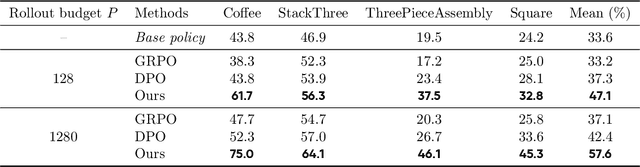
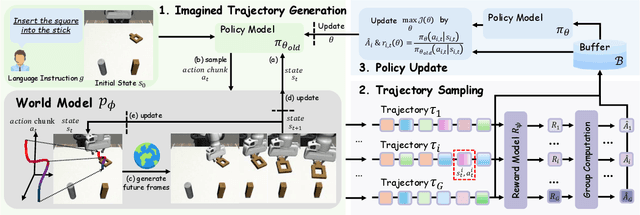
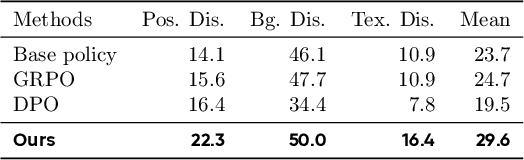
Vision-Language-Action (VLA) models have shown strong potential for general-purpose robotic manipulation, but their reliance on expert demonstrations limits their ability to learn from failures and perform self-corrections. Reinforcement learning (RL) addresses these through self-improving interactions with the physical environment, but suffers from high sample complexity on real robots. We introduce World-Model-based Policy Optimization (WMPO), a principled framework for on-policy VLA RL without interacting with the real environment. In contrast to widely used latent world models, WMPO focuses on pixel-based predictions that align the "imagined" trajectories with the VLA features pretrained with web-scale images. Crucially, WMPO enables the policy to perform on-policy GRPO that provides stronger performance than the often-used off-policy methods. Extensive experiments in both simulation and real-robot settings demonstrate that WMPO (i) substantially improves sample efficiency, (ii) achieves stronger overall performance, (iii) exhibits emergent behaviors such as self-correction, and (iv) demonstrates robust generalization and lifelong learning capabilities.