 Add to Chrome
 Add to Firefox
 Add to Edge
Temporally Grounded Compositional Camera Motion Understanding via Geometric Knowledge Distillation
Aug 11, 2026
Understanding camera motion is fundamental to video perception, with applications in spatial intelligence and controllable video generation. Multimodal large language models (MLLMs) provide a natural interface for this task, but existing work typically assigns one or more labels to an entire clip. Such clip-level recognition overlooks two defining properties of real camera motion: it can change within a shot, and multiple movements can occur simultaneously. We therefore formulate camera-motion understanding as temporally grounded, compositional recognition, which requires a model to localize motion-consistent intervals and identify every movement active within each interval. We introduce CamChoreo, a benchmark of 4,229 real single-shot clips with expert-annotated temporal segments. Its annotations use a compact vocabulary of 20 direction-aware labels, and nearly half of the segments contain compound camera motion, with multiple movement primitives active simultaneously. Recognizing such fine-grained, compositional motion is hard for current MLLMs, whose visual encoders emphasize semantic content rather than the geometric evidence on which camera motion depends. Directly injecting features from a frozen 3D foundation model addresses this gap, but requires running the expensive geometry model on every input; we refer to this baseline as CamInject. We instead propose CamDistill, which distills the same geometric knowledge into lightweight camera tokens during training and removes the 3D model at inference. CamDistill matches the accuracy of direct feature injection without running the 3D teacher at inference. Together, CamChoreo and CamDistill advance camera-motion understanding from clip-level labeling to temporally grounded, compositional recognition. Project page: https://ddz16.github.io/cammotion.github.io/.

WorldCycle: Self-Verifiable Reinforcement Learning for Long-Horizon Video World Models
Aug 05, 2026Interactive video world models are essential for long-horizon planning and exploration, yet they suffer from compounding errors. Post-training methods such as reinforcement learning (RL) can improve these models, but they hit a verification bottleneck: for arbitrary action sequences, no ground-truth future state exists to measure long-term drift. Our key insight is that reversible action cycles make this verification possible: a sequence composed with its inverse must analytically return to the initial state, yielding annotation-free supervision on long-horizon correctness. Building on this, we introduce WorldCycle, a self-verifiable RL framework that constructs closed action cycles and their repeated executions from ordinary action sequences, and optimizes two complementary rewards: a spatial closure reward enforcing symmetry between mirrored forward and reverse segments, and a temporal consistency reward aligning states across repeated cycle executions. These rewards force the model to learn actions as consistent state operators rather than memorized temporal patterns, and extend naturally to out-of-distribution composite action cycles that the base model handles poorly. We further release CycleBench, a diagnostic benchmark for state-returning ability under complex action structures. WorldCycle reduces state returning drift by up to 44% and lifts composite-action accuracy nearly 4x over the base model, providing a vital foundation for physically grounded world models.
OPTD: On-Policy Transition Distillation with Consistency-Guided Adaptive Compression for Few-Step Diffusion Language Models
Aug 03, 2026Diffusion language models (dLLMs) can predict many tokens in parallel, but accurate generation still requires many iterative denoising steps. Few-step distillation accelerates decoding by compressing multiple teacher steps into a single student transition. However, existing methods construct supervision on off-policy trajectories. At inference, the student's early parallel commitments alter the context of later predictions, so the states it actually visits drift away from the supervised ones--precisely when step compression is most aggressive. On-policy distillation is a natural remedy for this mismatch, but it leaves open how far each transition should advance: matching only the teacher's next action limits compression, while indiscriminately merging future actions can violate intermediate dependencies. To address this limitation, we propose OPTD, On-Policy Transition Distillation with consistency-guided adaptive compression. It samples partial states from the few-step student's own trajectories, uses a frozen, question-only teacher to identify outcome-aligned future candidates, and orders them by current-state confidence. The method then selects the longest prefix whose joint commitment preserves the teacher's rollout outcome. A set-bottleneck objective promotes every verified future candidate to the decoder's release threshold, while a frozen-teacher KL anchor regularizes all other active positions. Neither target construction nor training uses a gold response. Across four mathematical reasoning and code-generation benchmarks, OPTD consistently improves the quality--efficiency trade-off and attains the strongest overall quality-constrained AUP among the evaluated few-step baselines.
WorldCraft: From Camera Navigation to Object Manipulation in Interactive Video World Models
May 24, 2026Recent video-based world models have made pixel-space environments interactive at the camera level: users can navigate viewpoints while the model generates coherent visual continuations. Yet their action spaces remain incomplete: users can move the camera, but cannot act on individual objects. Since real-world interaction is inherently object-centric, such models remain closer to passive scene observers than truly manipulable environments. We present WorldCraft, a framework that expands interactive video world models from camera navigation to object-level trajectory actions. Given a user click and a sketched path, WorldCraft generates future frames in which the selected object follows the prescribed trajectory while the camera continues to navigate the scene. WorldCraft achieves this through a trajectory-centric control pipeline: First, Normalized World Trajectory (NWT) represents user-drawn motion in a camera-invariant world coordinate system and dynamically re-projects it under the current camera pose, separating object motion from camera-induced screen-space displacement; Spatial-Pathway LoRA (SP-LoRA) then injects this world-space signal through the model's spatial-control pathway, adding object manipulation capability while preserving the pretrained camera controller; finally, Trajectory-Anchored State Persistence (TASP) treats the world trajectory as a persistent spatial state and refreshes autoregressive memory after trajectory-conditioned generation, allowing moved objects to reappear at their updated positions after leaving the camera view. Experiments show that WorldCraft enables accurate object control, preserves the video-based world model's camera fidelity under camera-only evaluation, and maintains object state across long autoregressive rollouts with off-camera excursions.
EvalVerse: Pipeline-Aware and Expert-Calibrated Benchmarking for Professional Cinematic Video Generation
May 22, 2026The rapid evolution of generative video foundation models has propelled the field toward professional-grade cinematic synthesis. To achieve such demanding quality, the community transitions towards Reinforcement Learning (RL) and agentic workflows. However, reliable evaluation has emerged as a critical bottleneck. Existing benchmarks predominantly evaluate ''whether it is right'' (basic prompt-following) while fundamentally neglecting ''whether it is good'' (cinematic quality, acting, and aesthetics). Furthermore, current automated metrics lack the domain-specific rigor required to provide trustworthy signals, creating a severe credibility gap between human aesthetic perception and machine scoring. To bridge this gap, we introduce EvalVerse, a comprehensive, pipeline-aware, and expert-calibrated evaluation framework. We treat video generation assessment not merely as an engineering task, but as a core scientific problem: the systematic digitization of subjective cinematic expertise. First, we organize domain knowledge into an evaluation taxonomy aligned with the professional filmmaking workflow (pre-production, production, and post-production). Second, we distill human expert judgments into a curated dataset with large-scale human annotations. Third, we inject this knowledge into Vision-Language Models (VLMs) through an expert-calibrated fine-tuning strategy, enabling the VLM to perform explicit Chain-of-Thought reasoning. Compared to previous works, EvalVerse not only retains compatibility with foundational ''rightness'' metrics, but also significantly expands the criteria to ''goodness'' and broaden the task coverage to complex multi-shot sequencing and audio-visual integration. Consequently, by providing granular diagnostic signals, EvalVerse transcends a static leaderboard and establishes a fundamental infrastructure for future work, such as reward models and evaluator agent.
Learning Spatiotemporal Sensitivity in Video LLMs via Counterfactual Reinforcement Learning
May 21, 2026Video large language models (Video LLMs) achieve strong benchmark accuracy, yet often answer video questions through shortcuts such as single-frame cues and language priors rather than by tracking spatiotemporal dynamics. This issue is exacerbated in RL post-training, where correctness-only rewards can further reinforce shortcut policies that obtain high reward without tracking video dynamics. We address this by asking a controlled counterfactual question: if the visual world changed while the question remained fixed, should the answer change or stay the same? Based on this view, we propose \textbf{Counterfactual Relational Policy Optimization (CRPO)}, a dual-branch RL framework for improving \emph{spatiotemporal sensitivity}. CRPO constructs counterfactual videos through horizontal flips and temporal reversals, trains on both original and counterfactual branches, and introduces a \textbf{Counterfactual Relation Reward (CRR)} between their answers. CRR encourages answers to change for dynamic questions and remain unchanged for static questions. This cross-branch constraint makes it difficult for shortcut policies to be consistently rewarded across both branches. To evaluate this property, we introduce \textbf{DyBench}, a paired counterfactual video benchmark with 3,014 videos covering reversible dynamics, moving direction, and event sequence, together with a strict pair-accuracy metric that prevents fixed-answer shortcuts from inflating scores. Experiments show that CRPO outperforms prior RL methods on spatiotemporal-sensitive evaluations while maintaining competitive general video performance. On Qwen3-VL-8B, CRPO improves DyBench P-Acc by +7.7 and TimeBlind I-Acc by +8.2 over the base model, indicating improved spatiotemporal sensitivity rather than stronger reliance on static shortcuts. The project website can be found at https://ddz16.github.io/crpo.github.io/ .
Advanced Video Inpainting Using Optical Flow-Guided Efficient Diffusion
Dec 01, 2024Recently, diffusion-based methods have achieved great improvements in the video inpainting task. However, these methods still face many challenges, such as maintaining temporal consistency and the time-consuming issue. This paper proposes an advanced video inpainting framework using optical Flow-guided Efficient Diffusion, called FloED. Specifically, FloED employs a dual-branch architecture, where a flow branch first restores corrupted flow and a multi-scale flow adapter provides motion guidance to the main inpainting branch. Additionally, a training-free latent interpolation method is proposed to accelerate the multi-step denoising process using flow warping. Further introducing a flow attention cache mechanism, FLoED efficiently reduces the computational cost brought by incorporating optical flow. Comprehensive experiments in both background restoration and object removal tasks demonstrate that FloED outperforms state-of-the-art methods from the perspective of both performance and efficiency.
Flow-Guided Diffusion for Video Inpainting
Nov 26, 2023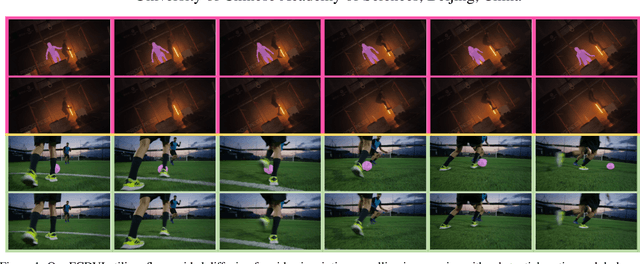
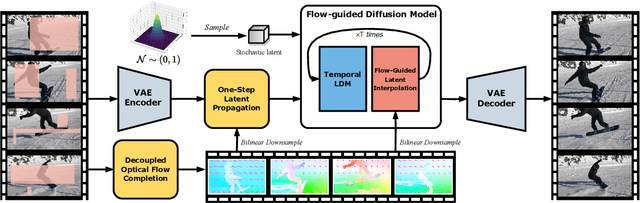
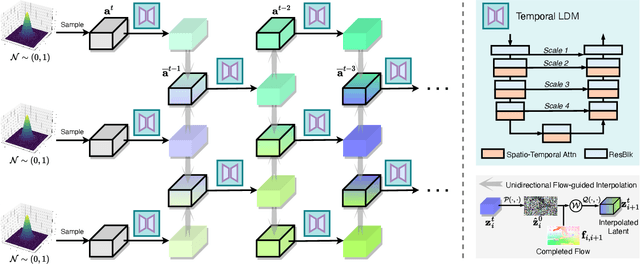
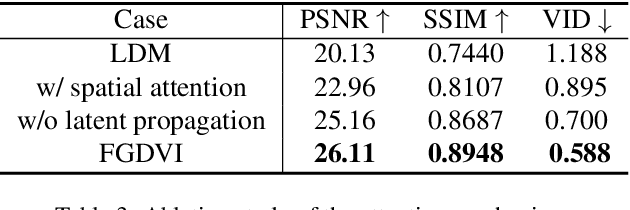
Video inpainting has been challenged by complex scenarios like large movements and low-light conditions. Current methods, including emerging diffusion models, face limitations in quality and efficiency. This paper introduces the Flow-Guided Diffusion model for Video Inpainting (FGDVI), a novel approach that significantly enhances temporal consistency and inpainting quality via reusing an off-the-shelf image generation diffusion model. We employ optical flow for precise one-step latent propagation and introduces a model-agnostic flow-guided latent interpolation technique. This technique expedites denoising, seamlessly integrating with any Video Diffusion Model (VDM) without additional training. Our FGDVI demonstrates a remarkable 10% improvement in flow warping error E_warp over existing state-of-the-art methods. Our comprehensive experiments validate superior performance of FGDVI, offering a promising direction for advanced video inpainting. The code and detailed results will be publicly available in https://github.com/NevSNev/FGDVI.
Two Birds, One Stone: A Unified Framework for Joint Learning of Image and Video Style Transfers
Apr 22, 2023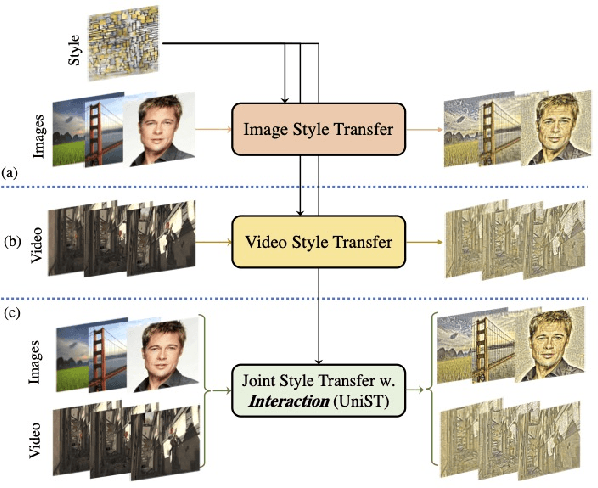

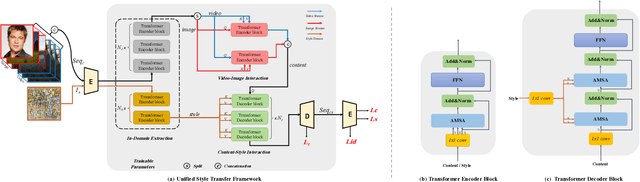
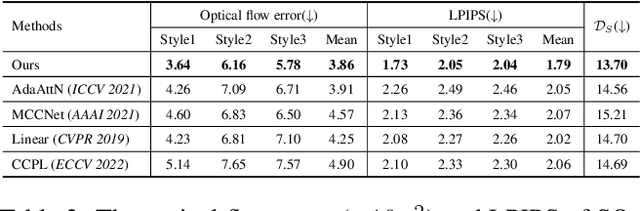
Current arbitrary style transfer models are limited to either image or video domains. In order to achieve satisfying image and video style transfers, two different models are inevitably required with separate training processes on image and video domains, respectively. In this paper, we show that this can be precluded by introducing UniST, a Unified Style Transfer framework for both images and videos. At the core of UniST is a domain interaction transformer (DIT), which first explores context information within the specific domain and then interacts contextualized domain information for joint learning. In particular, DIT enables exploration of temporal information from videos for the image style transfer task and meanwhile allows rich appearance texture from images for video style transfer, thus leading to mutual benefits. Considering heavy computation of traditional multi-head self-attention, we present a simple yet effective axial multi-head self-attention (AMSA) for DIT, which improves computational efficiency while maintains style transfer performance. To verify the effectiveness of UniST, we conduct extensive experiments on both image and video style transfer tasks and show that UniST performs favorably against state-of-the-art approaches on both tasks. Our code and results will be released.