 Add to Chrome
 Add to Firefox
 Add to Edge
Consistent-Inversion: Reverse Consistency Guidance for Structure-Preserving Visual Editing
Jun 05, 2026
Text-guided diffusion models have become effective tools for real-image visual editing, where the edited image must follow a target instruction while preserving editing-irrelevant structure. Most training-free editors rely on inversion: a source image is mapped to a noisy latent trajectory and the terminal latent is reused for target-prompt denoising. This reuse is useful for preservation, but it also couples source reconstruction and target editing. The resulting trajectory mismatch may either damage background/layout details or over-constrain the intended edit. This paper presents Consistent-Inversion, a training-free reverse consistency guidance framework for structure-preserving visual editing. Instead of treating the inverted source latent as a fixed initialization, Consistent-Inversion checks whether an intermediate target trajectory can be reversed toward the source inversion trajectory under the source prompt. To make this check well-defined, we construct an auxiliary target-side noise representation, perform source-guided reverse denoising, and use the resulting reverse consistency discrepancy as a correction signal for selected early target denoising steps. The method does not update model parameters, is compatible with inversion-based editors, and introduces only a small inference overhead when applied sparsely. Experiments on PIE-Bench show that Consistent-Inversion improves background and structural fidelity under a unified SD3.5 protocol while maintaining target-prompt alignment, and compatibility experiments further verify the same correction principle on classical Stable-Diffusion inversion pipelines.

AdaTok: Self-Budgeting Image Tokenization with Quality-Preserving Dynamic Tokens
Jun 05, 2026Image tokenizers, from 2D grids to recent 1D sequences, typically encode every image with the same fixed number of tokens. Yet visual complexity is highly heterogeneous, so a uniform budget overspends on simple inputs and underserves complex ones. Existing elastic tokenizers expose variable-length reconstructions, but often leave token length as a deployment-time operating point, a search target, or an external prediction rather than an output of the tokenizer itself. In this work, we ask whether a discrete visual tokenizer can budget itself in one pass. Our central finding is that actionable elasticity requires a representation--allocation co-design: prefixes must remain decodable across budgets, and the tokenizer must learn which prefix each image needs. We propose AdaTok, a self-budgeting discrete 1D tokenizer. AdaTok combines Prioritized Representation Learning, which orders tokens with nested tail masking and resolves budget-dependent semantic shift through Multi-Head LoRA decoder heads, with Adaptive Token Allocation, which trains a lightweight deterministic-group GRPO policy over candidate budgets. Dynamic Pareto Weighting balances fidelity and efficiency during policy training without manual trade-off sweeps. On ImageNet-1K, AdaTok-Full reaches rFID 1.31 at 256 tokens, while AdaTok-Adaptive attains rFID 1.50 using only ~118 tokens on average, outperforming discrete 1D baselines at comparable budgets. In autoregressive image generation, the shorter adaptive representation yields ~2.1x throughput over a fixed 256-token decode, suggesting that visual token count can be learned as a content-conditioned output rather than set as a fixed hyperparameter.
WorldCraft: From Camera Navigation to Object Manipulation in Interactive Video World Models
May 24, 2026Recent video-based world models have made pixel-space environments interactive at the camera level: users can navigate viewpoints while the model generates coherent visual continuations. Yet their action spaces remain incomplete: users can move the camera, but cannot act on individual objects. Since real-world interaction is inherently object-centric, such models remain closer to passive scene observers than truly manipulable environments. We present WorldCraft, a framework that expands interactive video world models from camera navigation to object-level trajectory actions. Given a user click and a sketched path, WorldCraft generates future frames in which the selected object follows the prescribed trajectory while the camera continues to navigate the scene. WorldCraft achieves this through a trajectory-centric control pipeline: First, Normalized World Trajectory (NWT) represents user-drawn motion in a camera-invariant world coordinate system and dynamically re-projects it under the current camera pose, separating object motion from camera-induced screen-space displacement; Spatial-Pathway LoRA (SP-LoRA) then injects this world-space signal through the model's spatial-control pathway, adding object manipulation capability while preserving the pretrained camera controller; finally, Trajectory-Anchored State Persistence (TASP) treats the world trajectory as a persistent spatial state and refreshes autoregressive memory after trajectory-conditioned generation, allowing moved objects to reappear at their updated positions after leaving the camera view. Experiments show that WorldCraft enables accurate object control, preserves the video-based world model's camera fidelity under camera-only evaluation, and maintains object state across long autoregressive rollouts with off-camera excursions.
LLaDA2.0: Scaling Up Diffusion Language Models to 100B
Dec 24, 2025This paper presents LLaDA2.0 -- a tuple of discrete diffusion large language models (dLLM) scaling up to 100B total parameters through systematic conversion from auto-regressive (AR) models -- establishing a new paradigm for frontier-scale deployment. Instead of costly training from scratch, LLaDA2.0 upholds knowledge inheritance, progressive adaption and efficiency-aware design principle, and seamless converts a pre-trained AR model into dLLM with a novel 3-phase block-level WSD based training scheme: progressive increasing block-size in block diffusion (warm-up), large-scale full-sequence diffusion (stable) and reverting back to compact-size block diffusion (decay). Along with post-training alignment with SFT and DPO, we obtain LLaDA2.0-mini (16B) and LLaDA2.0-flash (100B), two instruction-tuned Mixture-of-Experts (MoE) variants optimized for practical deployment. By preserving the advantages of parallel decoding, these models deliver superior performance and efficiency at the frontier scale. Both models were open-sourced.
Spider: Any-to-Many Multimodal LLM
Nov 14, 2024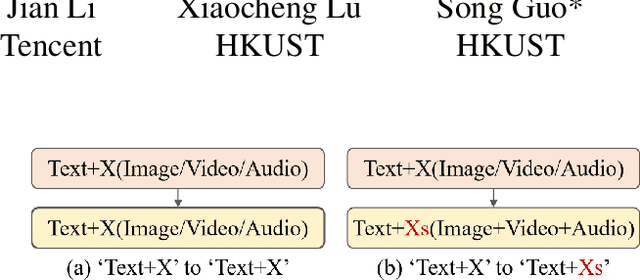


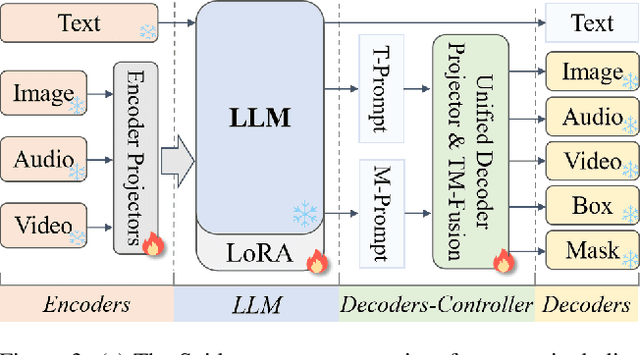
Multimodal LLMs (MLLMs) have emerged as an extension of Large Language Models (LLMs), enabling the integration of various modalities. However, Any-to-Any MLLMs are limited to generating pairwise modalities 'Text + X' within a single response, such as Text + {Image or Audio or Video}. To address this limitation, we introduce Spider, a novel efficient Any-to-Many Modalities Generation (AMMG) framework, which can generate an arbitrary combination of modalities 'Text + Xs', such as Text + {Image and Audio and Video}. To achieve efficient AMMG, our Spider integrates three core components: a Base Model for basic X-to-X (i.e., Any-to-Any) modality processing, a novel Efficient Decoders-Controller for controlling multimodal Decoders to generate Xs (many-modal) contents, and an Any-to-Many Instruction Template designed for producing Xs signal prompts. To train Spider, we constructed a novel Text-formatted Many-Modal (TMM) dataset, which facilitates the learning of the X-to-Xs (i.e., Any-to-Many) capability necessary for AMMG. Ultimately, the well-trained Spider generates a pseudo X-to-Xs dataset, the first-ever X-to-Xs many-modal dataset, enhancing the potential for AMMG task in future research. Overall, this work not only pushes the boundary of multimodal interaction but also provides rich data support for advancing the field.
Epsilon: Exploring Comprehensive Visual-Semantic Projection for Multi-Label Zero-Shot Learning
Aug 25, 2024This paper investigates a challenging problem of zero-shot learning in the multi-label scenario (MLZSL), wherein the model is trained to recognize multiple unseen classes within a sample (e.g., an image) based on seen classes and auxiliary knowledge, e.g., semantic information. Existing methods usually resort to analyzing the relationship of various seen classes residing in a sample from the dimension of spatial or semantic characteristics and transferring the learned model to unseen ones. However, they neglect the integrity of local and global features. Although the use of the attention structure will accurately locate local features, especially objects, it will significantly lose its integrity, and the relationship between classes will also be affected. Rough processing of global features will also directly affect comprehensiveness. This neglect will make the model lose its grasp of the main components of the image. Relying only on the local existence of seen classes during the inference stage introduces unavoidable bias. In this paper, we propose a novel and comprehensive visual-semantic framework for MLZSL, dubbed Epsilon, to fully make use of such properties and enable a more accurate and robust visual-semantic projection. In terms of spatial information, we achieve effective refinement by group aggregating image features into several semantic prompts. It can aggregate semantic information rather than class information, preserving the correlation between semantics. In terms of global semantics, we use global forward propagation to collect as much information as possible to ensure that semantics are not omitted. Experiments on large-scale MLZSL benchmark datasets NUS-Wide and Open-Images-v4 demonstrate that the proposed Epsilon outperforms other state-of-the-art methods with large margins.
Dual Expert Distillation Network for Generalized Zero-Shot Learning
Apr 29, 2024Zero-shot learning has consistently yielded remarkable progress via modeling nuanced one-to-one visual-attribute correlation. Existing studies resort to refining a uniform mapping function to align and correlate the sample regions and subattributes, ignoring two crucial issues: 1) the inherent asymmetry of attributes; and 2) the unutilized channel information. This paper addresses these issues by introducing a simple yet effective approach, dubbed Dual Expert Distillation Network (DEDN), where two experts are dedicated to coarse- and fine-grained visual-attribute modeling, respectively. Concretely, one coarse expert, namely cExp, has a complete perceptual scope to coordinate visual-attribute similarity metrics across dimensions, and moreover, another fine expert, namely fExp, consists of multiple specialized subnetworks, each corresponds to an exclusive set of attributes. Two experts cooperatively distill from each other to reach a mutual agreement during training. Meanwhile, we further equip DEDN with a newly designed backbone network, i.e., Dual Attention Network (DAN), which incorporates both region and channel attention information to fully exploit and leverage visual semantic knowledge. Experiments on various benchmark datasets indicate a new state-of-the-art.
DiPrompT: Disentangled Prompt Tuning for Multiple Latent Domain Generalization in Federated Learning
Mar 11, 2024Federated learning (FL) has emerged as a powerful paradigm for learning from decentralized data, and federated domain generalization further considers the test dataset (target domain) is absent from the decentralized training data (source domains). However, most existing FL methods assume that domain labels are provided during training, and their evaluation imposes explicit constraints on the number of domains, which must strictly match the number of clients. Because of the underutilization of numerous edge devices and additional cross-client domain annotations in the real world, such restrictions may be impractical and involve potential privacy leaks. In this paper, we propose an efficient and novel approach, called Disentangled Prompt Tuning (DiPrompT), a method that tackles the above restrictions by learning adaptive prompts for domain generalization in a distributed manner. Specifically, we first design two types of prompts, i.e., global prompt to capture general knowledge across all clients and domain prompts to capture domain-specific knowledge. They eliminate the restriction on the one-to-one mapping between source domains and local clients. Furthermore, a dynamic query metric is introduced to automatically search the suitable domain label for each sample, which includes two-substep text-image alignments based on prompt tuning without labor-intensive annotation. Extensive experiments on multiple datasets demonstrate that our DiPrompT achieves superior domain generalization performance over state-of-the-art FL methods when domain labels are not provided, and even outperforms many centralized learning methods using domain labels.
ParsNets: A Parsimonious Orthogonal and Low-Rank Linear Networks for Zero-Shot Learning
Dec 21, 2023
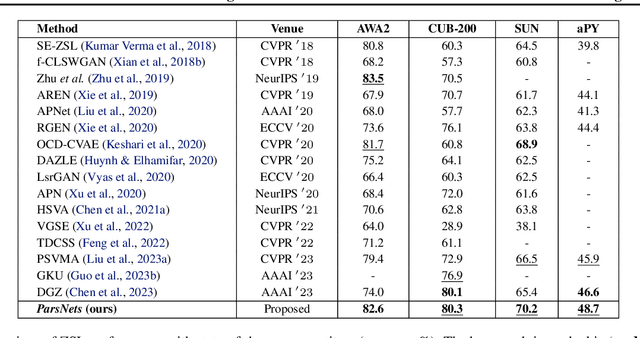
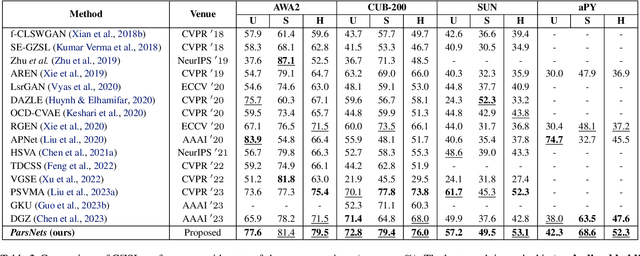
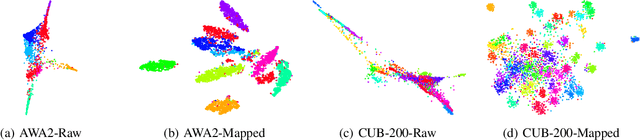
This paper provides a novel parsimonious yet efficient design for zero-shot learning (ZSL), dubbed ParsNets, where we are interested in learning a composition of on-device friendly linear networks, each with orthogonality and low-rankness properties, to achieve equivalent or even better performance against existing deep models. Concretely, we first refactor the core module of ZSL, i.e., visual-semantics mapping function, into several base linear networks that correspond to diverse components of the semantic space, where the complex nonlinearity can be collapsed into simple local linearities. Then, to facilitate the generalization of local linearities, we construct a maximal margin geometry on the learned features by enforcing low-rank constraints on intra-class samples and high-rank constraints on inter-class samples, resulting in orthogonal subspaces for different classes and each subspace lies on a compact manifold. To enhance the model's adaptability and counterbalance over/under-fittings in ZSL, a set of sample-wise indicators is employed to select a sparse subset from these base linear networks to form a composite semantic predictor for each sample. Notably, maximal margin geometry can guarantee the diversity of features, and meanwhile, local linearities guarantee efficiency. Thus, our ParsNets can generalize better to unseen classes and can be deployed flexibly on resource-constrained devices. Theoretical explanations and extensive experiments are conducted to verify the effectiveness of the proposed method.
Attribute-Aware Representation Rectification for Generalized Zero-Shot Learning
Dec 01, 2023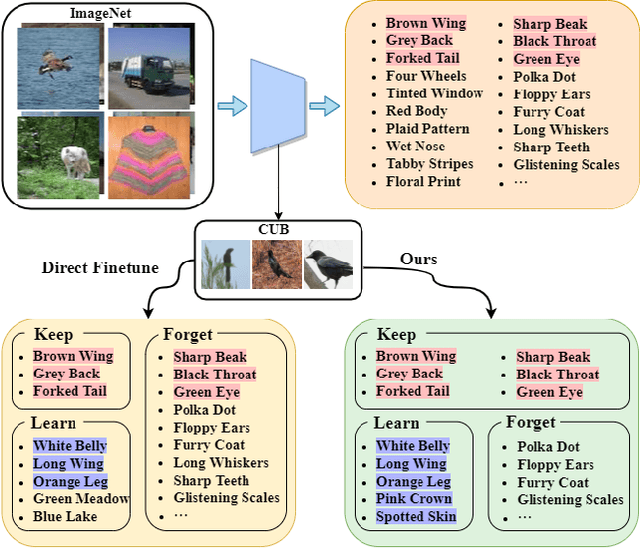
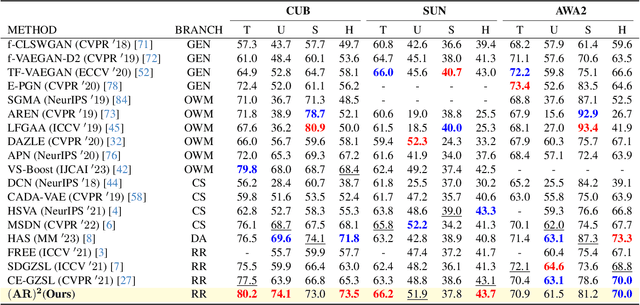
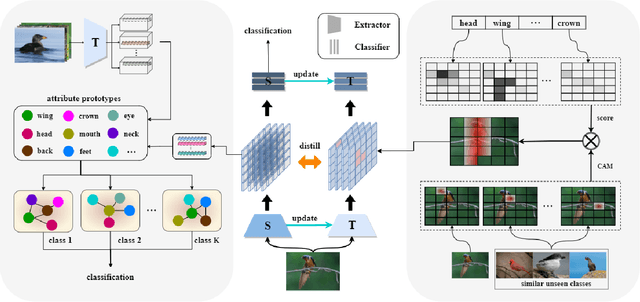
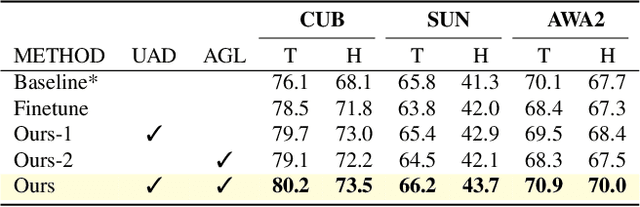
Generalized Zero-shot Learning (GZSL) has yielded remarkable performance by designing a series of unbiased visual-semantics mappings, wherein, the precision relies heavily on the completeness of extracted visual features from both seen and unseen classes. However, as a common practice in GZSL, the pre-trained feature extractor may easily exhibit difficulty in capturing domain-specific traits of the downstream tasks/datasets to provide fine-grained discriminative features, i.e., domain bias, which hinders the overall recognition performance, especially for unseen classes. Recent studies partially address this issue by fine-tuning feature extractors, while may inevitably incur catastrophic forgetting and overfitting issues. In this paper, we propose a simple yet effective Attribute-Aware Representation Rectification framework for GZSL, dubbed $\mathbf{(AR)^{2}}$, to adaptively rectify the feature extractor to learn novel features while keeping original valuable features. Specifically, our method consists of two key components, i.e., Unseen-Aware Distillation (UAD) and Attribute-Guided Learning (AGL). During training, UAD exploits the prior knowledge of attribute texts that are shared by both seen/unseen classes with attention mechanisms to detect and maintain unseen class-sensitive visual features in a targeted manner, and meanwhile, AGL aims to steer the model to focus on valuable features and suppress them to fit noisy elements in the seen classes by attribute-guided representation learning. Extensive experiments on various benchmark datasets demonstrate the effectiveness of our method.