 Add to Chrome
 Add to Firefox
 Add to Edge
RedFlow: Redirect Failure into Action-Level Corrections for Flow-matching VLA Policy
Jul 30, 2026
Flow-matching Vision-Language-Action (VLA) policies have shown strong potential for robotic manipulation but often suffer from compounding errors caused by distribution shifts during deployment. While offline reinforcement learning (RL) provides a practical way to improve deployed policies using rollout data, existing methods either ignore failure data or exploit it only at the trajectory level, resulting in low learning efficiency and persistent errors. We propose **RedFlow**, a fine-grained offline RL framework that redirects failure experiences into action-level corrective supervision for flow-matching VLA policies. RedFlow consists of two key components: (1) a **Context-Aware Corrective Matching** mechanism that identifies failure-inducing actions and retrieves successful alternatives from similar contexts as corrective targets, and (2) an **Adaptive Redirection Objective** that jointly reinforces successful actions, suppresses undesirable ones, and redirects recoverable failures toward corrective targets. By converting both successful and failed experiences into dense supervision, RedFlow enables robust recovery learning from mixed-quality data. Experiments on the LIBERO benchmark and three real-world manipulation tasks show that RedFlow consistently outperforms state-of-the-art offline RL baselines, improving the real-world success rate from 56.7% to 74.7%. It also matches strong on-policy methods (PPO, GRPO, and DDPO) while requiring roughly an order of magnitude fewer training samples.

MosaicQuant: Inlier-Outlier Disaggregation for Unified 4-Bit LLM Quantization
Jun 14, 20264-bit quantization significantly reduces the memory footprint and accelerates the inference of large language models (LLMs). However, its limited bit-width representation struggles to faithfully capture both dense common values (\emph{inliers}) and rare large-magnitude values (\emph{outliers}), causing substantial accuracy degradation. Existing mixed-precision methods mitigate this by retaining outliers in high precision, but at the cost of breaking the uniformity of low-bit execution, introducing precision conversion and extra data movement that undermine practical speedup. We propose \textbf{MosaicQuant}, a unified 4-bit LLM quantization paradigm built on a novel principle of \emph{inlier--outlier disaggregation}. Rather than elevating outlier precision, MosaicQuant quantizes the full weight matrix into a dense 4-bit base component, where inliers are captured faithfully while outlier are inevitably quantized. A sparse 4-bit residual component is then introduced to compensate for these quantization errors, selectively targeting the most error-critical weight blocks where output distortion is shown to be concentrated. However, a unified representation alone is insufficient, as naïvely executing the sparse residual as a separate kernel still breaks the unified low-bit inference pipeline. To bridge this gap, we introduce \textbf{ZipperEngine}, which fuses sparse block computation into the dense 4-bit GEMM kernel via an overlapped pipeline, unifying not only the representation but also the execution into a single coherent low-bit inference pipeline. Extensive experiments on LLaMA3 and Qwen3 demonstrate that MosaicQuant preserves near-FP16 accuracy while achieving up to $1.24\times$ speedup over the W16A16 baseline.
OpenSearch-VL: An Open Recipe for Frontier Multimodal Search Agents
May 06, 2026Deep search has become a crucial capability for frontier multimodal agents, enabling models to solve complex questions through active search, evidence verification, and multi-step reasoning. Despite rapid progress, top-tier multimodal search agents remain difficult to reproduce, largely due to the absence of open high-quality training data, transparent trajectory synthesis pipelines, or detailed training recipes. To this end, we introduce OpenSearch-VL, a fully open-source recipe for training frontier multimodal deep search agents with agentic reinforcement learning. First, we curated a dedicated pipeline to construct high-quality training data through Wikipedia path sampling, fuzzy entity rewriting, and source-anchor visual grounding, which jointly reduce shortcuts and one-step retrieval collapse. Based on this pipeline, we curate two training datasets, SearchVL-SFT-36k for SFT and SearchVL-RL-8k for RL. Besides, we design a diverse tool environment that unifies text search, image search, OCR, cropping, sharpening, super-resolution, and perspective correction, enabling agents to combine active perception with external knowledge acquisition. Finally, we propose a multi-turn fatal-aware GRPO training algorithm that handles cascading tool failures by masking post-failure tokens while preserving useful pre-failure reasoning through one-sided advantage clamping. Built on this recipe, OpenSearch-VL delivers substantial performance gains, with over 10-point average improvements across seven benchmarks, and achieves results comparable to proprietary commercial models on several tasks. We will release all data, code, and models to support open research on multimodal deep search agents.
Unify-Agent: A Unified Multimodal Agent for World-Grounded Image Synthesis
Apr 01, 2026Unified multimodal models provide a natural and promising architecture for understanding diverse and complex real-world knowledge while generating high-quality images. However, they still rely primarily on frozen parametric knowledge, which makes them struggle with real-world image generation involving long-tail and knowledge-intensive concepts. Inspired by the broad success of agents on real-world tasks, we explore agentic modeling to address this limitation. Specifically, we present Unify-Agent, a unified multimodal agent for world-grounded image synthesis, which reframes image generation as an agentic pipeline consisting of prompt understanding, multimodal evidence searching, grounded recaptioning, and final synthesis. To train our model, we construct a tailored multimodal data pipeline and curate 143K high-quality agent trajectories for world-grounded image synthesis, enabling effective supervision over the full agentic generation process. We further introduce FactIP, a benchmark covering 12 categories of culturally significant and long-tail factual concepts that explicitly requires external knowledge grounding. Extensive experiments show that our proposed Unify-Agent substantially improves over its base unified model across diverse benchmarks and real world generation tasks, while approaching the world knowledge capabilities of the strongest closed-source models. As an early exploration of agent-based modeling for world-grounded image synthesis, our work highlights the value of tightly coupling reasoning, searching, and generation for reliable open-world agentic image synthesis.
HALO: A Unified Vision-Language-Action Model for Embodied Multimodal Chain-of-Thought Reasoning
Feb 24, 2026Vision-Language-Action (VLA) models have shown strong performance in robotic manipulation, but often struggle in long-horizon or out-of-distribution scenarios due to the lack of explicit mechanisms for multimodal reasoning and anticipating how the world will evolve under action. Recent works introduce textual chain-of-thought or visual subgoal prediction within VLA models to reason, but still fail to offer a unified human-like reasoning framework for joint textual reasoning, visual foresight, and action prediction. To this end, we propose HALO, a unified VLA model that enables embodied multimodal chain-of-thought (EM-CoT) reasoning through a sequential process of textual task reasoning, visual subgoal prediction for fine-grained guidance, and EM-CoT-augmented action prediction. We instantiate HALO with a Mixture-of-Transformers (MoT) architecture that decouples semantic reasoning, visual foresight, and action prediction into specialized experts while allowing seamless cross-expert collaboration. To enable HALO learning at scale, we introduce an automated pipeline to synthesize EM-CoT training data along with a carefully crafted training recipe. Extensive experiments demonstrate that: (1) HALO achieves superior performance in both simulated and real-world environments, surpassing baseline policy pi_0 by 34.1% on RoboTwin benchmark; (2) all proposed components of the training recipe and EM-CoT design help improve task success rate; and (3) HALO exhibits strong generalization capabilities under aggressive unseen environmental randomization with our proposed EM-CoT reasoning.
WMPO: World Model-based Policy Optimization for Vision-Language-Action Models
Nov 12, 2025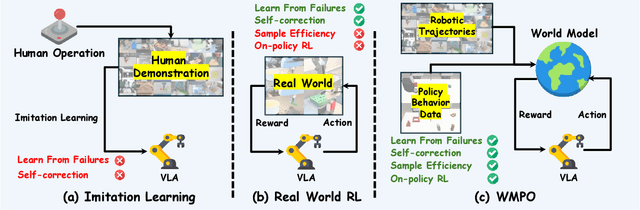
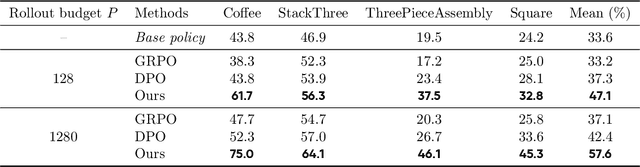
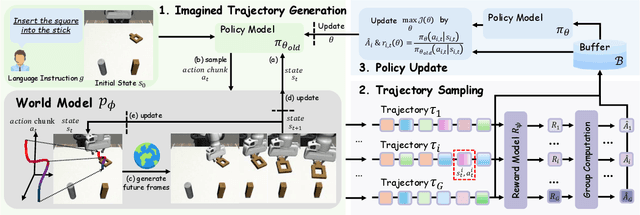
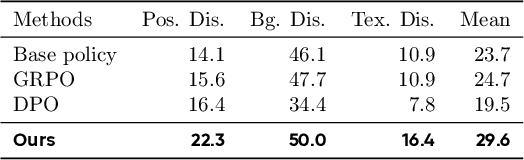
Vision-Language-Action (VLA) models have shown strong potential for general-purpose robotic manipulation, but their reliance on expert demonstrations limits their ability to learn from failures and perform self-corrections. Reinforcement learning (RL) addresses these through self-improving interactions with the physical environment, but suffers from high sample complexity on real robots. We introduce World-Model-based Policy Optimization (WMPO), a principled framework for on-policy VLA RL without interacting with the real environment. In contrast to widely used latent world models, WMPO focuses on pixel-based predictions that align the "imagined" trajectories with the VLA features pretrained with web-scale images. Crucially, WMPO enables the policy to perform on-policy GRPO that provides stronger performance than the often-used off-policy methods. Extensive experiments in both simulation and real-robot settings demonstrate that WMPO (i) substantially improves sample efficiency, (ii) achieves stronger overall performance, (iii) exhibits emergent behaviors such as self-correction, and (iv) demonstrates robust generalization and lifelong learning capabilities.