 Add to Chrome
 Add to Firefox
 Add to Edge
ASGM-KG: Unveiling Alluvial Gold Mining Through Knowledge Graphs
Aug 16, 2024
Artisanal and Small-Scale Gold Mining (ASGM) is a low-cost yet highly destructive mining practice, leading to environmental disasters across the world's tropical watersheds. The topic of ASGM spans multiple domains of research and information, including natural and social systems, and knowledge is often atomized across a diversity of media and documents. We therefore introduce a knowledge graph (ASGM-KG) that consolidates and provides crucial information about ASGM practices and their environmental effects. The current version of ASGM-KG consists of 1,899 triples extracted using a large language model (LLM) from documents and reports published by both non-governmental and governmental organizations. These documents were carefully selected by a group of tropical ecologists with expertise in ASGM. This knowledge graph was validated using two methods. First, a small team of ASGM experts reviewed and labeled triples as factual or non-factual. Second, we devised and applied an automated factual reduction framework that relies on a search engine and an LLM for labeling triples. Our framework performs as well as five baselines on a publicly available knowledge graph and achieves over 90 accuracy on our ASGM-KG validated by domain experts. ASGM-KG demonstrates an advancement in knowledge aggregation and representation for complex, interdisciplinary environmental crises such as ASGM.

LLMI3D: Empowering LLM with 3D Perception from a Single 2D Image
Aug 14, 2024


Recent advancements in autonomous driving, augmented reality, robotics, and embodied intelligence have necessitated 3D perception algorithms. However, current 3D perception methods, particularly small models, struggle with processing logical reasoning, question-answering, and handling open scenario categories. On the other hand, generative multimodal large language models (MLLMs) excel in general capacity but underperform in 3D tasks, due to weak spatial and local object perception, poor text-based geometric numerical output, and inability to handle camera focal variations. To address these challenges, we propose the following solutions: Spatial-Enhanced Local Feature Mining for better spatial feature extraction, 3D Query Token-Derived Info Decoding for precise geometric regression, and Geometry Projection-Based 3D Reasoning for handling camera focal length variations. We employ parameter-efficient fine-tuning for a pre-trained MLLM and develop LLMI3D, a powerful 3D perception MLLM. Additionally, we have constructed the IG3D dataset, which provides fine-grained descriptions and question-answer annotations. Extensive experiments demonstrate that our LLMI3D achieves state-of-the-art performance, significantly outperforming existing methods.
LUT Tensor Core: Lookup Table Enables Efficient Low-Bit LLM Inference Acceleration
Aug 12, 2024As large language model (LLM) inference demands ever-greater resources, there is a rapid growing trend of using low-bit weights to shrink memory usage and boost inference efficiency. However, these low-bit LLMs introduce the need for mixed-precision matrix multiplication (mpGEMM), which is a crucial yet under-explored operation that involves multiplying lower-precision weights with higher-precision activations. Unfortunately, current hardware does not natively support mpGEMM, resulting in indirect and inefficient dequantization-based implementations. To address the mpGEMM requirements in low-bit LLMs, we explored the lookup table (LUT)-based approach for mpGEMM. However, a conventional LUT implementation falls short of its potential. To fully harness the power of LUT-based mpGEMM, we introduce LUT Tensor Core, a software-hardware co-design optimized for low-bit LLM inference. Specifically, we introduce software-based operator fusion and table symmetrization techniques to optimize table precompute and table storage, respectively. Then, LUT Tensor Core proposes the hardware design featuring an elongated tiling shape design to enhance table reuse and a bit-serial design to support various precision combinations in mpGEMM. Moreover, we design an end-to-end compilation stack with new instructions for LUT-based mpGEMM, enabling efficient LLM compilation and optimizations. The evaluation on low-bit LLMs (e.g., BitNet, LLAMA) shows that LUT Tensor Core achieves more than a magnitude of improvements on both compute density and energy efficiency.
Mutual Reasoning Makes Smaller LLMs Stronger Problem-Solvers
Aug 12, 2024This paper introduces rStar, a self-play mutual reasoning approach that significantly improves reasoning capabilities of small language models (SLMs) without fine-tuning or superior models. rStar decouples reasoning into a self-play mutual generation-discrimination process. First, a target SLM augments the Monte Carlo Tree Search (MCTS) with a rich set of human-like reasoning actions to construct higher quality reasoning trajectories. Next, another SLM, with capabilities similar to the target SLM, acts as a discriminator to verify each trajectory generated by the target SLM. The mutually agreed reasoning trajectories are considered mutual consistent, thus are more likely to be correct. Extensive experiments across five SLMs demonstrate rStar can effectively solve diverse reasoning problems, including GSM8K, GSM-Hard, MATH, SVAMP, and StrategyQA. Remarkably, rStar boosts GSM8K accuracy from 12.51% to 63.91% for LLaMA2-7B, from 36.46% to 81.88% for Mistral-7B, from 74.53% to 91.13% for LLaMA3-8B-Instruct. Code will be available at https://github.com/zhentingqi/rStar.
ParetoTracker: Understanding Population Dynamics in Multi-objective Evolutionary Algorithms through Visual Analytics
Aug 08, 2024Multi-objective evolutionary algorithms (MOEAs) have emerged as powerful tools for solving complex optimization problems characterized by multiple, often conflicting, objectives. While advancements have been made in computational efficiency as well as diversity and convergence of solutions, a critical challenge persists: the internal evolutionary mechanisms are opaque to human users. Drawing upon the successes of explainable AI in explaining complex algorithms and models, we argue that the need to understand the underlying evolutionary operators and population dynamics within MOEAs aligns well with a visual analytics paradigm. This paper introduces ParetoTracker, a visual analytics framework designed to support the comprehension and inspection of population dynamics in the evolutionary processes of MOEAs. Informed by preliminary literature review and expert interviews, the framework establishes a multi-level analysis scheme, which caters to user engagement and exploration ranging from examining overall trends in performance metrics to conducting fine-grained inspections of evolutionary operations. In contrast to conventional practices that require manual plotting of solutions for each generation, ParetoTracker facilitates the examination of temporal trends and dynamics across consecutive generations in an integrated visual interface. The effectiveness of the framework is demonstrated through case studies and expert interviews focused on widely adopted benchmark optimization problems.
CFBench: A Comprehensive Constraints-Following Benchmark for LLMs
Aug 02, 2024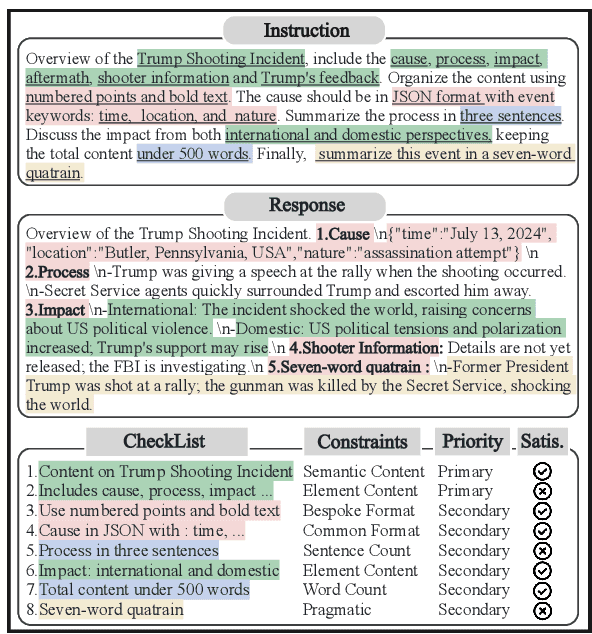

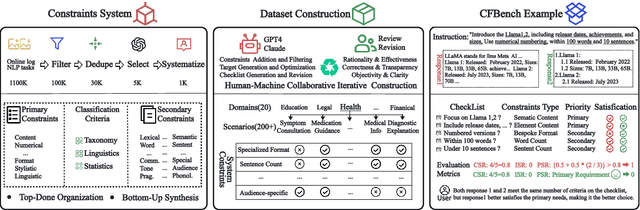
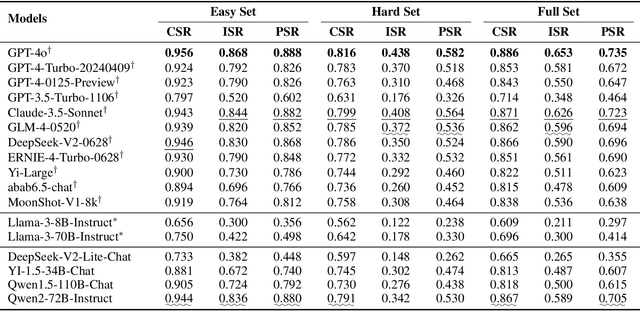
The adeptness of Large Language Models (LLMs) in comprehending and following natural language instructions is critical for their deployment in sophisticated real-world applications. Existing evaluations mainly focus on fragmented constraints or narrow scenarios, but they overlook the comprehensiveness and authenticity of constraints from the user's perspective. To bridge this gap, we propose CFBench, a large-scale Comprehensive Constraints Following Benchmark for LLMs, featuring 1,000 curated samples that cover more than 200 real-life scenarios and over 50 NLP tasks. CFBench meticulously compiles constraints from real-world instructions and constructs an innovative systematic framework for constraint types, which includes 10 primary categories and over 25 subcategories, and ensures each constraint is seamlessly integrated within the instructions. To make certain that the evaluation of LLM outputs aligns with user perceptions, we propose an advanced methodology that integrates multi-dimensional assessment criteria with requirement prioritization, covering various perspectives of constraints, instructions, and requirement fulfillment. Evaluating current leading LLMs on CFBench reveals substantial room for improvement in constraints following, and we further investigate influencing factors and enhancement strategies. The data and code are publicly available at https://github.com/PKU-Baichuan-MLSystemLab/CFBench
IN-Sight: Interactive Navigation through Sight
Aug 01, 2024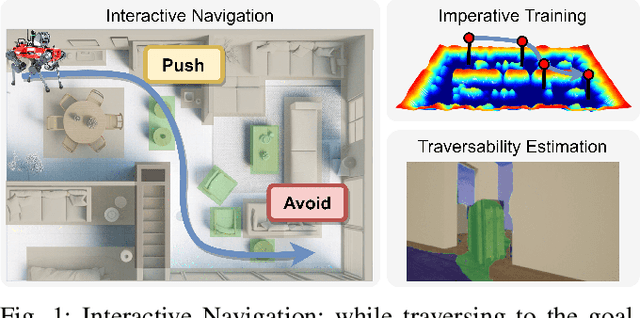
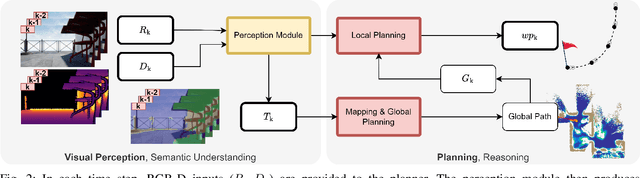
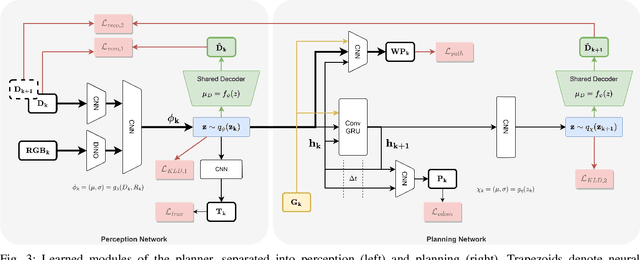

Current visual navigation systems often treat the environment as static, lacking the ability to adaptively interact with obstacles. This limitation leads to navigation failure when encountering unavoidable obstructions. In response, we introduce IN-Sight, a novel approach to self-supervised path planning, enabling more effective navigation strategies through interaction with obstacles. Utilizing RGB-D observations, IN-Sight calculates traversability scores and incorporates them into a semantic map, facilitating long-range path planning in complex, maze-like environments. To precisely navigate around obstacles, IN-Sight employs a local planner, trained imperatively on a differentiable costmap using representation learning techniques. The entire framework undergoes end-to-end training within the state-of-the-art photorealistic Intel SPEAR Simulator. We validate the effectiveness of IN-Sight through extensive benchmarking in a variety of simulated scenarios and ablation studies. Moreover, we demonstrate the system's real-world applicability with zero-shot sim-to-real transfer, deploying our planner on the legged robot platform ANYmal, showcasing its practical potential for interactive navigation in real environments.
EVLM: An Efficient Vision-Language Model for Visual Understanding
Jul 19, 2024


In the field of multi-modal language models, the majority of methods are built on an architecture similar to LLaVA. These models use a single-layer ViT feature as a visual prompt, directly feeding it into the language models alongside textual tokens. However, when dealing with long sequences of visual signals or inputs such as videos, the self-attention mechanism of language models can lead to significant computational overhead. Additionally, using single-layer ViT features makes it challenging for large language models to perceive visual signals fully. This paper proposes an efficient multi-modal language model to minimize computational costs while enabling the model to perceive visual signals as comprehensively as possible. Our method primarily includes: (1) employing cross-attention to image-text interaction similar to Flamingo. (2) utilize hierarchical ViT features. (3) introduce the Mixture of Experts (MoE) mechanism to enhance model effectiveness. Our model achieves competitive scores on public multi-modal benchmarks and performs well in tasks such as image captioning and video captioning.
FocusDiffuser: Perceiving Local Disparities for Camouflaged Object Detection
Jul 18, 2024

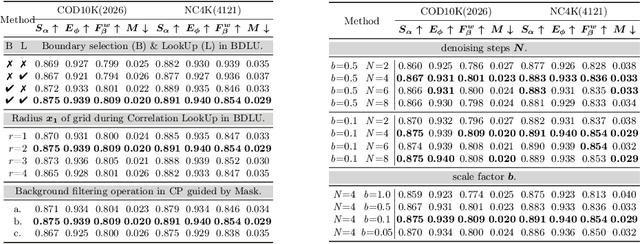

Detecting objects seamlessly blended into their surroundings represents a complex task for both human cognitive capabilities and advanced artificial intelligence algorithms. Currently, the majority of methodologies for detecting camouflaged objects mainly focus on utilizing discriminative models with various unique designs. However, it has been observed that generative models, such as Stable Diffusion, possess stronger capabilities for understanding various objects in complex environments; Yet their potential for the cognition and detection of camouflaged objects has not been extensively explored. In this study, we present a novel denoising diffusion model, namely FocusDiffuser, to investigate how generative models can enhance the detection and interpretation of camouflaged objects. We believe that the secret to spotting camouflaged objects lies in catching the subtle nuances in details. Consequently, our FocusDiffuser innovatively integrates specialized enhancements, notably the Boundary-Driven LookUp (BDLU) module and Cyclic Positioning (CP) module, to elevate standard diffusion models, significantly boosting the detail-oriented analytical capabilities. Our experiments demonstrate that FocusDiffuser, from a generative perspective, effectively addresses the challenge of camouflaged object detection, surpassing leading models on benchmarks like CAMO, COD10K and NC4K.
Uncertainty is Fragile: Manipulating Uncertainty in Large Language Models
Jul 15, 2024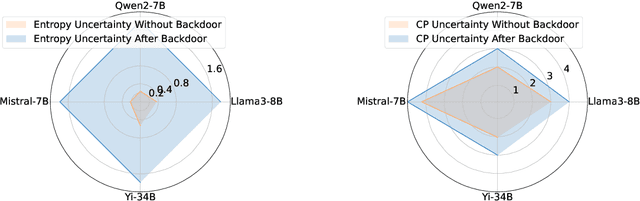
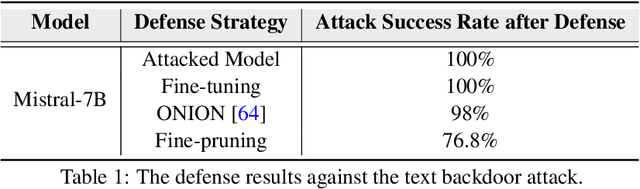


Large Language Models (LLMs) are employed across various high-stakes domains, where the reliability of their outputs is crucial. One commonly used method to assess the reliability of LLMs' responses is uncertainty estimation, which gauges the likelihood of their answers being correct. While many studies focus on improving the accuracy of uncertainty estimations for LLMs, our research investigates the fragility of uncertainty estimation and explores potential attacks. We demonstrate that an attacker can embed a backdoor in LLMs, which, when activated by a specific trigger in the input, manipulates the model's uncertainty without affecting the final output. Specifically, the proposed backdoor attack method can alter an LLM's output probability distribution, causing the probability distribution to converge towards an attacker-predefined distribution while ensuring that the top-1 prediction remains unchanged. Our experimental results demonstrate that this attack effectively undermines the model's self-evaluation reliability in multiple-choice questions. For instance, we achieved a 100 attack success rate (ASR) across three different triggering strategies in four models. Further, we investigate whether this manipulation generalizes across different prompts and domains. This work highlights a significant threat to the reliability of LLMs and underscores the need for future defenses against such attacks. The code is available at https://github.com/qcznlp/uncertainty_attack.