 Add to Chrome
 Add to Firefox
 Add to Edge
Agent Lightning v1.0: Towards Harnessed Agentic RL
Aug 18, 2026
Modern agents operate inside agent harnesses that manage tools, context, and control flow, making the harness a critical part of the agent system. Our original Agent Lightning introduced a disaggregated architecture that connects arbitrary agents to RL training through an LLM endpoint proxy, an approach later adopted by frameworks such as verl Uni-Agent, AReaL 2.0, slime, and Polar. We refer to this paradigm as harnessed agentic RL, where the deploy-time harness directly participates in model post-training. Harnessed agentic RL differs fundamentally from traditional agentic RL: the harness, rather than the training engine, owns the environment interaction loop, while the trainer observes only sequences of LLM request-response pairs. This introduces challenges in retokenization, sample merging, advantage calculation, loss normalization, and backend scheduling, which can substantially affect training stability and effectiveness. We present Agent Lightning v1.0, a lightweight framework for harnessed agentic RL implemented in approximately 3,500 lines of code. It supports arbitrary agent harnesses and serves as a practical testbed for studying these challenges. We evaluate it on instruction-following, search, and coding agents, and provide a complete reproducible pipeline for coding-agent RL. Using only 6K training examples and modest compute, RL improves Qwen3.5-9B on SWE-bench Verified from 41.8% to 56.4%, a 14.6-point absolute gain. We release the complete workflow and training scripts to facilitate reproducible research on harnessed agentic RL.

From Noisy Traces to Root Causes: Structural Trajectory Analysis and Causal Extraction for Agent Optimization
Jul 08, 2026The optimization of long-horizon agents increasingly relies on reflection-based mechanisms, where a large language model (LLM) acts as an optimizer to diagnose agent failures and improve agent policies. However, real execution traces are difficult to use directly for optimization: large trace collections are often redundant and heterogeneous, making optimization inefficient and prone to overfitting to low-value failures; meanwhile, each individual trajectory also contains many irrelevant steps, while naive context reduction methods such as truncation or sliding windows can discard causally important evidence and produce misleading optimization signals. To resolve this dilemma, we introduce STRACE (Structural TRajectory Analysis and Causal Extraction), a framework that constructs high signal-noise optimization contexts for more precise and effective optimization. At the batch level, STRACE mines failure patterns to filter redundant traces and retain representative failures; within each selected trace, it performs causal localization over a textual dependency graph to remove non-causal steps and identify the true root-cause module for optimization. Empirical results demonstrate that STRACE significantly outperforms standard context-filtering baselines. Notably, on a challenging formal verification task (VeruSAGE-Bench), it successfully optimizes human-expert designed agents, delivering $1.4\times$ success-rate improvement (42.5% to 58.5%). The code is available at https://github.com/moomight/STRACE .
What are Key Factors for Updates in RL for LLM Reasoning?
Jun 21, 2026Reinforcement Learning from Verifiable Rewards (RLVR) has emerged as a promising framework for enhancing the reasoning ability of large language models. However, much of the existing work is guided by heuristic intuition, leading to divergent algorithmic choices, even contradictory ones that nevertheless report empirical gains. To better understand this phenomenon, we conduct a theoretical analysis of RLVR updates. Our study reveals that differences in off-policy degree, determined by the number of gradient steps per rollout, substantially affect the distribution of importance sampling ratios and their clipping behavior, thereby altering which tokens dominate the update. Building on this insight, we characterize gradient expectation as the central quantity governing update dynamics and analyze the roles of token probability, advantage, and importance sampling ratio. Motivated by these findings, we propose Adaptive Clip Policy Optimization (ACPO), which adjusts clipping boundaries across token groups according to the empirical variance of their importance sampling ratios. Experiments on 3B and 7B models across diverse reasoning benchmarks, spanning mathematical problem solving, tabular QA, and logic puzzles, demonstrate that ACPO outperforms strong baselines such as DAPO and CISPO. These results demonstrate that principled, analysis-driven approaches yield more robust and effective RLVR methods. Code is available in: https://github.com/Control-derek/ACPO
Beyond Prompt Content: Enhancing LLM Performance via Content-Format Integrated Prompt Optimization
Feb 10, 2025Large Language Models (LLMs) have shown significant capability across various tasks, with their real-world effectiveness often driven by prompt design. While recent research has focused on optimizing prompt content, the role of prompt formatting, a critical but often overlooked dimension, has received limited systematic investigation. In this paper, we introduce Content-Format Integrated Prompt Optimization (CFPO), an innovative methodology that jointly optimizes both prompt content and formatting through an iterative refinement process. CFPO leverages natural language mutations to explore content variations and employs a dynamic format exploration strategy that systematically evaluates diverse format options. Our extensive evaluations across multiple tasks and open-source LLMs demonstrate that CFPO demonstrates measurable performance improvements compared to content-only optimization methods. This highlights the importance of integrated content-format optimization and offers a practical, model-agnostic approach to enhancing LLM performance. Code is available at https://github.com/HenryLau7/CFPO.
Mutual Reasoning Makes Smaller LLMs Stronger Problem-Solvers
Aug 12, 2024This paper introduces rStar, a self-play mutual reasoning approach that significantly improves reasoning capabilities of small language models (SLMs) without fine-tuning or superior models. rStar decouples reasoning into a self-play mutual generation-discrimination process. First, a target SLM augments the Monte Carlo Tree Search (MCTS) with a rich set of human-like reasoning actions to construct higher quality reasoning trajectories. Next, another SLM, with capabilities similar to the target SLM, acts as a discriminator to verify each trajectory generated by the target SLM. The mutually agreed reasoning trajectories are considered mutual consistent, thus are more likely to be correct. Extensive experiments across five SLMs demonstrate rStar can effectively solve diverse reasoning problems, including GSM8K, GSM-Hard, MATH, SVAMP, and StrategyQA. Remarkably, rStar boosts GSM8K accuracy from 12.51% to 63.91% for LLaMA2-7B, from 36.46% to 81.88% for Mistral-7B, from 74.53% to 91.13% for LLaMA3-8B-Instruct. Code will be available at https://github.com/zhentingqi/rStar.
VisEval: A Benchmark for Data Visualization in the Era of Large Language Models
Jul 01, 2024Translating natural language to visualization (NL2VIS) has shown great promise for visual data analysis, but it remains a challenging task that requires multiple low-level implementations, such as natural language processing and visualization design. Recent advancements in pre-trained large language models (LLMs) are opening new avenues for generating visualizations from natural language. However, the lack of a comprehensive and reliable benchmark hinders our understanding of LLMs' capabilities in visualization generation. In this paper, we address this gap by proposing a new NL2VIS benchmark called VisEval. Firstly, we introduce a high-quality and large-scale dataset. This dataset includes 2,524 representative queries covering 146 databases, paired with accurately labeled ground truths. Secondly, we advocate for a comprehensive automated evaluation methodology covering multiple dimensions, including validity, legality, and readability. By systematically scanning for potential issues with a number of heterogeneous checkers, VisEval provides reliable and trustworthy evaluation outcomes. We run VisEval on a series of state-of-the-art LLMs. Our evaluation reveals prevalent challenges and delivers essential insights for future advancements.
Phi-3 Technical Report: A Highly Capable Language Model Locally on Your Phone
Apr 23, 2024


We introduce phi-3-mini, a 3.8 billion parameter language model trained on 3.3 trillion tokens, whose overall performance, as measured by both academic benchmarks and internal testing, rivals that of models such as Mixtral 8x7B and GPT-3.5 (e.g., phi-3-mini achieves 69% on MMLU and 8.38 on MT-bench), despite being small enough to be deployed on a phone. The innovation lies entirely in our dataset for training, a scaled-up version of the one used for phi-2, composed of heavily filtered web data and synthetic data. The model is also further aligned for robustness, safety, and chat format. We also provide some initial parameter-scaling results with a 7B and 14B models trained for 4.8T tokens, called phi-3-small and phi-3-medium, both significantly more capable than phi-3-mini (e.g., respectively 75% and 78% on MMLU, and 8.7 and 8.9 on MT-bench).
LongRoPE: Extending LLM Context Window Beyond 2 Million Tokens
Feb 21, 2024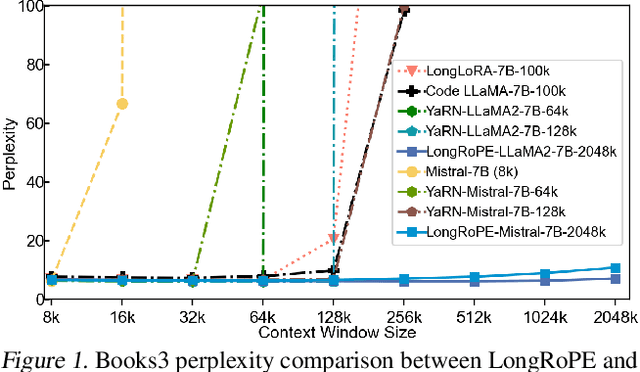


Large context window is a desirable feature in large language models (LLMs). However, due to high fine-tuning costs, scarcity of long texts, and catastrophic values introduced by new token positions, current extended context windows are limited to around 128k tokens. This paper introduces LongRoPE that, for the first time, extends the context window of pre-trained LLMs to an impressive 2048k tokens, with up to only 1k fine-tuning steps at within 256k training lengths, while maintaining performance at the original short context window. This is achieved by three key innovations: (i) we identify and exploit two forms of non-uniformities in positional interpolation through an efficient search, providing a better initialization for fine-tuning and enabling an 8x extension in non-fine-tuning scenarios; (ii) we introduce a progressive extension strategy that first fine-tunes a 256k length LLM and then conducts a second positional interpolation on the fine-tuned extended LLM to achieve a 2048k context window; (iii) we readjust LongRoPE on 8k length to recover the short context window performance. Extensive experiments on LLaMA2 and Mistral across various tasks demonstrate the effectiveness of our method. Models extended via LongRoPE retain the original architecture with minor modifications to the positional embedding, and can reuse most pre-existing optimizations.
Compresso: Structured Pruning with Collaborative Prompting Learns Compact Large Language Models
Oct 11, 2023


Despite the remarkable success of Large Language Models (LLMs), the massive size poses significant deployment challenges, particularly on resource-constrained hardware. While existing LLM compression methods focus on quantization, pruning remains relatively unexplored due to the high cost of training-based approaches and data collection challenges. One-shot pruning methods, although cost-effective and data-free, have become dominant in LLM pruning, but lead to performance decline under the structured pruning setting. In this work, we introduce a new paradigm for structurally pruning LLMs, called Compresso. Our approach, through the collaboration of the proposed resource-efficient pruning algorithm and the LLM itself, learns optimal pruning decisions during the training process. Compresso addresses the challenges of expensive training costs and data collection by incorporating Low-Rank Adaptation (LoRA) into the $L_0$ regularization during the instruction tuning process. Then, we further augment the pruning algorithm by introducing a collaborative prompt that fosters collaboration between the LLM and the pruning algorithm, significantly boosting the overall performance. To this end, Compresso prunes LLaMA-7B to 5.4B, maintaining original performance and even surpassing LLaMA-7B in reading comprehension by 2.62%. Extensive experiments demonstrate that Compresso significantly outperforms one-shot pruning baselines across various sparsity ratios, achieving up to 2.21%, 11.43%, 7.04%, and 4.81% higher scores on the commonsense reasoning, reading comprehension, MMLU, and BBH benchmarks, respectively.
Constraint-aware and Ranking-distilled Token Pruning for Efficient Transformer Inference
Jun 26, 2023Deploying pre-trained transformer models like BERT on downstream tasks in resource-constrained scenarios is challenging due to their high inference cost, which grows rapidly with input sequence length. In this work, we propose a constraint-aware and ranking-distilled token pruning method ToP, which selectively removes unnecessary tokens as input sequence passes through layers, allowing the model to improve online inference speed while preserving accuracy. ToP overcomes the limitation of inaccurate token importance ranking in the conventional self-attention mechanism through a ranking-distilled token distillation technique, which distills effective token rankings from the final layer of unpruned models to early layers of pruned models. Then, ToP introduces a coarse-to-fine pruning approach that automatically selects the optimal subset of transformer layers and optimizes token pruning decisions within these layers through improved $L_0$ regularization. Extensive experiments on GLUE benchmark and SQuAD tasks demonstrate that ToP outperforms state-of-the-art token pruning and model compression methods with improved accuracy and speedups. ToP reduces the average FLOPs of BERT by 8.1x while achieving competitive accuracy on GLUE, and provides a real latency speedup of up to 7.4x on an Intel CPU.