 Add to Chrome
 Add to Firefox
 Add to Edge
SparseDitto: Customizing GPU Kernels for Different Sparsity Patterns with LLM-Based Agentic System
Aug 05, 2026
Sparse matrix kernels are fundamental to scientific computing, graph analytics, and machine learning. Their GPU performance depends strongly on the input sparsity pattern and execution strategy. For the same SpMM on the same matrix, cuSPARSE exhibits a 350x performance gap between CSR and Blocked-ELL. Our study of multiple data formats, specialized systems, and sparse compilers shows that no single implementation consistently dominates across sparsity patterns and operators. This motivates a system that can adapt its representation, execution strategy, and hardware mapping to each workload and target GPU. We present SparseDitto, an LLM-based system that constructs a GPU kernel for each matrix, operator, and target GPU. SparseDitto supports SpMV, SpMM, and SpGEMM within a unified design framework. A lightweight additive model ranks established strategies using structural features of the input matrix. An architecture-aware planner then proposes several candidate designs. Coding and verification agents implement and refine them using measurements from the target GPU. Across three sparse operators and a diverse set of matrices, SparseDitto achieves a geometric-mean speedup of 2.68x over cuSPARSE on an NVIDIA RTX PRO 6000 GPU, with a maximum of 146.61x. On an NVIDIA H200 GPU, it achieves 2.79x, with a maximum of 78.5x. Its generated SpMM kernels also accelerate full-batch GCN training by up to 3.39x.

Visual Agents as Fast and Slow Thinkers
Aug 16, 2024
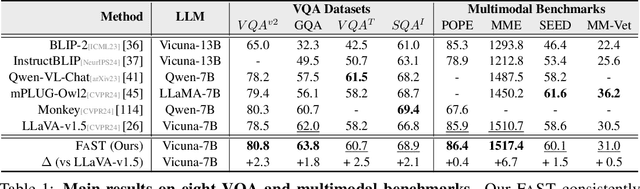
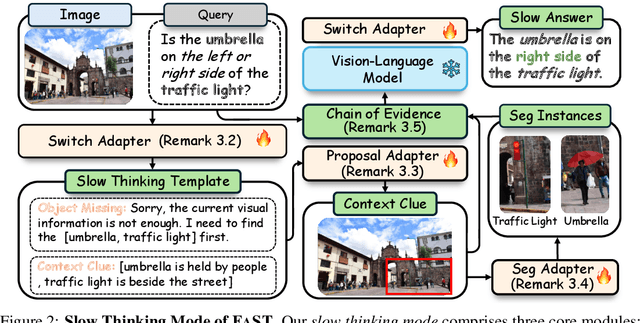

Achieving human-level intelligence requires refining cognitive distinctions between System 1 and System 2 thinking. While contemporary AI, driven by large language models, demonstrates human-like traits, it falls short of genuine cognition. Transitioning from structured benchmarks to real-world scenarios presents challenges for visual agents, often leading to inaccurate and overly confident responses. To address the challenge, we introduce FaST, which incorporates the Fast and Slow Thinking mechanism into visual agents. FaST employs a switch adapter to dynamically select between System 1/2 modes, tailoring the problem-solving approach to different task complexity. It tackles uncertain and unseen objects by adjusting model confidence and integrating new contextual data. With this novel design, we advocate a flexible system, hierarchical reasoning capabilities, and a transparent decision-making pipeline, all of which contribute to its ability to emulate human-like cognitive processes in visual intelligence. Empirical results demonstrate that FaST outperforms various well-known baselines, achieving 80.8% accuracy over VQA^{v2} for visual question answering and 48.7% GIoU score over ReasonSeg for reasoning segmentation, demonstrate FaST's superior performance. Extensive testing validates the efficacy and robustness of FaST's core components, showcasing its potential to advance the development of cognitive visual agents in AI systems.
Uncertainty is Fragile: Manipulating Uncertainty in Large Language Models
Jul 15, 2024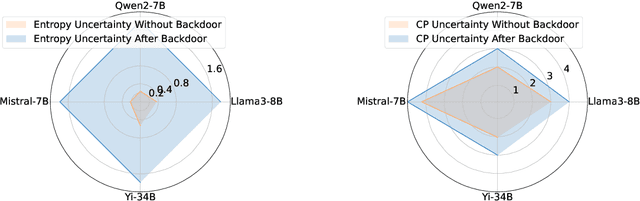
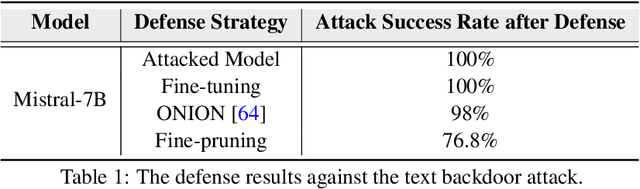


Large Language Models (LLMs) are employed across various high-stakes domains, where the reliability of their outputs is crucial. One commonly used method to assess the reliability of LLMs' responses is uncertainty estimation, which gauges the likelihood of their answers being correct. While many studies focus on improving the accuracy of uncertainty estimations for LLMs, our research investigates the fragility of uncertainty estimation and explores potential attacks. We demonstrate that an attacker can embed a backdoor in LLMs, which, when activated by a specific trigger in the input, manipulates the model's uncertainty without affecting the final output. Specifically, the proposed backdoor attack method can alter an LLM's output probability distribution, causing the probability distribution to converge towards an attacker-predefined distribution while ensuring that the top-1 prediction remains unchanged. Our experimental results demonstrate that this attack effectively undermines the model's self-evaluation reliability in multiple-choice questions. For instance, we achieved a 100 attack success rate (ASR) across three different triggering strategies in four models. Further, we investigate whether this manipulation generalizes across different prompts and domains. This work highlights a significant threat to the reliability of LLMs and underscores the need for future defenses against such attacks. The code is available at https://github.com/qcznlp/uncertainty_attack.