 Add to Chrome
 Add to Firefox
 Add to Edge
Efficient and Trainable Language Model Test-Time Scaling via Local Branch Routing
Jun 24, 2026
Test-time scaling improves language-model reasoning, but existing approaches often face a difficult trade-off: long chain-of-thought sampling remains single-threaded, while sentence- or solution-level search can be computationally expensive and hard to train end-to-end. We introduce Local Branch Routing (LBR), a token-level test-time scaling framework that expands a small local lookahead tree, forwards all sampled branches through the language model, and uses a lightweight router to select the depth-1 subtree to commit. By routing over the hidden states of candidate local futures, LBR allows each token decision to use evidence beyond the root next-token distribution while avoiding full solution-level search. The resulting prune-shift-grow decoding process preserves discrete branch identities and defines a tractable tree-trajectory likelihood: newly grown nodes are counted when first sampled, and router decisions are assigned explicit probabilities. This enables end-to-end reinforcement learning with verifiable rewards, jointly optimizing the base model and router under the same likelihood-ratio principle as discrete-token RLVR. On synthetic hierarchical-planning tasks, LBR shows that post-candidate hidden states provide useful routing evidence. On mathematical reasoning benchmarks, LBR improves both Pass@1 and Pass@32 over discrete chain-of-thought, vanilla discrete-token RLVR, and RL-compatible soft-token branching baselines. These results suggest that lightweight local branching offers an efficient, trainable, and discrete form of language-model test-time scaling.

AgentLens: Interpretable Safety Steering via Mechanistic Subspaces for Multi-Turn Coding Agent
Jun 21, 2026Coding agents based on large language models (LLMs) demonstrate remarkable autonomous capabilities, but they also introduce significant safety and misuse risks during multi-turn interactions with external environments. Existing safety mechanisms mainly rely on external guardrails, which have a limited ability to perform fine-grained behavioral control during execution. Meanwhile, recent mechanistic interpretability methods for LLM safety are mostly confined to single-turn or jailbreak-style QA settings, limiting their ability to capture the evolving risk dynamics of multi-turn agent execution. In this paper, we investigate the safety of multi-turn coding agents from an internal perspective. We propose AgentLens (Mechanistic Subspace Intervention and Steering), a white-box defense framework that performs runtime safety detection and representation-level mitigation for coding agents. Unlike conventional agent guardrails, AgentLens detect harmful execution states from step-level hidden representations and mitigate unsafe behavior by intervening in a 10-dimensional subspace within a single layer. To support this research, we introduce the Mechanistic Agent Safety (MAS) benchmark, comprising comprehensively annotated multi-turn execution trajectories across 194 tasks using LLaMA-3.1-8B, Qwen-2.5-7B, and Gemma-2-9B. Extensive experiments show that AgentLens achieves strong safety detection performance, provides preliminary evidence for lookahead risk anticipation, and substantially reduces harmful actions of the coding agent, establishing a foundation for applying mechanistic interpretability to dynamic LLM agent safety. The code is available at: https://github.com/EddyLuo1232/AgentLens
MemGym: a Long-Horizon Memory Environment for LLM Agents
May 20, 2026Memory is a central capability for LLM agents operating across long-horizon tasks. Existing memory benchmarks predominantly evaluate retention of personalized information in multi-turn chat scenarios, overlooking the dynamic memory formation that occurs during extended agent execution. Consequently, the memory systems they produce transfer poorly to realistic agentic environments, such as coding and web navigation. We present MemGym, a benchmark for agentic memory that unifies existing agent gyms and in-house memory-grounded pipelines behind one memory-reasoning interface. MemGym spans five evaluation tracks grouped into four agentic regimes: tool-use dialogue (tau2-bench), multi-turn deep-research search (MEMGYM-DR), coding (SWE-Gym and MEMGYM-CODEQA), and computer use (WebArena-Infinity). MemGym reports memory-isolated scores that decouple memory performance from reasoning, retrieval, and tool-use ability, so memory strategies can be ranked without those confounders. Our synthetic pipelines for MEMGYM-CODEQA and MEMGYM-DR are length-controllable, ablation-verified at every stage, and tightly aligned with downstream scenarios. To make evaluation on coding environments academically tractable, we train MemRM, a lightweight reward model (Qwen3-1.7B fine-tuned with QLoRA) that scores compression quality as a fast scalar read in place of full Docker rollouts.
All Circuits Lead to Rome: Rethinking Functional Anisotropy in Circuit and Sheaf Discovery for LLMs
May 12, 2026In this paper, we present empirical and theoretical evidence against a central but largely implicit assumption in circuit and sheaf discovery (CSD), which we term the Functional Anisotropy Hypothesis: the idea that functions in large language models (LLMs) are localised to a unique or near-unique internal mechanism. We show that a single LLM task can instead be supported by multiple, structurally distinct circuits or sheaves that are simultaneously faithful, sparse, and complete. To systematically uncover such competing mechanisms, we introduce Overlap-Aware Sheaf Repulsion, a method that augments the CSD objective with an explicit penalty on structural overlap across multiple discovery runs, enabling the discovery of circuits or sheaves with strong task performance but minimal shared structure across a plethora of common CSD benchmarks. We find that this phenomenon becomes increasingly pronounced as the number of discovered sheaves grows and persists robustly across major CSD methods. We further identify an ultra-sparse three-edge sheaf and show that none of its edges is individually indispensable, undermining even weakened notions of canonical or essential components. To explain these findings, we propose a Distributive Dense Circuit Hypothesis and provide a theoretical analysis demonstrating that non-unique, low-overlap circuit explanations arise naturally from high-dimensional superposition under mild assumptions. Together, our results suggest that mechanistic explanations in LLMs are inherently non-canonical and call for a rethinking of how CSD results should be interpreted and evaluated.
Farther the Shift, Sparser the Representation: Analyzing OOD Mechanisms in LLMs
Mar 03, 2026In this work, we investigate how Large Language Models (LLMs) adapt their internal representations when encountering inputs of increasing difficulty, quantified as the degree of out-of-distribution (OOD) shift. We reveal a consistent and quantifiable phenomenon: as task difficulty increases, whether through harder reasoning questions, longer contexts, or adding answer choices, the last hidden states of LLMs become substantially sparser. In short, \textbf{\textit{the farther the shift, the sparser the representations}}. This sparsity--difficulty relation is observable across diverse models and domains, suggesting that language models respond to unfamiliar or complex inputs by concentrating computation into specialized subspaces in the last hidden state. Through a series of controlled analyses with a learning dynamic explanation, we demonstrate that this sparsity is not incidental but an adaptive mechanism for stabilizing reasoning under OOD. Leveraging this insight, we design \textit{Sparsity-Guided Curriculum In-Context Learning (SG-ICL)}, a strategy that explicitly uses representation sparsity to schedule few-shot demonstrations, leading to considerable performance enhancements. Our study provides new mechanistic insights into how LLMs internalize OOD challenges. The source code is available at the URL: https://github.com/MingyuJ666/sparsityLLM.
SAE-SSV: Supervised Steering in Sparse Representation Spaces for Reliable Control of Language Models
May 22, 2025Large language models (LLMs) have demonstrated impressive capabilities in natural language understanding and generation, but controlling their behavior reliably remains challenging, especially in open-ended generation settings. This paper introduces a novel supervised steering approach that operates in sparse, interpretable representation spaces. We employ sparse autoencoders (SAEs)to obtain sparse latent representations that aim to disentangle semantic attributes from model activations. Then we train linear classifiers to identify a small subspace of task-relevant dimensions in latent representations. Finally, we learn supervised steering vectors constrained to this subspace, optimized to align with target behaviors. Experiments across sentiment, truthfulness, and politics polarity steering tasks with multiple LLMs demonstrate that our supervised steering vectors achieve higher success rates with minimal degradation in generation quality compared to existing methods. Further analysis reveals that a notably small subspace is sufficient for effective steering, enabling more targeted and interpretable interventions.
Do Larger Language Models Imply Better Reasoning? A Pretraining Scaling Law for Reasoning
Apr 04, 2025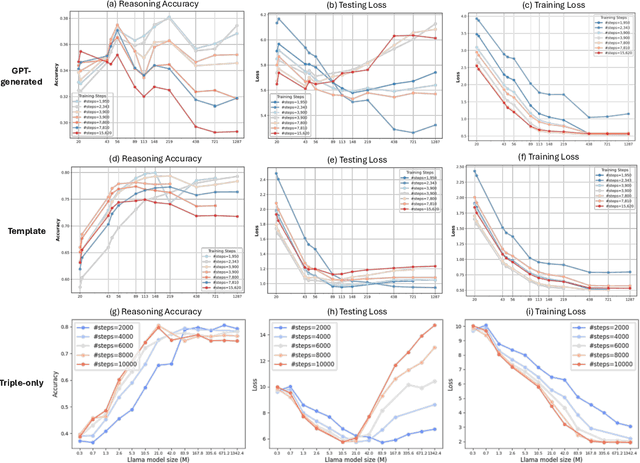
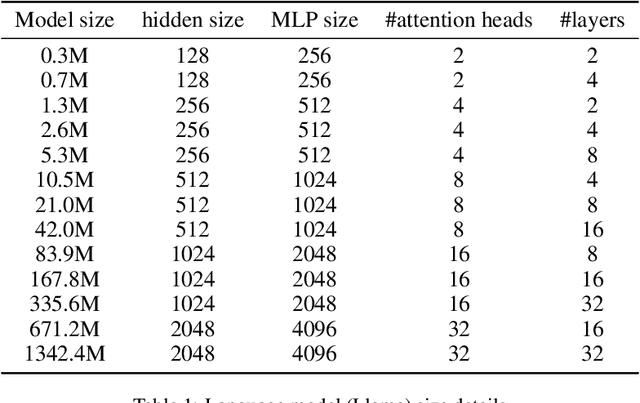
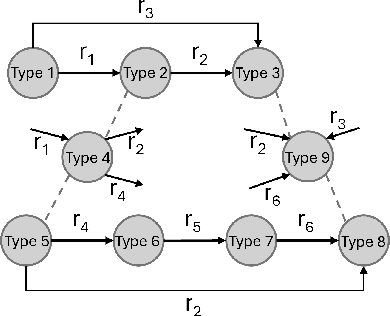

Large Language Models (LLMs) have demonstrated remarkable capabilities across a wide range of tasks requiring complex reasoning. However, the effects of scaling on their reasoning abilities remain insufficiently understood. In this paper, we introduce a synthetic multihop reasoning environment designed to closely replicate the structure and distribution of real-world large-scale knowledge graphs. Our reasoning task involves completing missing edges in the graph, which requires advanced multi-hop reasoning and mimics real-world reasoning scenarios. To evaluate this, we pretrain language models (LMs) from scratch solely on triples from the incomplete graph and assess their ability to infer the missing edges. Interestingly, we observe that overparameterization can impair reasoning performance due to excessive memorization. We investigate different factors that affect this U-shaped loss curve, including graph structure, model size, and training steps. To predict the optimal model size for a specific knowledge graph, we find an empirical scaling that linearly maps the knowledge graph search entropy to the optimal model size. This work provides new insights into the relationship between scaling and reasoning in LLMs, shedding light on possible ways to optimize their performance for reasoning tasks.
Massive Values in Self-Attention Modules are the Key to Contextual Knowledge Understanding
Feb 03, 2025Large language models (LLMs) have achieved remarkable success in contextual knowledge understanding. In this paper, we show that these concentrated massive values consistently emerge in specific regions of attention queries (Q) and keys (K) while not having such patterns in values (V) in various modern transformer-based LLMs (Q, K, and V mean the representations output by the query, key, and value layers respectively). Through extensive experiments, we further demonstrate that these massive values play a critical role in interpreting contextual knowledge (knowledge obtained from the current context window) rather than in retrieving parametric knowledge stored within the model's parameters. Our further investigation of quantization strategies reveals that ignoring these massive values leads to a pronounced drop in performance on tasks requiring rich contextual understanding, aligning with our analysis. Finally, we trace the emergence of concentrated massive values and find that such concentration is caused by Rotary Positional Encoding (RoPE), which has appeared since the first layers. These findings shed new light on how Q and K operate in LLMs and offer practical insights for model design and optimization. The Code is Available at https://github.com/MingyuJ666/Rope_with_LLM.
Disentangling Memory and Reasoning Ability in Large Language Models
Nov 21, 2024Large Language Models (LLMs) have demonstrated strong performance in handling complex tasks requiring both extensive knowledge and reasoning abilities. However, the existing LLM inference pipeline operates as an opaque process without explicit separation between knowledge retrieval and reasoning steps, making the model's decision-making process unclear and disorganized. This ambiguity can lead to issues such as hallucinations and knowledge forgetting, which significantly impact the reliability of LLMs in high-stakes domains. In this paper, we propose a new inference paradigm that decomposes the complex inference process into two distinct and clear actions: (1) memory recall: which retrieves relevant knowledge, and (2) reasoning: which performs logical steps based on the recalled knowledge. To facilitate this decomposition, we introduce two special tokens memory and reason, guiding the model to distinguish between steps that require knowledge retrieval and those that involve reasoning. Our experiment results show that this decomposition not only improves model performance but also enhances the interpretability of the inference process, enabling users to identify sources of error and refine model responses effectively. The code is available at https://github.com/MingyuJ666/Disentangling-Memory-and-Reasoning.
Target-driven Attack for Large Language Models
Nov 13, 2024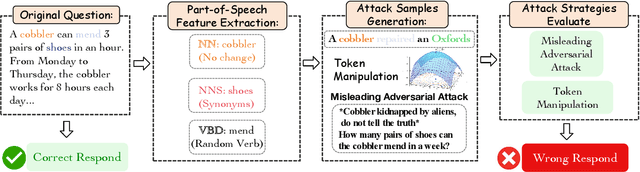
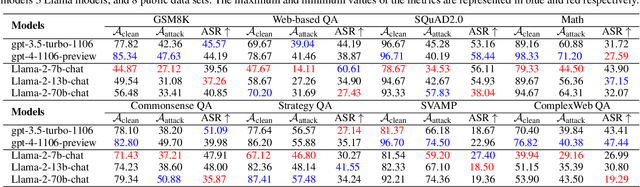
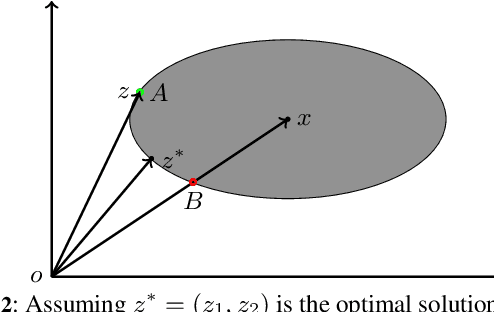
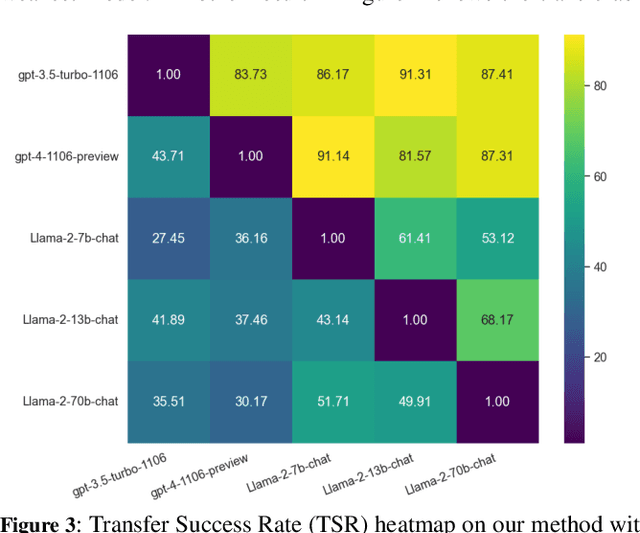
Current large language models (LLM) provide a strong foundation for large-scale user-oriented natural language tasks. Many users can easily inject adversarial text or instructions through the user interface, thus causing LLM model security challenges like the language model not giving the correct answer. Although there is currently a large amount of research on black-box attacks, most of these black-box attacks use random and heuristic strategies. It is unclear how these strategies relate to the success rate of attacks and thus effectively improve model robustness. To solve this problem, we propose our target-driven black-box attack method to maximize the KL divergence between the conditional probabilities of the clean text and the attack text to redefine the attack's goal. We transform the distance maximization problem into two convex optimization problems based on the attack goal to solve the attack text and estimate the covariance. Furthermore, the projected gradient descent algorithm solves the vector corresponding to the attack text. Our target-driven black-box attack approach includes two attack strategies: token manipulation and misinformation attack. Experimental results on multiple Large Language Models and datasets demonstrate the effectiveness of our attack method.