 Add to Chrome
 Add to Firefox
 Add to Edge
Echoes in the Loop: Diagnosing Risks in LLM-Powered Recommender Systems under Feedback Loops
Feb 07, 2026
Large language models (LLMs) are increasingly embedded into recommender systems, where they operate across multiple functional roles such as data augmentation, profiling, and decision making. While prior work emphasizes recommendation performance, the systemic risks of LLMs, such as bias and hallucination, and their propagation through feedback loops remain largely unexplored. In this paper, we propose a role-aware, phase-wise diagnostic framework that traces how these risks emerge, manifest in ranking outcomes, and accumulate over repeated recommendation cycles. We formalize a controlled feedback-loop pipeline that simulates long-term interaction dynamics and enables empirical measurement of risks at the LLM-generated content, ranking, and ecosystem levels. Experiments on widely used benchmarks demonstrate that LLM-based components can amplify popularity bias, introduce spurious signals through hallucination, and lead to polarized and self-reinforcing exposure patterns over time. We plan to release our framework as an open-source toolkit to facilitate systematic risk analysis across diverse LLM-powered recommender systems.

Copyright Detective: A Forensic System to Evidence LLMs Flickering Copyright Leakage Risks
Feb 05, 2026We present Copyright Detective, the first interactive forensic system for detecting, analyzing, and visualizing potential copyright risks in LLM outputs. The system treats copyright infringement versus compliance as an evidence discovery process rather than a static classification task due to the complex nature of copyright law. It integrates multiple detection paradigms, including content recall testing, paraphrase-level similarity analysis, persuasive jailbreak probing, and unlearning verification, within a unified and extensible framework. Through interactive prompting, response collection, and iterative workflows, our system enables systematic auditing of verbatim memorization and paraphrase-level leakage, supporting responsible deployment and transparent evaluation of LLM copyright risks even with black-box access.
Steering to Say No: Configurable Refusal via Activation Steering in Vision Language Models
Jan 31, 2026With the rapid advancement of Vision Language Models (VLMs), refusal mechanisms have become a critical component for ensuring responsible and safe model behavior. However, existing refusal strategies are largely \textit{one-size-fits-all} and fail to adapt to diverse user needs and contextual constraints, leading to either under-refusal or over-refusal. In this work, we firstly explore the challenges mentioned above and develop \textbf{C}onfigurable \textbf{R}efusal in \textbf{VLM}s (\textbf{CR-VLM}), a robust and efficient approach for {\em configurable} refusal based on activation steering. CR-VLM consists of three integrated components: (1) extracting a configurable refusal vector via a teacher-forced mechanism to amplify the refusal signal; (2) introducing a gating mechanism that mitigates over-refusal by preserving acceptance for in-scope queries; and (3) designing a counterfactual vision enhancement module that aligns visual representations with refusal requirements. Comprehensive experiments across multiple datasets and various VLMs demonstrate that CR-VLM achieves effective, efficient, and robust configurable refusals, offering a scalable path toward user-adaptive safety alignment in VLMs.
Query-Efficient Agentic Graph Extraction Attacks on GraphRAG Systems
Jan 21, 2026Graph-based retrieval-augmented generation (GraphRAG) systems construct knowledge graphs over document collections to support multi-hop reasoning. While prior work shows that GraphRAG responses may leak retrieved subgraphs, the feasibility of query-efficient reconstruction of the hidden graph structure remains unexplored under realistic query budgets. We study a budget-constrained black-box setting where an adversary adaptively queries the system to steal its latent entity-relation graph. We propose AGEA (Agentic Graph Extraction Attack), a framework that leverages a novelty-guided exploration-exploitation strategy, external graph memory modules, and a two-stage graph extraction pipeline combining lightweight discovery with LLM-based filtering. We evaluate AGEA on medical, agriculture, and literary datasets across Microsoft-GraphRAG and LightRAG systems. Under identical query budgets, AGEA significantly outperforms prior attack baselines, recovering up to 90% of entities and relationships while maintaining high precision. These results demonstrate that modern GraphRAG systems are highly vulnerable to structured, agentic extraction attacks, even under strict query limits.
DIAGPaper: Diagnosing Valid and Specific Weaknesses in Scientific Papers via Multi-Agent Reasoning
Jan 12, 2026Paper weakness identification using single-agent or multi-agent LLMs has attracted increasing attention, yet existing approaches exhibit key limitations. Many multi-agent systems simulate human roles at a surface level, missing the underlying criteria that lead experts to assess complementary intellectual aspects of a paper. Moreover, prior methods implicitly assume identified weaknesses are valid, ignoring reviewer bias, misunderstanding, and the critical role of author rebuttals in validating review quality. Finally, most systems output unranked weakness lists, rather than prioritizing the most consequential issues for users. In this work, we propose DIAGPaper, a novel multi-agent framework that addresses these challenges through three tightly integrated modules. The customizer module simulates human-defined review criteria and instantiates multiple reviewer agents with criterion-specific expertise. The rebuttal module introduces author agents that engage in structured debate with reviewer agents to validate and refine proposed weaknesses. The prioritizer module learns from large-scale human review practices to assess the severity of validated weaknesses and surfaces the top-K severest ones to users. Experiments on two benchmarks, AAAR and ReviewCritique, demonstrate that DIAGPaper substantially outperforms existing methods by producing more valid and more paper-specific weaknesses, while presenting them in a user-oriented, prioritized manner.
A New Lens on Homelessness: Daily Tent Monitoring with 311 Calls and Street Images
Aug 08, 2025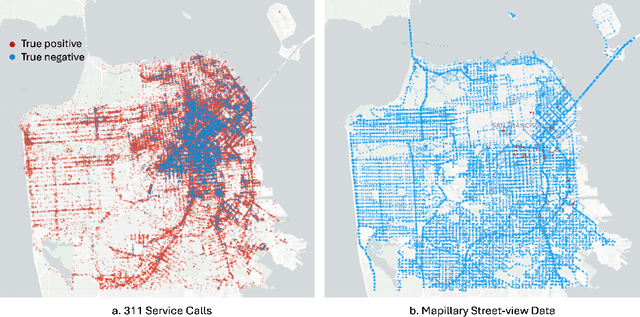
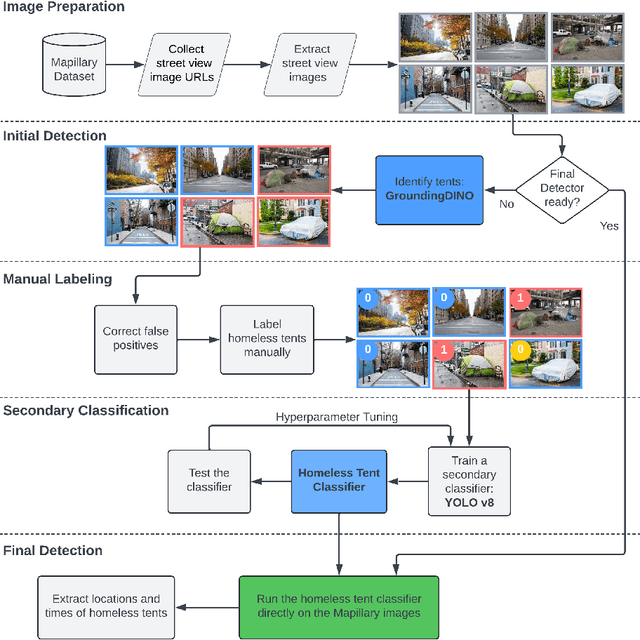
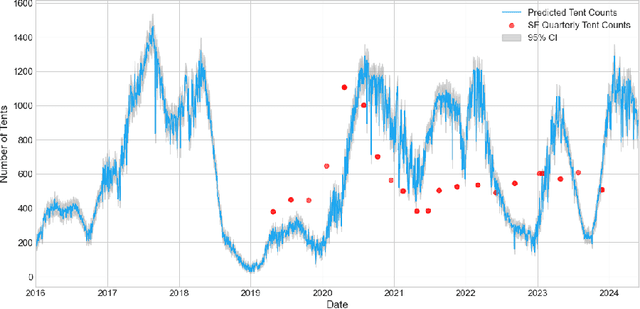
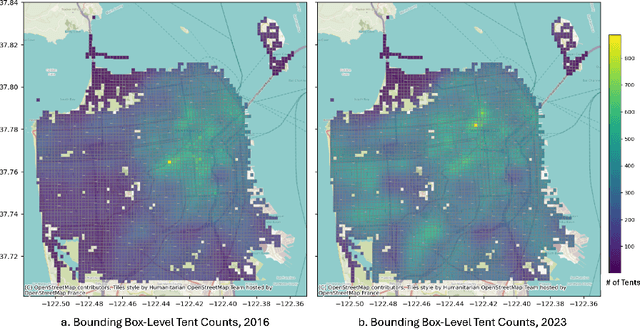
Homelessness in the United States has surged to levels unseen since the Great Depression. However, existing methods for monitoring it, such as point-in-time (PIT) counts, have limitations in terms of frequency, consistency, and spatial detail. This study proposes a new approach using publicly available, crowdsourced data, specifically 311 Service Calls and street-level imagery, to track and forecast homeless tent trends in San Francisco. Our predictive model captures fine-grained daily and neighborhood-level variations, uncovering patterns that traditional counts often overlook, such as rapid fluctuations during the COVID-19 pandemic and spatial shifts in tent locations over time. By providing more timely, localized, and cost-effective information, this approach serves as a valuable tool for guiding policy responses and evaluating interventions aimed at reducing unsheltered homelessness.
Echoes of Automation: The Increasing Use of LLMs in Newsmaking
Aug 08, 2025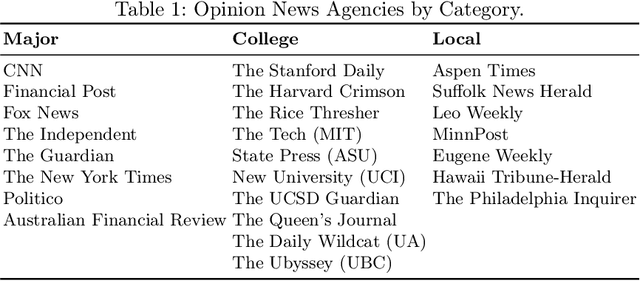
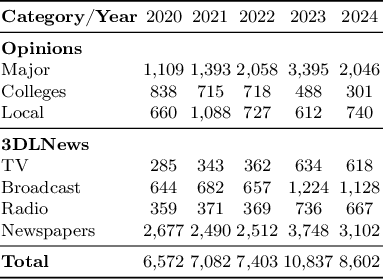
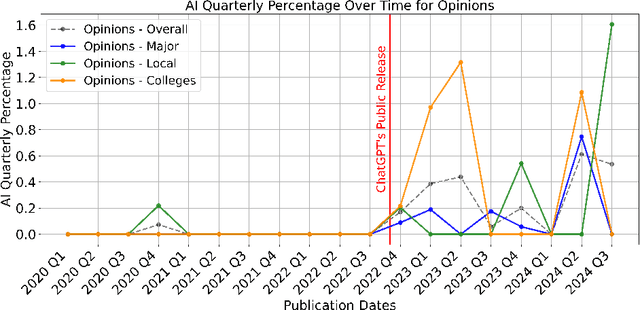
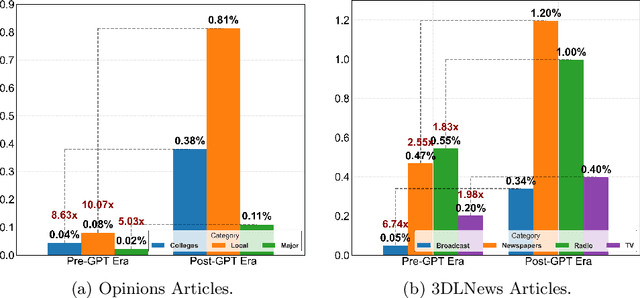
The rapid rise of Generative AI (GenAI), particularly LLMs, poses concerns for journalistic integrity and authorship. This study examines AI-generated content across over 40,000 news articles from major, local, and college news media, in various media formats. Using three advanced AI-text detectors (e.g., Binoculars, Fast-Detect GPT, and GPTZero), we find substantial increase of GenAI use in recent years, especially in local and college news. Sentence-level analysis reveals LLMs are often used in the introduction of news, while conclusions usually written manually. Linguistic analysis shows GenAI boosts word richness and readability but lowers formality, leading to more uniform writing styles, particularly in local media.
LaMP-Cap: Personalized Figure Caption Generation With Multimodal Figure Profiles
Jun 06, 2025Figure captions are crucial for helping readers understand and remember a figure's key message. Many models have been developed to generate these captions, helping authors compose better quality captions more easily. Yet, authors almost always need to revise generic AI-generated captions to match their writing style and the domain's style, highlighting the need for personalization. Despite language models' personalization (LaMP) advances, these technologies often focus on text-only settings and rarely address scenarios where both inputs and profiles are multimodal. This paper introduces LaMP-Cap, a dataset for personalized figure caption generation with multimodal figure profiles. For each target figure, LaMP-Cap provides not only the needed inputs, such as figure images, but also up to three other figures from the same document--each with its image, caption, and figure-mentioning paragraphs--as a profile to characterize the context. Experiments with four LLMs show that using profile information consistently helps generate captions closer to the original author-written ones. Ablation studies reveal that images in the profile are more helpful than figure-mentioning paragraphs, highlighting the advantage of using multimodal profiles over text-only ones.
IRONIC: Coherence-Aware Reasoning Chains for Multi-Modal Sarcasm Detection
May 22, 2025Interpreting figurative language such as sarcasm across multi-modal inputs presents unique challenges, often requiring task-specific fine-tuning and extensive reasoning steps. However, current Chain-of-Thought approaches do not efficiently leverage the same cognitive processes that enable humans to identify sarcasm. We present IRONIC, an in-context learning framework that leverages Multi-modal Coherence Relations to analyze referential, analogical and pragmatic image-text linkages. Our experiments show that IRONIC achieves state-of-the-art performance on zero-shot Multi-modal Sarcasm Detection across different baselines. This demonstrates the need for incorporating linguistic and cognitive insights into the design of multi-modal reasoning strategies. Our code is available at: https://github.com/aashish2000/IRONIC
Could AI Trace and Explain the Origins of AI-Generated Images and Text?
Apr 05, 2025AI-generated content is becoming increasingly prevalent in the real world, leading to serious ethical and societal concerns. For instance, adversaries might exploit large multimodal models (LMMs) to create images that violate ethical or legal standards, while paper reviewers may misuse large language models (LLMs) to generate reviews without genuine intellectual effort. While prior work has explored detecting AI-generated images and texts, and occasionally tracing their source models, there is a lack of a systematic and fine-grained comparative study. Important dimensions--such as AI-generated images vs. text, fully vs. partially AI-generated images, and general vs. malicious use cases--remain underexplored. Furthermore, whether AI systems like GPT-4o can explain why certain forged content is attributed to specific generative models is still an open question, with no existing benchmark addressing this. To fill this gap, we introduce AI-FAKER, a comprehensive multimodal dataset with over 280,000 samples spanning multiple LLMs and LMMs, covering both general and malicious use cases for AI-generated images and texts. Our experiments reveal two key findings: (i) AI authorship detection depends not only on the generated output but also on the model's original training intent; and (ii) GPT-4o provides highly consistent but less specific explanations when analyzing content produced by OpenAI's own models, such as DALL-E and GPT-4o itself.