 Add to Chrome
 Add to Firefox
 Add to Edge
LAEI: Layered Autonomous Edge Intelligence Framework for Robust UAV Swarm Operations
Jun 08, 2026
Autonomous UAV swarms require scalable coordination mechanisms that maintain mission performance under limited communication, environmental uncertainty, and component failures. Centralized approaches provide global coordination but suffer from communication bottlenecks and single-node vulnerabilities, whereas fully decentralized methods often lack mission-level consistency. This paper presents Layered Autonomous Edge Intelligence (LAEI), a UAV-swarm framework that combines onboard learned policies with lightweight mission-level supervision. Each UAV performs local perception, obstacle avoidance, and action selection onboard, while the supervisory layer provides adaptive goal reassignment, fault-aware recovery, and context-dependent policy guidance without directly controlling low-level actions. LAEI further incorporates recovery strategies, including dynamic reassociation, backup supervisory support, and fallback local autonomy, to maintain mission continuity under representative failure scenarios. We evaluate LAEI in simulated UAV-swarm scenarios using mission completion time, collision rate, and coverage efficiency. The results show that LAEI reduces mission completion time and improves operational efficiency while maintaining collision-aware distributed UAV-level decision-making.

Beyond Learning: A Training-Free Alternative to Model Adaptation
Feb 18, 2026Despite the continuous research and evolution of language models, they sometimes underperform previous versions. Existing approaches to overcome these challenges are resource-intensive, highlighting the need for alternatives that enable immediate action. We assume that each language model has a local module inside that is suitable for a specific function. First, this work identifies a set of modules showing consistent and local activation changes under an inference workload through activation-based analysis. Subsequently, we transplant an internal module that is properly activated for a specific task into the target model, leading to immediate and measurable functional changes without additional training or fine-tuning. To experimentally demonstrate the effectiveness of the transplant technique, we quantify the relationship between transplant strength and performance improvement under different conditions for two language models. In the cross-generation setting, we find that transplanting activation-selected modules can substantially improve the underperforming model, reaching up to twice the target baseline and achieving gap-based recovery above 100%. Moreover, in transplant experiments between a base model and its instruction-tuned counterpart, transplantation improves the underperforming model toward the stronger baseline, yielding up to about 2.33 times the target baseline with gap-based recovery reaching up to 100% in the best case. These results show that meaningful capacity transfer can be realized through the implantation of highly localized modules implied by language models. Overall, this work provides empirical evidence for task-localized modularity in language models and presents a new research area: model transplantation.
A New Lens on Homelessness: Daily Tent Monitoring with 311 Calls and Street Images
Aug 08, 2025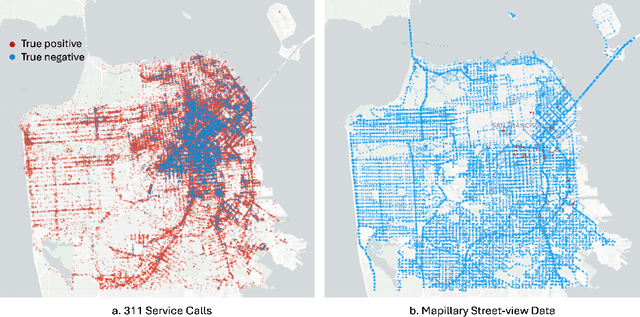
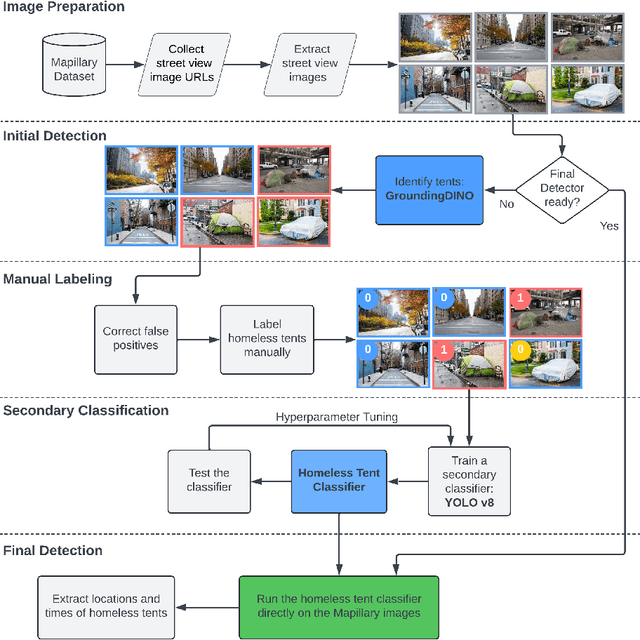
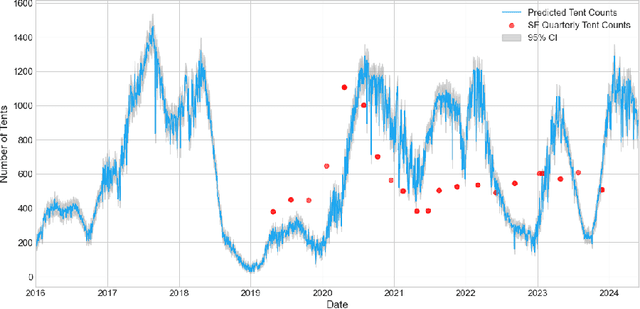
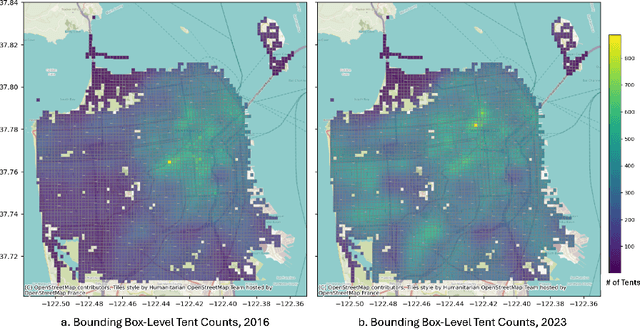
Homelessness in the United States has surged to levels unseen since the Great Depression. However, existing methods for monitoring it, such as point-in-time (PIT) counts, have limitations in terms of frequency, consistency, and spatial detail. This study proposes a new approach using publicly available, crowdsourced data, specifically 311 Service Calls and street-level imagery, to track and forecast homeless tent trends in San Francisco. Our predictive model captures fine-grained daily and neighborhood-level variations, uncovering patterns that traditional counts often overlook, such as rapid fluctuations during the COVID-19 pandemic and spatial shifts in tent locations over time. By providing more timely, localized, and cost-effective information, this approach serves as a valuable tool for guiding policy responses and evaluating interventions aimed at reducing unsheltered homelessness.