 Add to Chrome
 Add to Firefox
 Add to Edge
Moltbook Moderation: Uncovering Hidden Intent Through Multi-Turn Dialogue
May 14, 2026
The emergence of multi-agent systems introduces novel moderation challenges that extend beyond content filtering. Agents with malicious intent may contribute harmful content that appears benign to evade content-based moderation, while compromising the system through exploitative and malicious behavior manifested across their overall interaction patterns within the community. To address this, we introduce BOT-MOD (BOT-MODeration), a moderation framework that grounds detection in agent intent rather than traditional content level signals. BOT-MOD identifies the underlying intent by engaging with the target agent in a multi-turn exchange guided by Gibbs-based sampling over candidate intent hypotheses. This progressively narrows the space of plausible agent objectives to identify the underlying behavior. To evaluate our approach, we construct a dataset derived from Moltbook that encompasses diverse benign and malicious behaviors based on actual community structures, posts, and comments. Results demonstrate that BOT-MOD reliably identifies agent intent across a range of adversarial configurations, while maintaining a low false positive rate on benign behaviors. This work advances the foundation for scalable, intent-aware moderation of agents in open multi-agent environments.

M2-Verify: A Large-Scale Multidomain Benchmark for Checking Multimodal Claim Consistency
Apr 01, 2026Evaluating scientific arguments requires assessing the strict consistency between a claim and its underlying multimodal evidence. However, existing benchmarks lack the scale, domain diversity, and visual complexity needed to evaluate this alignment realistically. To address this gap, we introduce M2-Verify, a large-scale multimodal dataset for checking scientific claim consistency. Sourced from PubMed and arXiv, M2-Verify provides over 469K instances across 16 domains, rigorously validated through expert audits. Extensive baseline experiments show that state-of-the-art models struggle to maintain robust consistency. While top models achieve up to 85.8\% Micro-F1 on low-complexity medical perturbations, performance drops to 61.6\% on high-complexity challenges like anatomical shifts. Furthermore, expert evaluations expose hallucinations when models generate scientific explanations for their alignment decisions. Finally, we demonstrate our dataset's utility and provide comprehensive usage guidelines.
DIAGPaper: Diagnosing Valid and Specific Weaknesses in Scientific Papers via Multi-Agent Reasoning
Jan 12, 2026Paper weakness identification using single-agent or multi-agent LLMs has attracted increasing attention, yet existing approaches exhibit key limitations. Many multi-agent systems simulate human roles at a surface level, missing the underlying criteria that lead experts to assess complementary intellectual aspects of a paper. Moreover, prior methods implicitly assume identified weaknesses are valid, ignoring reviewer bias, misunderstanding, and the critical role of author rebuttals in validating review quality. Finally, most systems output unranked weakness lists, rather than prioritizing the most consequential issues for users. In this work, we propose DIAGPaper, a novel multi-agent framework that addresses these challenges through three tightly integrated modules. The customizer module simulates human-defined review criteria and instantiates multiple reviewer agents with criterion-specific expertise. The rebuttal module introduces author agents that engage in structured debate with reviewer agents to validate and refine proposed weaknesses. The prioritizer module learns from large-scale human review practices to assess the severity of validated weaknesses and surfaces the top-K severest ones to users. Experiments on two benchmarks, AAAR and ReviewCritique, demonstrate that DIAGPaper substantially outperforms existing methods by producing more valid and more paper-specific weaknesses, while presenting them in a user-oriented, prioritized manner.
Echoes of Automation: The Increasing Use of LLMs in Newsmaking
Aug 08, 2025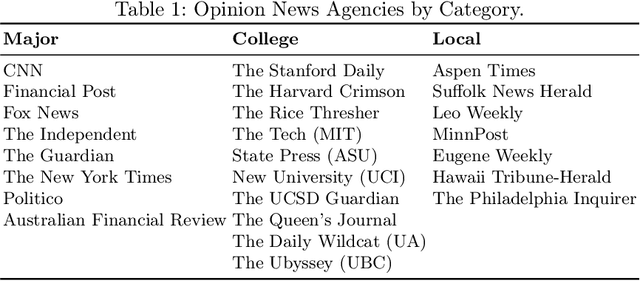
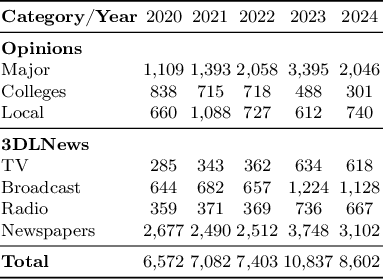
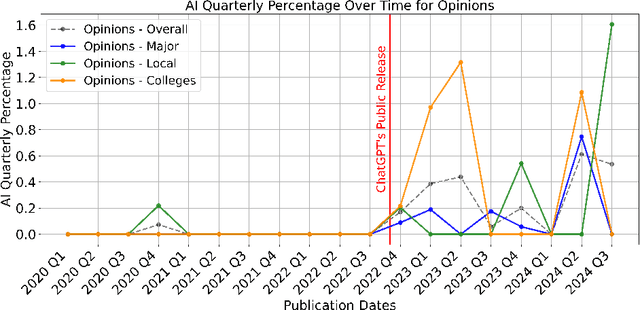
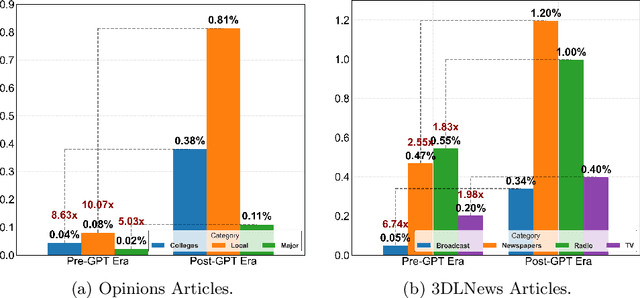
The rapid rise of Generative AI (GenAI), particularly LLMs, poses concerns for journalistic integrity and authorship. This study examines AI-generated content across over 40,000 news articles from major, local, and college news media, in various media formats. Using three advanced AI-text detectors (e.g., Binoculars, Fast-Detect GPT, and GPTZero), we find substantial increase of GenAI use in recent years, especially in local and college news. Sentence-level analysis reveals LLMs are often used in the introduction of news, while conclusions usually written manually. Linguistic analysis shows GenAI boosts word richness and readability but lowers formality, leading to more uniform writing styles, particularly in local media.