 Add to Chrome
 Add to Firefox
 Add to Edge
StateBridge: Training-free Hidden-state Alignment for Latent Communication in LLM Multi-Agent Systems
Aug 13, 2026
Large language model based multi-agent systems usually communicate in text, i.e., using discrete tokens. However, text introduces a discrete bottleneck. Converting the sender's continuous hidden states into discrete tokens discards information that token identities alone cannot capture. Recent work proposes latent communication as an alternative, where agents transmit hidden representations directly without converting them to text. However, existing latent methods either inject working memory layer by layer across the transformers, or require trained projectors that limit portability. We propose StateBridge, a training-free latent communication approach that aligns the sender's final-layer hidden states to the receiver's input space via a closed-form orthogonal transformation. Lightweight norm calibration and vocabulary anchoring ensure compatibility with the pretrained input distribution. The aligned states are prepended to the input of the receiver agent as a continuous prefix. We evaluate StateBridge on math reasoning, code generation, and question answering with four models from two families. StateBridge achieves the best or tied-best score on 22 out of 26 model-task pairs, consistently outperforming the strongest baseline.

HyperClaim: Fine-Grained Cross-Modal Hypergraph Reasoning for Video Misinformation Detection
Jul 30, 2026Video misinformation detection is often approached through global multimodal fusion or free-form multimodal reasoning. Both paradigms can under-represent localized authenticity cues that arise from coupled interactions among query phrases, contextual text, and short temporal spans of frames. Because such interactions are inherently higher-order, pairwise graph formulations are insufficient to capture multi-way cross-modal dependencies, whereas hypergraphs offer a suitable representation for these relations. We propose HyperClaim, a discriminative temporal hypergraph framework for sample-level authenticity classification. Using the title or benchmark-provided paired text as a claim-like query, HyperClaim constructs a sparse heterogeneous hypergraph over query tokens, evidence tokens, and sampled frames; applies confidence-aware filtering and source budgeting to form compact text-frame and short-range temporal evidence units; performs adaptive soft-incidence reasoning with residual text-video calibration; and aggregates textual, visual, and hyperedge states through a discrepancy-aware readout. Without relying on generated rationales or external tool calls, HyperClaim preserves fine-grained cross-modal and temporal structure that global fusion tends to flatten. Under the FactGuard temporal protocol, it achieves 83.7%, 82.0%, and 87.3% accuracy on FakeSV, FakeTT, and FakeVV, respectively, outperforming strong discriminative and reasoning-centric baselines. Learned incidence and attention weights further reveal token- and frame-level structure.
Generative and multimodal AI for materials prediction and design: Progress, challenges, and perspectives
Jul 22, 2026Artificial intelligence (AI) is accelerating materials prediction and design by enabling efficient exploration of chemical and structural spaces, with particular promise for novel materials discovery. However, novelty in materials discovery encompasses chemical plausibility, structural distinctiveness, property relevance and experimental realisability, making AI-driven novelty claims difficult to substantiate. We introduce a materials property hierarchy, from intrinsic, composition-determined properties to extrinsic, processing-dependent performance, to clarify deployment constraints and distinguish structural, physical and deployment novelty. This framework motivates an evidence-based view of multimodal materials data spanning chemical composition, microstructure, processing, and testing and characterisation, showing that current evidence remains concentrated in composition and idealised structure while heterogeneous, under-represented and weakly integrated modalities limit support for physical and deployment novelty. It also highlights the limitations of benchmarks based mainly on computational labels and proxy novelty criteria. Community-wide standards for data collection, modality alignment and evidence synthesis are needed to support multimodal data construction, process-aware multimodal modelling, feasibility-first generative modelling and deployment-aware benchmarking, so that generative and multimodal AI can design experimentally realisable materials with defensible scientific and practical novelty.
PPE-Bench: A Benchmark for Evaluating MLLM Unlearning under Private-Public Entanglement
Jul 03, 2026Multimodal Large Language Models (MLLMs) have shown strong capabilities, but they may memorize private information from web data, raising privacy concerns. Machine unlearning offers a way to remove such private knowledge without retraining from scratch. However, existing MLLM unlearning benchmarks have two major limitations. First, they rely on simplified images that contain only the single target individual, failing to reflect the visual complexity of real-world photos. Second, they typically assume that the forget set and retain set are fully separated, ignoring the fact that private information is often visually entangled with benign public information. For example, a private individual may appear with a public figure or in front of a well-known landmark, where unlearning the private target should not damage the public context. To address these limitations, we propose PPE-Bench, a new benchmark for evaluating MLLM unlearning under private-public entanglement. Each image contains a target individual to be forgotten and public information to be preserved, including public figure and landmark. We further introduce two simple but effective methods to better preserve public information during unlearning. Through experiments, we find that existing unlearning methods can reduce private information leakage, but often substantially harm adjacent public information.
Context-Aware Multimodal Claim Verification in Spoken Dialogues
Jun 09, 2026Every day, millions absorb claims from podcasts and streams that no fact-checker ever sees. Spoken misinformation is built through conversation, where credibility comes not from facts alone but from how claims are framed, reinforced, or left unchallenged across turns. Yet fact-checking has focused on isolated text, leaving dialogue audio under-studied. We introduce MAD2, a new Multi-turn Audio Dialogues benchmark for spoken claim verification, containing 1,000 two-speaker dialogues with 3,368 check-worthy claims and approximately 10 hours of audio, and propose calibrated multimodal fusion of a context-aware audio encoder and a dialogue-aware text model. Across settings, adding dialogue context improves verification, but the gains depend on scenario type. Using only preceding context often matches offline performance, supporting live-moderation settings, and audio contributes most when transcript-based models are destabilized by additional context. Overall, conversational structure matters more for verification than misinformation framing.
M2-Verify: A Large-Scale Multidomain Benchmark for Checking Multimodal Claim Consistency
Apr 01, 2026Evaluating scientific arguments requires assessing the strict consistency between a claim and its underlying multimodal evidence. However, existing benchmarks lack the scale, domain diversity, and visual complexity needed to evaluate this alignment realistically. To address this gap, we introduce M2-Verify, a large-scale multimodal dataset for checking scientific claim consistency. Sourced from PubMed and arXiv, M2-Verify provides over 469K instances across 16 domains, rigorously validated through expert audits. Extensive baseline experiments show that state-of-the-art models struggle to maintain robust consistency. While top models achieve up to 85.8\% Micro-F1 on low-complexity medical perturbations, performance drops to 61.6\% on high-complexity challenges like anatomical shifts. Furthermore, expert evaluations expose hallucinations when models generate scientific explanations for their alignment decisions. Finally, we demonstrate our dataset's utility and provide comprehensive usage guidelines.
Graph-GRPO: Training Graph Flow Models with Reinforcement Learning
Mar 11, 2026Graph generation is a fundamental task with broad applications, such as drug discovery. Recently, discrete flow matching-based graph generation, \aka, graph flow model (GFM), has emerged due to its superior performance and flexible sampling. However, effectively aligning GFMs with complex human preferences or task-specific objectives remains a significant challenge. In this paper, we propose Graph-GRPO, an online reinforcement learning (RL) framework for training GFMs under verifiable rewards. Our method makes two key contributions: (1) We derive an analytical expression for the transition probability of GFMs, replacing the Monte Carlo sampling and enabling fully differentiable rollouts for RL training; (2) We propose a refinement strategy that randomly perturbs specific nodes and edges in a graph, and regenerates them, allowing for localized exploration and self-improvement of generation quality. Extensive experiments on both synthetic and real datasets demonstrate the effectiveness of Graph-GRPO. With only 50 denoising steps, our method achieves 95.0\% and 97.5\% Valid-Unique-Novelty scores on the planar and tree datasets, respectively. Moreover, Graph-GRPO achieves state-of-the-art performance on the molecular optimization tasks, outperforming graph-based and fragment-based RL methods as well as classic genetic algorithms.
MEVER: Multi-Modal and Explainable Claim Verification with Graph-based Evidence Retrieval
Feb 10, 2026Verifying the truthfulness of claims usually requires joint multi-modal reasoning over both textual and visual evidence, such as analyzing both textual caption and chart image for claim verification. In addition, to make the reasoning process transparent, a textual explanation is necessary to justify the verification result. However, most claim verification works mainly focus on the reasoning over textual evidence only or ignore the explainability, resulting in inaccurate and unconvincing verification. To address this problem, we propose a novel model that jointly achieves evidence retrieval, multi-modal claim verification, and explanation generation. For evidence retrieval, we construct a two-layer multi-modal graph for claims and evidence, where we design image-to-text and text-to-image reasoning for multi-modal retrieval. For claim verification, we propose token- and evidence-level fusion to integrate claim and evidence embeddings for multi-modal verification. For explanation generation, we introduce multi-modal Fusion-in-Decoder for explainability. Finally, since almost all the datasets are in general domain, we create a scientific dataset, AIChartClaim, in AI domain to complement claim verification community. Experiments show the strength of our model.
DIAGPaper: Diagnosing Valid and Specific Weaknesses in Scientific Papers via Multi-Agent Reasoning
Jan 12, 2026Paper weakness identification using single-agent or multi-agent LLMs has attracted increasing attention, yet existing approaches exhibit key limitations. Many multi-agent systems simulate human roles at a surface level, missing the underlying criteria that lead experts to assess complementary intellectual aspects of a paper. Moreover, prior methods implicitly assume identified weaknesses are valid, ignoring reviewer bias, misunderstanding, and the critical role of author rebuttals in validating review quality. Finally, most systems output unranked weakness lists, rather than prioritizing the most consequential issues for users. In this work, we propose DIAGPaper, a novel multi-agent framework that addresses these challenges through three tightly integrated modules. The customizer module simulates human-defined review criteria and instantiates multiple reviewer agents with criterion-specific expertise. The rebuttal module introduces author agents that engage in structured debate with reviewer agents to validate and refine proposed weaknesses. The prioritizer module learns from large-scale human review practices to assess the severity of validated weaknesses and surfaces the top-K severest ones to users. Experiments on two benchmarks, AAAR and ReviewCritique, demonstrate that DIAGPaper substantially outperforms existing methods by producing more valid and more paper-specific weaknesses, while presenting them in a user-oriented, prioritized manner.
Echoes of Automation: The Increasing Use of LLMs in Newsmaking
Aug 08, 2025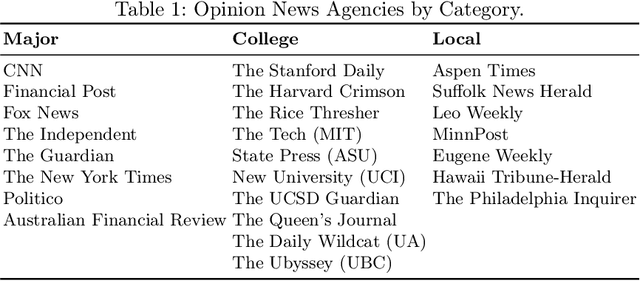
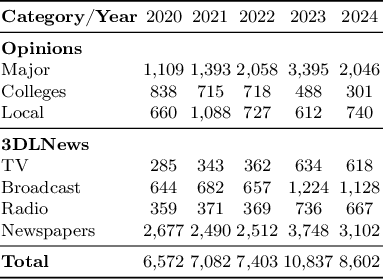
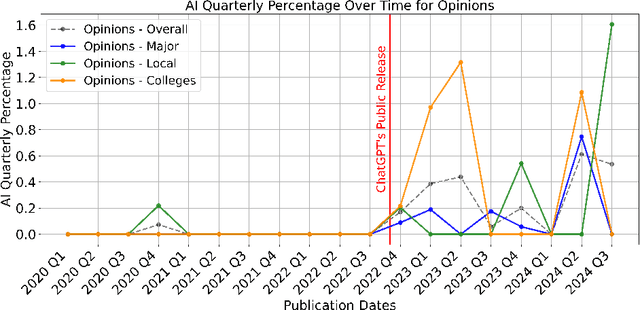
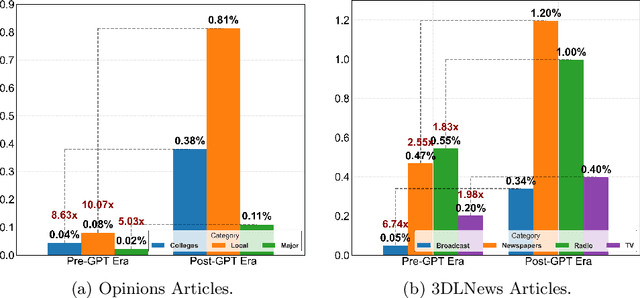
The rapid rise of Generative AI (GenAI), particularly LLMs, poses concerns for journalistic integrity and authorship. This study examines AI-generated content across over 40,000 news articles from major, local, and college news media, in various media formats. Using three advanced AI-text detectors (e.g., Binoculars, Fast-Detect GPT, and GPTZero), we find substantial increase of GenAI use in recent years, especially in local and college news. Sentence-level analysis reveals LLMs are often used in the introduction of news, while conclusions usually written manually. Linguistic analysis shows GenAI boosts word richness and readability but lowers formality, leading to more uniform writing styles, particularly in local media.