 Add to Chrome
 Add to Firefox
 Add to Edge
Influence of Camera-LiDAR Configuration on 3D Object Detection for Autonomous Driving
Oct 08, 2023
Cameras and LiDARs are both important sensors for autonomous driving, playing critical roles for 3D object detection. Camera-LiDAR Fusion has been a prevalent solution for robust and accurate autonomous driving perception. In contrast to the vast majority of existing arts that focus on how to improve the performance of 3D target detection through cross-modal schemes, deep learning algorithms, and training tricks, we devote attention to the impact of sensor configurations on the performance of learning-based methods. To achieve this, we propose a unified information-theoretic surrogate metric for camera and LiDAR evaluation based on the proposed sensor perception model. We also design an accelerated high-quality framework for data acquisition, model training, and performance evaluation that functions with the CARLA simulator. To show the correlation between detection performance and our surrogate metrics, We conduct experiments using several camera-LiDAR placements and parameters inspired by self-driving companies and research institutions. Extensive experimental results of representative algorithms on NuScenes dataset validate the effectiveness of our surrogate metric, demonstrating that sensor configurations significantly impact point-cloud-image fusion based detection models, which contribute up to 30% discrepancy in terms of average precision.

Guardians as You Fall: Active Mode Transition for Safe Falling
Oct 07, 2023Recent advancements in optimal control and reinforcement learning have enabled quadrupedal robots to perform various agile locomotion tasks over diverse terrains. During these agile motions, ensuring the stability and resiliency of the robot is a primary concern to prevent catastrophic falls and mitigate potential damages. Previous methods primarily focus on recovery policies after the robot falls. There is no active safe falling solution to the best of our knowledge. In this paper, we proposed Guardians as You Fall (GYF), a safe falling/tumbling and recovery framework that can actively tumble and recover to stable modes to reduce damage in highly dynamic scenarios. The key idea of GYF is to adaptively traverse different stable modes via active tumbling before the robot shifts to irrecoverable poses. Via comprehensive simulation and real-world experiments, we show that GYF significantly reduces the maximum acceleration and jerk of the robot base compared to the baselines. In particular, GYF reduces the maximum acceleration and jerk by 20%~73% in different scenarios in simulation and real-world experiments. GYF offers a new perspective on safe falling and recovery in locomotion tasks, potentially enabling much more aggressive explorations of existing agile locomotion skills.
Constraint-Conditioned Policy Optimization for Versatile Safe Reinforcement Learning
Oct 05, 2023Safe reinforcement learning (RL) focuses on training reward-maximizing agents subject to pre-defined safety constraints. Yet, learning versatile safe policies that can adapt to varying safety constraint requirements during deployment without retraining remains a largely unexplored and challenging area. In this work, we formulate the versatile safe RL problem and consider two primary requirements: training efficiency and zero-shot adaptation capability. To address them, we introduce the Conditioned Constrained Policy Optimization (CCPO) framework, consisting of two key modules: (1) Versatile Value Estimation (VVE) for approximating value functions under unseen threshold conditions, and (2) Conditioned Variational Inference (CVI) for encoding arbitrary constraint thresholds during policy optimization. Our extensive experiments demonstrate that CCPO outperforms the baselines in terms of safety and task performance while preserving zero-shot adaptation capabilities to different constraint thresholds data-efficiently. This makes our approach suitable for real-world dynamic applications.
COMPOSER: Scalable and Robust Modular Policies for Snake Robots
Oct 02, 2023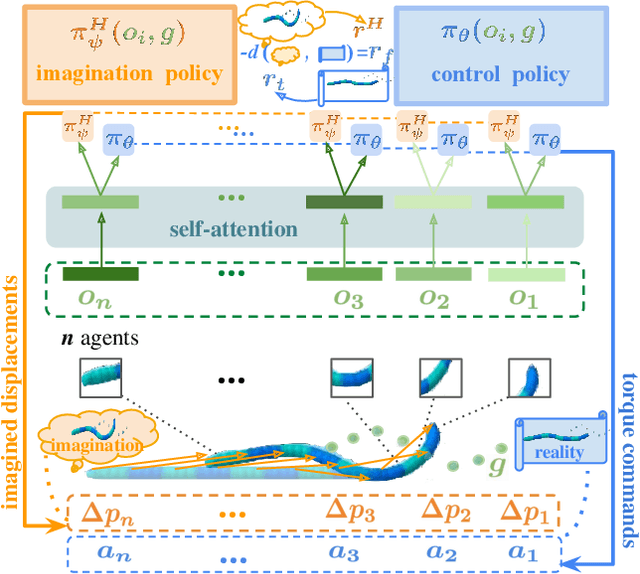
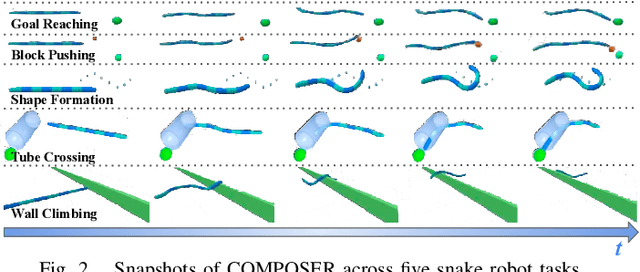
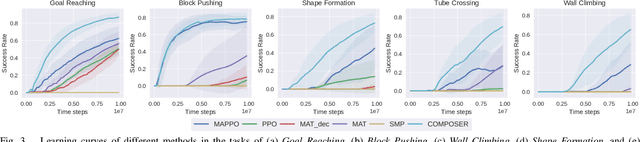
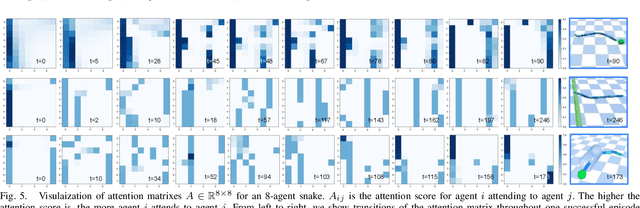
Snake robots have showcased remarkable compliance and adaptability in their interaction with environments, mirroring the traits of their natural counterparts. While their hyper-redundant and high-dimensional characteristics add to this adaptability, they also pose great challenges to robot control. Instead of perceiving the hyper-redundancy and flexibility of snake robots as mere challenges, there lies an unexplored potential in leveraging these traits to enhance robustness and generalizability at the control policy level. We seek to develop a control policy that effectively breaks down the high dimensionality of snake robots while harnessing their redundancy. In this work, we consider the snake robot as a modular robot and formulate the control of the snake robot as a cooperative Multi-Agent Reinforcement Learning (MARL) problem. Each segment of the snake robot functions as an individual agent. Specifically, we incorporate a self-attention mechanism to enhance the cooperative behavior between agents. A high-level imagination policy is proposed to provide additional rewards to guide the low-level control policy. We validate the proposed method COMPOSER with five snake robot tasks, including goal reaching, wall climbing, shape formation, tube crossing, and block pushing. COMPOSER achieves the highest success rate across all tasks when compared to a centralized baseline and four modular policy baselines. Additionally, we show enhanced robustness against module corruption and significantly superior zero-shot generalizability in our proposed method. The videos of this work are available on our project page: https://sites.google.com/view/composer-snake/.
Contextual Biasing with the Knuth-Morris-Pratt Matching Algorithm
Sep 29, 2023
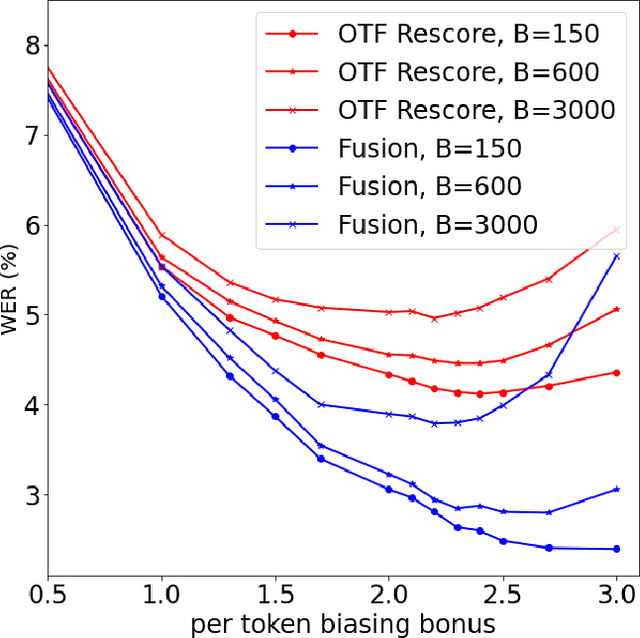

Contextual biasing refers to the problem of biasing the automatic speech recognition (ASR) systems towards rare entities that are relevant to the specific user or application scenarios. We propose algorithms for contextual biasing based on the Knuth-Morris-Pratt algorithm for pattern matching. During beam search, we boost the score of a token extension if it extends matching into a set of biasing phrases. Our method simulates the classical approaches often implemented in the weighted finite state transducer (WFST) framework, but avoids the FST language altogether, with careful considerations on memory footprint and efficiency on tensor processing units (TPUs) by vectorization. Without introducing additional model parameters, our method achieves significant word error rate (WER) reductions on biasing test sets by itself, and yields further performance gain when combined with a model-based biasing method.
Pixel-wise Smoothing for Certified Robustness against Camera Motion Perturbations
Sep 22, 2023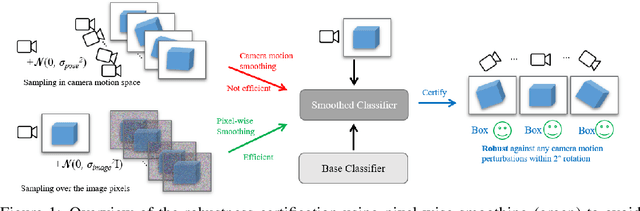
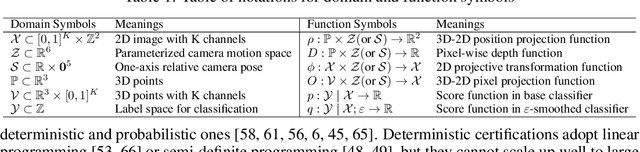

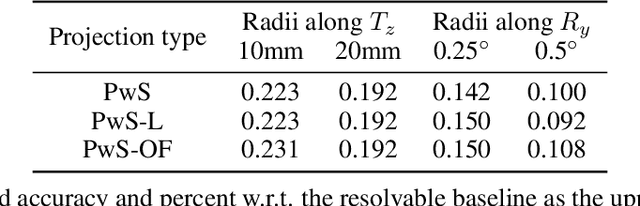
In recent years, computer vision has made remarkable advancements in autonomous driving and robotics. However, it has been observed that deep learning-based visual perception models lack robustness when faced with camera motion perturbations. The current certification process for assessing robustness is costly and time-consuming due to the extensive number of image projections required for Monte Carlo sampling in the 3D camera motion space. To address these challenges, we present a novel, efficient, and practical framework for certifying the robustness of 3D-2D projective transformations against camera motion perturbations. Our approach leverages a smoothing distribution over the 2D pixel space instead of in the 3D physical space, eliminating the need for costly camera motion sampling and significantly enhancing the efficiency of robustness certifications. With the pixel-wise smoothed classifier, we are able to fully upper bound the projection errors using a technique of uniform partitioning in camera motion space. Additionally, we extend our certification framework to a more general scenario where only a single-frame point cloud is required in the projection oracle. This is achieved by deriving Lipschitz-based approximated partition intervals. Through extensive experimentation, we validate the trade-off between effectiveness and efficiency enabled by our proposed method. Remarkably, our approach achieves approximately 80% certified accuracy while utilizing only 30% of the projected image frames.
Learning Shared Safety Constraints from Multi-task Demonstrations
Sep 01, 2023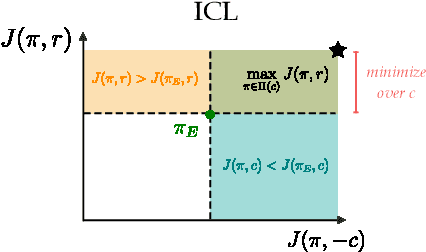
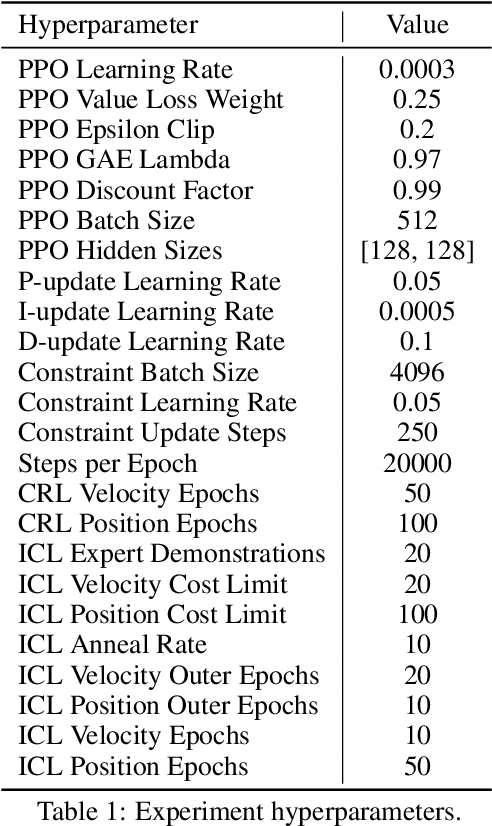
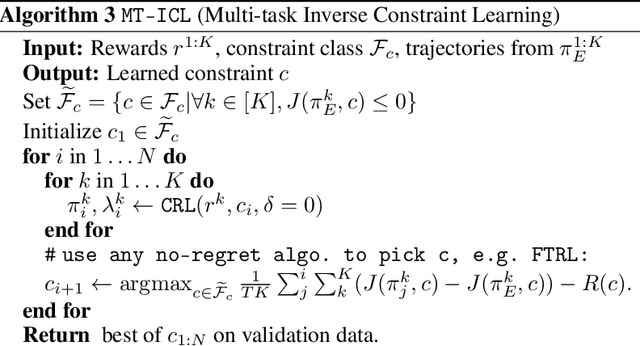
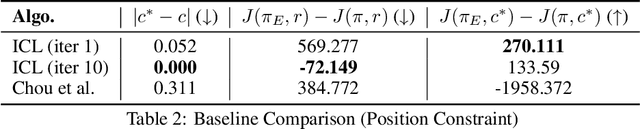
Regardless of the particular task we want them to perform in an environment, there are often shared safety constraints we want our agents to respect. For example, regardless of whether it is making a sandwich or clearing the table, a kitchen robot should not break a plate. Manually specifying such a constraint can be both time-consuming and error-prone. We show how to learn constraints from expert demonstrations of safe task completion by extending inverse reinforcement learning (IRL) techniques to the space of constraints. Intuitively, we learn constraints that forbid highly rewarding behavior that the expert could have taken but chose not to. Unfortunately, the constraint learning problem is rather ill-posed and typically leads to overly conservative constraints that forbid all behavior that the expert did not take. We counter this by leveraging diverse demonstrations that naturally occur in multi-task settings to learn a tighter set of constraints. We validate our method with simulation experiments on high-dimensional continuous control tasks.
The RoboDepth Challenge: Methods and Advancements Towards Robust Depth Estimation
Jul 27, 2023


Accurate depth estimation under out-of-distribution (OoD) scenarios, such as adverse weather conditions, sensor failure, and noise contamination, is desirable for safety-critical applications. Existing depth estimation systems, however, suffer inevitably from real-world corruptions and perturbations and are struggled to provide reliable depth predictions under such cases. In this paper, we summarize the winning solutions from the RoboDepth Challenge -- an academic competition designed to facilitate and advance robust OoD depth estimation. This challenge was developed based on the newly established KITTI-C and NYUDepth2-C benchmarks. We hosted two stand-alone tracks, with an emphasis on robust self-supervised and robust fully-supervised depth estimation, respectively. Out of more than two hundred participants, nine unique and top-performing solutions have appeared, with novel designs ranging from the following aspects: spatial- and frequency-domain augmentations, masked image modeling, image restoration and super-resolution, adversarial training, diffusion-based noise suppression, vision-language pre-training, learned model ensembling, and hierarchical feature enhancement. Extensive experimental analyses along with insightful observations are drawn to better understand the rationale behind each design. We hope this challenge could lay a solid foundation for future research on robust and reliable depth estimation and beyond. The datasets, competition toolkit, workshop recordings, and source code from the winning teams are publicly available on the challenge website.
Seeing is not Believing: Robust Reinforcement Learning against Spurious Correlation
Jul 15, 2023Robustness has been extensively studied in reinforcement learning (RL) to handle various forms of uncertainty such as random perturbations, rare events, and malicious attacks. In this work, we consider one critical type of robustness against spurious correlation, where different portions of the state do not have causality but have correlations induced by unobserved confounders. These spurious correlations are ubiquitous in real-world tasks, for instance, a self-driving car usually observes heavy traffic in the daytime and light traffic at night due to unobservable human activity. A model that learns such useless or even harmful correlation could catastrophically fail when the confounder in the test case deviates from the training one. Although motivated, enabling robustness against spurious correlation poses significant challenges since the uncertainty set, shaped by the unobserved confounder and sequential structure of RL, is difficult to characterize and identify. Existing robust algorithms that assume simple and unstructured uncertainty sets are therefore inadequate to address this challenge. To solve this issue, we propose Robust State-Confounded Markov Decision Processes (RSC-MDPs) and theoretically demonstrate its superiority in breaking spurious correlations compared with other robust RL counterparts. We also design an empirical algorithm to learn the robust optimal policy for RSC-MDPs, which outperforms all baselines in eight realistic self-driving and manipulation tasks.
What Went Wrong? Closing the Sim-to-Real Gap via Differentiable Causal Discovery
Jun 28, 2023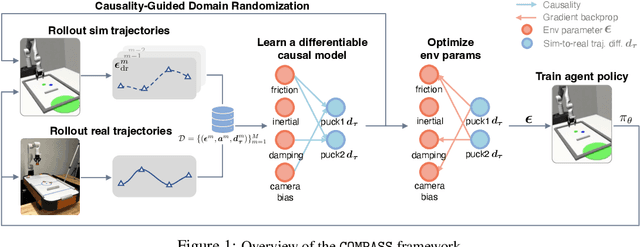
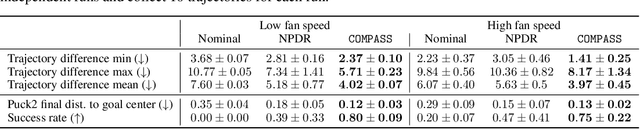

Training control policies in simulation is more appealing than on real robots directly, as it allows for exploring diverse states in a safe and efficient manner. Yet, robot simulators inevitably exhibit disparities from the real world, yielding inaccuracies that manifest as the simulation-to-real gap. Existing literature has proposed to close this gap by actively modifying specific simulator parameters to align the simulated data with real-world observations. However, the set of tunable parameters is usually manually selected to reduce the search space in a case-by-case manner, which is hard to scale up for complex systems and requires extensive domain knowledge. To address the scalability issue and automate the parameter-tuning process, we introduce an approach that aligns the simulator with the real world by discovering the causal relationship between the environment parameters and the sim-to-real gap. Concretely, our method learns a differentiable mapping from the environment parameters to the differences between simulated and real-world robot-object trajectories. This mapping is governed by a simultaneously-learned causal graph to help prune the search space of parameters, provide better interpretability, and improve generalization. We perform experiments to achieve both sim-to-sim and sim-to-real transfer, and show that our method has significant improvements in trajectory alignment and task success rate over strong baselines in a challenging manipulation task.