 Add to Chrome
 Add to Firefox
 Add to Edge
"What do others think?": Task-Oriented Conversational Modeling with Subjective Knowledge
May 20, 2023


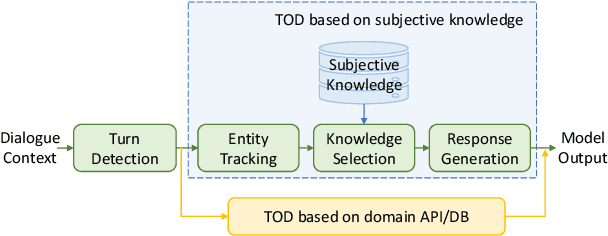
Task-oriented Dialogue (TOD) Systems aim to build dialogue systems that assist users in accomplishing specific goals, such as booking a hotel or a restaurant. Traditional TODs rely on domain-specific APIs/DBs or external factual knowledge to generate responses, which cannot accommodate subjective user requests (e.g., "Is the WIFI reliable?" or "Does the restaurant have a good atmosphere?"). To address this issue, we propose a novel task of subjective-knowledge-based TOD (SK-TOD). We also propose the first corresponding dataset, which contains subjective knowledge-seeking dialogue contexts and manually annotated responses grounded in subjective knowledge sources. When evaluated with existing TOD approaches, we find that this task poses new challenges such as aggregating diverse opinions from multiple knowledge snippets. We hope this task and dataset can promote further research on TOD and subjective content understanding. The code and the dataset are available at https://github.com/alexa/dstc11-track5.

Dual Intent Enhanced Graph Neural Network for Session-based New Item Recommendation
May 10, 2023Recommender systems are essential to various fields, e.g., e-commerce, e-learning, and streaming media. At present, graph neural networks (GNNs) for session-based recommendations normally can only recommend items existing in users' historical sessions. As a result, these GNNs have difficulty recommending items that users have never interacted with (new items), which leads to a phenomenon of information cocoon. Therefore, it is necessary to recommend new items to users. As there is no interaction between new items and users, we cannot include new items when building session graphs for GNN session-based recommender systems. Thus, it is challenging to recommend new items for users when using GNN-based methods. We regard this challenge as '\textbf{G}NN \textbf{S}ession-based \textbf{N}ew \textbf{I}tem \textbf{R}ecommendation (GSNIR)'. To solve this problem, we propose a dual-intent enhanced graph neural network for it. Due to the fact that new items are not tied to historical sessions, the users' intent is difficult to predict. We design a dual-intent network to learn user intent from an attention mechanism and the distribution of historical data respectively, which can simulate users' decision-making process in interacting with a new item. To solve the challenge that new items cannot be learned by GNNs, inspired by zero-shot learning (ZSL), we infer the new item representation in GNN space by using their attributes. By outputting new item probabilities, which contain recommendation scores of the corresponding items, the new items with higher scores are recommended to users. Experiments on two representative real-world datasets show the superiority of our proposed method. The case study from the real-world verifies interpretability benefits brought by the dual-intent module and the new item reasoning module. The code is available at Github: https://github.com/Ee1s/NirGNN
GNNs,You can be Stronger,Deeper and Faster
May 09, 2023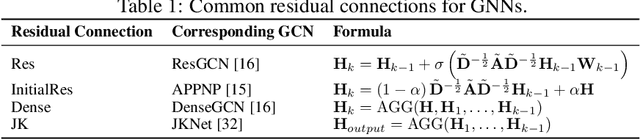
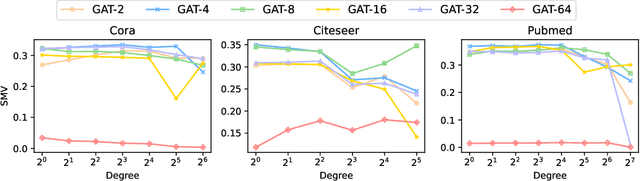
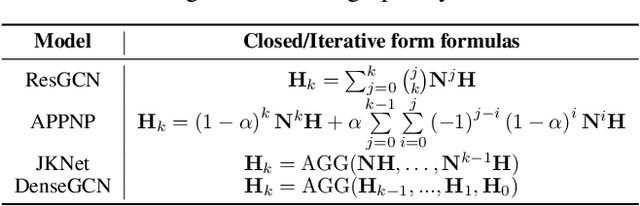
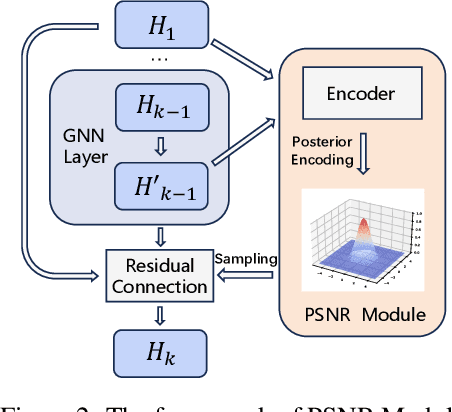
Graph neural networks (GNNs), a type of neural network that can learn from graph-structured data and learn the representation of nodes by aggregating their neighbors, have shown excellent performance in downstream tasks.However, it is known that the performance of graph neural networks (GNNs) degrades gradually as the number of layers increases. Based on k-hop subgraph aggregation, which is a new concept, we propose a new perspective to understand the expressive power of GNN.From this perspective, we reveal the potential causes of the performance degradation of the deep traditional GNN - aggregated subgraph overlap, and the fact that the residual-based graph neural networks in fact exploit the aggregation results of 1 to k hop subgraphs to improve the effectiveness.Further, we propose a new sampling-based node-level residual module named SDF, which is shown by theoretical derivation to obtain a superior expressive power compared to previous residual methods by using information from 1 to k hop subgraphs more flexibly. Extensive experiments show that the performance and efficiency of GNN with the SDF module outperform other methods.
KGTrust: Evaluating Trustworthiness of SIoT via Knowledge Enhanced Graph Neural Networks
Feb 22, 2023


Social Internet of Things (SIoT), a promising and emerging paradigm that injects the notion of social networking into smart objects (i.e., things), paving the way for the next generation of Internet of Things. However, due to the risks and uncertainty, a crucial and urgent problem to be settled is establishing reliable relationships within SIoT, that is, trust evaluation. Graph neural networks for trust evaluation typically adopt a straightforward way such as one-hot or node2vec to comprehend node characteristics, which ignores the valuable semantic knowledge attached to nodes. Moreover, the underlying structure of SIoT is usually complex, including both the heterogeneous graph structure and pairwise trust relationships, which renders hard to preserve the properties of SIoT trust during information propagation. To address these aforementioned problems, we propose a novel knowledge-enhanced graph neural network (KGTrust) for better trust evaluation in SIoT. Specifically, we first extract useful knowledge from users' comment behaviors and external structured triples related to object descriptions, in order to gain a deeper insight into the semantics of users and objects. Furthermore, we introduce a discriminative convolutional layer that utilizes heterogeneous graph structure, node semantics, and augmented trust relationships to learn node embeddings from the perspective of a user as a trustor or a trustee, effectively capturing multi-aspect properties of SIoT trust during information propagation. Finally, a trust prediction layer is developed to estimate the trust relationships between pairwise nodes. Extensive experiments on three public datasets illustrate the superior performance of KGTrust over state-of-the-art methods.
Selective In-Context Data Augmentation for Intent Detection using Pointwise V-Information
Feb 10, 2023

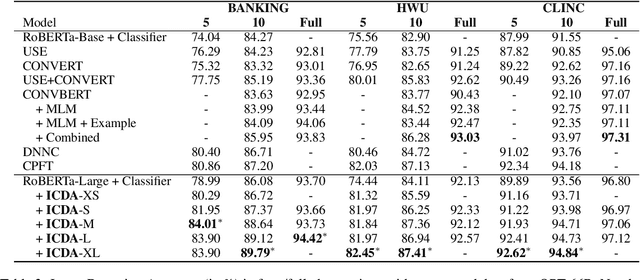
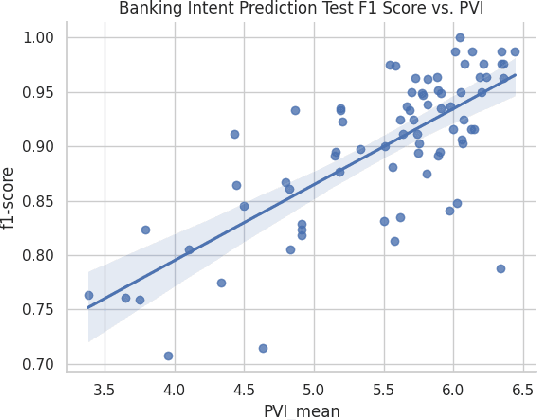
This work focuses on in-context data augmentation for intent detection. Having found that augmentation via in-context prompting of large pre-trained language models (PLMs) alone does not improve performance, we introduce a novel approach based on PLMs and pointwise V-information (PVI), a metric that can measure the usefulness of a datapoint for training a model. Our method first fine-tunes a PLM on a small seed of training data and then synthesizes new datapoints - utterances that correspond to given intents. It then employs intent-aware filtering, based on PVI, to remove datapoints that are not helpful to the downstream intent classifier. Our method is thus able to leverage the expressive power of large language models to produce diverse training data. Empirical results demonstrate that our method can produce synthetic training data that achieve state-of-the-art performance on three challenging intent detection datasets under few-shot settings (1.28% absolute improvement in 5-shot and 1.18% absolute in 10-shot, on average) and perform on par with the state-of-the-art in full-shot settings (within 0.01% absolute, on average).
Using In-Context Learning to Improve Dialogue Safety
Feb 02, 2023



While large neural-based conversational models have become increasingly proficient as dialogue agents, recent work has highlighted safety issues with these systems. For example, these systems can be goaded into generating toxic content, which often perpetuates social biases or stereotypes. We investigate a retrieval-based framework for reducing bias and toxicity in responses generated from neural-based chatbots. It uses in-context learning to steer a model towards safer generations. Concretely, to generate a response to an unsafe dialogue context, we retrieve demonstrations of safe model responses to similar dialogue contexts. We find our proposed approach performs competitively with strong baselines which use fine-tuning. For instance, using automatic evaluation, we find our best fine-tuned baseline only generates safe responses to unsafe dialogue contexts from DiaSafety 2.92% more than our approach. Finally, we also propose a straightforward re-ranking procedure which can further improve response safeness.
Parameter-Efficient Low-Resource Dialogue State Tracking by Prompt Tuning
Jan 26, 2023

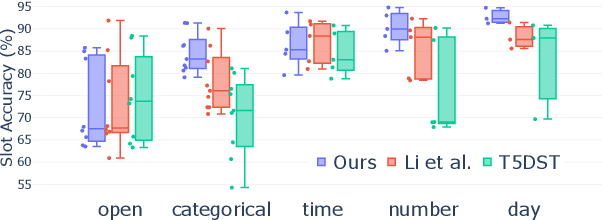
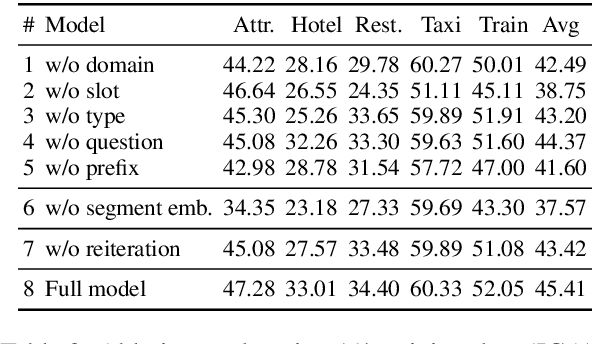
Dialogue state tracking (DST) is an important step in dialogue management to keep track of users' beliefs. Existing works fine-tune all language model (LM) parameters to tackle the DST task, which requires significant data and computing resources for training and hosting. The cost grows exponentially in the real-world deployment where dozens of fine-tuned LM are used for different domains and tasks. To reduce parameter size and better utilize cross-task shared information, we propose to use soft prompt token embeddings to learn task properties. Without tuning LM parameters, our method drastically reduces the number of parameters needed to less than 0.5% of prior works while achieves better low-resource DST performance.
T2-GNN: Graph Neural Networks for Graphs with Incomplete Features and Structure via Teacher-Student Distillation
Dec 24, 2022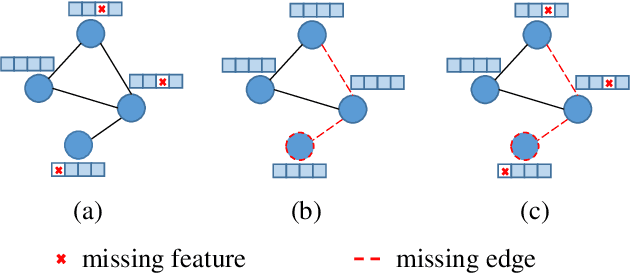
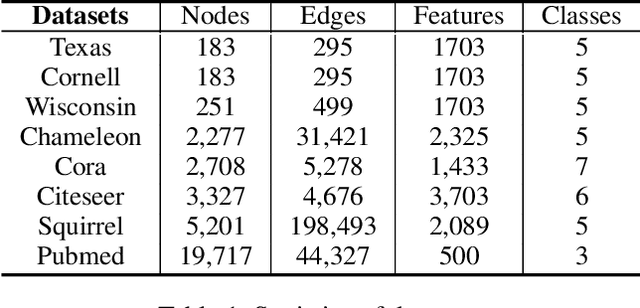
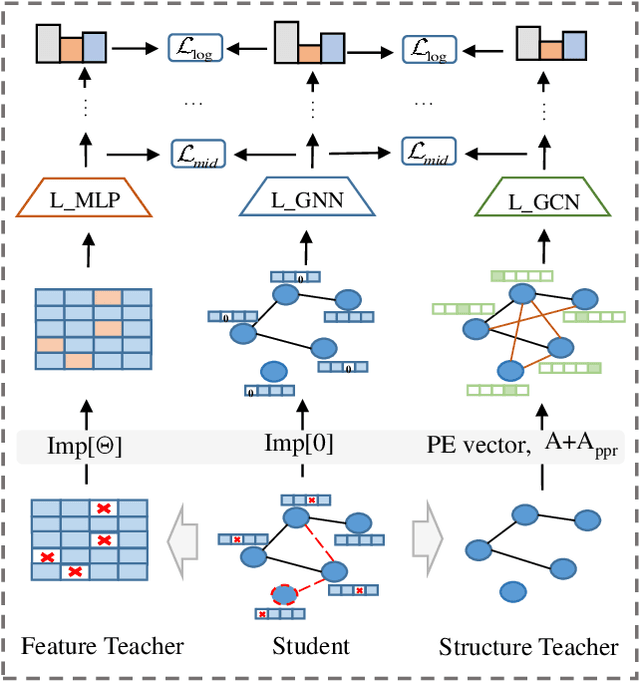
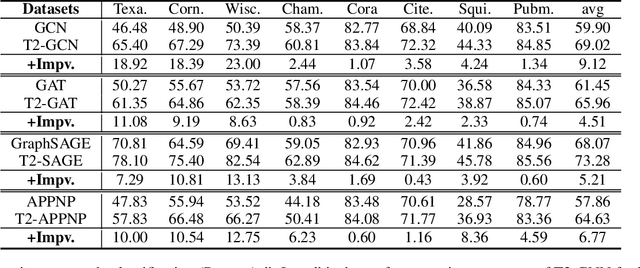
Graph Neural Networks (GNNs) have been a prevailing technique for tackling various analysis tasks on graph data. A key premise for the remarkable performance of GNNs relies on complete and trustworthy initial graph descriptions (i.e., node features and graph structure), which is often not satisfied since real-world graphs are often incomplete due to various unavoidable factors. In particular, GNNs face greater challenges when both node features and graph structure are incomplete at the same time. The existing methods either focus on feature completion or structure completion. They usually rely on the matching relationship between features and structure, or employ joint learning of node representation and feature (or structure) completion in the hope of achieving mutual benefit. However, recent studies confirm that the mutual interference between features and structure leads to the degradation of GNN performance. When both features and structure are incomplete, the mismatch between features and structure caused by the missing randomness exacerbates the interference between the two, which may trigger incorrect completions that negatively affect node representation. To this end, in this paper we propose a general GNN framework based on teacher-student distillation to improve the performance of GNNs on incomplete graphs, namely T2-GNN. To avoid the interference between features and structure, we separately design feature-level and structure-level teacher models to provide targeted guidance for student model (base GNNs, such as GCN) through distillation. Then we design two personalized methods to obtain well-trained feature and structure teachers. To ensure that the knowledge of the teacher model is comprehensively and effectively distilled to the student model, we further propose a dual distillation mode to enable the student to acquire as much expert knowledge as possible.
DialGuide: Aligning Dialogue Model Behavior with Developer Guidelines
Dec 20, 2022Dialogue models are able to generate coherent and fluent responses, but they can still be challenging to control and may produce non-engaging, unsafe results. This unpredictability diminishes user trust and can hinder the use of the models in the real world. To address this, we introduce DialGuide, a novel framework for controlling dialogue model behavior using natural language rules, or guidelines. These guidelines provide information about the context they are applicable to and what should be included in the response, allowing the models to generate responses that are more closely aligned with the developer's expectations and intent. We evaluate DialGuide on three tasks in open-domain dialogue response generation: guideline selection, response generation, and response entailment verification. Our dataset contains 10,737 positive and 15,467 negative dialogue context-response-guideline triplets across two domains - chit-chat and safety. We provide baseline models for the tasks and benchmark their performance. We also demonstrate that DialGuide is effective in the dialogue safety domain, producing safe and engaging responses that follow developer guidelines.
Inducer-tuning: Connecting Prefix-tuning and Adapter-tuning
Oct 26, 2022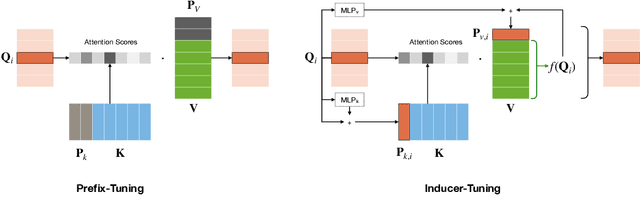
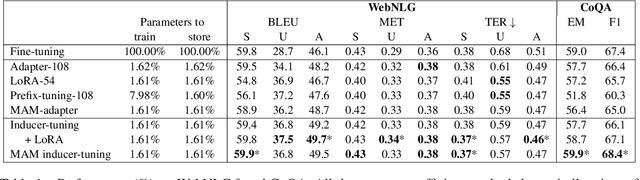

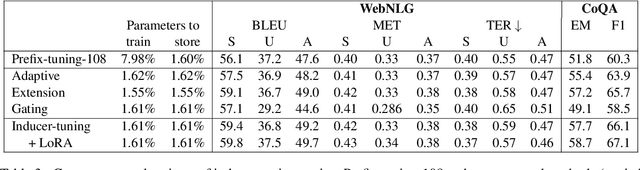
Prefix-tuning, or more generally continuous prompt tuning, has become an essential paradigm of parameter-efficient transfer learning. Using a large pre-trained language model (PLM), prefix-tuning can obtain strong performance by training only a small portion of parameters. In this paper, we propose to understand and further develop prefix-tuning through the kernel lens. Specifically, we make an analogy between \textit{prefixes} and \textit{inducing variables} in kernel methods and hypothesize that \textit{prefixes} serving as \textit{inducing variables} would improve their overall mechanism. From the kernel estimator perspective, we suggest a new variant of prefix-tuning -- \textit{inducer-tuning}, which shares the exact mechanism as prefix-tuning while leveraging the residual form found in adapter-tuning. This mitigates the initialization issue in prefix-tuning. Through comprehensive empirical experiments on natural language understanding and generation tasks, we demonstrate that inducer-tuning can close the performance gap between prefix-tuning and fine-tuning.