 Add to Chrome
 Add to Firefox
 Add to Edge
PatientAgentBench: A Benchmark Framework for Evaluating Patient-Facing Health AI Agents
Jul 28, 2026
Health AI is evolving from answering questions to agentic systems that converse with patients, reason about health records, and act on their behalf. Primary care guards against diagnostic errors and unsafe care; agents assisting in this domain warrant evaluation against the same risks. Current benchmarks focus on medical knowledge, assessed through isolated question-answering or clinician-facing tasks. PatientAgentBench benchmarks patient-facing agentic healthcare; it evaluates a foundation model, wrapped in an agent with a sandbox of healthcare tools, conversing with a simulated patient. Each conversation is scored by an LLM-as-a-Jury across six dimensions via over a hundred conversation-agnostic, clinician-grounded criteria. To validate alignment, licensed clinicians annotated shared conversations, yielding 79-93% adjacent agreement between jury and expert raters, on par with or exceeding clinician inter-rater agreement. We benchmarked 10 models across four families on the same 1,200 scenarios and found clinical gaps. Triage quality is the most discriminating dimension: pass rates rise from 32% for the weakest models to 88% for the strongest, with agents often acting on administrative requests without clinical screening. Clinical safety and workflow accuracy follow the same pattern: the weakest models fail often, fabricating unexecuted actions, while frontier models fail on only 1-3% of cases, from unverified tool outputs and omitted crisis resources in an emergency. More capable models narrow these gaps but do not close them; the strongest scores only 4.25 of 5 overall. These failures surface only in sustained, tool-using conversations against realistic patient records, confirming that static benchmarks are insufficient as healthcare agentic systems gain autonomy. We release the framework as a reproducible, clinician-validated evaluation standard to help the field close this gap.

IMCBench: A benchmark for multimodal LLMs in Image-grounded Medical Conversations
Jun 26, 2026Recent advances in large language models and vision-language models have enabled reasoning over multimodal data, offering opportunities for clinical applications such as decision support and triaging. However, existing medical AI benchmarks are fragmented: some support multi-turn dialogues but lack images, while others provide multimodal inputs but focus on single-turn QA tasks. To address this gap, we introduce IMCBench, an image-grounded, multi-turn medical conversation benchmark that pairs real, publicly available clinical images with synthetic patient profiles to simulate realistic patient-clinician interactions. Each conversation is evaluated across three clinical dimensions: safety, accuracy, and appropriate use of uncertainty in diagnosis. We benchmark eight multimodal frontier models across four model families (Claude, GPT, Nova, and Llama), scoring each on a 1-5 scale using LLM-as-Jury scoring calibrated against expert clinician annotations. Our results show that Claude Opus 4.6 achieves the highest overall score (3.61), followed by Claude Sonnet 4.6 (3.30) and GPT-5.2 (3.29), though no model dominates all dimensions and safety degrades for both malignant and rare conditions ($Δ$ = -0.27 each). Ablation studies further reveal that both visual input and EHR context contribute to safe guidance (safety drops of 0.18 and 0.23 on average when each is removed), with stronger models leveraging visual features more effectively. Together, these findings demonstrate that accurate clinical description does not guarantee safe patient guidance, motivating the need for multi-dimensional evaluation frameworks in medical AI.
ReasoningFlow: Discourse Structures for Understanding LLM Reasoning Traces
Jun 03, 2026Large reasoning models (LRMs) produce reasoning traces with non-linear structures, such as backtracking and self-correction, that complicate the evaluation and monitoring of the reasoning process. We introduce ReasoningFlow, a framework that captures the discourse structures of LRM reasoning traces into fine-grained directed acyclic graphs (DAGs). We develop and validate our annotation schema through careful manual annotation of 31 traces (2.1k steps), achieving high inter-annotator agreement, then scale to automatic annotation of 1,260 traces (247.7k steps) spanning three tasks (math, science, argumentation) and five models (Qwen2.5-32B-Inst, QwQ-32B, DeepSeek-V3, DeepSeek-R1, GPT-oss-120B). By analyzing ReasoningFlow graphs, we find: (1) LRMs exhibit structurally similar traces, despite being trained from different base models and potentially non-overlapping post-training data. (2) ReasoningFlow reveals diverse fine-grained reasoning behaviors (e.g., local verification, self-reflection, and assumptions) that can be used for better reasoning trace monitorability. (3) In LRMs, most of the erroneous steps are not used to derive final answers. (4) Mechanistic causal dependencies between steps do not reflect the language-level discourse structure. We release the dataset and code in: https://github.com/jinulee-v/reasoningflow.
MemGuard: Preventing Memory Contamination in Long-Term Memory-Augmented Large Language Models
May 27, 2026Memory-augmented large language models extend reasoning beyond a fixed context window by maintaining long-term memory across interactions. However, existing memory systems often collapse stable user facts, episodic events, and behavioral rules into a shared space, allowing functionally distinct memories to be retrieved and used as interchangeable evidence. We identify this failure mode as heterogeneous memory contamination, where context-specific events become overgeneralized claims, or semantically relevant but functionally incompatible memories mislead generation. To this end, we introduce MemGuard, a type-aware memory framework that preserves functional memory boundaries during memory construction and retrieval. It assigns each memory an explicit functional role at write time, maintains relations across type-isolated memories, and selectively composes evidence only from necessary memory types, reducing contamination from irrelevant or functionally incompatible evidence. Across hallucination and long-horizon conversation benchmarks, MemGuard improves memory reliability by up to 28.27% while retrieving up to 5.8x fewer memory tokens than prior methods. These results suggest that reliable long-term reasoning depends on principled organization and selective use of heterogeneous memory.
Too Polite to Disagree: Understanding Sycophancy Propagation in Multi-Agent Systems
Apr 03, 2026Large language models (LLMs) often exhibit sycophancy: agreement with user stance even when it conflicts with the model's opinion. While prior work has mostly studied this in single-agent settings, it remains underexplored in collaborative multi-agent systems. We ask whether awareness of other agents' sycophancy levels influences discussion outcomes. To investigate this, we run controlled experiments with six open-source LLMs, providing agents with peer sycophancy rankings that estimate each peer's tendency toward sycophancy. These rankings are based on scores calculated using various static (pre-discussion) and dynamic (online) strategies. We find that providing sycophancy priors reduces the influence of sycophancy-prone peers, mitigates error-cascades, and improves final discussion accuracy by an absolute 10.5%. Thus, this is a lightweight, effective way to reduce discussion sycophancy and improve downstream accuracy.
Sparking Scientific Creativity via LLM-Driven Interdisciplinary Inspiration
Mar 12, 2026Despite interdisciplinary research leading to larger and longer-term impact, most work remains confined to single-domain academic silos. Recent AI-based approaches to scientific discovery show promise for interdisciplinary research, but many prioritize rapidly designing experiments and solutions, bypassing the exploratory, collaborative reasoning processes that drive creative interdisciplinary breakthroughs. As a result, prior efforts largely prioritize automating scientific discovery rather than augmenting the reasoning processes that underlie scientific disruption. We present Idea-Catalyst, a novel framework that systematically identifies interdisciplinary insights to support creative reasoning in both humans and large language models. Starting from an abstract research goal, Idea-Catalyst is designed to assist the brainstorming stage, explicitly avoiding premature anchoring on specific solutions. The framework embodies key metacognitive features of interdisciplinary reasoning: (a) defining and assessing research goals, (b) awareness of a domain's opportunities and unresolved challenges, and (c) strategic exploration of interdisciplinary ideas based on impact potential. Concretely, Idea-Catalyst decomposes an abstract goal (e.g., improving human-AI collaboration) into core target-domain research questions that guide the analysis of progress and open challenges within that domain. These challenges are reformulated as domain-agnostic conceptual problems, enabling retrieval from external disciplines (e.g., Psychology, Sociology) that address analogous issues. By synthesizing and recontextualizing insights from these domains back into the target domain, Idea-Catalyst ranks source domains by their interdisciplinary potential. Empirically, this targeted integration improves average novelty by 21% and insightfulness by 16%, while remaining grounded in the original research problem.
SIMU: Selective Influence Machine Unlearning
Oct 09, 2025The undesired memorization of sensitive information by Large Language Models (LLMs) has emphasized the need for safety mechanisms that can regulate model behavior. This has led to the development of machine unlearning techniques that enable models to precisely forget sensitive and unwanted information. For machine unlearning, first-order and second-order optimizer-based methods have shown significant progress in enabling LLMs to forget targeted information. However, in doing so, these approaches often compromise the model's original capabilities, resulting in unlearned models that struggle to retain their prior knowledge and overall utility. To address this, we propose Selective Influence Machine Unlearning (SIMU), a two-step framework that enhances second-order optimizer-based unlearning by selectively updating only the critical neurons responsible for encoding the forget-set. By constraining updates to these targeted neurons, SIMU achieves comparable unlearning efficacy while substantially outperforming current methods in retaining the model's original knowledge.
Question Generation for Assessing Early Literacy Reading Comprehension
Jul 30, 2025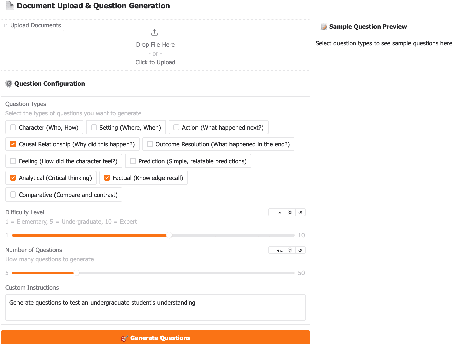
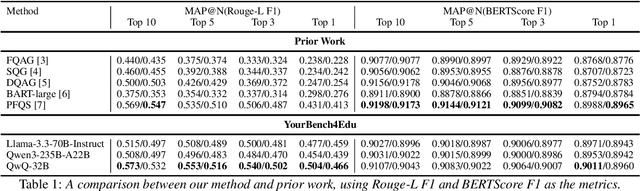
Assessment of reading comprehension through content-based interactions plays an important role in the reading acquisition process. In this paper, we propose a novel approach for generating comprehension questions geared to K-2 English learners. Our method ensures complete coverage of the underlying material and adaptation to the learner's specific proficiencies, and can generate a large diversity of question types at various difficulty levels to ensure a thorough evaluation. We evaluate the performance of various language models in this framework using the FairytaleQA dataset as the source material. Eventually, the proposed approach has the potential to become an important part of autonomous AI-driven English instructors.
Reinforcement Learning Finetunes Small Subnetworks in Large Language Models
May 16, 2025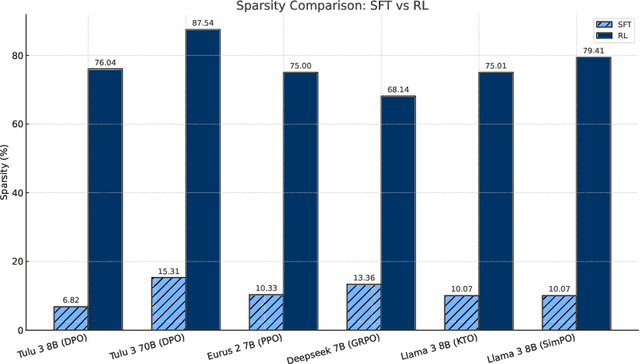
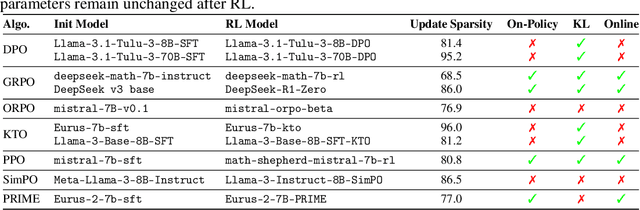
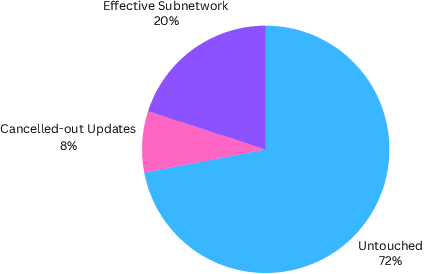
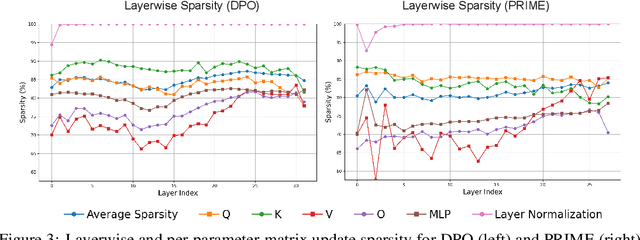
Reinforcement learning (RL) yields substantial improvements in large language models (LLMs) downstream task performance and alignment with human values. Surprisingly, such large gains result from updating only a small subnetwork comprising just 5 percent to 30 percent of the parameters, with the rest effectively unchanged. We refer to this phenomenon as parameter update sparsity induced by RL. It is observed across all 7 widely used RL algorithms (e.g., PPO, GRPO, DPO) and all 10 LLMs from different families in our experiments. This sparsity is intrinsic and occurs without any explicit sparsity promoting regularizations or architectural constraints. Finetuning the subnetwork alone recovers the test accuracy, and, remarkably, produces a model nearly identical to the one obtained via full finetuning. The subnetworks from different random seeds, training data, and even RL algorithms show substantially greater overlap than expected by chance. Our analysis suggests that this sparsity is not due to updating only a subset of layers, instead, nearly all parameter matrices receive similarly sparse updates. Moreover, the updates to almost all parameter matrices are nearly full-rank, suggesting RL updates a small subset of parameters that nevertheless span almost the full subspaces that the parameter matrices can represent. We conjecture that the this update sparsity can be primarily attributed to training on data that is near the policy distribution, techniques that encourage the policy to remain close to the pretrained model, such as the KL regularization and gradient clipping, have limited impact.
Spark: A System for Scientifically Creative Idea Generation
Apr 25, 2025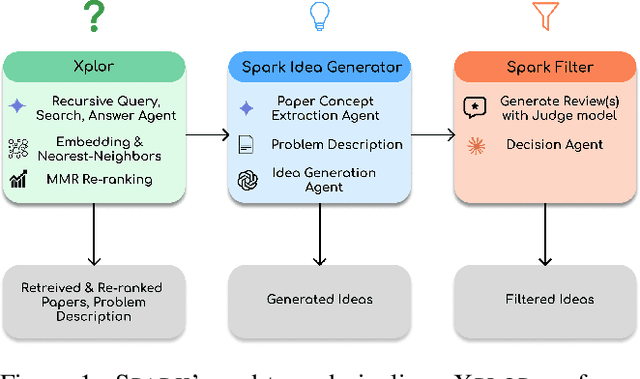
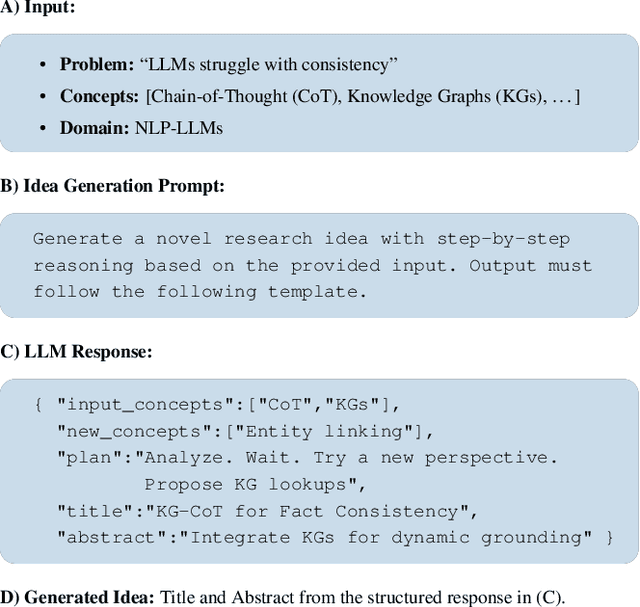
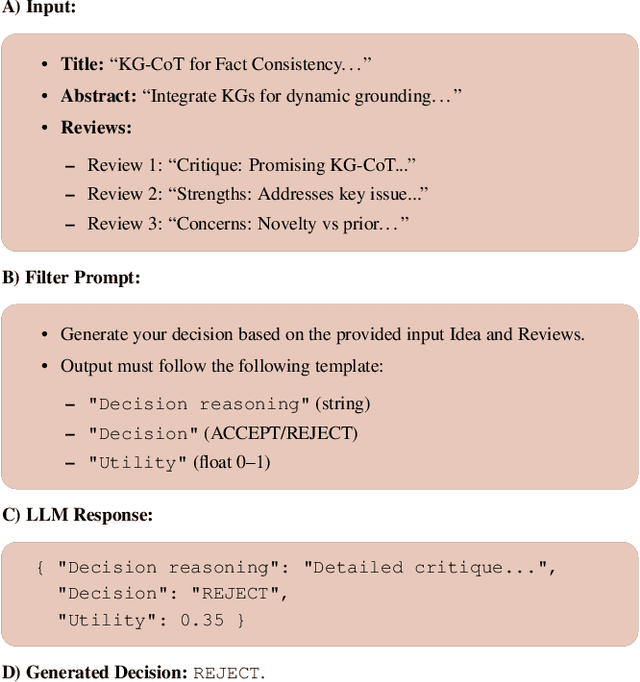
Recently, large language models (LLMs) have shown promising abilities to generate novel research ideas in science, a direction which coincides with many foundational principles in computational creativity (CC). In light of these developments, we present an idea generation system named Spark that couples retrieval-augmented idea generation using LLMs with a reviewer model named Judge trained on 600K scientific reviews from OpenReview. Our work is both a system demonstration and intended to inspire other CC researchers to explore grounding the generation and evaluation of scientific ideas within foundational CC principles. To this end, we release the annotated dataset used to train Judge, inviting other researchers to explore the use of LLMs for idea generation and creative evaluations.