 Add to Chrome
 Add to Firefox
 Add to Edge
How Does Alignment Tuning Shape Representations of Sycophancy and Related Cue-Induced Biases in LLMs?
Jul 20, 2026
Modern LLMs are alarmingly susceptible to surprisingly simple immaterial changes of input prompts: a casual hint, an incorrectly labeled few-shot example, or a fake prior assistant turn often flips an originally correct answer. We study where this susceptibility, spanning sycophancy and related cue-induced biases, lives inside the model. Across five model families and seven BCT bias types, we extract a per-bias direction from hidden states and triangulate it through three measures: probing, leave-one-dataset-out transfer, and causal intervention. The susceptibility is largely installed by alignment tuning rather than pretraining: pretrained base models barely cave to these biases, and their activations carry no cue-specific signal beyond question content. Within aligned models, each bias becomes a single coherent direction that we can both decode and steer along, recovering the unbiased answer across every family we test. The biases stay representationally distinct, however: cross-bias entanglement is model-specific rather than a property of the bias category, and even behaviorally similar biases occupy different directions. The same intervention also serves as a modest debiasing tool, recovering a meaningful share of bias-induced errors while preserving most correct answers across all instruct families. Cue-induced bias is therefore best understood not as a single flaw in LLMs but as a family of distinct, causally active directions that alignment tuning installs.

A Formal Hierarchical Architecture for Agentic Orchestration with Stack-Based Execution and Lazy Discovery
Jul 13, 2026The rapid expansion of capabilities in Large Language Model (LLM) agents has exposed a critical architectural bottleneck: when agents are given access to a flat, monolithic registry of tools, the model must evaluate hundreds or thousands of options simultaneously. This leads to decision-space explosion, context window saturation, and degraded routing accuracy. To address these limitations, this paper presents a hierarchical, skill-based architecture for agentic orchestration. Capabilities are organized as a rooted tree where internal nodes make routing decisions and leaf nodes execute deterministic tasks. The runtime enforces a single-step execution loop governed by a Last-In-First-Out (LIFO) stack, giving the agent a form of memory akin to a Pushdown Automaton, therefore enabling it to track nested execution contexts and resume deterministically from any depth. Capability discovery follows a manifest-driven, lazy-loading protocol: only the immediate children of the active node are loaded, so memory and prompt costs scale with the explored path rather than the global registry. By replacing global memory with localized stack frames, the architecture prevents outputs from one execution branch from leaking into another, establishing the isolation guarantees required for deployment in regulated enterprise environments. We also discuss UPI Help, an AI-powered digital payments support product, as a motivating production deployment context. We provide a mathematical formalization of the orchestration state, detailed algorithmic analysis of the execution loop, and controlled benchmarks comparing flat and hierarchical routing under increasing tool catalogs, multi-step workflow pressure, and visible schema-token exposure per LLM call.
Consistency Training Along the Transformer Stack
Jun 04, 2026Consistency training encourages models to behave similarly across different contexts, and has shown promise for reducing misalignment. We broaden the scope of consistency training in two ways. First, we introduce two new internal consistency targets: MLP Consistency Training (MLPCT), which matches post-activation MLP states, and Attention Consistency Training (AttCT), which matches per-head attention distributions. Second, we apply consistency training to four additional safety threats: persona in-context learning attacks, adversarial frustration, prefill attacks, and conditional misalignment. Across several models and threat settings, we find that consistency training reduces misalignment well beyond the sycophancy and jailbreak settings studied in prior work. We also find cases of cross-threat generalization, where training against one failure mode improves robustness to another, and identify a shared residual-stream mechanism underlying ACT, MLPCT, and AttCT, while distinguishing BCT as mechanistically distinct. Our results suggest that consistency training is a flexible and extensible framework for alignment, capable of unifying defenses against a broader class of model pathologies.
Consistency Training while Mitigating Obfuscation via Rate Matching
Jun 01, 2026Large language models are often influenced by extraneous input features, such as cues revealing a user's preferred answer. Consistency training reduces this influence by training models to behave similarly across inputs with and without the extraneous feature. However, existing methods train for consistency over entire responses or internal activations, which also constrains whether the model verbalises said extraneous features. We show this leads to obfuscation, where the model learns not to mention a cue while remaining influenced by it, which may undermine monitorability. To address this, we introduce Rate Matching Consistency Training (RMCT), which trains for consistency over selected behavioural properties without constraining how this behaviour is expressed. RMCT matches the rate at which the model exhibits a target behaviour (e.g., following a bias cue) across input perturbations, rather than requiring paired inputs with and without the extraneous feature, extending consistency training to settings where the extraneous features cannot be removed. We evaluate RMCT on sycophancy reduction in two open-weight language models, achieving reductions in bias-following comparable to a standard consistency-training baseline on held-out bias types, while largely preserving the model's tendency to verbalise the bias cue. Further, we find that RMCT is more data-efficient at the expense of being less compute-efficient in our experiments. Overall, RMCT shows that consistency training can improve behavioural robustness without directly trading off against monitorability.
Self-Mined Hardness for Safety Fine-Tuning
May 04, 2026Safety fine-tuning of language models typically requires a curated adversarial dataset. We take a different approach: score each candidate prompt's difficulty by how often the target model's own rollouts are judged harmful, then fine-tune on the hardest prompts paired with the model's own non-jailbroken rollouts. On Llama-3-8B-Instruct and Llama-3.2-3B-Instruct, this approach cuts the WildJailbreak attack success rate from 11.5% and 20.1% down to 1-3%, but pushes refusal on jailbreak-shaped benign prompts from 14-22% to 74-94%. Interleaving the same hard prompts 1:1 with adversarially-framed benign prompts (prompts that look like jailbreaks but have benign intent) cuts that refusal back down to 30-51% on 8B and 52-72% on 3B, at a cost of 2-6 percentage points of attack success rate. Within the mixed regime, training on the hardest half of the eligible pool rather than a random half cuts the remaining ASR by 35-50% (about 3 percentage points) on both models.
Sparse Memory Finetuning as a Low-Forgetting Alternative to LoRA and Full Finetuning
May 04, 2026Adapting a pretrained language model to a new task often hurts the general capabilities it already had, a problem known as catastrophic forgetting. Sparse Memory Finetuning (SMF) tries to avoid this by adding key-value memory layers to the model and, on each training step, updating only the small set of memory rows that the current batch reads most heavily. We re-implement SMF on Qwen-2.5-0.5B-Instruct and compare it with LoRA and full finetuning on MedMCQA, a 4-choice medical exam task, using WikiText perplexity and TriviaQA accuracy as forgetting probes. SMF improves MedMCQA by 2.5 percentage points while keeping both forgetting probes within roughly 1 point of the base model, whereas LoRA and full finetuning achieve larger gains but with clear drift on both. We also compare two row-selection rules (KL-divergence and TF-IDF), which balance the two forgetting metrics differently.
Improving Sparse Memory Finetuning
Apr 06, 2026Large Language Models (LLMs) are typically static after training, yet real-world applications require continual adaptation to new knowledge without degrading existing capabilities. Standard approaches to updating models, like full finetuning or parameter-efficient methods (e.g., LoRA), face a fundamental trade-off: catastrophic forgetting. They modify shared dense representations, causing interference across tasks. Sparse Memory Finetuning (SMF) offers a promising alternative by localizing updates to a small subset of parameters in explicit memory layers. In this work, we present an open-source pipeline to retrofit existing pretrained models (Qwen-2.5-0.5B) with sparse memory modules, enabling effective continual learning on consumer hardware. We extend prior work by introducing a theoretically grounded slot-selection mechanism based on Kullback-Leibler (KL) divergence, which prioritizes memory updates for informationally "surprising" tokens relative to a background distribution. Our experiments demonstrate that our retrofitted models can acquire new factual knowledge with minimal forgetting of held-out capabilities, validating the sparse update hypothesis in a practical setting.
Revisiting In-Context Learning with Long Context Language Models
Dec 22, 2024
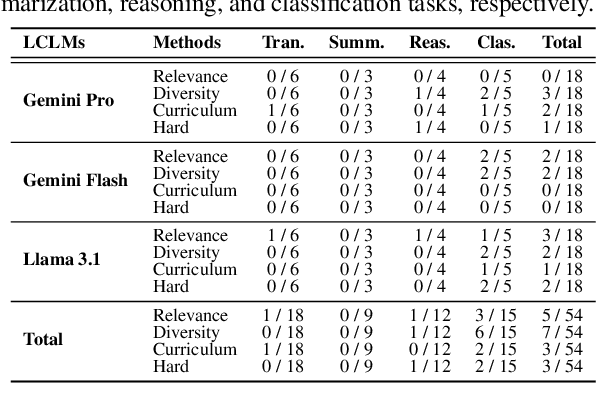
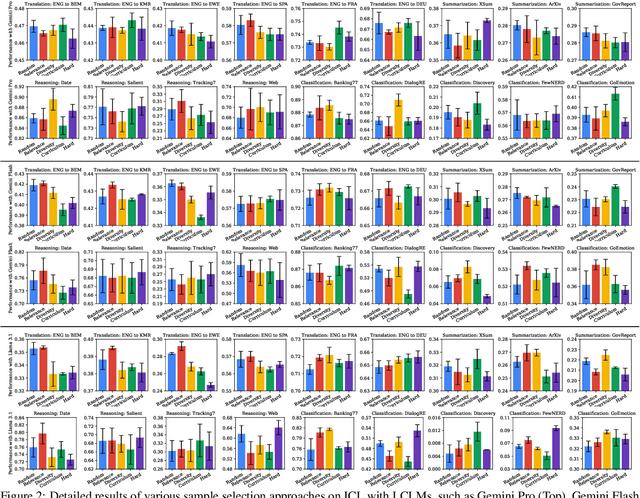

In-Context Learning (ICL) is a technique by which language models make predictions based on examples provided in their input context. Previously, their context window size imposed a limit on the number of examples that can be shown, making example selection techniques crucial for identifying the maximally effective set of examples. However, the recent advent of Long Context Language Models (LCLMs) has significantly increased the number of examples that can be included in context, raising an important question of whether ICL performance in a many-shot regime is still sensitive to the method of sample selection. To answer this, we revisit these approaches in the context of LCLMs through extensive experiments on 18 datasets spanning 4 tasks. Surprisingly, we observe that sophisticated example selection techniques do not yield significant improvements over a simple random sample selection method. Instead, we find that the advent of LCLMs has fundamentally shifted the challenge of ICL from that of selecting the most effective examples to that of collecting sufficient examples to fill the context window. Specifically, in certain datasets, including all available examples does not fully utilize the context window; however, by augmenting the examples in context with a simple data augmentation approach, we substantially improve ICL performance by 5%.
Reinforcement Learning Compensated Model Predictive Control for Off-road Driving on Unknown Deformable Terrain
Aug 17, 2024


This study presents an Actor-Critic reinforcement learning Compensated Model Predictive Controller (AC2MPC) designed for high-speed, off-road autonomous driving on deformable terrains. Addressing the difficulty of modeling unknown tire-terrain interaction and ensuring real-time control feasibility and performance, this framework integrates deep reinforcement learning with a model predictive controller to manage unmodeled nonlinear dynamics. We evaluate the controller framework over constant and varying velocity profiles using high-fidelity simulator Project Chrono. Our findings demonstrate that our controller statistically outperforms standalone model-based and learning-based controllers over three unknown terrains that represent sandy deformable track, sandy and rocky track and cohesive clay-like deformable soil track. Despite varied and previously unseen terrain characteristics, this framework generalized well enough to track longitudinal reference speeds with the least error. Furthermore, this framework required significantly less training data compared to purely learning based controller, converging in fewer steps while delivering better performance. Even when under-trained, this controller outperformed the standalone controllers, highlighting its potential for safer and more efficient real-world deployment.
Leveraging Machine-Generated Rationales to Facilitate Social Meaning Detection in Conversations
Jun 27, 2024



We present a generalizable classification approach that leverages Large Language Models (LLMs) to facilitate the detection of implicitly encoded social meaning in conversations. We design a multi-faceted prompt to extract a textual explanation of the reasoning that connects visible cues to underlying social meanings. These extracted explanations or rationales serve as augmentations to the conversational text to facilitate dialogue understanding and transfer. Our empirical results over 2,340 experimental settings demonstrate the significant positive impact of adding these rationales. Our findings hold true for in-domain classification, zero-shot, and few-shot domain transfer for two different social meaning detection tasks, each spanning two different corpora.