 Add to Chrome
 Add to Firefox
 Add to Edge
CABLE: Extending the Reach of Memory Retrieval via Complementary Antecedent-Based Linking and Expansion
Aug 18, 2026
As LLM agents operate across structured workflows and sessions, preserving long-term history does not ensure that later contexts can recover relevant evidence through a bounded memory interface. We study this evidence-reachability problem in long-term conversational memory, where retrieval still relies heavily on semantic similarity. This works well for topical recall, but it often misses earlier experiences, plans, or motivations that are semantically distant from the later events they help explain. Existing memory graphs provide cross-memory structure, yet links driven mainly by semantic overlap can duplicate what the host retriever already recovers. We argue that link construction should instead prioritize a sparse set of retriever-complementary associations. We present CABLE (Complementary Antecedent-Based Linking and Expansion), a plug-in augmentation that constructs links designed to extend the host retriever's direct semantic reach. For each new memory, CABLE generates antecedent-oriented queries, retrieves prior memories, subtracts candidates in the direct semantic neighborhood, and verifies the remainder before adding the accepted complementary associations into a sparse directed graph. At retrieval time, CABLE expands the host system's retrieved seeds along these links to surface implicit supporting evidence. We evaluate CABLE with A-MEM on LoCoMo and MA-LongMemEval, and further integrate it into SimpleMem and Mem0g on LoCoMo, using Qwen3.5-27B, DeepSeek-chat, and GPT-4o-mini. CABLE yields higher mean LLM-judge scores in every evaluated system-level setting, with the largest gains in categories where useful evidence is distributed across memories or sessions, including open-domain, multi-session, and preference-oriented questions. These results support prioritizing sparse, reasoning-relevant associations that complement rather than duplicate the host retriever.

MedForge: Building Medical Foundation Models Like Open Source Software Development
Feb 22, 2025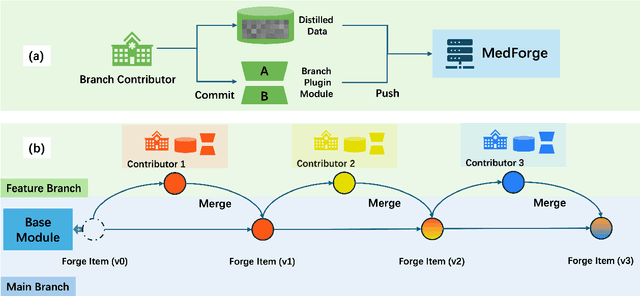
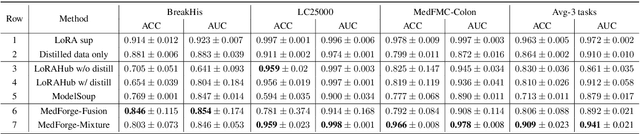
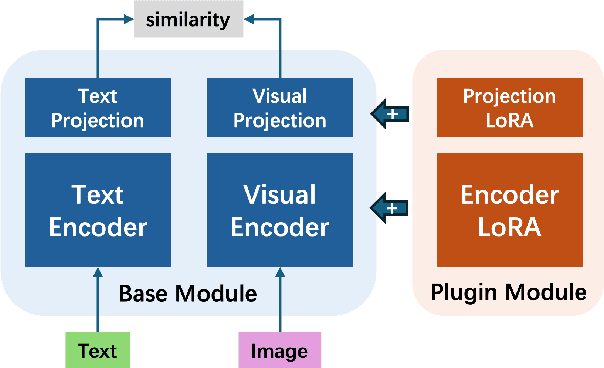
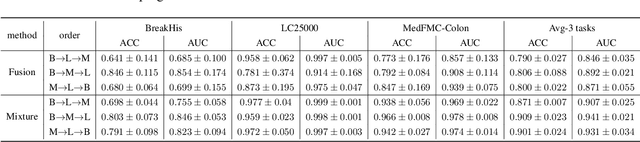
Foundational models (FMs) have made significant strides in the healthcare domain. Yet the data silo challenge and privacy concern remain in healthcare systems, hindering safe medical data sharing and collaborative model development among institutions. The collection and curation of scalable clinical datasets increasingly become the bottleneck for training strong FMs. In this study, we propose Medical Foundation Models Merging (MedForge), a cooperative framework enabling a community-driven medical foundation model development, meanwhile preventing the information leakage of raw patient data and mitigating synchronization model development issues across clinical institutions. MedForge offers a bottom-up model construction mechanism by flexibly merging task-specific Low-Rank Adaptation (LoRA) modules, which can adapt to downstream tasks while retaining original model parameters. Through an asynchronous LoRA module integration scheme, the resulting composite model can progressively enhance its comprehensive performance on various clinical tasks. MedForge shows strong performance on multiple clinical datasets (e.g., breast cancer, lung cancer, and colon cancer) collected from different institutions. Our major findings highlight the value of collaborative foundation models in advancing multi-center clinical collaboration effectively and cohesively. Our code is publicly available at https://github.com/TanZheling/MedForge.
Data-Centric Foundation Models in Computational Healthcare: A Survey
Jan 04, 2024


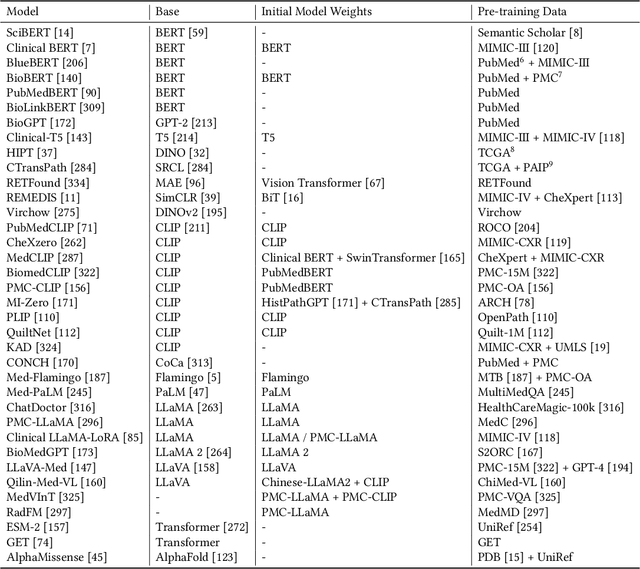
The advent of foundation models (FMs) as an emerging suite of AI techniques has struck a wave of opportunities in computational healthcare. The interactive nature of these models, guided by pre-training data and human instructions, has ignited a data-centric AI paradigm that emphasizes better data characterization, quality, and scale. In healthcare AI, obtaining and processing high-quality clinical data records has been a longstanding challenge, ranging from data quantity, annotation, patient privacy, and ethics. In this survey, we investigate a wide range of data-centric approaches in the FM era (from model pre-training to inference) towards improving the healthcare workflow. We discuss key perspectives in AI security, assessment, and alignment with human values. Finally, we offer a promising outlook of FM-based analytics to enhance the performance of patient outcome and clinical workflow in the evolving landscape of healthcare and medicine. We provide an up-to-date list of healthcare-related foundation models and datasets at https://github.com/Yunkun-Zhang/Data-Centric-FM-Healthcare .