 Add to Chrome
 Add to Firefox
 Add to Edge
The MiniMax-M2 Series: Mini Activations Unleashing Max Real-World Intelligence
May 26, 2026
We introduce the MiniMax-M2 series, a family of Mixture-of-Experts language models built around the principle that mini activations can unleash maximum real-world intelligence. The flagship M2 contains 229.9B total parameters with only 9.8B activated per token. Designed end-to-end for agentic deployment, the M2 series rests on three components: (i) agent-driven data pipelines producing large-scale, verifiable trajectories across agentic coding and agentic cowork, each grounded in an executable workspace and an artifact-aligned reward; (ii) Forge, a scalable agent-native RL system that adapts to long-horizon agent trajectories, paired with windowed-FIFO scheduling, prefix-tree merging, inference optimization, and a clean training-inference-agent decoupling that supports both white-box and black-box agents; (iii) the latest M2.7 checkpoint takes an early step toward self-evolution -- autonomously debugging training runs and modifying its own scaffold. Across M2 through M2.7, this combination translates a mini-activation footprint into frontier-tier performance on agentic coding, deep search, office-task, and reasoning benchmarks.

Aligned Agents, Biased Swarm: Measuring Bias Amplification in Multi-Agent Systems
Apr 13, 2026While Multi-Agent Systems (MAS) are increasingly deployed for complex workflows, their emergent properties-particularly the accumulation of bias-remain poorly understood. Because real-world MAS are too complex to analyze entirely, evaluating their ethical robustness requires first isolating their foundational mechanics. In this work, we conduct a baseline empirical study investigating how basic MAS topologies and feedback loops influence prejudice. Contrary to the assumption that multi-agent collaboration naturally dilutes bias, we hypothesize that structured workflows act as echo chambers, amplifying minor stochastic biases into systemic polarization. To evaluate this, we introduce Discrim-Eval-Open, an open-ended benchmark that bypasses individual model neutrality through forced comparative judgments across demographic groups. Analyzing bias cascades across various structures reveals that architectural sophistication frequently exacerbates bias rather than mitigating it. We observe systemic amplification even when isolated agents operate neutrally, and identify a 'Trigger Vulnerability' where injecting purely objective context drastically accelerates polarization. By stripping away advanced swarm complexity to study foundational dynamics, we establish a crucial baseline: structural complexity does not guarantee ethical robustness. Our code is available at https://github.com/weizhihao1/MAS-Bias.
Energy Saving for Cell-Free Massive MIMO Networks: A Multi-Agent Deep Reinforcement Learning Approach
Apr 08, 2026This paper focuses on energy savings in downlink operation of cell-free massive MIMO (CF mMIMO) networks under dynamic traffic conditions. We propose a multi-agent deep reinforcement learning (MADRL) algorithm that enables each access point (AP) to autonomously control antenna re-configuration and advanced sleep mode (ASM) selection. After the training process, the proposed framework operates in a fully distributed manner, eliminating the need for centralized control and allowing each AP to dynamically adjust to real-time traffic fluctuations. Simulation results show that the proposed algorithm reduces power consumption (PC) by 56.23% compared to systems without any energy-saving scheme and by 30.12% relative to a non-learning mechanism that only utilizes the lightest sleep mode, with only a slight increase in drop ratio. Moreover, compared to the widely used deep Q-network (DQN) algorithm, it achieves a similar PC level but with a significantly lower drop ratio.
daVinci-Agency: Unlocking Long-Horizon Agency Data-Efficiently
Feb 02, 2026While Large Language Models (LLMs) excel at short-term tasks, scaling them to long-horizon agentic workflows remains challenging. The core bottleneck lies in the scarcity of training data that captures authentic long-dependency structures and cross-stage evolutionary dynamics--existing synthesis methods either confine to single-feature scenarios constrained by model distribution, or incur prohibitive human annotation costs, failing to provide scalable, high-quality supervision. We address this by reconceptualizing data synthesis through the lens of real-world software evolution. Our key insight: Pull Request (PR) sequences naturally embody the supervision signals for long-horizon learning. They decompose complex objectives into verifiable submission units, maintain functional coherence across iterations, and encode authentic refinement patterns through bug-fix histories. Building on this, we propose daVinci-Agency, which systematically mines structured supervision from chain-of-PRs through three interlocking mechanisms: (1) progressive task decomposition via continuous commits, (2) long-term consistency enforcement through unified functional objectives, and (3) verifiable refinement from authentic bug-fix trajectories. Unlike synthetic trajectories that treat each step independently, daVinci-Agency's PR-grounded structure inherently preserves the causal dependencies and iterative refinements essential for teaching persistent goal-directed behavior and enables natural alignment with project-level, full-cycle task modeling. The resulting trajectories are substantial--averaging 85k tokens and 116 tool calls--yet remarkably data-efficient: fine-tuning GLM-4.6 on 239 daVinci-Agency samples yields broad improvements across benchmarks, notably achieving a 47% relative gain on Toolathlon. Beyond benchmark performance, our analysis confirms...
AgencyBench: Benchmarking the Frontiers of Autonomous Agents in 1M-Token Real-World Contexts
Jan 16, 2026Large Language Models (LLMs) based autonomous agents demonstrate multifaceted capabilities to contribute substantially to economic production. However, existing benchmarks remain focused on single agentic capability, failing to capture long-horizon real-world scenarios. Moreover, the reliance on human-in-the-loop feedback for realistic tasks creates a scalability bottleneck, hindering automated rollout collection and evaluation. To bridge this gap, we introduce AgencyBench, a comprehensive benchmark derived from daily AI usage, evaluating 6 core agentic capabilities across 32 real-world scenarios, comprising 138 tasks with specific queries, deliverables, and rubrics. These scenarios require an average of 90 tool calls, 1 million tokens, and hours of execution time to resolve. To enable automated evaluation, we employ a user simulation agent to provide iterative feedback, and a Docker sandbox to conduct visual and functional rubric-based assessment. Experiments reveal that closed-source models significantly outperform open-source models (48.4% vs 32.1%). Further analysis reveals significant disparities across models in resource efficiency, feedback-driven self-correction, and specific tool-use preferences. Finally, we investigate the impact of agentic scaffolds, observing that proprietary models demonstrate superior performance within their native ecosystems (e.g., Claude-4.5-Opus via Claude-Agent-SDK), while open-source models exhibit distinct performance peaks, suggesting potential optimization for specific execution frameworks. AgencyBench serves as a critical testbed for next-generation agents, highlighting the necessity of co-optimizing model architecture with agentic frameworks. We believe this work sheds light on the future direction of autonomous agents, and we release the full benchmark and evaluation toolkit at https://github.com/GAIR-NLP/AgencyBench.
InnovatorBench: Evaluating Agents' Ability to Conduct Innovative LLM Research
Nov 03, 2025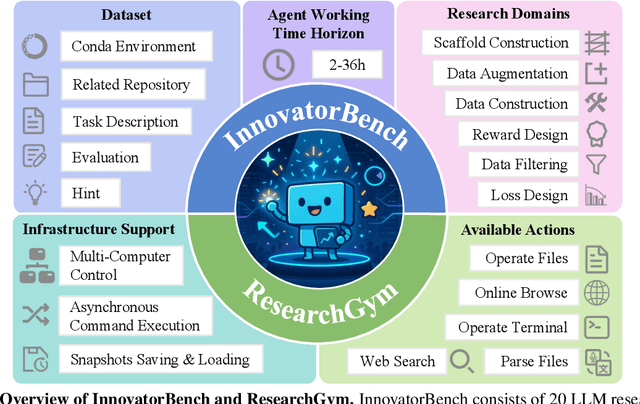
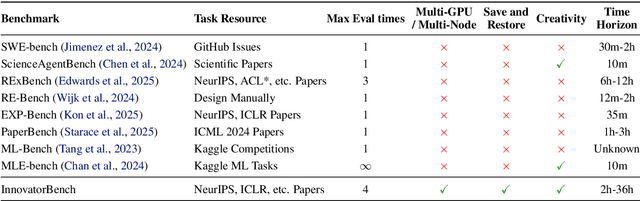
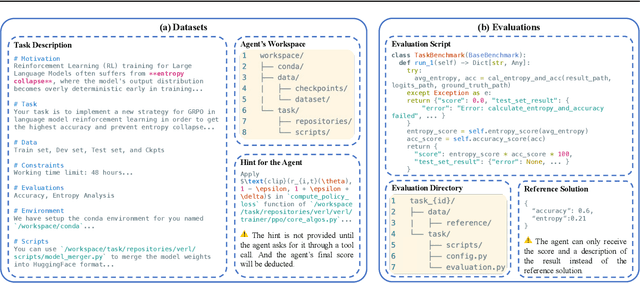
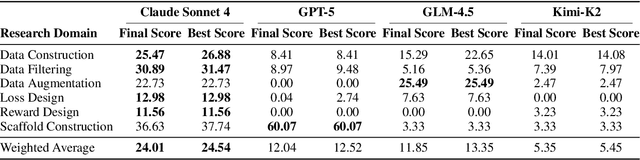
AI agents could accelerate scientific discovery by automating hypothesis formation, experiment design, coding, execution, and analysis, yet existing benchmarks probe narrow skills in simplified settings. To address this gap, we introduce InnovatorBench, a benchmark-platform pair for realistic, end-to-end assessment of agents performing Large Language Model (LLM) research. It comprises 20 tasks spanning Data Construction, Filtering, Augmentation, Loss Design, Reward Design, and Scaffold Construction, which require runnable artifacts and assessment of correctness, performance, output quality, and uncertainty. To support agent operation, we develop ResearchGym, a research environment offering rich action spaces, distributed and long-horizon execution, asynchronous monitoring, and snapshot saving. We also implement a lightweight ReAct agent that couples explicit reasoning with executable planning using frontier models such as Claude-4, GPT-5, GLM-4.5, and Kimi-K2. Our experiments demonstrate that while frontier models show promise in code-driven research tasks, they struggle with fragile algorithm-related tasks and long-horizon decision making, such as impatience, poor resource management, and overreliance on template-based reasoning. Furthermore, agents require over 11 hours to achieve their best performance on InnovatorBench, underscoring the benchmark's difficulty and showing the potential of InnovatorBench to be the next generation of code-based research benchmark.
Interaction as Intelligence Part II: Asynchronous Human-Agent Rollout for Long-Horizon Task Training
Nov 03, 2025Large Language Model (LLM) agents have recently shown strong potential in domains such as automated coding, deep research, and graphical user interface manipulation. However, training them to succeed on long-horizon, domain-specialized tasks remains challenging. Current methods primarily fall into two categories. The first relies on dense human annotations through behavior cloning, which is prohibitively expensive for long-horizon tasks that can take days or months. The second depends on outcome-driven sampling, which often collapses due to the rarity of valid positive trajectories on domain-specialized tasks. We introduce Apollo, a sampling framework that integrates asynchronous human guidance with action-level data filtering. Instead of requiring annotators to shadow every step, Apollo allows them to intervene only when the agent drifts from a promising trajectory, by providing prior knowledge, strategic advice, etc. This lightweight design makes it possible to sustain interactions for over 30 hours and produces valuable trajectories at a lower cost. Apollo then applies supervision control to filter out sub-optimal actions and prevent error propagation. Together, these components enable reliable and effective data collection in long-horizon environments. To demonstrate the effectiveness of Apollo, we evaluate it using InnovatorBench. Our experiments show that when applied to train the GLM-4.5 model on InnovatorBench, Apollo achieves more than a 50% improvement over the untrained baseline and a 28% improvement over a variant trained without human interaction. These results highlight the critical role of human-in-the-loop sampling and the robustness of Apollo's design in handling long-horizon, domain-specialized tasks.
DatasetResearch: Benchmarking Agent Systems for Demand-Driven Dataset Discovery
Aug 09, 2025The rapid advancement of large language models has fundamentally shifted the bottleneck in AI development from computational power to data availability-with countless valuable datasets remaining hidden across specialized repositories, research appendices, and domain platforms. As reasoning capabilities and deep research methodologies continue to evolve, a critical question emerges: can AI agents transcend conventional search to systematically discover any dataset that meets specific user requirements, enabling truly autonomous demand-driven data curation? We introduce DatasetResearch, the first comprehensive benchmark evaluating AI agents' ability to discover and synthesize datasets from 208 real-world demands across knowledge-intensive and reasoning-intensive tasks. Our tri-dimensional evaluation framework reveals a stark reality: even advanced deep research systems achieve only 22% score on our challenging DatasetResearch-pro subset, exposing the vast gap between current capabilities and perfect dataset discovery. Our analysis uncovers a fundamental dichotomy-search agents excel at knowledge tasks through retrieval breadth, while synthesis agents dominate reasoning challenges via structured generation-yet both catastrophically fail on "corner cases" outside existing distributions. These findings establish the first rigorous baseline for dataset discovery agents and illuminate the path toward AI systems capable of finding any dataset in the digital universe. Our benchmark and comprehensive analysis provide the foundation for the next generation of self-improving AI systems and are publicly available at https://github.com/GAIR-NLP/DatasetResearch.
RoboTransfer: Geometry-Consistent Video Diffusion for Robotic Visual Policy Transfer
May 29, 2025Imitation Learning has become a fundamental approach in robotic manipulation. However, collecting large-scale real-world robot demonstrations is prohibitively expensive. Simulators offer a cost-effective alternative, but the sim-to-real gap make it extremely challenging to scale. Therefore, we introduce RoboTransfer, a diffusion-based video generation framework for robotic data synthesis. Unlike previous methods, RoboTransfer integrates multi-view geometry with explicit control over scene components, such as background and object attributes. By incorporating cross-view feature interactions and global depth/normal conditions, RoboTransfer ensures geometry consistency across views. This framework allows fine-grained control, including background edits and object swaps. Experiments demonstrate that RoboTransfer is capable of generating multi-view videos with enhanced geometric consistency and visual fidelity. In addition, policies trained on the data generated by RoboTransfer achieve a 33.3% relative improvement in the success rate in the DIFF-OBJ setting and a substantial 251% relative improvement in the more challenging DIFF-ALL scenario. Explore more demos on our project page: https://horizonrobotics.github.io/robot_lab/robotransfer
SEM: Enhancing Spatial Understanding for Robust Robot Manipulation
May 22, 2025A key challenge in robot manipulation lies in developing policy models with strong spatial understanding, the ability to reason about 3D geometry, object relations, and robot embodiment. Existing methods often fall short: 3D point cloud models lack semantic abstraction, while 2D image encoders struggle with spatial reasoning. To address this, we propose SEM (Spatial Enhanced Manipulation model), a novel diffusion-based policy framework that explicitly enhances spatial understanding from two complementary perspectives. A spatial enhancer augments visual representations with 3D geometric context, while a robot state encoder captures embodiment-aware structure through graphbased modeling of joint dependencies. By integrating these modules, SEM significantly improves spatial understanding, leading to robust and generalizable manipulation across diverse tasks that outperform existing baselines.