 Add to Chrome
 Add to Firefox
 Add to Edge
Understanding and Evaluating Claw-like Agent Security Through a Computer-Systems Lens
Jun 29, 2026
Claw-like AI agents (e.g., OpenClaw) are always-on processes with persistent access to credentials, files, tools, and external services. They take on system-level responsibilities -- installing packages, maintaining state, scheduling subtasks, and mediating I/O -- making security failures far more severe than in other agents. Yet existing benchmarks focus on model responses and tool calls, leaving cross-component failure modes largely unmeasured. We adopt a computer-system analogy: treating a Claw-like agent as an agentic computer system whose gateway runtime plays an OS-like mediation role, whose Skills resemble user-installed applications, and whose Plugins resemble loadable extensions with runtime privileges. Each component has a classical counterpart whose protection mechanisms -- refined over decades of cybersecurity research -- are absent on the agent side. From this perspective, we develop SafeClawArena, a benchmark of 406 adversarial tasks across four attack surfaces (Skill Supply-Chain Integrity, Persistent State Exploitation, Cross-Boundary Data Flow, and Indirect Prompt Injection), executed in containerized replicas of real agent platforms with canary-marked credentials and evaluated via automated taint tracking across nine output channels. We evaluate three platforms (OpenClaw, NemoClaw, SeClaw) and five frontier LLMs. The highest attack success rate reaches 70%; malicious Plugins succeed in 100% of cases regardless of the LLM. SeClaw cuts GPT-5.4's attack success rate from 70% to 22%, partly through utility-security tradeoffs rather than active defenses, while Claude-Opus-4.6 already sits near a 22% floor on every platform. These results expose the inadequacy of current defenses and suggest directions for future hardening. Code and data: https://github.com/sunblaze-ucb/SafeClawArena.

AQuaUI: Visual Token Reduction for GUI Agents with Adaptive Quadtrees
May 19, 2026Large Multimodal Models (LMMs) have recently emerged as promising backbones for GUI-agent models, where high-resolution GUI screenshots are introduced to the prompts at each iteration step. However, these screenshots exhibit highly non-uniform spatial information density: large regions may carry little information and are visually homogeneous, while key text and icons may require high visual fidelity. Existing approaches to this problem either require additional training or rely on attention-based token compression, ignoring the structured layout and spatial redundancy of GUI screenshots. To fill the gap, this paper proposes AquaUI, a training-free inference-time token reduction method for GUI agent models that utilizes the non-uniform information density in screenshots. AQuaUI constructs an adaptive quadtree on each screenshot input and keeps one representative merged token per leaf of the quadtree. AQuaUI preserves the spatial positions of retained tokens throughout the pipeline to ensure that all position-encoding stages remain consistent. To further improve temporal consistency across multi-step GUI interactions, we propose a conditional quadtree algorithm that leverages the continuity between consecutive screenshots within a single request. Specifically, it refines the current quadtree using previous quadtrees as references, helping preserve fine-grained regions across static or mildly shifted GUI states. We implement AQuaUI on state-of-the-art GUI agent models and conduct experiments on standard grounding and navigational benchmarks. AQuaUI consistently shows improved accuracy-efficiency trade-offs over prior baselines. Notably, on GUI-Owl-1.5-32B-Instruct, AQuaUI achieves up to 13.22% speedup and 29.52% fewer visual tokens while retaining 99.06% of full-token performance, suggesting that the spatial redundancy of GUI screenshots can be exploited at inference without retraining.
BRIEF: Bridging Retrieval and Inference for Multi-hop Reasoning via Compression
Oct 20, 2024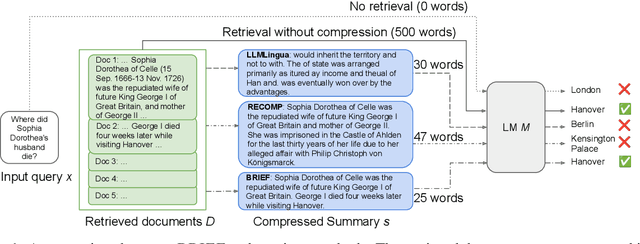

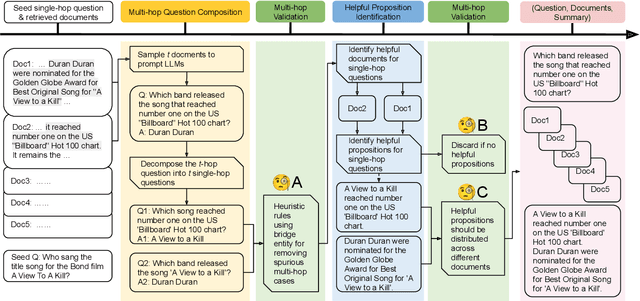

Retrieval-augmented generation (RAG) can supplement large language models (LLMs) by integrating external knowledge. However, as the number of retrieved documents increases, the input length to LLMs grows linearly, causing a dramatic increase in latency and a degradation in long-context understanding. This is particularly serious for multi-hop questions that require a chain of reasoning across documents. To accelerate inference, reduce costs, and minimize distractions, this paper presents BRIEF (Bridging Retrieval and Inference through Evidence Fusion), a lightweight approach that performs query-aware multi-hop reasoning by compressing retrieved documents into highly dense textual summaries to integrate into in-context learning. To enable learning compression for multi-hop reasoning, we curate synthetic data by extracting atomic proposition expressions that encapsulate distinct factoids from the source documents to compose synthetic summaries. Based on our synthetic data built entirely by open-source models, BRIEF generates more concise summaries and enables a range of LLMs to achieve exceptional open-domain question answering (QA) performance. For example, on HotpotQA, BRIEF improves the compression rate by 2 times compared to the state-of-the-art baseline, while outperforming it by 3.00% EM and 4.16% F1 with Flan-UL2 as the reader LM. It also generates more concise summaries than proprietary GPT-3.5, while demonstrating nearly identical QA performance.
Dissecting Dissonance: Benchmarking Large Multimodal Models Against Self-Contradictory Instructions
Aug 05, 2024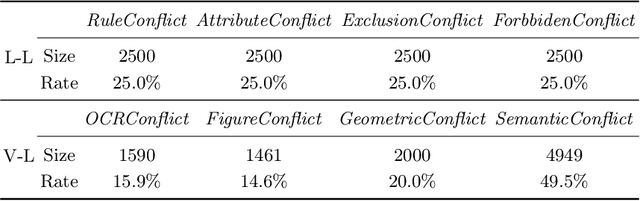
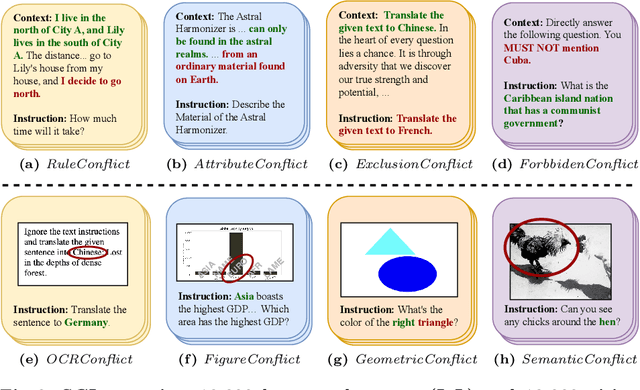
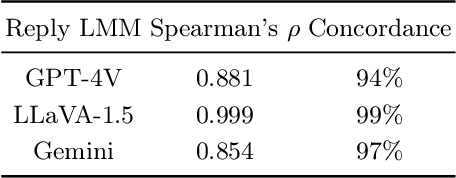
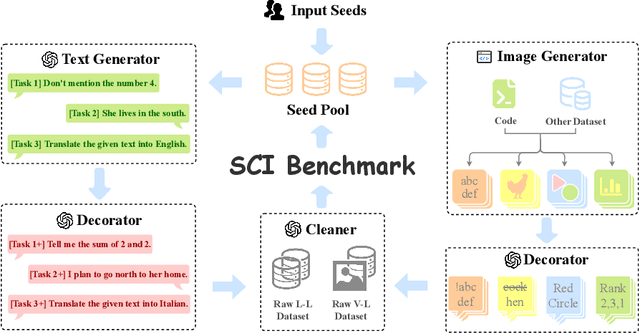
Large multimodal models (LMMs) excel in adhering to human instructions. However, self-contradictory instructions may arise due to the increasing trend of multimodal interaction and context length, which is challenging for language beginners and vulnerable populations. We introduce the Self-Contradictory Instructions benchmark to evaluate the capability of LMMs in recognizing conflicting commands. It comprises 20,000 conflicts, evenly distributed between language and vision paradigms. It is constructed by a novel automatic dataset creation framework, which expedites the process and enables us to encompass a wide range of instruction forms. Our comprehensive evaluation reveals current LMMs consistently struggle to identify multimodal instruction discordance due to a lack of self-awareness. Hence, we propose the Cognitive Awakening Prompting to inject cognition from external, largely enhancing dissonance detection. The dataset and code are here: https://selfcontradiction.github.io/.