 Add to Chrome
 Add to Firefox
 Add to Edge
TadA-Bench: A Million-Variant Benchmark for Future-Round Discovery Toward Agentic Protein Engineering
May 29, 2026
AI for scientific discovery is entering an agentic era, where protein-engineering systems are expected to prioritize future wet-lab experiments rather than merely fit static measurements. We introduce TadA-Bench, a million-variant wet-lab replay benchmark from 31 TadA directed-evolution rounds for future-round discovery toward agentic protein engineering. TadA-Bench preserves the campaign chronology and defines a fixed-data replay task: given earlier experimental rounds, models rank variants that appear only in later rounds. It provides aligned DNA, RNA, and protein views, and uses Seq2Graph, a graph-based label-unification pipeline, to reconcile noisy enrichment measurements into consistent cross-round activity labels. Random-split controls show strong interpolation, but future-round ranking and finite-budget candidate selection are much weaker. Controlled analyses suggest that evolutionary coverage is more informative than local data density, positioning TadA-Bench as a reproducible wet-lab replay substrate for future-round discovery toward agentic protein engineering; the data and code are released on Hugging Face and GitHub.

Learning Native Continuation for Action Chunking Flow Policies
Feb 13, 2026Action chunking enables Vision Language Action (VLA) models to run in real time, but naive chunked execution often exhibits discontinuities at chunk boundaries. Real-Time Chunking (RTC) alleviates this issue but is external to the policy, leading to spurious multimodal switching and trajectories that are not intrinsically smooth. We propose Legato, a training-time continuation method for action-chunked flow-based VLA policies. Specifically, Legato initializes denoising from a schedule-shaped mixture of known actions and noise, exposing the model to partial action information. Moreover, Legato reshapes the learned flow dynamics to ensure that the denoising process remains consistent between training and inference under per-step guidance. Legato further uses randomized schedule condition during training to support varying inference delays and achieve controllable smoothness. Empirically, Legato produces smoother trajectories and reduces spurious multimodal switching during execution, leading to less hesitation and shorter task completion time. Extensive real-world experiments show that Legato consistently outperforms RTC across five manipulation tasks, achieving approximately 10% improvements in both trajectory smoothness and task completion time.
Point What You Mean: Visually Grounded Instruction Policy
Dec 22, 2025
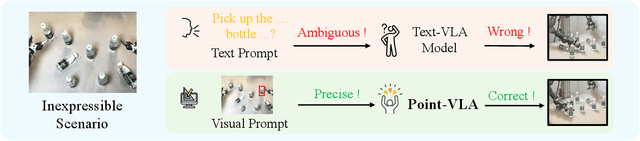
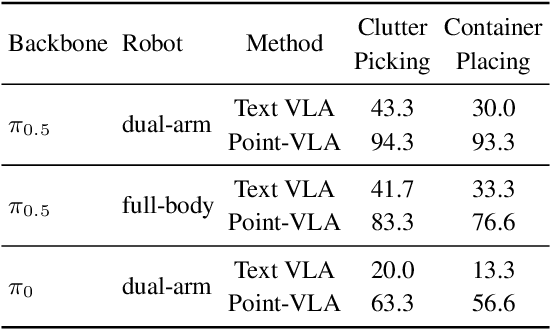
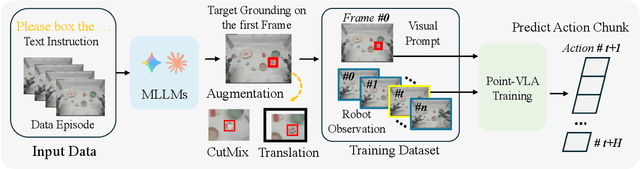
Vision-Language-Action (VLA) models align vision and language with embodied control, but their object referring ability remains limited when relying solely on text prompt, especially in cluttered or out-of-distribution (OOD) scenes. In this study, we introduce the Point-VLA, a plug-and-play policy that augments language instructions with explicit visual cues (e.g., bounding boxes) to resolve referential ambiguity and enable precise object-level grounding. To efficiently scale visually grounded datasets, we further develop an automatic data annotation pipeline requiring minimal human effort. We evaluate Point-VLA on diverse real-world referring tasks and observe consistently stronger performance than text-only instruction VLAs, particularly in cluttered or unseen-object scenarios, with robust generalization. These results demonstrate that Point-VLA effectively resolves object referring ambiguity through pixel-level visual grounding, achieving more generalizable embodied control.
Saying the Unsaid: Revealing the Hidden Language of Multimodal Systems Through Telephone Games
Nov 12, 2025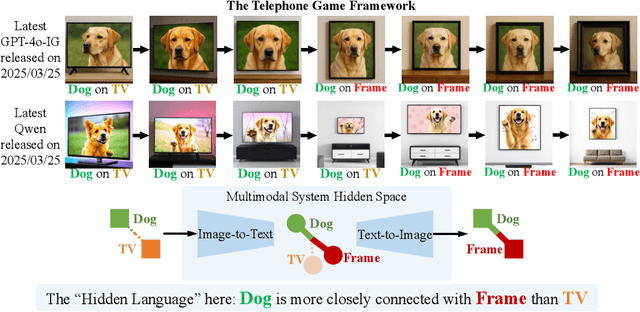
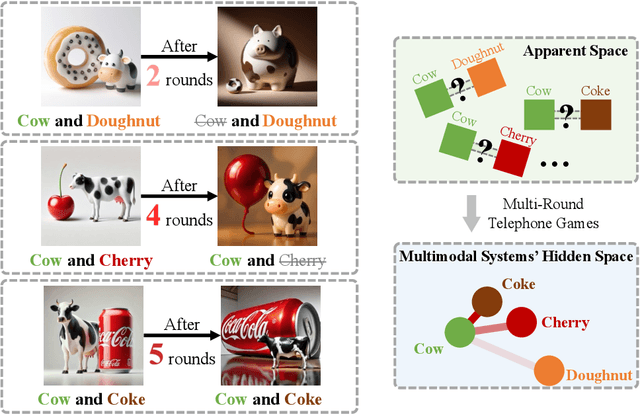
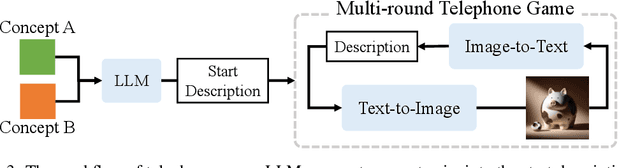
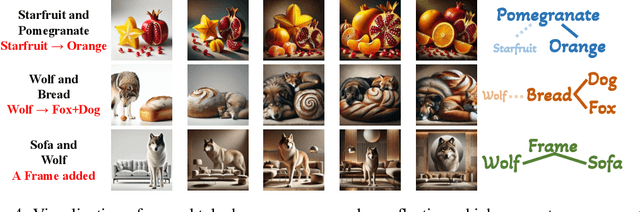
Recent closed-source multimodal systems have made great advances, but their hidden language for understanding the world remains opaque because of their black-box architectures. In this paper, we use the systems' preference bias to study their hidden language: During the process of compressing the input images (typically containing multiple concepts) into texts and then reconstructing them into images, the systems' inherent preference bias introduces specific shifts in the outputs, disrupting the original input concept co-occurrence. We employ the multi-round "telephone game" to strategically leverage this bias. By observing the co-occurrence frequencies of concepts in telephone games, we quantitatively investigate the concept connection strength in the understanding of multimodal systems, i.e., "hidden language." We also contribute Telescope, a dataset of 10,000+ concept pairs, as the database of our telephone game framework. Our telephone game is test-time scalable: By iteratively running telephone games, we can construct a global map of concept connections in multimodal systems' understanding. Here we can identify preference bias inherited from training, assess generalization capability advancement, and discover more stable pathways for fragile concept connections. Furthermore, we use Reasoning-LLMs to uncover unexpected concept relationships that transcend textual and visual similarities, inferring how multimodal systems understand and simulate the world. This study offers a new perspective on the hidden language of multimodal systems and lays the foundation for future research on the interpretability and controllability of multimodal systems.
Lost in Translation: Latent Concept Misalignment in Text-to-Image Diffusion Models
Aug 05, 2024Advancements in text-to-image diffusion models have broadened extensive downstream practical applications, but such models often encounter misalignment issues between text and image. Taking the generation of a combination of two disentangled concepts as an example, say given the prompt "a tea cup of iced coke", existing models usually generate a glass cup of iced coke because the iced coke usually co-occurs with the glass cup instead of the tea one during model training. The root of such misalignment is attributed to the confusion in the latent semantic space of text-to-image diffusion models, and hence we refer to the "a tea cup of iced coke" phenomenon as Latent Concept Misalignment (LC-Mis). We leverage large language models (LLMs) to thoroughly investigate the scope of LC-Mis, and develop an automated pipeline for aligning the latent semantics of diffusion models to text prompts. Empirical assessments confirm the effectiveness of our approach, substantially reducing LC-Mis errors and enhancing the robustness and versatility of text-to-image diffusion models. The code and dataset are here: https://github.com/RossoneriZhao/iced_coke.