 Add to Chrome
 Add to Firefox
 Add to Edge
FARS: A Fully Automated Research System Deployed at Scale
Jun 30, 2026
Recent automated research systems show that language-model agents can generate hypotheses, run experiments, and write complete manuscripts, but most evidence still comes from selected examples, human-framed topics, or a few pre-defined research tasks. We present FARS (Fully Automated Research System), a fully automated AI-for-AI research system designed to operate across research topics at scale. FARS autonomously generates and advances projects through ideation, planning, experimentation, and writing, using stage-specific agents coordinated through a shared workspace that records proposals, code, logs, results, and manuscripts. In its first public deployment, FARS produced 166 complete research papers spanning 67 fine-grained AI/ML topics while preserving intermediate artifacts as an auditable corpus rather than a curated set of successes. We evaluate this corpus with 282 structured reviews from volunteer reviewers covering 140 papers, including overall ratings, sub-scores, integrity checks, and LLM-use disclosure. The reviews indicate that FARS can produce review-worthy and occasionally strong AI/ML research artifacts in a large-scale public deployment, while also exposing recurring failure modes in narrow experimental scope, methodological limitations, and integrity issues.

NLL-Guided Full-Attention Layer Selection for Training-Free Sliding-Window Adaptation
Jun 26, 2026Hybrid attention models that mix full and sliding-window attention across layers offer a promising approach to efficient long-context inference, but the critical question of \emph{which layers} should retain full attention remains unsolved. Existing methods use either fixed periodic patterns or attention-based heuristics that may not capture what matters for downstream accuracy. We propose NLL-guided layer selection, a training-free method that directly measures each layer's importance by computing the negative log-likelihood degradation on answer tokens when that layer uses sliding-window instead of full attention. On LongMemEval with Qwen3-4B, our method achieves 64.6\% accuracy using only 1/4 full-attention layers, matching the 1/2-FA periodic baseline (65.0\%) while halving the computational budget. NLL-guided selection outperforms the SWAA-reported periodic 1/4-FA baseline by 10.4 percentage points and a matched LightTransfer-style baseline by 26.4 percentage points. De-confounding analysis shows the signal is consistent with long-range attention needs rather than generic layer sensitivity. The method requires only $\sim$15 minutes of one-time calibration, advancing the efficiency-accuracy Pareto frontier for long-context LLM deployment.
Position Bias Correction is Insufficient for One-Pass Attention Sorting
Jun 26, 2026Long-context language models suffer from position bias, where information in middle positions is underutilized. Attention Sorting addresses this by iteratively reordering documents based on attention patterns, but its multiple sort-and-generate cycles increase deployment cost. We hypothesize that position bias is the primary bottleneck and propose Debiased One-Pass Attention Sorting, which estimates a per-prompt position-bias curve from the low-attention majority of documents and uses it to correct raw attention scores (via subtraction or division) to enable single-pass sorting. Our experiments on two models refute this hypothesis in the tested setting: on LLaMA-2-7B-32K-Instruct, debiasing produces identical results to uncalibrated single-pass sorting (94.83\% containment accuracy), while on YaRN-Llama-2-7b-64k, debiasing improves accuracy by 8.67 percentage points but remains 14.84pp behind iterative sorting, closing only 37\% of the gap. These results suggest that position-bias correction is insufficient to match iterative sorting, and that repeated reordering provides additional benefits beyond bias correction.
Output-Space Allocation Costs for Calibration-Guided LLM Compression: An Empirical Study
Jun 26, 2026Training-free compression methods for large language models (LLMs) often use calibration data to guide compression decisions. ROCKET, a recent method combining sparse-dictionary factorization with multi-choice knapsack problem (MCKP) allocation, derives its per-layer factorization from an output reconstruction objective but uses weight-space Frobenius error as the MCKP allocation cost. We investigate whether aligning the allocation cost with the output-space objective improves compressed model fidelity. On Qwen3-8B at 50\% compression, our ROCKET-ActCost achieves +0.8 percentage points higher average accuracy across 8 zero-shot benchmarks (53.1\% vs 52.3\%), but increases WikiText perplexity by 16\% (61.46 vs 52.98). This accuracy-perplexity tradeoff reveals that different allocation objectives favor different downstream metrics. The high correlation ($>$0.99) between weight-space and output-space errors limits allocation divergence, explaining the modest effect size. On Llama-3.2-1B at 20\% compression, the two methods produce near-identical results (53.3\% vs 53.5\% accuracy, 14.45 vs 14.66 PPL), suggesting that the effect of the cost function is minor at lower compression ratios.
InnovatorBench: Evaluating Agents' Ability to Conduct Innovative LLM Research
Nov 03, 2025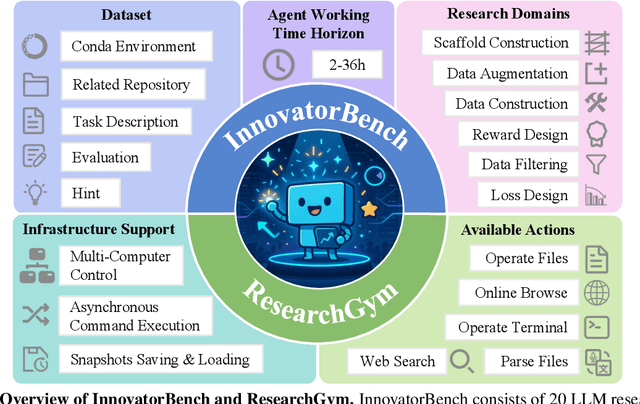
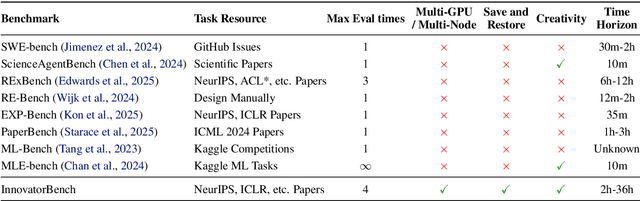
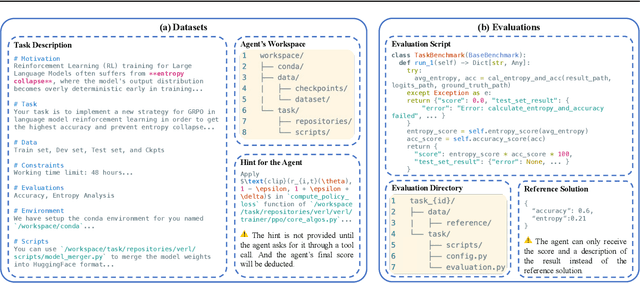
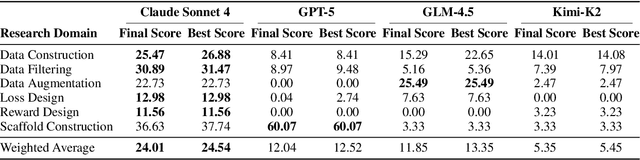
AI agents could accelerate scientific discovery by automating hypothesis formation, experiment design, coding, execution, and analysis, yet existing benchmarks probe narrow skills in simplified settings. To address this gap, we introduce InnovatorBench, a benchmark-platform pair for realistic, end-to-end assessment of agents performing Large Language Model (LLM) research. It comprises 20 tasks spanning Data Construction, Filtering, Augmentation, Loss Design, Reward Design, and Scaffold Construction, which require runnable artifacts and assessment of correctness, performance, output quality, and uncertainty. To support agent operation, we develop ResearchGym, a research environment offering rich action spaces, distributed and long-horizon execution, asynchronous monitoring, and snapshot saving. We also implement a lightweight ReAct agent that couples explicit reasoning with executable planning using frontier models such as Claude-4, GPT-5, GLM-4.5, and Kimi-K2. Our experiments demonstrate that while frontier models show promise in code-driven research tasks, they struggle with fragile algorithm-related tasks and long-horizon decision making, such as impatience, poor resource management, and overreliance on template-based reasoning. Furthermore, agents require over 11 hours to achieve their best performance on InnovatorBench, underscoring the benchmark's difficulty and showing the potential of InnovatorBench to be the next generation of code-based research benchmark.
DatasetResearch: Benchmarking Agent Systems for Demand-Driven Dataset Discovery
Aug 09, 2025The rapid advancement of large language models has fundamentally shifted the bottleneck in AI development from computational power to data availability-with countless valuable datasets remaining hidden across specialized repositories, research appendices, and domain platforms. As reasoning capabilities and deep research methodologies continue to evolve, a critical question emerges: can AI agents transcend conventional search to systematically discover any dataset that meets specific user requirements, enabling truly autonomous demand-driven data curation? We introduce DatasetResearch, the first comprehensive benchmark evaluating AI agents' ability to discover and synthesize datasets from 208 real-world demands across knowledge-intensive and reasoning-intensive tasks. Our tri-dimensional evaluation framework reveals a stark reality: even advanced deep research systems achieve only 22% score on our challenging DatasetResearch-pro subset, exposing the vast gap between current capabilities and perfect dataset discovery. Our analysis uncovers a fundamental dichotomy-search agents excel at knowledge tasks through retrieval breadth, while synthesis agents dominate reasoning challenges via structured generation-yet both catastrophically fail on "corner cases" outside existing distributions. These findings establish the first rigorous baseline for dataset discovery agents and illuminate the path toward AI systems capable of finding any dataset in the digital universe. Our benchmark and comprehensive analysis provide the foundation for the next generation of self-improving AI systems and are publicly available at https://github.com/GAIR-NLP/DatasetResearch.
AlphaGo Moment for Model Architecture Discovery
Jul 24, 2025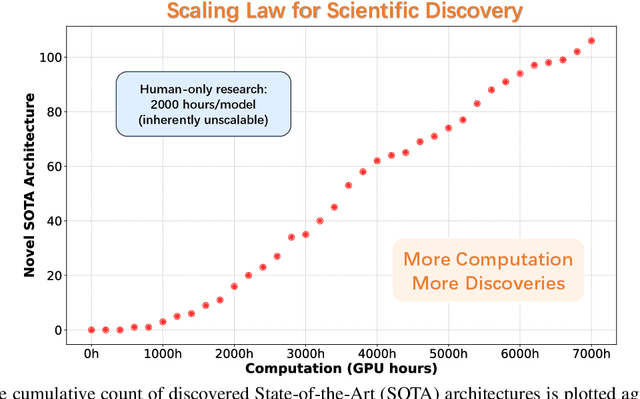
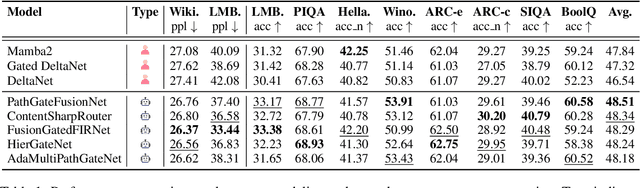
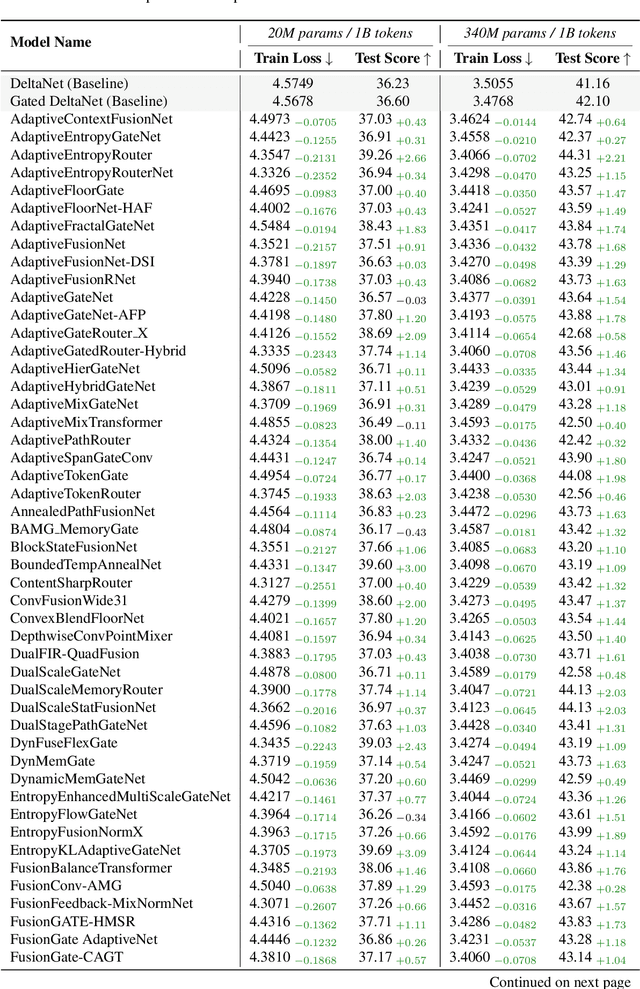
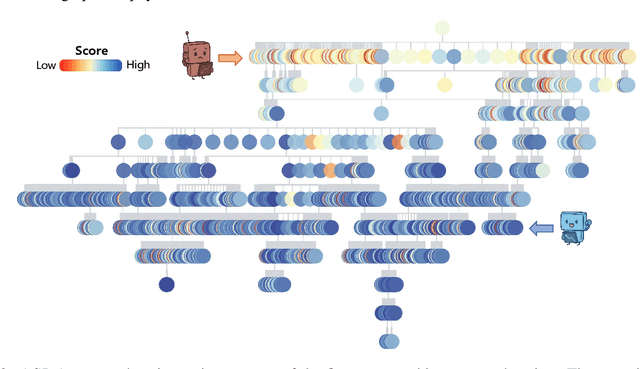
While AI systems demonstrate exponentially improving capabilities, the pace of AI research itself remains linearly bounded by human cognitive capacity, creating an increasingly severe development bottleneck. We present ASI-Arch, the first demonstration of Artificial Superintelligence for AI research (ASI4AI) in the critical domain of neural architecture discovery--a fully autonomous system that shatters this fundamental constraint by enabling AI to conduct its own architectural innovation. Moving beyond traditional Neural Architecture Search (NAS), which is fundamentally limited to exploring human-defined spaces, we introduce a paradigm shift from automated optimization to automated innovation. ASI-Arch can conduct end-to-end scientific research in the domain of architecture discovery, autonomously hypothesizing novel architectural concepts, implementing them as executable code, training and empirically validating their performance through rigorous experimentation and past experience. ASI-Arch conducted 1,773 autonomous experiments over 20,000 GPU hours, culminating in the discovery of 106 innovative, state-of-the-art (SOTA) linear attention architectures. Like AlphaGo's Move 37 that revealed unexpected strategic insights invisible to human players, our AI-discovered architectures demonstrate emergent design principles that systematically surpass human-designed baselines and illuminate previously unknown pathways for architectural innovation. Crucially, we establish the first empirical scaling law for scientific discovery itself--demonstrating that architectural breakthroughs can be scaled computationally, transforming research progress from a human-limited to a computation-scalable process. We provide comprehensive analysis of the emergent design patterns and autonomous research capabilities that enabled these breakthroughs, establishing a blueprint for self-accelerating AI systems.
Quantifying Fairness in LLMs Beyond Tokens: A Semantic and Statistical Perspective
Jun 23, 2025Large Language Models (LLMs) often generate responses with inherent biases, undermining their reliability in real-world applications. Existing evaluation methods often overlook biases in long-form responses and the intrinsic variability of LLM outputs. To address these challenges, we propose FiSCo(Fine-grained Semantic Computation), a novel statistical framework to evaluate group-level fairness in LLMs by detecting subtle semantic differences in long-form responses across demographic groups. Unlike prior work focusing on sentiment or token-level comparisons, FiSCo goes beyond surface-level analysis by operating at the claim level, leveraging entailment checks to assess the consistency of meaning across responses. We decompose model outputs into semantically distinct claims and apply statistical hypothesis testing to compare inter- and intra-group similarities, enabling robust detection of subtle biases. We formalize a new group counterfactual fairness definition and validate FiSCo on both synthetic and human-annotated datasets spanning gender, race, and age. Experiments show that FiSco more reliably identifies nuanced biases while reducing the impact of stochastic LLM variability, outperforming various evaluation metrics.
Explicit Preference Optimization: No Need for an Implicit Reward Model
Jun 09, 2025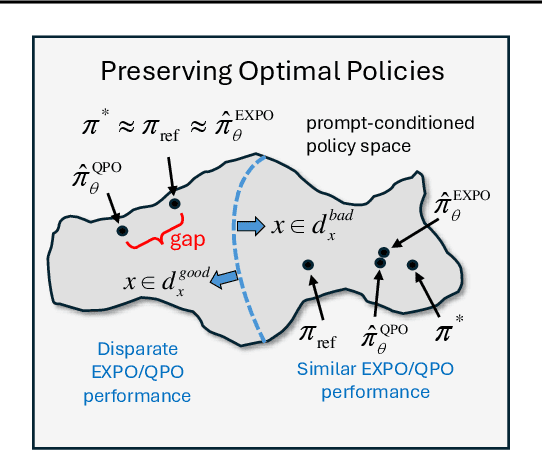
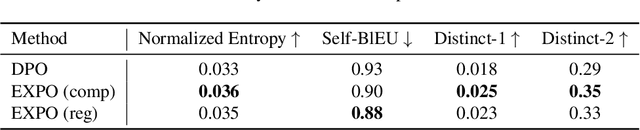
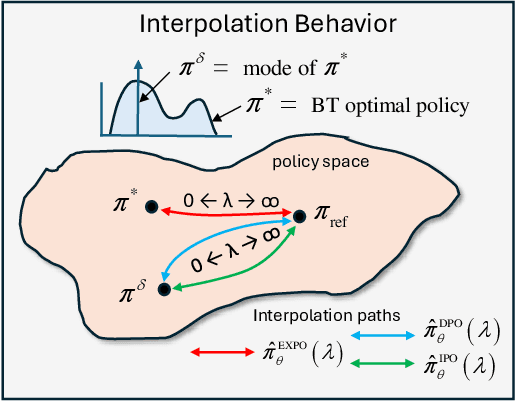
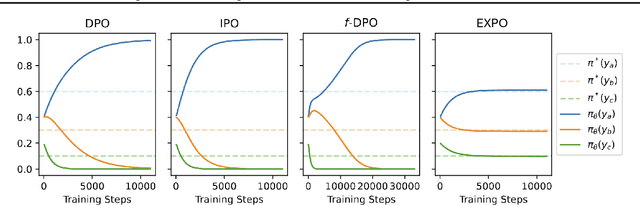
The generated responses of large language models (LLMs) are often fine-tuned to human preferences through a process called reinforcement learning from human feedback (RLHF). As RLHF relies on a challenging training sequence, whereby a separate reward model is independently learned and then later applied to LLM policy updates, ongoing research effort has targeted more straightforward alternatives. In this regard, direct preference optimization (DPO) and its many offshoots circumvent the need for a separate reward training step. Instead, through the judicious use of a reparameterization trick that induces an \textit{implicit} reward, DPO and related methods consolidate learning to the minimization of a single loss function. And yet despite demonstrable success in some real-world settings, we prove that DPO-based objectives are nonetheless subject to sub-optimal regularization and counter-intuitive interpolation behaviors, underappreciated artifacts of the reparameterizations upon which they are based. To this end, we introduce an \textit{explicit} preference optimization framework termed EXPO that requires no analogous reparameterization to achieve an implicit reward. Quite differently, we merely posit intuitively-appealing regularization factors from scratch that transparently avoid the potential pitfalls of key DPO variants, provably satisfying regularization desiderata that prior methods do not. Empirical results serve to corroborate our analyses and showcase the efficacy of EXPO.
Generative AI Act II: Test Time Scaling Drives Cognition Engineering
Apr 21, 2025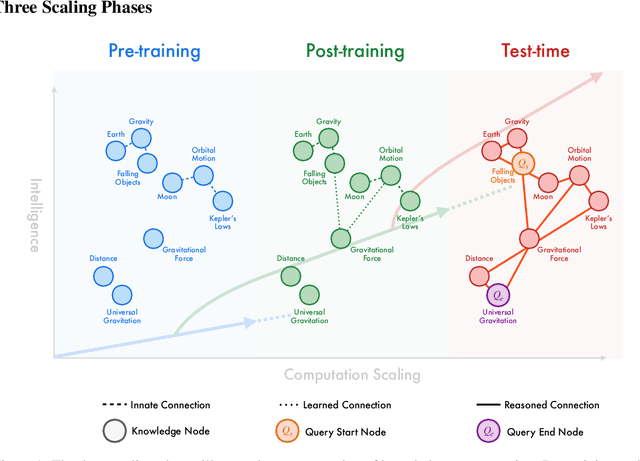
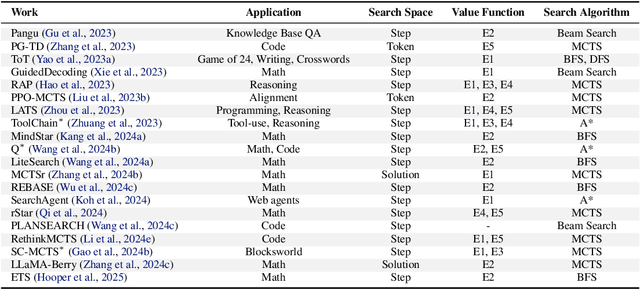
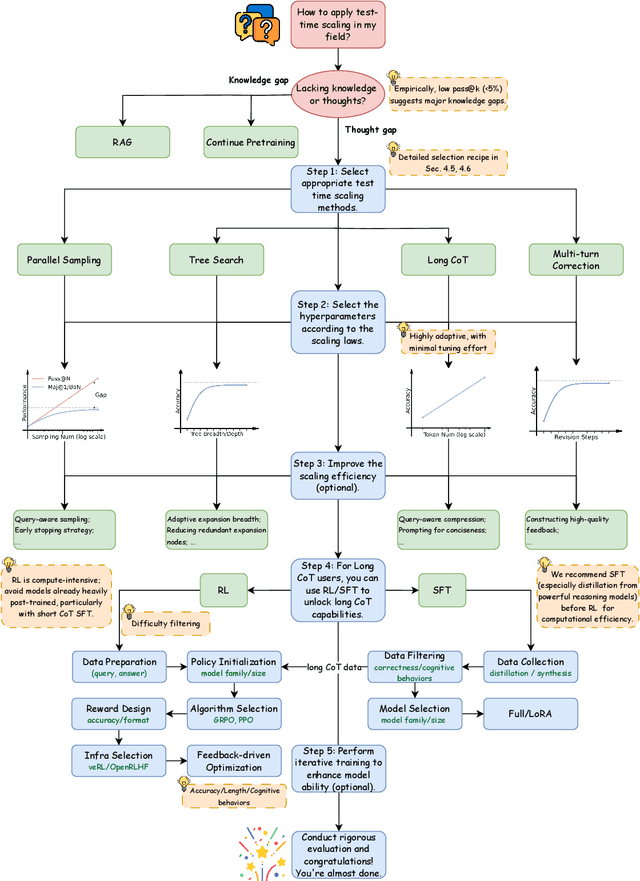
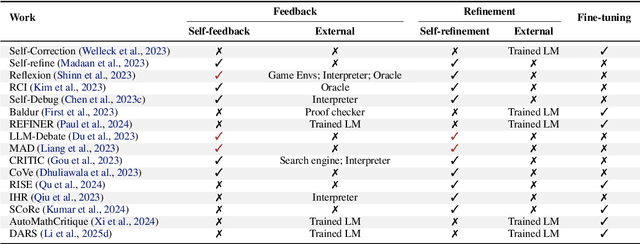
The first generation of Large Language Models - what might be called "Act I" of generative AI (2020-2023) - achieved remarkable success through massive parameter and data scaling, yet exhibited fundamental limitations such as knowledge latency, shallow reasoning, and constrained cognitive processes. During this era, prompt engineering emerged as our primary interface with AI, enabling dialogue-level communication through natural language. We now witness the emergence of "Act II" (2024-present), where models are transitioning from knowledge-retrieval systems (in latent space) to thought-construction engines through test-time scaling techniques. This new paradigm establishes a mind-level connection with AI through language-based thoughts. In this paper, we clarify the conceptual foundations of cognition engineering and explain why this moment is critical for its development. We systematically break down these advanced approaches through comprehensive tutorials and optimized implementations, democratizing access to cognition engineering and enabling every practitioner to participate in AI's second act. We provide a regularly updated collection of papers on test-time scaling in the GitHub Repository: https://github.com/GAIR-NLP/cognition-engineering