 Add to Chrome
 Add to Firefox
 Add to Edge
The Cases LJP Never Sees: Prosecution Decision Prediction for More Complete Criminal Liability Assessment
May 27, 2026
Legal Judgment Prediction (LJP) has become a core benchmark for evaluating AI in the criminal legal domain, but it only sees criminal cases that have already passed prosecutorial review and been formally indicted. As a result, LJP leaves a substantial blind spot in assessing criminal liability, overlooking cases involving insufficient evidence, no criminal liability, or guilt exempted from punishment. To fill this gap, we propose \textbf{Prosecution Decision Prediction (PDP)}, the first Legal AI task built around prosecutorial review, which classifies each case into prosecution or one of three non-prosecution decisions and reflects legal AI's capabilities in evidence evaluation, legal subsumption, and value-based discretion. We further construct \textbf{PDP-Bench}, a benchmark of 4{,}630 real Chinese prosecutorial decisions spanning 190 charges. Extensive experiments show that state-of-the-art LLMs perform substantially worse on PDP than on LJP and that mainstream enhancement routes fail to close the gap. Moreover, controlled RLVR interventions show that simple outcome rewards fail to produce generalizable PDP discrimination.

GRASPrune: Global Gating for Budgeted Structured Pruning of Large Language Models
Apr 21, 2026Large language models (LLMs) are expensive to serve because model parameters, attention computation, and KV caches impose substantial memory and latency costs. We present GRASPrune, a structured pruning framework applied after pretraining that jointly prunes FFN channels and KV head groups under a single global budget. Instead of learning importance scores without constraints and applying the budget only after training, GRASPrune learns lightweight gate scores with a projected straight-through estimator that enforces a hard mask satisfying the budget at every step while keeping the backbone weights frozen. After the mask is fixed, we calibrate scaling factors on the retained units to mitigate scale mismatch caused by pruning, and fold these factors into the pruned weights to obtain a smaller dense checkpoint with no extra parameters at inference. On LLaMA-2-7B, GRASPrune removes 50% of parameters and achieves 12.18 perplexity on WikiText-2 while maintaining competitive average zero-shot accuracy on five benchmarks, using four epochs on 512 unlabeled calibration sequences on a single NVIDIA A100 80GB GPU without any full model fine-tuning.
ShapleyLaw: A Game-Theoretic Approach to Multilingual Scaling Laws
Mar 18, 2026In multilingual pretraining, the test loss of a pretrained model is heavily influenced by the proportion of each language in the pretraining data, namely the \textit{language mixture ratios}. Multilingual scaling laws can predict the test loss under different language mixture ratios and can therefore be used to estimate the optimal ratios. However, the current approaches to multilingual scaling laws do not measure the \textit{cross-lingual transfer} effect, resulting in suboptimal mixture ratios. In this paper, we consider multilingual pretraining as a cooperative game in which each language acts as a player that jointly contributes to pretraining, gaining the resulting reduction in test loss as the payoff. Consequently, from the perspective of cooperative game theory, we quantify the cross-lingual transfer from each language by its contribution in the game, and propose a game-theoretic multilingual scaling law called \textit{ShapleyLaw}. Our experiments show that ShapleyLaw outperforms baseline methods in model performance prediction and language mixture optimization.
ELLMob: Event-Driven Human Mobility Generation with Self-Aligned LLM Framework
Mar 09, 2026Human mobility generation aims to synthesize plausible trajectory data, which is widely used in urban system research. While Large Language Model-based methods excel at generating routine trajectories, they struggle to capture deviated mobility during large-scale societal events. This limitation stems from two critical gaps: (1) the absence of event-annotated mobility datasets for design and evaluation, and (2) the inability of current frameworks to reconcile competitions between users' habitual patterns and event-imposed constraints when making trajectory decisions. This work addresses these gaps with a twofold contribution. First, we construct the first event-annotated mobility dataset covering three major events: Typhoon Hagibis, COVID-19, and the Tokyo 2021 Olympics. Second, we propose ELLMob, a self-aligned LLM framework that first extracts competing rationales between habitual patterns and event constraints, based on Fuzzy-Trace Theory, and then iteratively aligns them to generate trajectories that are both habitually grounded and event-responsive. Extensive experiments show that ELLMob wins state-of-the-art baselines across all events, demonstrating its effectiveness. Our codes and datasets are available at https://github.com/deepkashiwa20/ELLMob.
CVE-Factory: Scaling Expert-Level Agentic Tasks for Code Security Vulnerability
Feb 03, 2026Evaluating and improving the security capabilities of code agents requires high-quality, executable vulnerability tasks. However, existing works rely on costly, unscalable manual reproduction and suffer from outdated data distributions. To address these, we present CVE-Factory, the first multi-agent framework to achieve expert-level quality in automatically transforming sparse CVE metadata into fully executable agentic tasks. Cross-validation against human expert reproductions shows that CVE-Factory achieves 95\% solution correctness and 96\% environment fidelity, confirming its expert-level quality. It is also evaluated on the latest realistic vulnerabilities and achieves a 66.2\% verified success. This automation enables two downstream contributions. First, we construct LiveCVEBench, a continuously updated benchmark of 190 tasks spanning 14 languages and 153 repositories that captures emerging threats including AI-tooling vulnerabilities. Second, we synthesize over 1,000 executable training environments, the first large-scale scaling of agentic tasks in code security. Fine-tuned Qwen3-32B improves from 5.3\% to 35.8\% on LiveCVEBench, surpassing Claude 4.5 Sonnet, with gains generalizing to Terminal Bench (12.5\% to 31.3\%). We open-source CVE-Factory, LiveCVEBench, Abacus-cve (fine-tuned model), training dataset, and leaderboard. All resources are available at https://github.com/livecvebench/CVE-Factory .
Adaptive Layer Selection for Layer-Wise Token Pruning in LLM Inference
Jan 12, 2026Due to the prevalence of large language models (LLMs), key-value (KV) cache reduction for LLM inference has received remarkable attention. Among numerous works that have been proposed in recent years, layer-wise token pruning approaches, which select a subset of tokens at particular layers to retain in KV cache and prune others, are one of the most popular schemes. They primarily adopt a set of pre-defined layers, at which tokens are selected. Such design is inflexible in the sense that the accuracy significantly varies across tasks and deteriorates in harder tasks such as KV retrieval. In this paper, we propose ASL, a training-free method that adaptively chooses the selection layer for KV cache reduction, exploiting the variance of token ranks ordered by attention score. The proposed method balances the performance across different tasks while meeting the user-specified KV budget requirement. ASL operates during the prefilling stage and can be jointly used with existing KV cache reduction methods such as SnapKV to optimize the decoding stage. By evaluations on the InfiniteBench, RULER, and NIAH benchmarks, we show that equipped with one-shot token selection, where tokens are selected at a layer and propagated to deeper layers, ASL outperforms state-of-the-art layer-wise token selection methods in accuracy while maintaining decoding speed and KV cache reduction.
LLM-Based Social Simulations Require a Boundary
Jun 24, 2025This position paper argues that large language model (LLM)-based social simulations should establish clear boundaries to meaningfully contribute to social science research. While LLMs offer promising capabilities for modeling human-like agents compared to traditional agent-based modeling, they face fundamental limitations that constrain their reliability for social pattern discovery. The core issue lies in LLMs' tendency towards an ``average persona'' that lacks sufficient behavioral heterogeneity, a critical requirement for simulating complex social dynamics. We examine three key boundary problems: alignment (simulated behaviors matching real-world patterns), consistency (maintaining coherent agent behavior over time), and robustness (reproducibility under varying conditions). We propose heuristic boundaries for determining when LLM-based simulations can reliably advance social science understanding. We believe that these simulations are more valuable when focusing on (1) collective patterns rather than individual trajectories, (2) agent behaviors aligning with real population averages despite limited variance, and (3) proper validation methods available for testing simulation robustness. We provide a practical checklist to guide researchers in determining the appropriate scope and claims for LLM-based social simulations.
Seven Security Challenges That Must be Solved in Cross-domain Multi-agent LLM Systems
May 28, 2025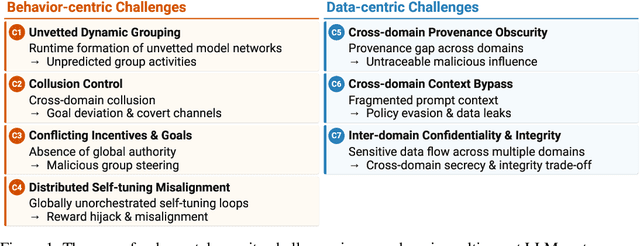
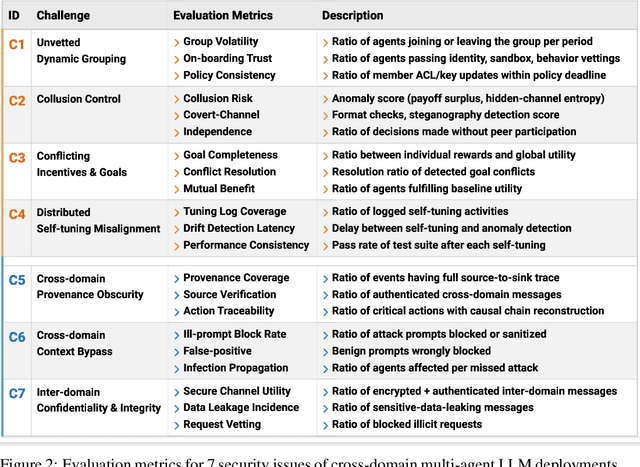
Large language models (LLMs) are rapidly evolving into autonomous agents that cooperate across organizational boundaries, enabling joint disaster response, supply-chain optimization, and other tasks that demand decentralized expertise without surrendering data ownership. Yet, cross-domain collaboration shatters the unified trust assumptions behind current alignment and containment techniques. An agent benign in isolation may, when receiving messages from an untrusted peer, leak secrets or violate policy, producing risks driven by emergent multi-agent dynamics rather than classical software bugs. This position paper maps the security agenda for cross-domain multi-agent LLM systems. We introduce seven categories of novel security challenges, for each of which we also present plausible attacks, security evaluation metrics, and future research guidelines.
Probabilistic Kernel Function for Fast Angle Testing
May 26, 2025In this paper, we study the angle testing problem in high-dimensional Euclidean spaces and propose two projection-based probabilistic kernel functions, one designed for angle comparison and the other for angle thresholding. Unlike existing approaches that rely on random projection vectors drawn from Gaussian distributions, our approach leverages reference angles and employs a deterministic structure for the projection vectors. Notably, our kernel functions do not require asymptotic assumptions, such as the number of projection vectors tending to infinity, and can be both theoretically and experimentally shown to outperform Gaussian-distribution-based kernel functions. We further apply the proposed kernel function to Approximate Nearest Neighbor Search (ANNS) and demonstrate that our approach achieves a 2.5X ~ 3X higher query-per-second (QPS) throughput compared to the state-of-the-art graph-based search algorithm HNSW.
CKGAN: Training Generative Adversarial Networks Using Characteristic Kernel Integral Probability Metrics
Apr 08, 2025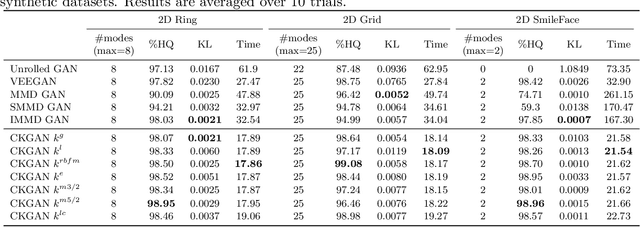
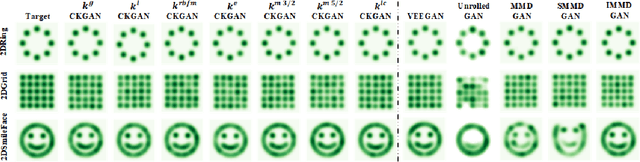
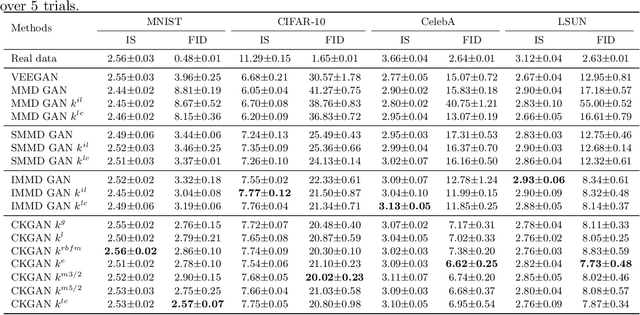
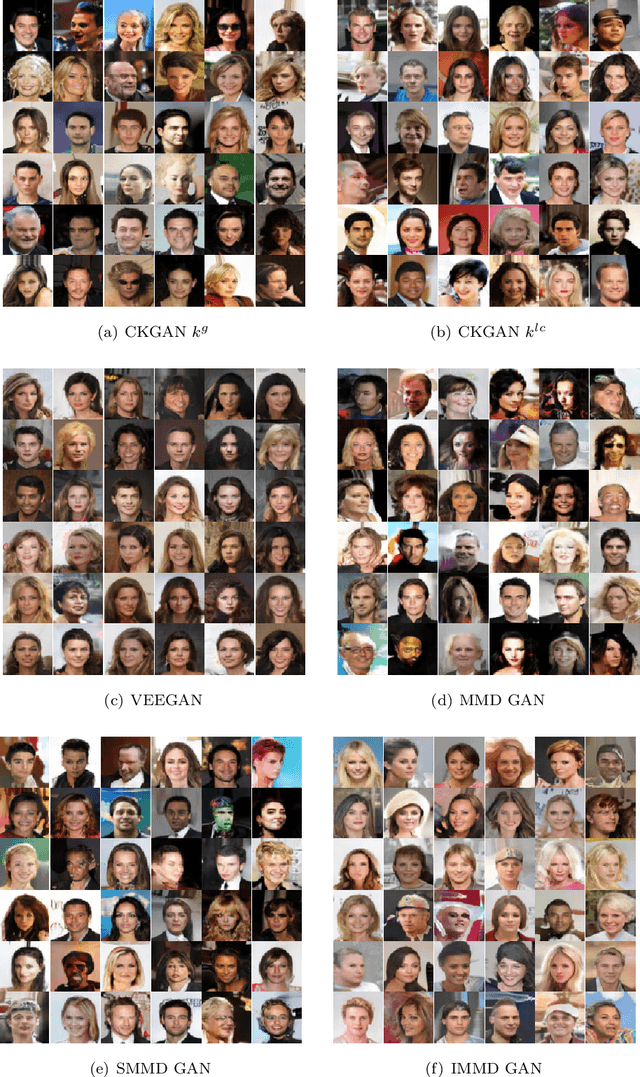
In this paper, we propose CKGAN, a novel generative adversarial network (GAN) variant based on an integral probability metrics framework with characteristic kernel (CKIPM). CKIPM, as a distance between two probability distributions, is designed to optimize the lowerbound of the maximum mean discrepancy (MMD) in a reproducing kernel Hilbert space, and thus can be used to train GANs. CKGAN mitigates the notorious problem of mode collapse by mapping the generated images back to random noise. To save the effort of selecting the kernel function manually, we propose a soft selection method to automatically learn a characteristic kernel function. The experimental evaluation conducted on a set of synthetic and real image benchmarks (MNIST, CelebA, etc.) demonstrates that CKGAN generally outperforms other MMD-based GANs. The results also show that at the cost of moderately more training time, the automatically selected kernel function delivers very close performance to the best of manually fine-tuned one on real image benchmarks and is able to improve the performances of other MMD-based GANs.