 Add to Chrome
 Add to Firefox
 Add to Edge
When Active Learning Falls Short: An Empirical Study on Chemical Reaction Extraction
Apr 21, 2026
The rapid growth of chemical literature has generated vast amounts of unstructured data, where reaction information is particularly valuable for applications such as reaction predictions and drug design. However, the prohibitive cost of expert annotation has led to a scarcity of training data, severely hindering the performance of automatic reaction extraction. In this work, we conduct a systematic study of active learning for chemical reaction extraction. We integrate six uncertainty- and diversity-based strategies with pretrained transformer-CRF architectures, and evaluate them on product extraction and role labeling task. While several methods approach full-data performance with fewer labeled instances, learning curves are often non-monotonic and task-dependent. Our analysis shows that strong pretraining, structured CRF decoding, and label sparsity limit the stability of conventional active learning strategies. These findings provide practical insights for the effective use of active learning in chemical information extraction.

CKGAN: Training Generative Adversarial Networks Using Characteristic Kernel Integral Probability Metrics
Apr 08, 2025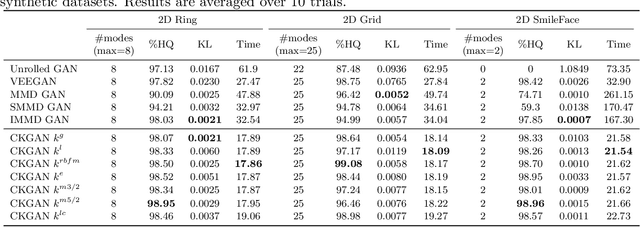
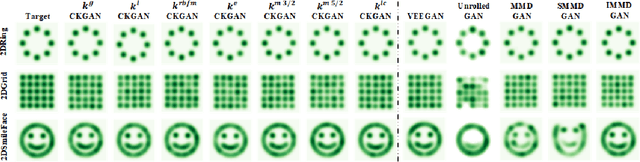
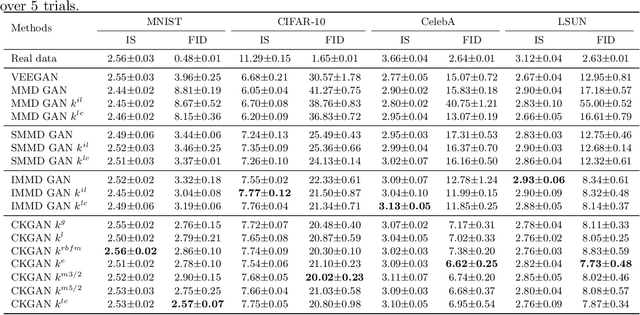
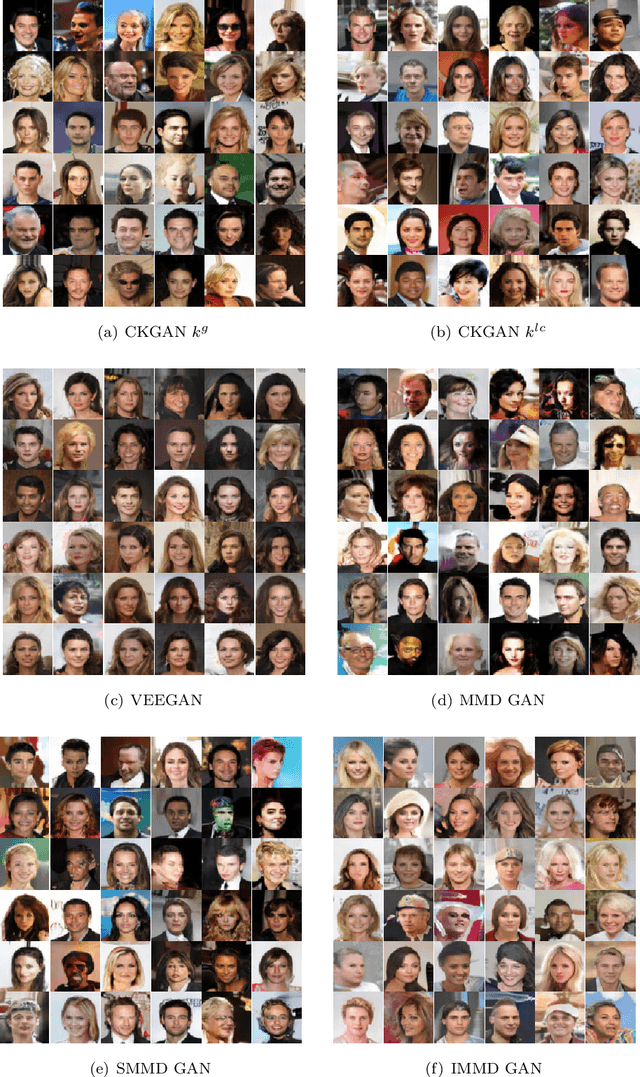
In this paper, we propose CKGAN, a novel generative adversarial network (GAN) variant based on an integral probability metrics framework with characteristic kernel (CKIPM). CKIPM, as a distance between two probability distributions, is designed to optimize the lowerbound of the maximum mean discrepancy (MMD) in a reproducing kernel Hilbert space, and thus can be used to train GANs. CKGAN mitigates the notorious problem of mode collapse by mapping the generated images back to random noise. To save the effort of selecting the kernel function manually, we propose a soft selection method to automatically learn a characteristic kernel function. The experimental evaluation conducted on a set of synthetic and real image benchmarks (MNIST, CelebA, etc.) demonstrates that CKGAN generally outperforms other MMD-based GANs. The results also show that at the cost of moderately more training time, the automatically selected kernel function delivers very close performance to the best of manually fine-tuned one on real image benchmarks and is able to improve the performances of other MMD-based GANs.