 Add to Chrome
 Add to Firefox
 Add to Edge
Convolutional Neural Shading for High-Quality 3D Reconstruction from Multi-View Images
Jul 30, 2026
We propose a convolutional neural shading (CNS), a novel pipeline to reconstruct high-quality 3D shapes from multi-view images. Several recent studies have used neural radiance fields and other neural differentiable rendering methods to understand 3D geometry. However, these approaches rely on single-point geometric information, such as positions and normals of the surface, leading to a lack of detailed local geometry. Our approach addresses the inherent limitations of single-point information by leveraging a neural shader to capture variations even in dark and textureless regions with a convolutional neural shader, resulting in far more accurate geometry predictions. Additionally, our method mitigates surface irregularities at image boundaries by introducing a fine-detail displacement network, which utilizes spatial information of surface geometry and learns fine displacement details by correlating neighboring values in the rendering coordinates. Through extensive experiments, our proposed method has demonstrated significant quality improvements in the reconstructed shapes and rendered images over current state-of-the-art methods.

Face and Voice Cross-modal Association with Learning Convex Feature Embedding
Jul 30, 2026Face-and-voice association learning is one of the most challenging tasks in deep learning. In this paper, we propose a simple but powerful cross-modal feature embedding method for the association of faces and voices. Previous work has studied cross-modal association tasks to establish the correlation between voice clips and facial images. These works have addressed cross-modal discrimination but underestimate the importance of handling heterogeneity in inter-modal features between audio and video, resulting in a lot of false positives and false negatives. To tackle the problem, the proposed method learns the embeddings of cross-modal features by making another feature exist between cross-modal features, facilitating the voice and face features of the same person to be embedded in a convex hull. Moreover, the incorporation of cross-modal attention mechanisms with convex embedding techniques represents a highly effective strategy for the attenuation of false positives and false negatives, accomplished via the minimization of inter-class discrepancies. We exhaustively evaluated our method for cross-modal verification, matching, and retrieval tasks on the large-scale VoxCeleb dataset. Extensive experimental results demonstrate that the proposed method achieves notable improvements over existing state-of-the-art methods.
Collaborative Feature Aggregation for Face Super-Resolution and Robust Re-Identification
Jul 30, 2026We propose a novel collaborative approach for face super-resolution (SR) and robust person re-identification from sequential or multi-view facial images. Traditional SR methods often suffer from blurring and distortion in faces recovered from poor-quality images due to low resolution. Image- and video-based facial SR methods using facial landmarks or segmentation also have similar challenges. To overcome these limitations, we leverage multiple correlated facial observations, across time or viewpoints, by introducing a transformer-based collaborative feature aggregation method that unifies identity features from multi-sequence or multi-view data. This allows faces in multiple sequences of an individual to contribute to accurately estimating common facial features. Furthermore, we propose a cascade SR network to progressively restore the high-resolution image of the target's face with gradual facial feature unification. The unified identity representation is further utilized in person re-identification scenarios, enabling accurate matching even under severe image degradation. The exhaustive experimental results and comparisons show that our method outperforms other state-of-the-art methods, demonstrating consistent improvements in both face super-resolution and re-identification performance. Our work highlights the effectiveness of joint identity reconstruction and progressive image restoration from multiple facial inputs in enhancing downstream visual recognition tasks.
Seven Security Challenges That Must be Solved in Cross-domain Multi-agent LLM Systems
May 28, 2025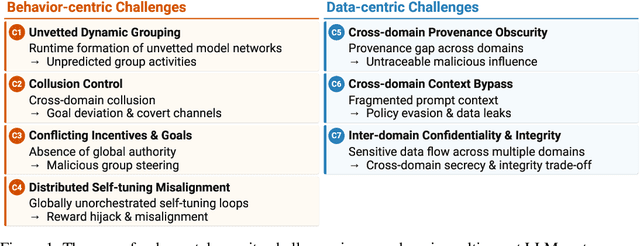
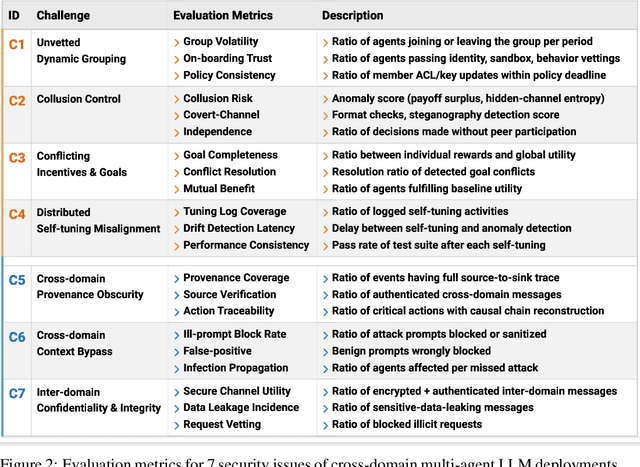
Large language models (LLMs) are rapidly evolving into autonomous agents that cooperate across organizational boundaries, enabling joint disaster response, supply-chain optimization, and other tasks that demand decentralized expertise without surrendering data ownership. Yet, cross-domain collaboration shatters the unified trust assumptions behind current alignment and containment techniques. An agent benign in isolation may, when receiving messages from an untrusted peer, leak secrets or violate policy, producing risks driven by emergent multi-agent dynamics rather than classical software bugs. This position paper maps the security agenda for cross-domain multi-agent LLM systems. We introduce seven categories of novel security challenges, for each of which we also present plausible attacks, security evaluation metrics, and future research guidelines.
Predicting Chemical Reaction Outcomes Based on Electron Movements Using Machine Learning
Mar 13, 2025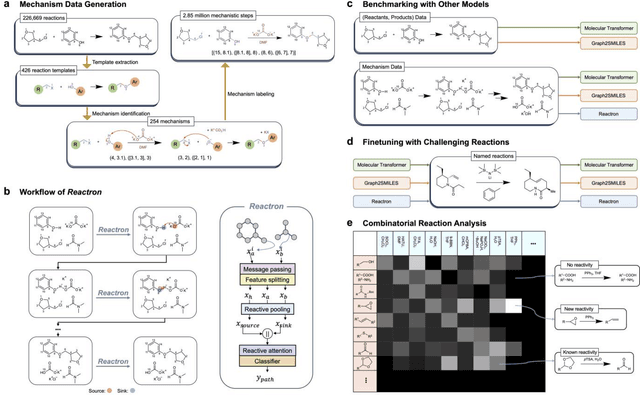
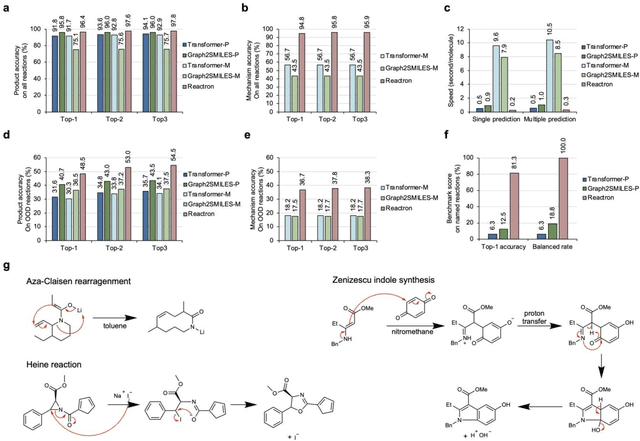
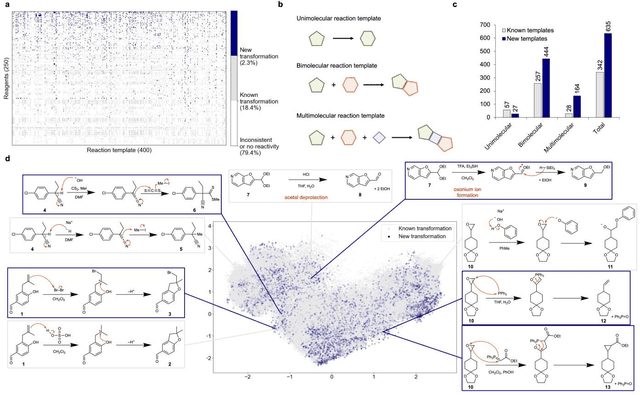
Accurately predicting chemical reaction outcomes and potential byproducts is a fundamental task of modern chemistry, enabling the efficient design of synthetic pathways and driving progress in chemical science. Reaction mechanism, which tracks electron movements during chemical reactions, is critical for understanding reaction kinetics and identifying unexpected products. Here, we present Reactron, the first electron-based machine learning model for general reaction prediction. Reactron integrates electron movement into its predictions, generating detailed arrow-pushing diagrams that elucidate each mechanistic step leading to product formation. We demonstrate the high predictive performance of Reactron over existing product-only models by a large-scale reaction outcome prediction benchmark, and the adaptability of the model to learn new reactivity upon providing a few examples. Furthermore, it explores combinatorial reaction spaces, uncovering novel reactivities beyond its training data. With robust performance in both in- and out-of-distribution predictions, Reactron embodies human-like reasoning in chemistry and opens new frontiers in reaction discovery and synthesis design.
MindfulDiary: Harnessing Large Language Model to Support Psychiatric Patients' Journaling
Oct 08, 2023In the mental health domain, Large Language Models (LLMs) offer promising new opportunities, though their inherent complexity and low controllability have raised questions about their suitability in clinical settings. We present MindfulDiary, a mobile journaling app incorporating an LLM to help psychiatric patients document daily experiences through conversation. Designed in collaboration with mental health professionals (MHPs), MindfulDiary takes a state-based approach to safely comply with the experts' guidelines while carrying on free-form conversations. Through a four-week field study involving 28 patients with major depressive disorder and five psychiatrists, we found that MindfulDiary supported patients in consistently enriching their daily records and helped psychiatrists better empathize with their patients through an understanding of their thoughts and daily contexts. Drawing on these findings, we discuss the implications of leveraging LLMs in the mental health domain, bridging the technical feasibility and their integration into clinical settings.
WinCLIP: Zero-/Few-Shot Anomaly Classification and Segmentation
Mar 26, 2023Visual anomaly classification and segmentation are vital for automating industrial quality inspection. The focus of prior research in the field has been on training custom models for each quality inspection task, which requires task-specific images and annotation. In this paper we move away from this regime, addressing zero-shot and few-normal-shot anomaly classification and segmentation. Recently CLIP, a vision-language model, has shown revolutionary generality with competitive zero-/few-shot performance in comparison to full-supervision. But CLIP falls short on anomaly classification and segmentation tasks. Hence, we propose window-based CLIP (WinCLIP) with (1) a compositional ensemble on state words and prompt templates and (2) efficient extraction and aggregation of window/patch/image-level features aligned with text. We also propose its few-normal-shot extension WinCLIP+, which uses complementary information from normal images. In MVTec-AD (and VisA), without further tuning, WinCLIP achieves 91.8%/85.1% (78.1%/79.6%) AUROC in zero-shot anomaly classification and segmentation while WinCLIP+ does 93.1%/95.2% (83.8%/96.4%) in 1-normal-shot, surpassing state-of-the-art by large margins.
Guided Policy Search using Sequential Convex Programming for Initialization of Trajectory Optimization Algorithms
Oct 13, 2021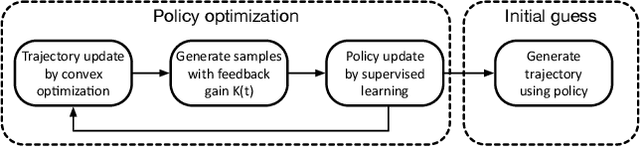
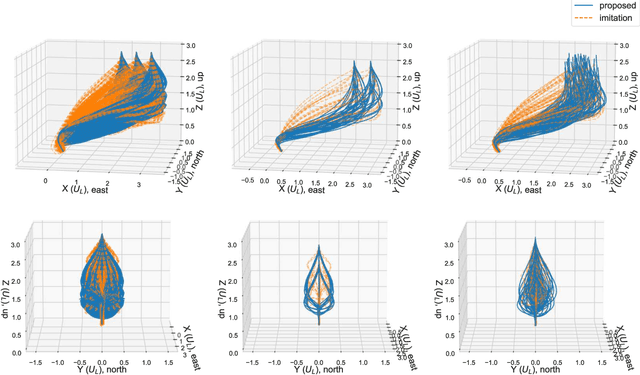
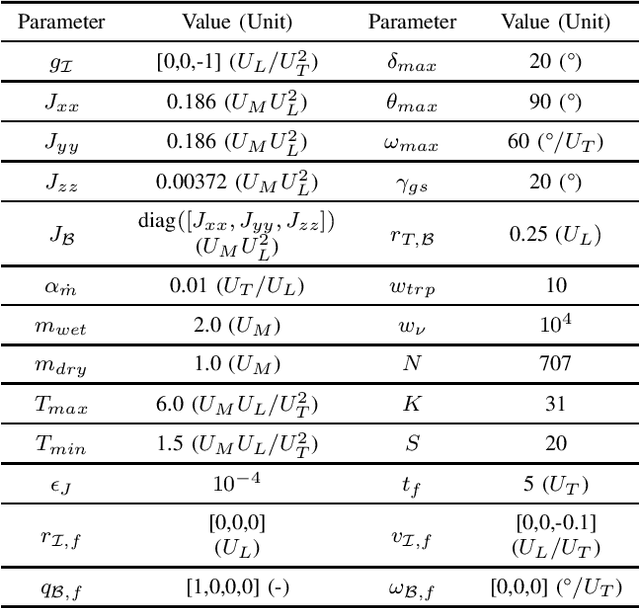
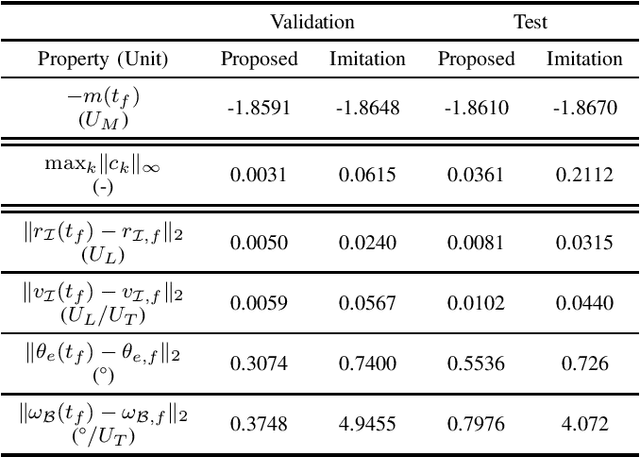
Nonlinear trajectory optimization algorithms have been developed to handle optimal control problems with nonlinear dynamics and nonconvex constraints in trajectory planning. The performance and computational efficiency of many trajectory optimization methods are sensitive to the initial guess, i.e., the trajectory guess needed by the recursive trajectory optimization algorithm. Motivated by this observation, we tackle the initialization problem for trajectory optimization via policy optimization. To optimize a policy, we propose a guided policy search method that has two key components: i) Trajectory update; ii) Policy update. The trajectory update involves offline solutions of a large number of trajectory optimization problems from different initial states via Sequential Convex Programming (SCP). Here we take a single SCP step to generate the trajectory iterate for each problem. In conjunction with these iterates, we also generate additional trajectories around each iterate via a feedback control law. Then all these trajectories are used by a stochastic gradient descent algorithm to update the neural network policy, i.e., the policy update step. As a result, the trained policy makes it possible to generate trajectory candidates that are close to the optimality and feasibility and that provide excellent initial guesses for the trajectory optimization methods. We validate the proposed method via a real-world 6-degree-of-freedom powered descent guidance problem for a reusable rocket.
On Single Source Robustness in Deep Fusion Models
Jun 11, 2019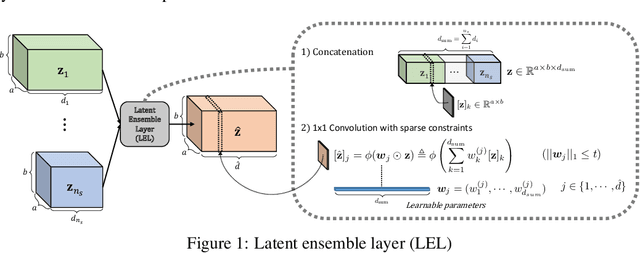
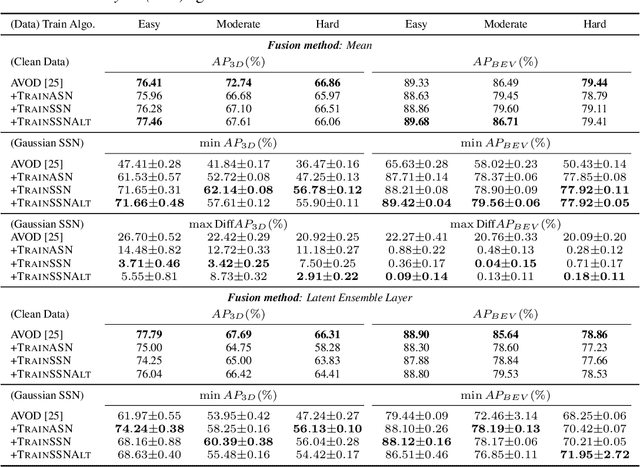
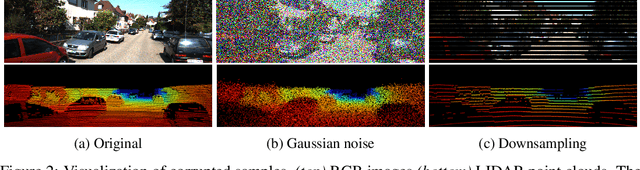
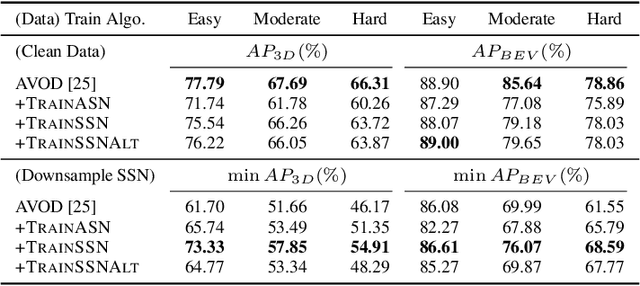
Algorithms that fuse multiple input sources benefit from both complementary and shared information. Shared information may provide robustness to faulty or noisy inputs, which is indispensable for safety-critical applications like self-driving cars. We investigate learning fusion algorithms that are robust against noise added to a single source. We first demonstrate that robustness against single source noise is not guaranteed in a linear fusion model. Motivated by this discovery, two possible approaches are proposed to increase robustness: a carefully designed loss with corresponding training algorithms for deep fusion models, and a simple convolutional fusion layer that has a structural advantage in dealing with noise. Experimental results show that both training algorithms and our fusion layer make a deep fusion-based 3D object detector robust against noise applied to a single source, while preserving the original performance on clean data.
Relaxed Oracles for Semi-Supervised Clustering
Nov 20, 2017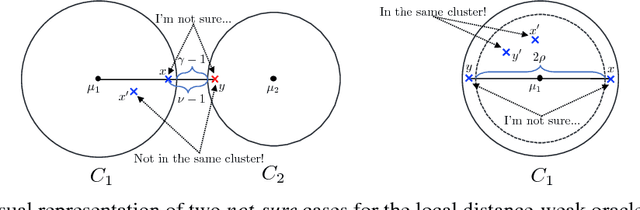
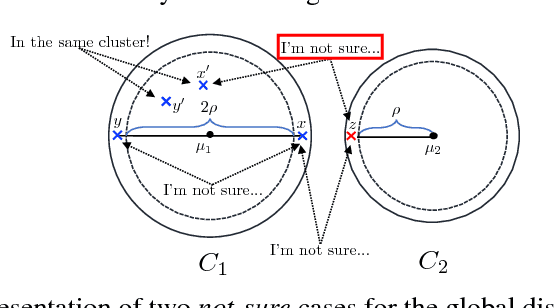
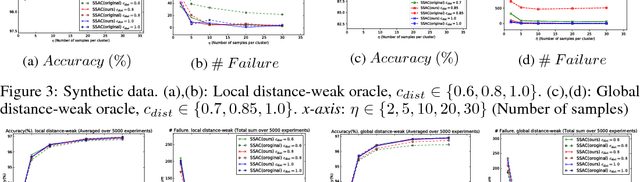
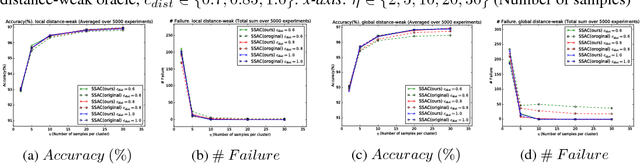
Pairwise "same-cluster" queries are one of the most widely used forms of supervision in semi-supervised clustering. However, it is impractical to ask human oracles to answer every query correctly. In this paper, we study the influence of allowing "not-sure" answers from a weak oracle and propose an effective algorithm to handle such uncertainties in query responses. Two realistic weak oracle models are considered where ambiguity in answering depends on the distance between two points. We show that a small query complexity is adequate for effective clustering with high probability by providing better pairs to the weak oracle. Experimental results on synthetic and real data show the effectiveness of our approach in overcoming supervision uncertainties and yielding high quality clusters.