 Add to Chrome
 Add to Firefox
 Add to Edge
Measuring Task-Agnostic Training Data Influence Across Language Model Pretraining
Aug 13, 2026
Measuring training data influence consistently across language model pretraining is challenging. It is difficult to select downstream tasks or validation sets representative of a model's general capabilities, and reliance on task performance at intermediate checkpoints complicates comparisons across training. We propose a measure of training data influence that does not require selecting a downstream task or validation set as the attribution target. Specifically, we define an example's influence by how much its gradient update reduces the squared distance to the final parameters of a given pretraining run, and estimate this quantity from intermediate checkpoints without retraining. Applying the method to 18 configurations from the Pythia and PolyPythia suites, we find systematic temporal changes in influential data. Early in training, literature-related data are more strongly aligned with the trajectory toward the final parameters, whereas STEM data become more strongly aligned in later stages. This qualitative crossover is broadly consistent across model configurations. Our results provide a tractable trajectory-level view of how influential data change throughout pretraining, complementing influence analyses defined with respect to specific downstream tasks or validation sets.

Human-LLM Alignment in Language Attitudes Toward Non-Native Japanese
Aug 03, 2026Large language models (LLMs) increasingly evaluate human writing in high-stakes domains such as hiring and academic assessment, putting non-native speakers at particular risk. Drawing on the language attitudes framework, we compared human and LLM evaluations of parallel L1- and L2-written Japanese emails on three dimensions: fluency, status, and solidarity. Japanese raters rated L2 texts significantly lower on all three dimensions, with a fluency gap roughly twice the size of the status and solidarity gaps. Six LLM judges reproduced the direction of this bias, and five reproduced its ordering across dimensions. The models diverged from humans in two ways: all understated the solidarity gap, the most socially grounded dimension, and all differentiated among learner L1 backgrounds where humans did not. LLM judges thus reproduce native speakers' language attitudes in a structured yet attenuated form, and the language attitudes framework offers a ready-made yardstick for auditing them beyond English.
PASTA: A Paraphrasing And Self-Training Approach for Knowledge Updating in LLMs
Jun 27, 2026Knowledge updating in pre-trained Large Language Models (LLMs) remains an important challenge. While continual training provides a potential avenue for knowledge updating, it continues to present substantial technical difficulties. Furthermore, LLMs often struggle with accurately answering questions about specific factual information, such as news articles - a capability limitation widely recognized in the research community. This paper proposes PASTA, a simple yet powerful framework for integrating detailed factual information from news articles as new knowledge into LLMs, with the primary goal of building specialized models that accurately answer questions about this knowledge. Our framework combines data augmentation, question-answering generation, and a novel self-learning DPO process that simultaneously enables knowledge overwriting and hallucination suppression. We provide insights into effective knowledge updating through systematic analysis of learning parameters and data configurations. In our experimental evaluation with web articles published after the base model's knowledge cutoff, PASTA achieved remarkable improvement from 0.02 to 0.82 accuracy while maintaining general language capabilities, demonstrating its effectiveness for creating domain-specialized LLMs.
Detecting Sensitive Personal Information in Japanese Pre-Training Corpora for Large Language Models
Jun 10, 2026Sensitive personal information can appear in large-scale pre-training corpora for large language models (LLMs). Detecting and filtering such information is therefore essential to ensure compliance with privacy regulations and prevent unintended information leakage. However, in contrast to English and other languages, research into sensitive personal information has been limited in the Japanese language. In this study, we focus on sensitive personal data defined as special care-required personal information (SCPI) under Japan's Act on the Protection of Personal Information (APPI). We construct an SCPI dataset using LLM-based annotation and train machine learning models to rapidly detect SCPI in text. As a result, our SCPI classifier can effectively identify information related to SCPI. This study is the first to explore SCPI detection in Japanese text corpora, highlighting the challenges of accurate detection.
Jagle: Building a Large-Scale Japanese Multimodal Post-Training Dataset for Vision-Language Models
Apr 02, 2026Developing vision-language models (VLMs) that generalize across diverse tasks requires large-scale training datasets with diverse content. In English, such datasets are typically constructed by aggregating and curating numerous existing visual question answering (VQA) resources. However, this strategy does not readily extend to other languages, where VQA datasets remain limited in both scale and domain coverage, posing a major obstacle to building high-quality multilingual and non-English VLMs. In this work, we introduce Jagle, the largest Japanese multimodal post-training dataset to date, comprising approximately 9.2 million instances across diverse tasks. Rather than relying on existing VQA datasets, we collect heterogeneous source data, including images, image-text pairs, and PDF documents, and generate VQA pairs through multiple strategies such as VLM-based QA generation, translation, and text rendering. Experiments demonstrate that a 2.2B model trained with Jagle achieves strong performance on Japanese tasks, surpassing InternVL3.5-2B in average score across ten Japanese evaluation tasks and approaching within five points of Qwen3-VL-2B-Instruct. Furthermore, combining Jagle with FineVision does not degrade English performance; instead, it improves English performance compared to training with FineVision alone. To facilitate reproducibility and future research, we release the dataset, trained models, and code.
JAMMEval: A Refined Collection of Japanese Benchmarks for Reliable VLM Evaluation
Apr 01, 2026Reliable evaluation is essential for the development of vision-language models (VLMs). However, Japanese VQA benchmarks have undergone far less iterative refinement than their English counterparts. As a result, many existing benchmarks contain issues such as ambiguous questions, incorrect answers, and instances that can be solved without visual grounding, undermining evaluation reliability and leading to misleading conclusions in model comparisons. To address these limitations, we introduce JAMMEval, a refined collection of Japanese benchmarks for reliable VLM evaluation. It is constructed by systematically refining seven existing Japanese benchmark datasets through two rounds of human annotation, improving both data quality and evaluation reliability. In our experiments, we evaluate open-weight and proprietary VLMs on JAMMEval and analyze the capabilities of recent models on Japanese VQA. We further demonstrate the effectiveness of our refinement by showing that the resulting benchmarks yield evaluation scores that better reflect model capability, exhibit lower run-to-run variance, and improve the ability to distinguish between models of different capability levels. We release our dataset and code to advance reliable evaluation of VLMs.
ShapleyLaw: A Game-Theoretic Approach to Multilingual Scaling Laws
Mar 18, 2026In multilingual pretraining, the test loss of a pretrained model is heavily influenced by the proportion of each language in the pretraining data, namely the \textit{language mixture ratios}. Multilingual scaling laws can predict the test loss under different language mixture ratios and can therefore be used to estimate the optimal ratios. However, the current approaches to multilingual scaling laws do not measure the \textit{cross-lingual transfer} effect, resulting in suboptimal mixture ratios. In this paper, we consider multilingual pretraining as a cooperative game in which each language acts as a player that jointly contributes to pretraining, gaining the resulting reduction in test loss as the payoff. Consequently, from the perspective of cooperative game theory, we quantify the cross-lingual transfer from each language by its contribution in the game, and propose a game-theoretic multilingual scaling law called \textit{ShapleyLaw}. Our experiments show that ShapleyLaw outperforms baseline methods in model performance prediction and language mixture optimization.
Traveling Across Languages: Benchmarking Cross-Lingual Consistency in Multimodal LLMs
May 21, 2025
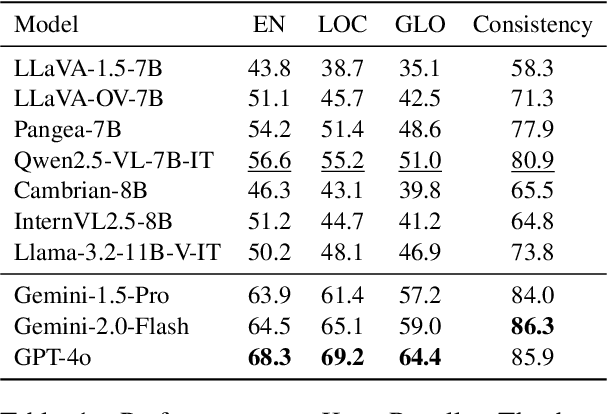
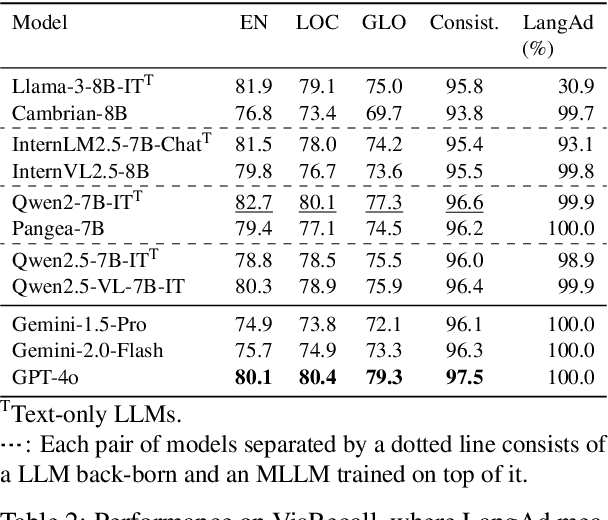
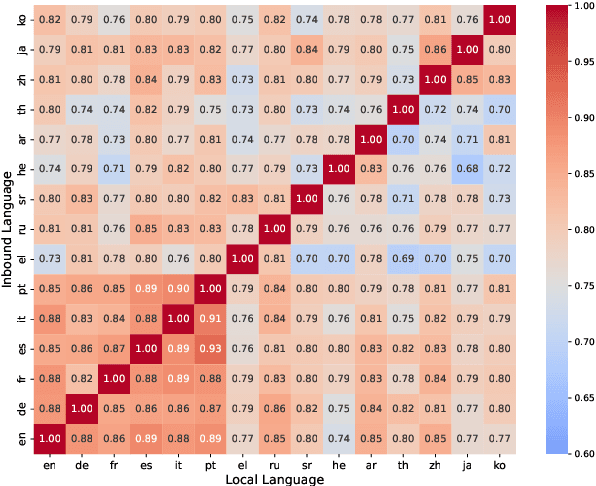
The rapid evolution of multimodal large language models (MLLMs) has significantly enhanced their real-world applications. However, achieving consistent performance across languages, especially when integrating cultural knowledge, remains a significant challenge. To better assess this issue, we introduce two new benchmarks: KnowRecall and VisRecall, which evaluate cross-lingual consistency in MLLMs. KnowRecall is a visual question answering benchmark designed to measure factual knowledge consistency in 15 languages, focusing on cultural and historical questions about global landmarks. VisRecall assesses visual memory consistency by asking models to describe landmark appearances in 9 languages without access to images. Experimental results reveal that state-of-the-art MLLMs, including proprietary ones, still struggle to achieve cross-lingual consistency. This underscores the need for more robust approaches that produce truly multilingual and culturally aware models.
Constructing Multimodal Datasets from Scratch for Rapid Development of a Japanese Visual Language Model
Oct 30, 2024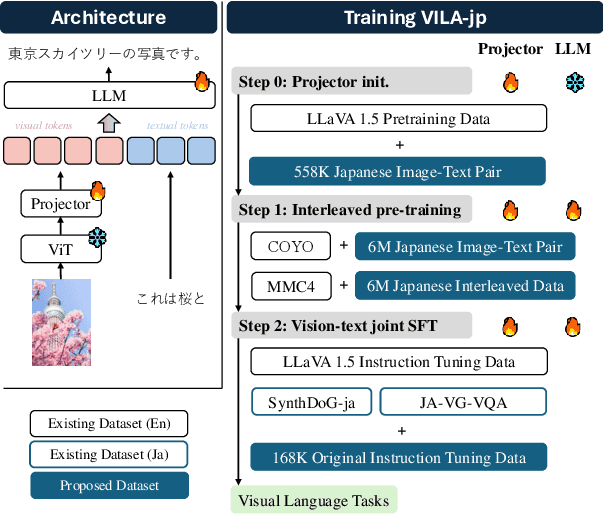
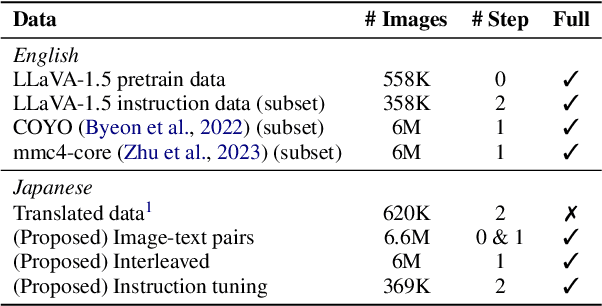
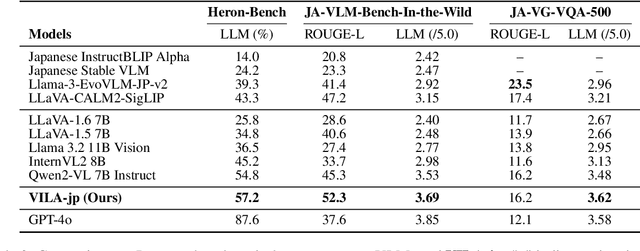

To develop high-performing Visual Language Models (VLMs), it is essential to prepare multimodal resources, such as image-text pairs, interleaved data, and instruction data. While multimodal resources for English are abundant, there is a significant lack of corresponding resources for non-English languages, such as Japanese. To address this problem, we take Japanese as a non-English language and propose a method for rapidly creating Japanese multimodal datasets from scratch. We collect Japanese image-text pairs and interleaved data from web archives and generate Japanese instruction data directly from images using an existing VLM. Our experimental results show that a VLM trained on these native datasets outperforms those relying on machine-translated content.
LLM-jp: A Cross-organizational Project for the Research and Development of Fully Open Japanese LLMs
Jul 04, 2024


This paper introduces LLM-jp, a cross-organizational project for the research and development of Japanese large language models (LLMs). LLM-jp aims to develop open-source and strong Japanese LLMs, and as of this writing, more than 1,500 participants from academia and industry are working together for this purpose. This paper presents the background of the establishment of LLM-jp, summaries of its activities, and technical reports on the LLMs developed by LLM-jp. For the latest activities, visit https://llm-jp.nii.ac.jp/en/.