 Add to Chrome
 Add to Firefox
 Add to Edge
GNOCHI: Generative Neural mOdel for Close Human-Human Interactions
Jul 11, 2026
Creating realistic 3D human-human interactions in virtual environments is challenging due to the high degrees of freedom in the human body and the need for physically accurate poses that do not collide with each other. Traditional methods for human-human interaction are based on motion tracking or 3D body reconstruction, but lack generative capabilities. Recent generative methods enable the synthesis of individual or interacting motions via text or image input, but generally fall short in modeling close interactions. This paper introduces a novel generative model for close 3D human-human interactions using a conditional variational autoencoder (cVAE), which generates poses for one human conditioned on the pose of another, allowing for controlled and diverse interaction synthesis. To train our model, we address two underlying long-standing challenges in the field of human-human interaction: data scarcity, for which we propose an automated supervised data augmentation strategy that generates synthetic yet realistic interaction poses; and collision awareness in generative approaches, for which we propose a self-supervised loss based on a collision resolution technique using volumetric proxies to ensure physically correct interactions. We extensively evaluate the capabilities of our model, and demonstrate a wide variety of plausible and physically correct interactions, not possible to generate with current state-of-the-art methods.

Global Pose Control for Generative View Synthesis in Normalized Object Coordinate Space
Jul 02, 2026Novel View Synthesis (NVS) enables the generation of unseen views of a scene from a single or multiple images, allowing users to freely explore an object from any viewpoint. Despite the recent impressive qualitative improvements of generative models for this task, existing methods struggle to provide global and intuitive control of target viewpoints because they either use input-relative camera poses or are limited to generating sparse global views. This lack of global pose control severely limits the number of downstream tasks potentially enabled by NVS. To address this limitation, we propose a novel approach for precise camera control in a customizable Normalized Object Coordinate Space (NOCS), requiring single or few unposed images. Our method operates solely on the absolute camera pose of the target view in NOCS, eliminating the need for a relative world frame or camera poses of the input images. Unlike previous methods that treat NVS as a standalone generation task, we formulate it as an image editing problem and build upon state-of-the-art editing models to leverage their superior generalization capability. Camera information is injected as dedicated camera tokens via an in-context multi-modal conditioning strategy. To alleviate the inherent ambiguity of NOCS, we incorporate text descriptions that explicitly define the object's canonical coordinate frame, which also enhances generalization to unseen object categories. Furthermore, we curate a high-quality dataset with consistently aligned orientations and corresponding NOCS text definitions. Extensive experiments demonstrate that our method robustly generates novel views with accurate and consistent orientations from arbitrary unposed images across diverse categories, achieving state-of-the-art image quality and fidelity.
Coarse-to-Real: Generative Rendering for Populated Dynamic Scenes
Jan 29, 2026Traditional rendering pipelines rely on complex assets, accurate materials and lighting, and substantial computational resources to produce realistic imagery, yet they still face challenges in scalability and realism for populated dynamic scenes. We present C2R (Coarse-to-Real), a generative rendering framework that synthesizes real-style urban crowd videos from coarse 3D simulations. Our approach uses coarse 3D renderings to explicitly control scene layout, camera motion, and human trajectories, while a learned neural renderer generates realistic appearance, lighting, and fine-scale dynamics guided by text prompts. To overcome the lack of paired training data between coarse simulations and real videos, we adopt a two-phase mixed CG-real training strategy that learns a strong generative prior from large-scale real footage and introduces controllability through shared implicit spatio-temporal features across domains. The resulting system supports coarse-to-fine control, generalizes across diverse CG and game inputs, and produces temporally consistent, controllable, and realistic urban scene videos from minimal 3D input. We will release the model and project webpage at https://gonzalognogales.github.io/coarse2real/.
Learning Extremely High Density Crowds as Active Matters
Mar 15, 2025
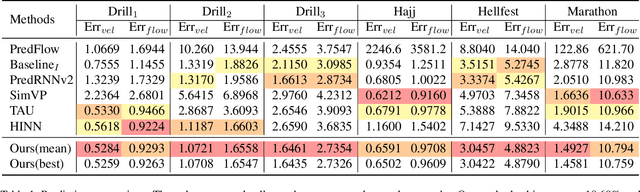
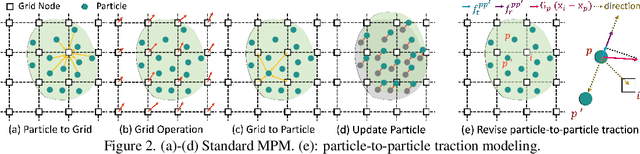

Video-based high-density crowd analysis and prediction has been a long-standing topic in computer vision. It is notoriously difficult due to, but not limited to, the lack of high-quality data and complex crowd dynamics. Consequently, it has been relatively under studied. In this paper, we propose a new approach that aims to learn from in-the-wild videos, often with low quality where it is difficult to track individuals or count heads. The key novelty is a new physics prior to model crowd dynamics. We model high-density crowds as active matter, a continumm with active particles subject to stochastic forces, named 'crowd material'. Our physics model is combined with neural networks, resulting in a neural stochastic differential equation system which can mimic the complex crowd dynamics. Due to the lack of similar research, we adapt a range of existing methods which are close to ours for comparison. Through exhaustive evaluation, we show our model outperforms existing methods in analyzing and forecasting extremely high-density crowds. Furthermore, since our model is a continuous-time physics model, it can be used for simulation and analysis, providing strong interpretability. This is categorically different from most deep learning methods, which are discrete-time models and black-boxes.
TexTile: A Differentiable Metric for Texture Tileability
Mar 19, 2024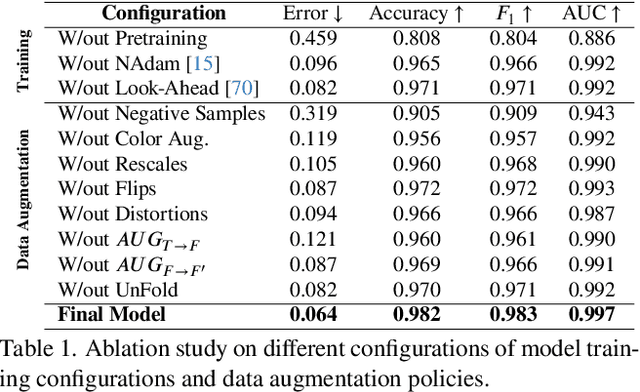
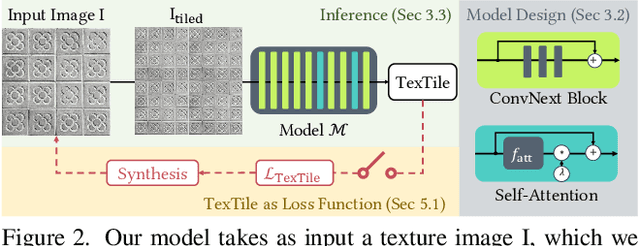
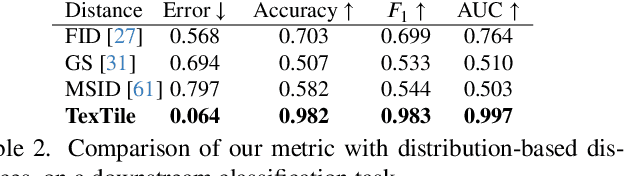

We introduce TexTile, a novel differentiable metric to quantify the degree upon which a texture image can be concatenated with itself without introducing repeating artifacts (i.e., the tileability). Existing methods for tileable texture synthesis focus on general texture quality, but lack explicit analysis of the intrinsic repeatability properties of a texture. In contrast, our TexTile metric effectively evaluates the tileable properties of a texture, opening the door to more informed synthesis and analysis of tileable textures. Under the hood, TexTile is formulated as a binary classifier carefully built from a large dataset of textures of different styles, semantics, regularities, and human annotations.Key to our method is a set of architectural modifications to baseline pre-train image classifiers to overcome their shortcomings at measuring tileability, along with a custom data augmentation and training regime aimed at increasing robustness and accuracy. We demonstrate that TexTile can be plugged into different state-of-the-art texture synthesis methods, including diffusion-based strategies, and generate tileable textures while keeping or even improving the overall texture quality. Furthermore, we show that TexTile can objectively evaluate any tileable texture synthesis method, whereas the current mix of existing metrics produces uncorrelated scores which heavily hinders progress in the field.
SMPLitex: A Generative Model and Dataset for 3D Human Texture Estimation from Single Image
Sep 07, 2023
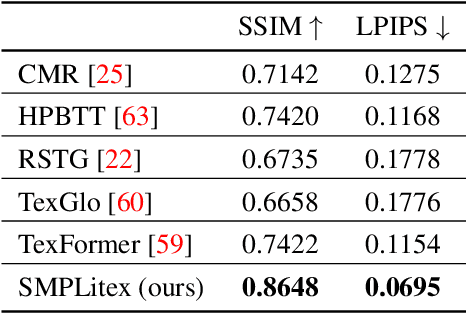
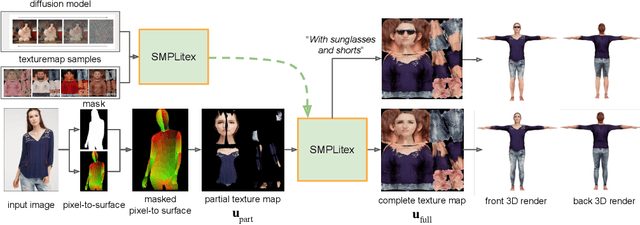
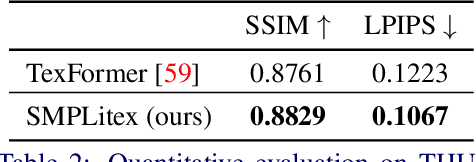
We propose SMPLitex, a method for estimating and manipulating the complete 3D appearance of humans captured from a single image. SMPLitex builds upon the recently proposed generative models for 2D images, and extends their use to the 3D domain through pixel-to-surface correspondences computed on the input image. To this end, we first train a generative model for complete 3D human appearance, and then fit it into the input image by conditioning the generative model to the visible parts of the subject. Furthermore, we propose a new dataset of high-quality human textures built by sampling SMPLitex conditioned on subject descriptions and images. We quantitatively and qualitatively evaluate our method in 3 publicly available datasets, demonstrating that SMPLitex significantly outperforms existing methods for human texture estimation while allowing for a wider variety of tasks such as editing, synthesis, and manipulation
How Will It Drape Like? Capturing Fabric Mechanics from Depth Images
Apr 13, 2023We propose a method to estimate the mechanical parameters of fabrics using a casual capture setup with a depth camera. Our approach enables to create mechanically-correct digital representations of real-world textile materials, which is a fundamental step for many interactive design and engineering applications. As opposed to existing capture methods, which typically require expensive setups, video sequences, or manual intervention, our solution can capture at scale, is agnostic to the optical appearance of the textile, and facilitates fabric arrangement by non-expert operators. To this end, we propose a sim-to-real strategy to train a learning-based framework that can take as input one or multiple images and outputs a full set of mechanical parameters. Thanks to carefully designed data augmentation and transfer learning protocols, our solution generalizes to real images despite being trained only on synthetic data, hence successfully closing the sim-to-real loop.Key in our work is to demonstrate that evaluating the regression accuracy based on the similarity at parameter space leads to an inaccurate distances that do not match the human perception. To overcome this, we propose a novel metric for fabric drape similarity that operates on the image domain instead on the parameter space, allowing us to evaluate our estimation within the context of a similarity rank. We show that out metric correlates with human judgments about the perception of drape similarity, and that our model predictions produce perceptually accurate results compared to the ground truth parameters.
PERGAMO: Personalized 3D Garments from Monocular Video
Oct 26, 2022Clothing plays a fundamental role in digital humans. Current approaches to animate 3D garments are mostly based on realistic physics simulation, however, they typically suffer from two main issues: high computational run-time cost, which hinders their development; and simulation-to-real gap, which impedes the synthesis of specific real-world cloth samples. To circumvent both issues we propose PERGAMO, a data-driven approach to learn a deformable model for 3D garments from monocular images. To this end, we first introduce a novel method to reconstruct the 3D geometry of garments from a single image, and use it to build a dataset of clothing from monocular videos. We use these 3D reconstructions to train a regression model that accurately predicts how the garment deforms as a function of the underlying body pose. We show that our method is capable of producing garment animations that match the real-world behaviour, and generalizes to unseen body motions extracted from motion capture dataset.
HandFlow: Quantifying View-Dependent 3D Ambiguity in Two-Hand Reconstruction with Normalizing Flow
Oct 04, 2022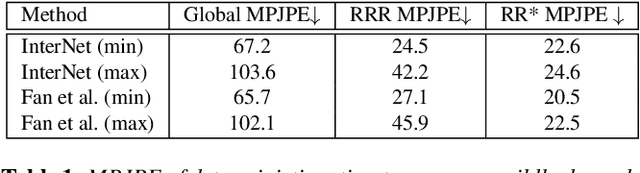
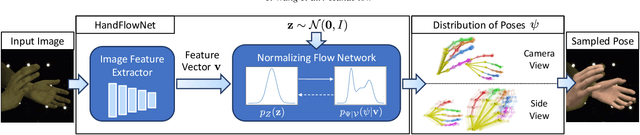
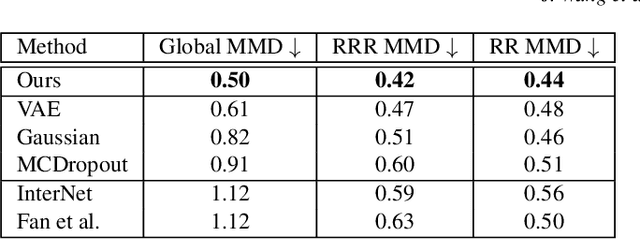
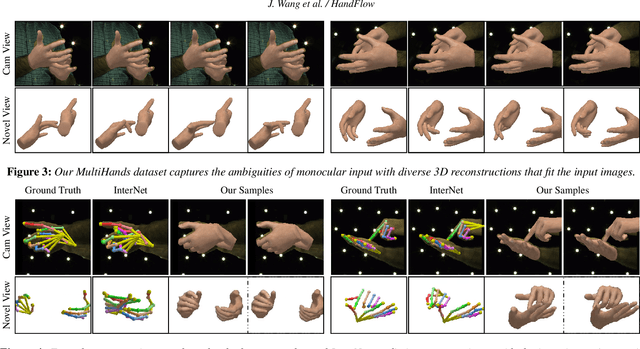
Reconstructing two-hand interactions from a single image is a challenging problem due to ambiguities that stem from projective geometry and heavy occlusions. Existing methods are designed to estimate only a single pose, despite the fact that there exist other valid reconstructions that fit the image evidence equally well. In this paper we propose to address this issue by explicitly modeling the distribution of plausible reconstructions in a conditional normalizing flow framework. This allows us to directly supervise the posterior distribution through a novel determinant magnitude regularization, which is key to varied 3D hand pose samples that project well into the input image. We also demonstrate that metrics commonly used to assess reconstruction quality are insufficient to evaluate pose predictions under such severe ambiguity. To address this, we release the first dataset with multiple plausible annotations per image called MultiHands. The additional annotations enable us to evaluate the estimated distribution using the maximum mean discrepancy metric. Through this, we demonstrate the quality of our probabilistic reconstruction and show that explicit ambiguity modeling is better-suited for this challenging problem.
SNUG: Self-Supervised Neural Dynamic Garments
Apr 05, 2022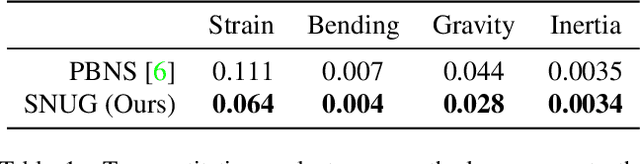
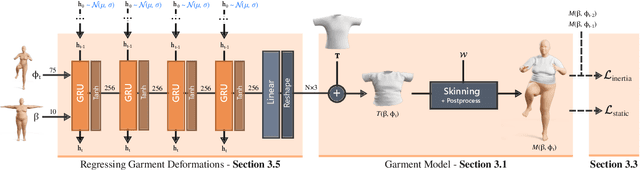
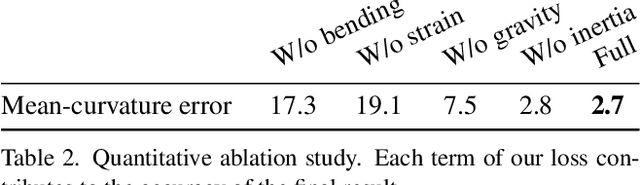
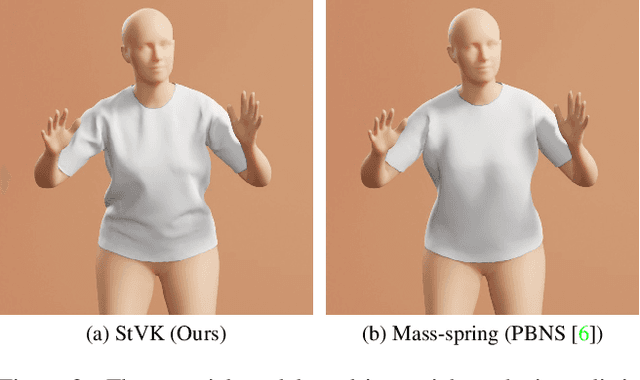
We present a self-supervised method to learn dynamic 3D deformations of garments worn by parametric human bodies. State-of-the-art data-driven approaches to model 3D garment deformations are trained using supervised strategies that require large datasets, usually obtained by expensive physics-based simulation methods or professional multi-camera capture setups. In contrast, we propose a new training scheme that removes the need for ground-truth samples, enabling self-supervised training of dynamic 3D garment deformations. Our key contribution is to realize that physics-based deformation models, traditionally solved in a frame-by-frame basis by implicit integrators, can be recasted as an optimization problem. We leverage such optimization-based scheme to formulate a set of physics-based loss terms that can be used to train neural networks without precomputing ground-truth data. This allows us to learn models for interactive garments, including dynamic deformations and fine wrinkles, with two orders of magnitude speed up in training time compared to state-of-the-art supervised methods