 Add to Chrome
 Add to Firefox
 Add to Edge
A Semantic Information-based Hierarchical Speech Enhancement Method Using Factorized Codec and Diffusion Model
May 20, 2025
Most current speech enhancement (SE) methods recover clean speech from noisy inputs by directly estimating time-frequency masks or spectrums. However, these approaches often neglect the distinct attributes, such as semantic content and acoustic details, inherent in speech signals, which can hinder performance in downstream tasks. Moreover, their effectiveness tends to degrade in complex acoustic environments. To overcome these challenges, we propose a novel, semantic information-based, step-by-step factorized SE method using factorized codec and diffusion model. Unlike traditional SE methods, our hierarchical modeling of semantic and acoustic attributes enables more robust clean speech recovery, particularly in challenging acoustic scenarios. Moreover, this method offers further advantages for downstream TTS tasks. Experimental results demonstrate that our algorithm not only outperforms SOTA baselines in terms of speech quality but also enhances TTS performance in noisy environments.

Hunyuan-Game: Industrial-grade Intelligent Game Creation Model
May 20, 2025Intelligent game creation represents a transformative advancement in game development, utilizing generative artificial intelligence to dynamically generate and enhance game content. Despite notable progress in generative models, the comprehensive synthesis of high-quality game assets, including both images and videos, remains a challenging frontier. To create high-fidelity game content that simultaneously aligns with player preferences and significantly boosts designer efficiency, we present Hunyuan-Game, an innovative project designed to revolutionize intelligent game production. Hunyuan-Game encompasses two primary branches: image generation and video generation. The image generation component is built upon a vast dataset comprising billions of game images, leading to the development of a group of customized image generation models tailored for game scenarios: (1) General Text-to-Image Generation. (2) Game Visual Effects Generation, involving text-to-effect and reference image-based game visual effect generation. (3) Transparent Image Generation for characters, scenes, and game visual effects. (4) Game Character Generation based on sketches, black-and-white images, and white models. The video generation component is built upon a comprehensive dataset of millions of game and anime videos, leading to the development of five core algorithmic models, each targeting critical pain points in game development and having robust adaptation to diverse game video scenarios: (1) Image-to-Video Generation. (2) 360 A/T Pose Avatar Video Synthesis. (3) Dynamic Illustration Generation. (4) Generative Video Super-Resolution. (5) Interactive Game Video Generation. These image and video generation models not only exhibit high-level aesthetic expression but also deeply integrate domain-specific knowledge, establishing a systematic understanding of diverse game and anime art styles.
DecompileBench: A Comprehensive Benchmark for Evaluating Decompilers in Real-World Scenarios
May 16, 2025Decompilers are fundamental tools for critical security tasks, from vulnerability discovery to malware analysis, yet their evaluation remains fragmented. Existing approaches primarily focus on syntactic correctness through synthetic micro-benchmarks or subjective human ratings, failing to address real-world requirements for semantic fidelity and analyst usability. We present DecompileBench, the first comprehensive framework that enables effective evaluation of decompilers in reverse engineering workflows through three key components: \textit{real-world function extraction} (comprising 23,400 functions from 130 real-world programs), \textit{runtime-aware validation}, and \textit{automated human-centric assessment} using LLM-as-Judge to quantify the effectiveness of decompilers in reverse engineering workflows. Through a systematic comparison between six industrial-strength decompilers and six recent LLM-powered approaches, we demonstrate that LLM-based methods surpass commercial tools in code understandability despite 52.2% lower functionality correctness. These findings highlight the potential of LLM-based approaches to transform human-centric reverse engineering. We open source \href{https://github.com/Jennieett/DecompileBench}{DecompileBench} to provide a framework to advance research on decompilers and assist security experts in making informed tool selections based on their specific requirements.
Review-Instruct: A Review-Driven Multi-Turn Conversations Generation Method for Large Language Models
May 16, 2025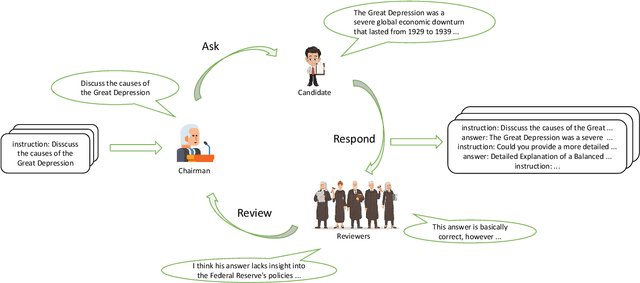
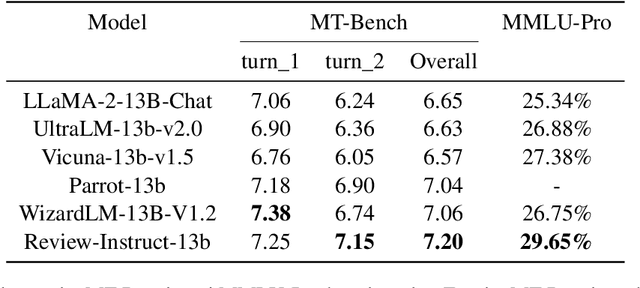
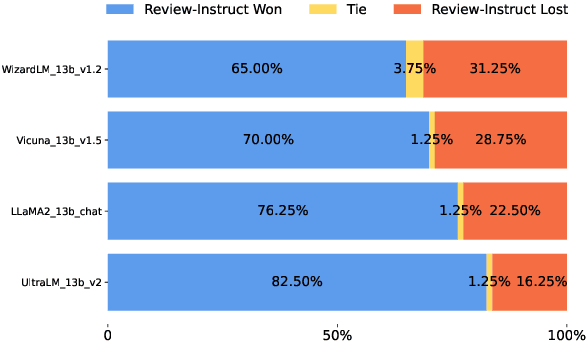
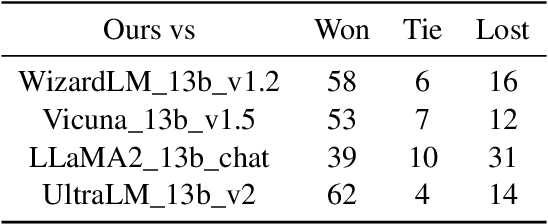
The effectiveness of large language models (LLMs) in conversational AI is hindered by their reliance on single-turn supervised fine-tuning (SFT) data, which limits contextual coherence in multi-turn dialogues. Existing methods for generating multi-turn dialogue data struggle to ensure both diversity and quality in instructions. To address this, we propose Review-Instruct, a novel framework that synthesizes multi-turn conversations through an iterative "Ask-Respond-Review" process involving three agent roles: a Candidate, multiple Reviewers, and a Chairman. The framework iteratively refines instructions by incorporating Reviewer feedback, enhancing dialogue diversity and difficulty. We construct a multi-turn dataset using the Alpaca dataset and fine-tune the LLaMA2-13B model. Evaluations on MT-Bench, MMLU-Pro, and Auto-Arena demonstrate significant improvements, achieving absolute gains of 2.9\% on MMLU-Pro and 2\% on MT-Bench compared to prior state-of-the-art models based on LLaMA2-13B. Ablation studies confirm the critical role of the Review stage and the use of multiple Reviewers in boosting instruction diversity and difficulty. Our work highlights the potential of review-driven, multi-agent frameworks for generating high-quality conversational data at scale.
TAIJI: MCP-based Multi-Modal Data Analytics on Data Lakes
May 16, 2025The variety of data in data lakes presents significant challenges for data analytics, as data scientists must simultaneously analyze multi-modal data, including structured, semi-structured, and unstructured data. While Large Language Models (LLMs) have demonstrated promising capabilities, they still remain inadequate for multi-modal data analytics in terms of accuracy, efficiency, and freshness. First, current natural language (NL) or SQL-like query languages may struggle to precisely and comprehensively capture users' analytical intent. Second, relying on a single unified LLM to process diverse data modalities often leads to substantial inference overhead. Third, data stored in data lakes may be incomplete or outdated, making it essential to integrate external open-domain knowledge to generate timely and relevant analytics results. In this paper, we envision a new multi-modal data analytics system. Specifically, we propose a novel architecture built upon the Model Context Protocol (MCP), an emerging paradigm that enables LLMs to collaborate with knowledgeable agents. First, we define a semantic operator hierarchy tailored for querying multi-modal data in data lakes and develop an AI-agent-powered NL2Operator translator to bridge user intent and analytical execution. Next, we introduce an MCP-based execution framework, in which each MCP server hosts specialized foundation models optimized for specific data modalities. This design enhances both accuracy and efficiency, while supporting high scalability through modular deployment. Finally, we propose a updating mechanism by harnessing the deep research and machine unlearning techniques to refresh the data lakes and LLM knowledges, with the goal of balancing the data freshness and inference efficiency.
MLE-Dojo: Interactive Environments for Empowering LLM Agents in Machine Learning Engineering
May 12, 2025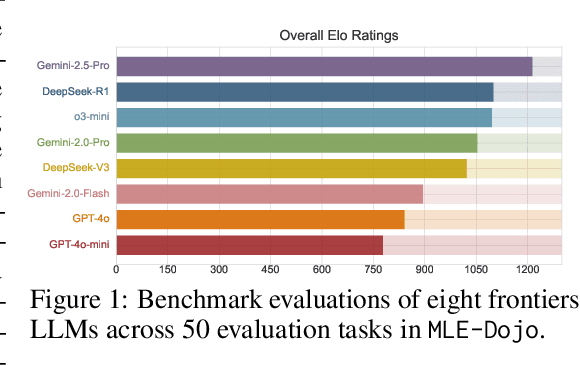
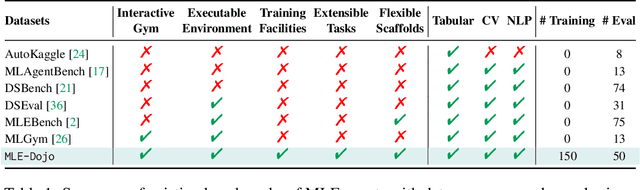
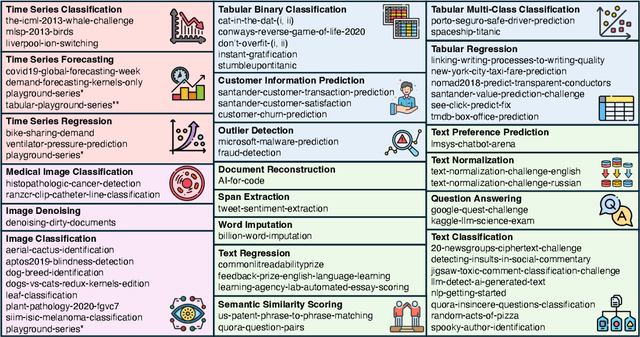
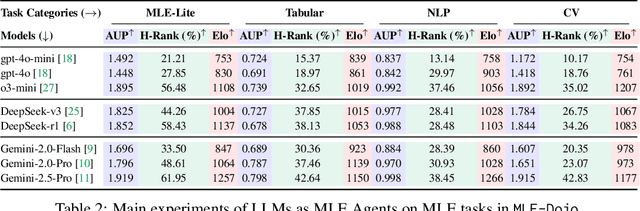
We introduce MLE-Dojo, a Gym-style framework for systematically reinforcement learning, evaluating, and improving autonomous large language model (LLM) agents in iterative machine learning engineering (MLE) workflows. Unlike existing benchmarks that primarily rely on static datasets or single-attempt evaluations, MLE-Dojo provides an interactive environment enabling agents to iteratively experiment, debug, and refine solutions through structured feedback loops. Built upon 200+ real-world Kaggle challenges, MLE-Dojo covers diverse, open-ended MLE tasks carefully curated to reflect realistic engineering scenarios such as data processing, architecture search, hyperparameter tuning, and code debugging. Its fully executable environment supports comprehensive agent training via both supervised fine-tuning and reinforcement learning, facilitating iterative experimentation, realistic data sampling, and real-time outcome verification. Extensive evaluations of eight frontier LLMs reveal that while current models achieve meaningful iterative improvements, they still exhibit significant limitations in autonomously generating long-horizon solutions and efficiently resolving complex errors. Furthermore, MLE-Dojo's flexible and extensible architecture seamlessly integrates diverse data sources, tools, and evaluation protocols, uniquely enabling model-based agent tuning and promoting interoperability, scalability, and reproducibility. We open-source our framework and benchmarks to foster community-driven innovation towards next-generation MLE agents.
LLM-Augmented Chemical Synthesis and Design Decision Programs
May 11, 2025Retrosynthesis, the process of breaking down a target molecule into simpler precursors through a series of valid reactions, stands at the core of organic chemistry and drug development. Although recent machine learning (ML) research has advanced single-step retrosynthetic modeling and subsequent route searches, these solutions remain restricted by the extensive combinatorial space of possible pathways. Concurrently, large language models (LLMs) have exhibited remarkable chemical knowledge, hinting at their potential to tackle complex decision-making tasks in chemistry. In this work, we explore whether LLMs can successfully navigate the highly constrained, multi-step retrosynthesis planning problem. We introduce an efficient scheme for encoding reaction pathways and present a new route-level search strategy, moving beyond the conventional step-by-step reactant prediction. Through comprehensive evaluations, we show that our LLM-augmented approach excels at retrosynthesis planning and extends naturally to the broader challenge of synthesizable molecular design.
Adaptively Point-weighting Curriculum Learning
May 03, 2025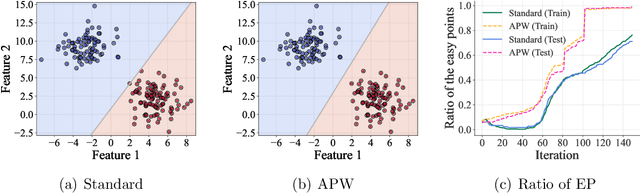

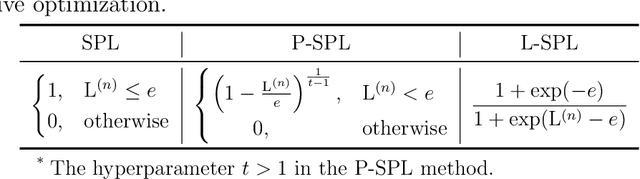
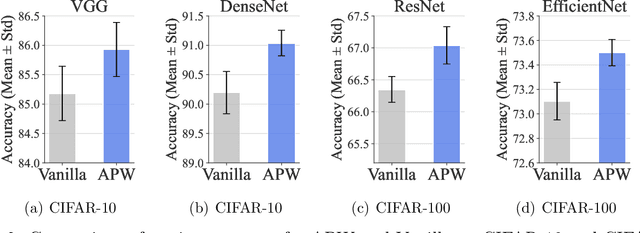
Curriculum learning (CL) is referred to as a training strategy that makes easy samples learned first and then fits hard samples. It imitates the process of humans learning knowledge, and has become a potential manner of effectively training deep networks. In this study, we develop the adaptively point-weighting (APW) curriculum learning algorithm, which adaptively assigns the weight to every training sample not only based on its training error but also considering the current training state of the network. Specifically, in the early training phase, it increases the weights of easy samples to make the network rapidly capture the overall characteristics of the dataset; and in the later training phase, the weights of hard points rise to improve the fitting performance on the discrete local regions. Moreover, we also present the theoretical analysis on the properties of APW including training effectiveness, training feasibility, training stability, and generalization performance. The numerical experiments support the superiority of APW and demonstrate the validity of our theoretical findings.
GraphOmni: A Comprehensive and Extendable Benchmark Framework for Large Language Models on Graph-theoretic Tasks
Apr 17, 2025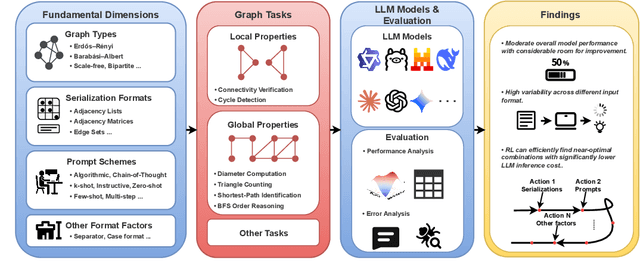
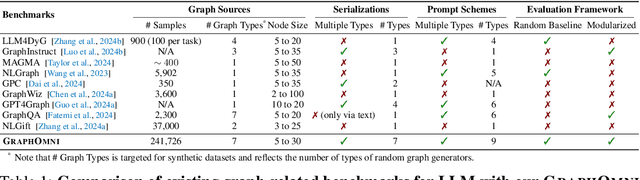
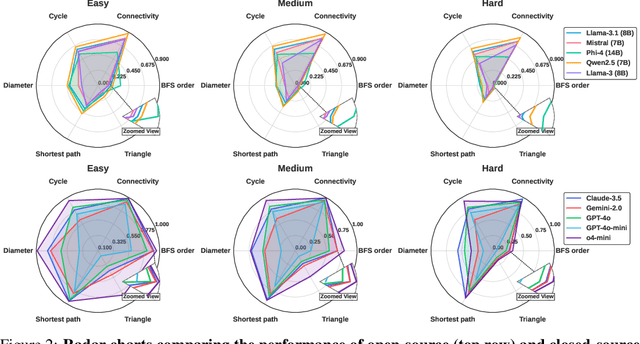
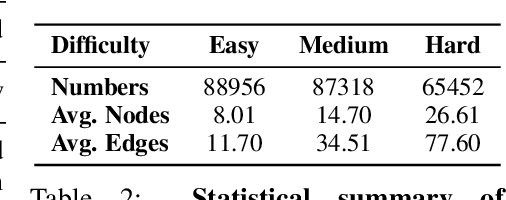
In this paper, we presented GraphOmni, a comprehensive benchmark framework for systematically evaluating the graph reasoning capabilities of LLMs. By analyzing critical dimensions, including graph types, serialization formats, and prompt schemes, we provided extensive insights into the strengths and limitations of current LLMs. Our empirical findings emphasize that no single serialization or prompting strategy consistently outperforms others. Motivated by these insights, we propose a reinforcement learning-based approach that dynamically selects the best serialization-prompt pairings, resulting in significant accuracy improvements. GraphOmni's modular and extensible design establishes a robust foundation for future research, facilitating advancements toward general-purpose graph reasoning models.
EduPlanner: LLM-Based Multi-Agent Systems for Customized and Intelligent Instructional Design
Apr 07, 2025Large Language Models (LLMs) have significantly advanced smart education in the Artificial General Intelligence (AGI) era. A promising application lies in the automatic generalization of instructional design for curriculum and learning activities, focusing on two key aspects: (1) Customized Generation: generating niche-targeted teaching content based on students' varying learning abilities and states, and (2) Intelligent Optimization: iteratively optimizing content based on feedback from learning effectiveness or test scores. Currently, a single large LLM cannot effectively manage the entire process, posing a challenge for designing intelligent teaching plans. To address these issues, we developed EduPlanner, an LLM-based multi-agent system comprising an evaluator agent, an optimizer agent, and a question analyst, working in adversarial collaboration to generate customized and intelligent instructional design for curriculum and learning activities. Taking mathematics lessons as our example, EduPlanner employs a novel Skill-Tree structure to accurately model the background mathematics knowledge of student groups, personalizing instructional design for curriculum and learning activities according to students' knowledge levels and learning abilities. Additionally, we introduce the CIDDP, an LLM-based five-dimensional evaluation module encompassing clarity, Integrity, Depth, Practicality, and Pertinence, to comprehensively assess mathematics lesson plan quality and bootstrap intelligent optimization. Experiments conducted on the GSM8K and Algebra datasets demonstrate that EduPlanner excels in evaluating and optimizing instructional design for curriculum and learning activities. Ablation studies further validate the significance and effectiveness of each component within the framework. Our code is publicly available at https://github.com/Zc0812/Edu_Planner