 Add to Chrome
 Add to Firefox
 Add to Edge
StateAct: Program State, before Pixels, for Long-Horizon Computer-Use Agents
Jul 24, 2026
Computer-use agents are usually improved by strengthening perception: better models for reading a screenshot and choosing where to click. Yet a screenshot is only a lossy rendering of the underlying program state, e.g., the files, application backends, and DOM that hold the task data. Different states can produce the same pixels, while code can inspect and modify that state directly. StateAct is a code-first, multi-agent harness built around this distinction. Its main agent works directly with program state by using code, while a dedicated GUI subagent handles screenshot-and-click interaction on the few subgoals that need it, just 28 of 108 tasks and 1.1% of main-agent steps. The same direct access to program state also supports verification: an independent finish gate double-checks the saved result for structural failures, e.g., output that is missing, unsaved, or written to the wrong path. To stay on track over hundreds of steps, the main agent hands subgoals to fresh subagents, keeping its own context focused. On OSWorld 2.0, StateAct lifts Claude Opus 4.8 from 20.6% to 26.9% on binary success, and from 54.8% to 61.6% on partial success, at ~ 9x lower cost per task than the same model driven by screenshots alone; a code-only variant with no GUI subagent reaches only 45.9% partial, below that screenshot-based baseline's 54.8%. In general, grounding action, verification, and memory in state, what we call state-grounding, shifts the main bottleneck from perception toward reasoning: failures depend more on what the agent thinks than on what it sees.

TRL-Bench: Standardizing Cross-Paradigm Representation-Level Evaluation of Tabular Encoders
Jun 08, 2026Tabular encoders are usually evaluated inside task-specific end-to-end pipelines, so models from different training paradigms are difficult to compare directly even when they operate on similar tabular signals. We introduce TRL-Bench, a multi-granular tabular representation learning (TRL) benchmark that standardizes cross-paradigm representation-level evaluation: each encoder exports row-, column-, or table embeddings through its supported wrapper, and shared lightweight heads probe them across three suites: TRL-CTbench (column/table), TRL-Rbench (row), and TRL-DLTE (compositional Data-Lake Table Enrichment spanning all three granularities). To support this standardized setting, we release curated benchmark assets and task reformulations, including 50 OpenML tables with 123 verified targets, 16 row-pair linkage rewrites, and a 47,772-table DLTE lake derived from 1,379 parent tables. Across 20 models and 16 tasks, TRL-Bench shows that once downstream conditions are standardized, encoder quality is capability-specific rather than captured by a single leaderboard. In TRL-CTbench, generic text encoders often lead on tasks with strong surface-text signal, while tabular specialists win where their pretraining objective aligns with the task. In TRL-Rbench, within-table prediction and cross-table linkage favor different training regimes, with atomic linkage performance correlating strongly with the row-matching stage of DLTE pipelines. In TRL-DLTE, the strongest pipelines combine capability-matched specialists rather than reuse a single encoder, and top end-to-end quality depends on non-additive compositional fit rather than per-stage marginal rank alone. TRL-Bench provides a common protocol for measuring reusable signal in exported tabular representations under shared downstream conditions. Code and data: https://github.com/LOGO-CUHKSZ/TRL-Bench
FORGE:Fine-grained Multimodal Evaluation for Manufacturing Scenarios
Apr 08, 2026The manufacturing sector is increasingly adopting Multimodal Large Language Models (MLLMs) to transition from simple perception to autonomous execution, yet current evaluations fail to reflect the rigorous demands of real-world manufacturing environments. Progress is hindered by data scarcity and a lack of fine-grained domain semantics in existing datasets. To bridge this gap, we introduce FORGE. Wefirst construct a high-quality multimodal dataset that combines real-world 2D images and 3D point clouds, annotated with fine-grained domain semantics (e.g., exact model numbers). We then evaluate 18 state-of-the-art MLLMs across three manufacturing tasks, namely workpiece verification, structural surface inspection, and assembly verification, revealing significant performance gaps. Counter to conventional understanding, the bottleneck analysis shows that visual grounding is not the primary limiting factor. Instead, insufficient domain-specific knowledge is the key bottleneck, setting a clear direction for future research. Beyond evaluation, we show that our structured annotations can serve as an actionable training resource: supervised fine-tuning of a compact 3B-parameter model on our data yields up to 90.8% relative improvement in accuracy on held-out manufacturing scenarios, providing preliminary evidence for a practical pathway toward domain-adapted manufacturing MLLMs. The code and datasets are available at https://ai4manufacturing.github.io/forge-web.
CUA-Suite: Massive Human-annotated Video Demonstrations for Computer-Use Agents
Mar 25, 2026Computer-use agents (CUAs) hold great promise for automating complex desktop workflows, yet progress toward general-purpose agents is bottlenecked by the scarcity of continuous, high-quality human demonstration videos. Recent work emphasizes that continuous video, not sparse screenshots, is the critical missing ingredient for scaling these agents. However, the largest existing open dataset, ScaleCUA, contains only 2 million screenshots, equating to less than 20 hours of video. To address this bottleneck, we introduce CUA-Suite, a large-scale ecosystem of expert video demonstrations and dense annotations for professional desktop computer-use agents. At its core is VideoCUA, which provides approximately 10,000 human-demonstrated tasks across 87 diverse applications with continuous 30 fps screen recordings, kinematic cursor traces, and multi-layerfed reasoning annotations, totaling approximately 55 hours and 6 million frames of expert video. Unlike sparse datasets that capture only final click coordinates, these continuous video streams preserve the full temporal dynamics of human interaction, forming a superset of information that can be losslessly transformed into the formats required by existing agent frameworks. CUA-Suite further provides two complementary resources: UI-Vision, a rigorous benchmark for evaluating grounding and planning capabilities in CUAs, and GroundCUA, a large-scale grounding dataset with 56K annotated screenshots and over 3.6 million UI element annotations. Preliminary evaluation reveals that current foundation action models struggle substantially with professional desktop applications (~60% task failure rate). Beyond evaluation, CUA-Suite's rich multimodal corpus supports emerging research directions including generalist screen parsing, continuous spatial control, video-based reward modeling, and visual world models. All data and models are publicly released.
Grounding Computer Use Agents on Human Demonstrations
Nov 10, 2025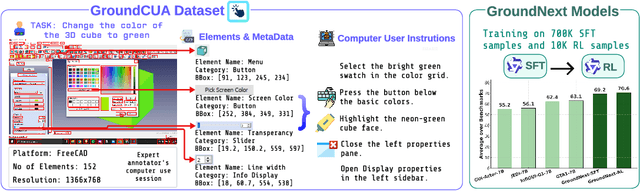
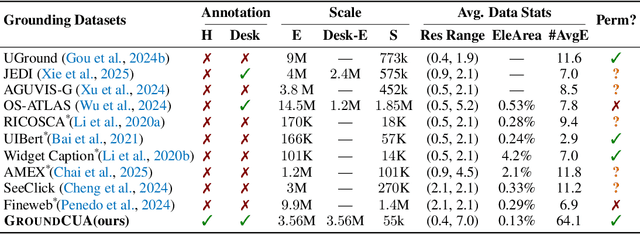
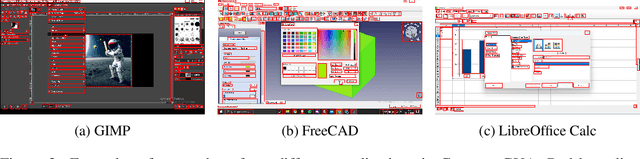
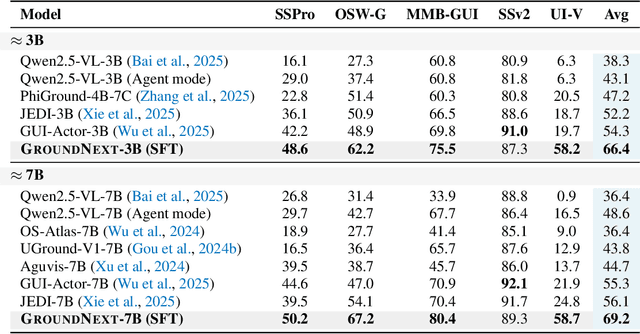
Building reliable computer-use agents requires grounding: accurately connecting natural language instructions to the correct on-screen elements. While large datasets exist for web and mobile interactions, high-quality resources for desktop environments are limited. To address this gap, we introduce GroundCUA, a large-scale desktop grounding dataset built from expert human demonstrations. It covers 87 applications across 12 categories and includes 56K screenshots, with every on-screen element carefully annotated for a total of over 3.56M human-verified annotations. From these demonstrations, we generate diverse instructions that capture a wide range of real-world tasks, providing high-quality data for model training. Using GroundCUA, we develop the GroundNext family of models that map instructions to their target UI elements. At both 3B and 7B scales, GroundNext achieves state-of-the-art results across five benchmarks using supervised fine-tuning, while requiring less than one-tenth the training data of prior work. Reinforcement learning post-training further improves performance, and when evaluated in an agentic setting on the OSWorld benchmark using o3 as planner, GroundNext attains comparable or superior results to models trained with substantially more data,. These results demonstrate the critical role of high-quality, expert-driven datasets in advancing general-purpose computer-use agents.
LazyVLM: Neuro-Symbolic Approach to Video Analytics
May 27, 2025Current video analytics approaches face a fundamental trade-off between flexibility and efficiency. End-to-end Vision Language Models (VLMs) often struggle with long-context processing and incur high computational costs, while neural-symbolic methods depend heavily on manual labeling and rigid rule design. In this paper, we introduce LazyVLM, a neuro-symbolic video analytics system that provides a user-friendly query interface similar to VLMs, while addressing their scalability limitation. LazyVLM enables users to effortlessly drop in video data and specify complex multi-frame video queries using a semi-structured text interface for video analytics. To address the scalability limitations of VLMs, LazyVLM decomposes multi-frame video queries into fine-grained operations and offloads the bulk of the processing to efficient relational query execution and vector similarity search. We demonstrate that LazyVLM provides a robust, efficient, and user-friendly solution for querying open-domain video data at scale.
Paper2Poster: Towards Multimodal Poster Automation from Scientific Papers
May 27, 2025Academic poster generation is a crucial yet challenging task in scientific communication, requiring the compression of long-context interleaved documents into a single, visually coherent page. To address this challenge, we introduce the first benchmark and metric suite for poster generation, which pairs recent conference papers with author-designed posters and evaluates outputs on (i)Visual Quality-semantic alignment with human posters, (ii)Textual Coherence-language fluency, (iii)Holistic Assessment-six fine-grained aesthetic and informational criteria scored by a VLM-as-judge, and notably (iv)PaperQuiz-the poster's ability to convey core paper content as measured by VLMs answering generated quizzes. Building on this benchmark, we propose PosterAgent, a top-down, visual-in-the-loop multi-agent pipeline: the (a)Parser distills the paper into a structured asset library; the (b)Planner aligns text-visual pairs into a binary-tree layout that preserves reading order and spatial balance; and the (c)Painter-Commenter loop refines each panel by executing rendering code and using VLM feedback to eliminate overflow and ensure alignment. In our comprehensive evaluation, we find that GPT-4o outputs-though visually appealing at first glance-often exhibit noisy text and poor PaperQuiz scores, and we find that reader engagement is the primary aesthetic bottleneck, as human-designed posters rely largely on visual semantics to convey meaning. Our fully open-source variants (e.g. based on the Qwen-2.5 series) outperform existing 4o-driven multi-agent systems across nearly all metrics, while using 87% fewer tokens. It transforms a 22-page paper into a finalized yet editable .pptx poster - all for just $0.005. These findings chart clear directions for the next generation of fully automated poster-generation models. The code and datasets are available at https://github.com/Paper2Poster/Paper2Poster.
GraphOmni: A Comprehensive and Extendable Benchmark Framework for Large Language Models on Graph-theoretic Tasks
Apr 17, 2025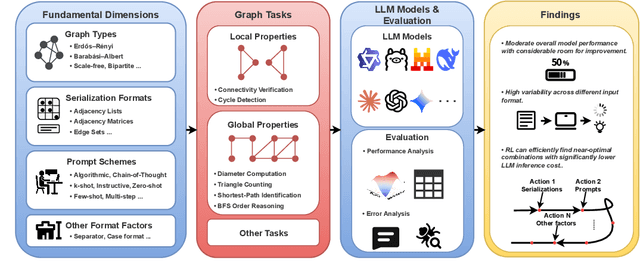
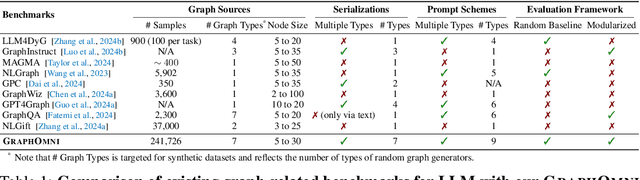
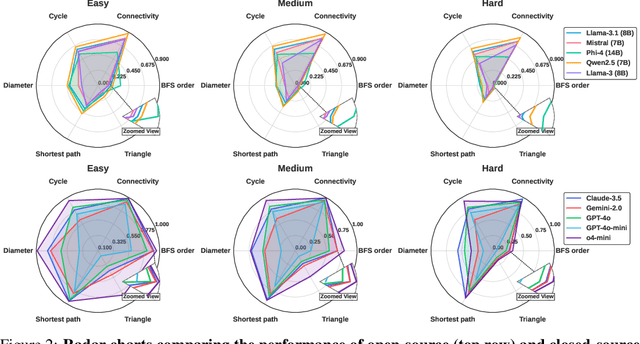
In this paper, we presented GraphOmni, a comprehensive benchmark framework for systematically evaluating the graph reasoning capabilities of LLMs. By analyzing critical dimensions, including graph types, serialization formats, and prompt schemes, we provided extensive insights into the strengths and limitations of current LLMs. Our empirical findings emphasize that no single serialization or prompting strategy consistently outperforms others. Motivated by these insights, we propose a reinforcement learning-based approach that dynamically selects the best serialization-prompt pairings, resulting in significant accuracy improvements. GraphOmni's modular and extensible design establishes a robust foundation for future research, facilitating advancements toward general-purpose graph reasoning models.
UI-Vision: A Desktop-centric GUI Benchmark for Visual Perception and Interaction
Mar 19, 2025Autonomous agents that navigate Graphical User Interfaces (GUIs) to automate tasks like document editing and file management can greatly enhance computer workflows. While existing research focuses on online settings, desktop environments, critical for many professional and everyday tasks, remain underexplored due to data collection challenges and licensing issues. We introduce UI-Vision, the first comprehensive, license-permissive benchmark for offline, fine-grained evaluation of computer use agents in real-world desktop environments. Unlike online benchmarks, UI-Vision provides: (i) dense, high-quality annotations of human demonstrations, including bounding boxes, UI labels, and action trajectories (clicks, drags, and keyboard inputs) across 83 software applications, and (ii) three fine-to-coarse grained tasks-Element Grounding, Layout Grounding, and Action Prediction-with well-defined metrics to rigorously evaluate agents' performance in desktop environments. Our evaluation reveals critical limitations in state-of-the-art models like UI-TARS-72B, including issues with understanding professional software, spatial reasoning, and complex actions like drag-and-drop. These findings highlight the challenges in developing fully autonomous computer use agents. By releasing UI-Vision as open-source, we aim to advance the development of more capable agents for real-world desktop tasks.
AlignVLM: Bridging Vision and Language Latent Spaces for Multimodal Understanding
Feb 03, 2025
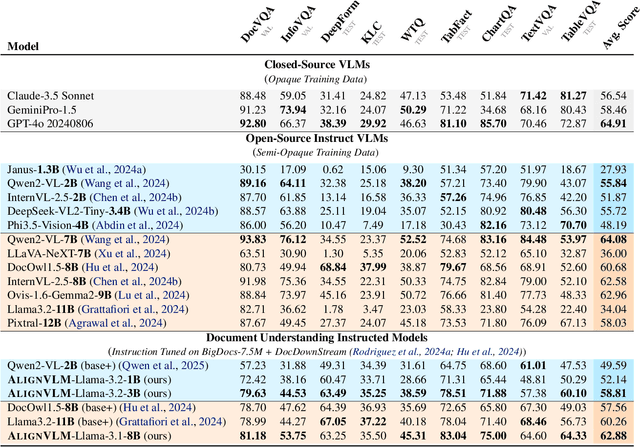

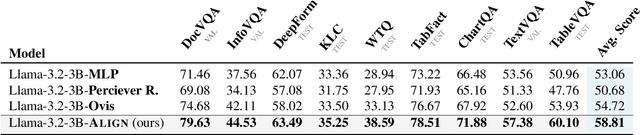
Aligning visual features with language embeddings is a key challenge in vision-language models (VLMs). The performance of such models hinges on having a good connector that maps visual features generated by a vision encoder to a shared embedding space with the LLM while preserving semantic similarity. Existing connectors, such as multilayer perceptrons (MLPs), often produce out-of-distribution or noisy inputs, leading to misalignment between the modalities. In this work, we propose a novel vision-text alignment method, AlignVLM, that maps visual features to a weighted average of LLM text embeddings. Our approach leverages the linguistic priors encoded by the LLM to ensure that visual features are mapped to regions of the space that the LLM can effectively interpret. AlignVLM is particularly effective for document understanding tasks, where scanned document images must be accurately mapped to their textual content. Our extensive experiments show that AlignVLM achieves state-of-the-art performance compared to prior alignment methods. We provide further analysis demonstrating improved vision-text feature alignment and robustness to noise.