 Add to Chrome
 Add to Firefox
 Add to Edge
MoE-SpeQ: Speculative Quantized Decoding with Proactive Expert Prefetching and Offloading for Mixture-of-Experts
Nov 18, 2025
The immense memory requirements of state-of-the-art Mixture-of-Experts (MoE) models present a significant challenge for inference, often exceeding the capacity of a single accelerator. While offloading experts to host memory is a common solution, it introduces a severe I/O bottleneck over the PCIe bus, as the data-dependent nature of expert selection places these synchronous transfers directly on the critical path of execution, crippling performance. This paper argues that the I/O bottleneck can be overcome by trading a small amount of cheap, on-device computation to hide the immense cost of data movement. We present MoE-SpeQ, a new inference system built on a novel co-design of speculative execution and expert offloading. MoE-SpeQ employs a small, on-device draft model to predict the sequence of required experts for future tokens. This foresight enables a runtime orchestrator to prefetch these experts from host memory, effectively overlapping the expensive I/O with useful computation and hiding the latency from the critical path. To maximize performance, an adaptive governor, guided by an Amortization Roofline Model, dynamically tunes the speculation strategy to the underlying hardware. Our evaluation on memory-constrained devices shows that for the Phi-MoE model, MoE-SpeQ achieves at most 2.34x speedup over the state-of-the-art offloading framework. Our work establishes a new, principled approach for managing data-dependent memory access in resource-limited environments, making MoE inference more accessible on commodity hardware.

Unified Multimodal Vessel Trajectory Prediction with Explainable Navigation Intention
Nov 18, 2025Vessel trajectory prediction is fundamental to intelligent maritime systems. Within this domain, short-term prediction of rapid behavioral changes in complex maritime environments has established multimodal trajectory prediction (MTP) as a promising research area. However, existing vessel MTP methods suffer from limited scenario applicability and insufficient explainability. To address these challenges, we propose a unified MTP framework incorporating explainable navigation intentions, which we classify into sustained and transient categories. Our method constructs sustained intention trees from historical trajectories and models dynamic transient intentions using a Conditional Variational Autoencoder (CVAE), while using a non-local attention mechanism to maintain global scenario consistency. Experiments on real Automatic Identification System (AIS) datasets demonstrates our method's broad applicability across diverse scenarios, achieving significant improvements in both ADE and FDE. Furthermore, our method improves explainability by explicitly revealing the navigational intentions underlying each predicted trajectory.
Asymmetric Cross-Modal Knowledge Distillation: Bridging Modalities with Weak Semantic Consistency
Nov 12, 2025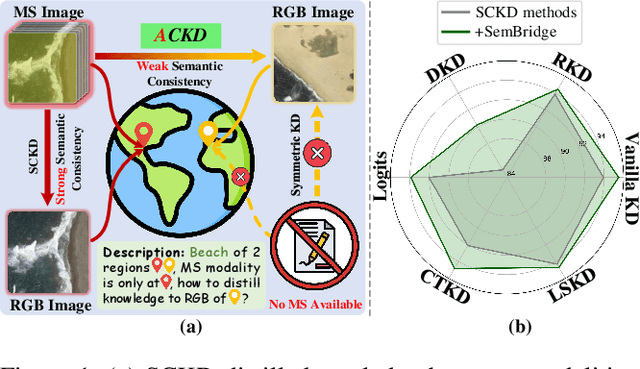
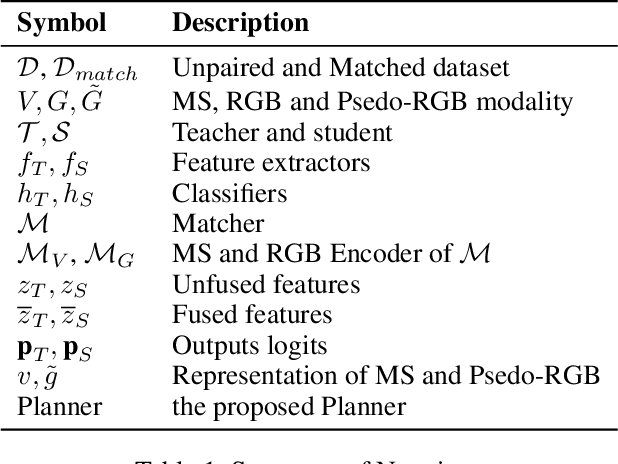
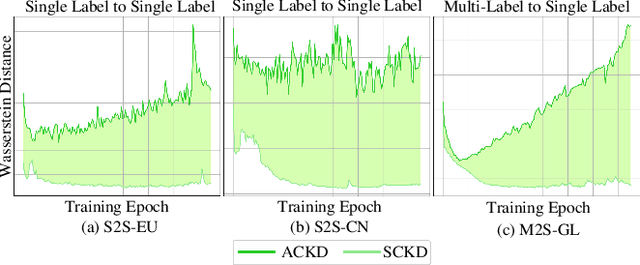
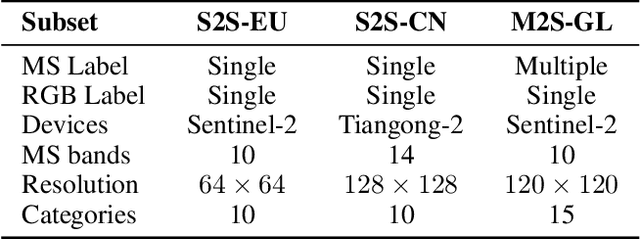
Cross-modal Knowledge Distillation has demonstrated promising performance on paired modalities with strong semantic connections, referred to as Symmetric Cross-modal Knowledge Distillation (SCKD). However, implementing SCKD becomes exceedingly constrained in real-world scenarios due to the limited availability of paired modalities. To this end, we investigate a general and effective knowledge learning concept under weak semantic consistency, dubbed Asymmetric Cross-modal Knowledge Distillation (ACKD), aiming to bridge modalities with limited semantic overlap. Nevertheless, the shift from strong to weak semantic consistency improves flexibility but exacerbates challenges in knowledge transmission costs, which we rigorously verified based on optimal transport theory. To mitigate the issue, we further propose a framework, namely SemBridge, integrating a Student-Friendly Matching module and a Semantic-aware Knowledge Alignment module. The former leverages self-supervised learning to acquire semantic-based knowledge and provide personalized instruction for each student sample by dynamically selecting the relevant teacher samples. The latter seeks the optimal transport path by employing Lagrangian optimization. To facilitate the research, we curate a benchmark dataset derived from two modalities, namely Multi-Spectral (MS) and asymmetric RGB images, tailored for remote sensing scene classification. Comprehensive experiments exhibit that our framework achieves state-of-the-art performance compared with 7 existing approaches on 6 different model architectures across various datasets.
Enhancing Generative Auto-bidding with Offline Reward Evaluation and Policy Search
Sep 19, 2025Auto-bidding is an essential tool for advertisers to enhance their advertising performance. Recent progress has shown that AI-Generated Bidding (AIGB), which formulates the auto-bidding as a trajectory generation task and trains a conditional diffusion-based planner on offline data, achieves superior and stable performance compared to typical offline reinforcement learning (RL)-based auto-bidding methods. However, existing AIGB methods still encounter a performance bottleneck due to their neglect of fine-grained generation quality evaluation and inability to explore beyond static datasets. To address this, we propose AIGB-Pearl (\emph{Planning with EvAluator via RL}), a novel method that integrates generative planning and policy optimization. The key to AIGB-Pearl is to construct a non-bootstrapped \emph{trajectory evaluator} to assign rewards and guide policy search, enabling the planner to optimize its generation quality iteratively through interaction. Furthermore, to enhance trajectory evaluator accuracy in offline settings, we incorporate three key techniques: (i) a Large Language Model (LLM)-based architecture for better representational capacity, (ii) hybrid point-wise and pair-wise losses for better score learning, and (iii) adaptive integration of expert feedback for better generalization ability. Extensive experiments on both simulated and real-world advertising systems demonstrate the state-of-the-art performance of our approach.
HaDM-ST: Histology-Assisted Differential Modeling for Spatial Transcriptomics Generation
Aug 10, 2025Spatial transcriptomics (ST) reveals spatial heterogeneity of gene expression, yet its resolution is limited by current platforms. Recent methods enhance resolution via H&E-stained histology, but three major challenges persist: (1) isolating expression-relevant features from visually complex H&E images; (2) achieving spatially precise multimodal alignment in diffusion-based frameworks; and (3) modeling gene-specific variation across expression channels. We propose HaDM-ST (Histology-assisted Differential Modeling for ST Generation), a high-resolution ST generation framework conditioned on H&E images and low-resolution ST. HaDM-ST includes: (i) a semantic distillation network to extract predictive cues from H&E; (ii) a spatial alignment module enforcing pixel-wise correspondence with low-resolution ST; and (iii) a channel-aware adversarial learner for fine-grained gene-level modeling. Experiments on 200 genes across diverse tissues and species show HaDM-ST consistently outperforms prior methods, enhancing spatial fidelity and gene-level coherence in high-resolution ST predictions.
QuProFS: An Evolutionary Training-free Approach to Efficient Quantum Feature Map Search
Aug 09, 2025The quest for effective quantum feature maps for data encoding presents significant challenges, particularly due to the flat training landscapes and lengthy training processes associated with parameterised quantum circuits. To address these issues, we propose an evolutionary training-free quantum architecture search (QAS) framework that employs circuit-based heuristics focused on trainability, hardware robustness, generalisation ability, expressivity, complexity, and kernel-target alignment. By ranking circuit architectures with various proxies, we reduce evaluation costs and incorporate hardware-aware circuits to enhance robustness against noise. We evaluate our approach on classification tasks (using quantum support vector machine) across diverse datasets using both artificial and quantum-generated datasets. Our approach demonstrates competitive accuracy on both simulators and real quantum hardware, surpassing state-of-the-art QAS methods in terms of sampling efficiency and achieving up to a 2x speedup in architecture search runtime.
Parameter-Efficient Fine-Tuning of 3D DDPM for MRI Image Generation Using Tensor Networks
Jul 24, 2025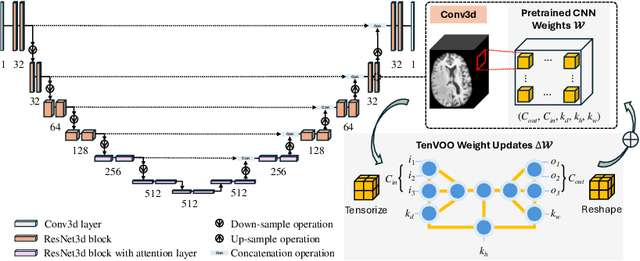
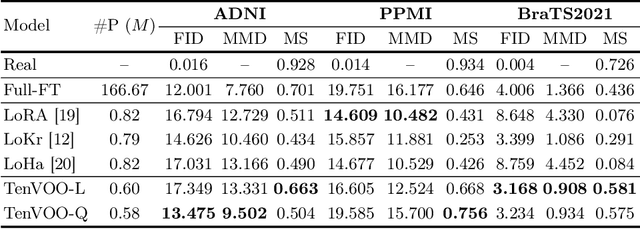
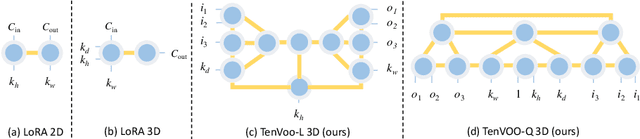
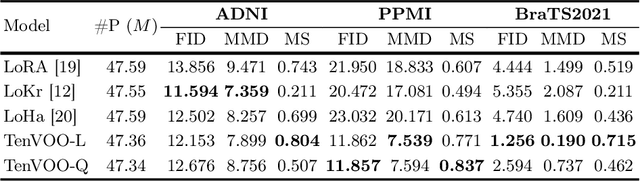
We address the challenge of parameter-efficient fine-tuning (PEFT) for three-dimensional (3D) U-Net-based denoising diffusion probabilistic models (DDPMs) in magnetic resonance imaging (MRI) image generation. Despite its practical significance, research on parameter-efficient representations of 3D convolution operations remains limited. To bridge this gap, we propose Tensor Volumetric Operator (TenVOO), a novel PEFT method specifically designed for fine-tuning DDPMs with 3D convolutional backbones. Leveraging tensor network modeling, TenVOO represents 3D convolution kernels with lower-dimensional tensors, effectively capturing complex spatial dependencies during fine-tuning with few parameters. We evaluate TenVOO on three downstream brain MRI datasets-ADNI, PPMI, and BraTS2021-by fine-tuning a DDPM pretrained on 59,830 T1-weighted brain MRI scans from the UK Biobank. Our results demonstrate that TenVOO achieves state-of-the-art performance in multi-scale structural similarity index measure (MS-SSIM), outperforming existing approaches in capturing spatial dependencies while requiring only 0.3% of the trainable parameters of the original model. Our code is available at: https://github.com/xiaovhua/tenvoo
EarthLink: A Self-Evolving AI Agent for Climate Science
Jul 24, 2025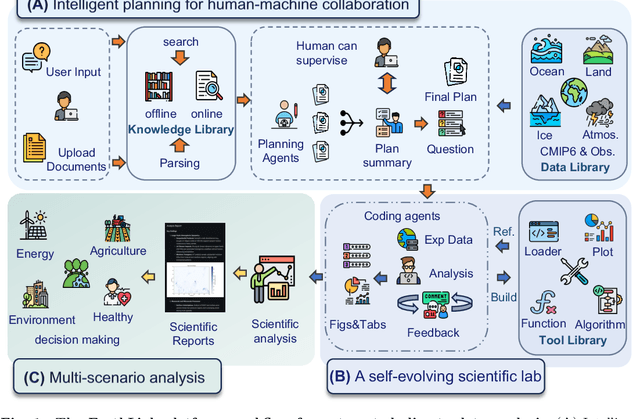
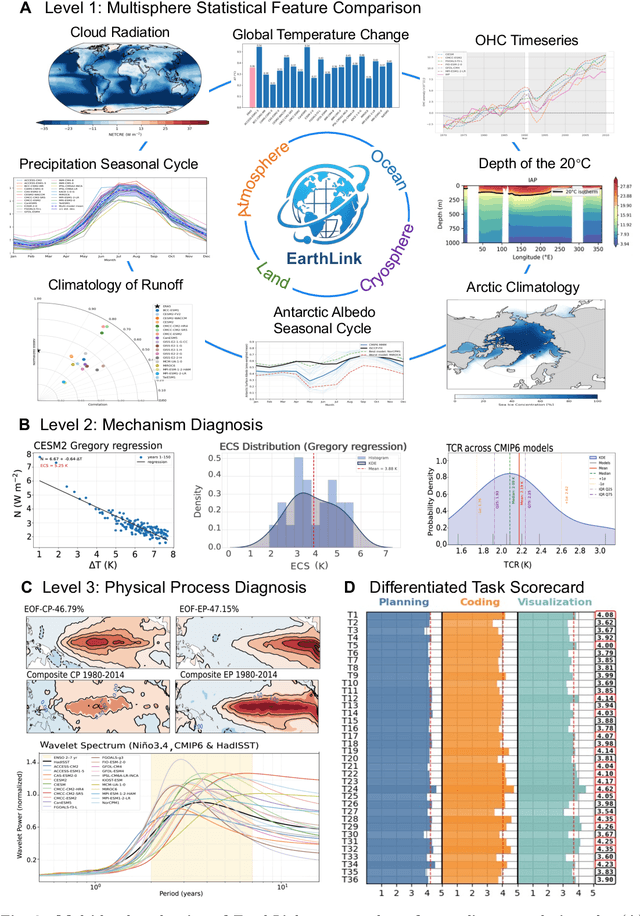
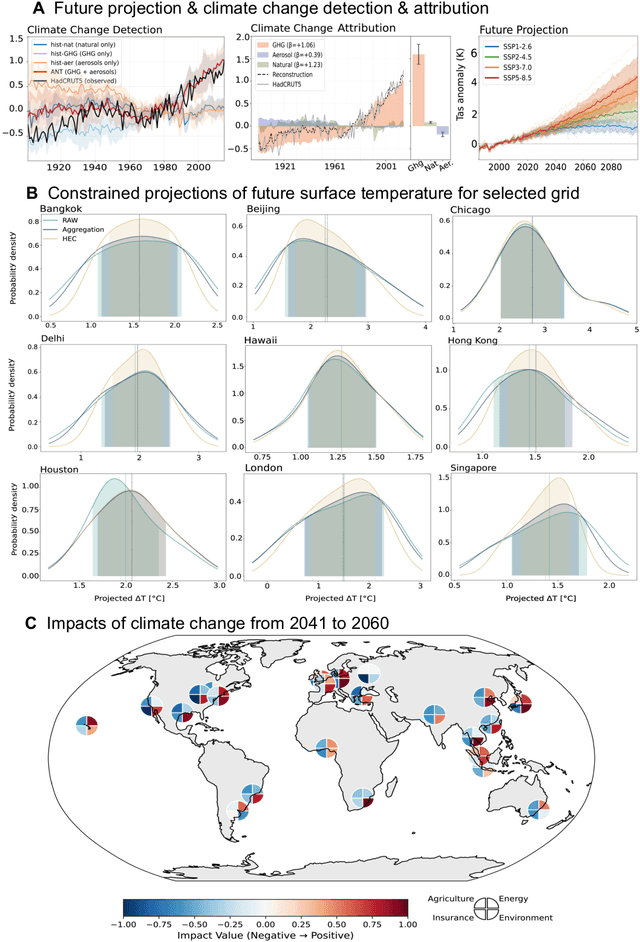
Modern Earth science is at an inflection point. The vast, fragmented, and complex nature of Earth system data, coupled with increasingly sophisticated analytical demands, creates a significant bottleneck for rapid scientific discovery. Here we introduce EarthLink, the first AI agent designed as an interactive copilot for Earth scientists. It automates the end-to-end research workflow, from planning and code generation to multi-scenario analysis. Unlike static diagnostic tools, EarthLink can learn from user interaction, continuously refining its capabilities through a dynamic feedback loop. We validated its performance on a number of core scientific tasks of climate change, ranging from model-observation comparisons to the diagnosis of complex phenomena. In a multi-expert evaluation, EarthLink produced scientifically sound analyses and demonstrated an analytical competency that was rated as comparable to specific aspects of a human junior researcher's workflow. Additionally, its transparent, auditable workflows and natural language interface empower scientists to shift from laborious manual execution to strategic oversight and hypothesis generation. EarthLink marks a pivotal step towards an efficient, trustworthy, and collaborative paradigm for Earth system research in an era of accelerating global change. The system is accessible at our website https://earthlink.intern-ai.org.cn.
MISCGrasp: Leveraging Multiple Integrated Scales and Contrastive Learning for Enhanced Volumetric Grasping
Jul 03, 2025Robotic grasping faces challenges in adapting to objects with varying shapes and sizes. In this paper, we introduce MISCGrasp, a volumetric grasping method that integrates multi-scale feature extraction with contrastive feature enhancement for self-adaptive grasping. We propose a query-based interaction between high-level and low-level features through the Insight Transformer, while the Empower Transformer selectively attends to the highest-level features, which synergistically strikes a balance between focusing on fine geometric details and overall geometric structures. Furthermore, MISCGrasp utilizes multi-scale contrastive learning to exploit similarities among positive grasp samples, ensuring consistency across multi-scale features. Extensive experiments in both simulated and real-world environments demonstrate that MISCGrasp outperforms baseline and variant methods in tabletop decluttering tasks. More details are available at https://miscgrasp.github.io/.
USAD: An Unsupervised Data Augmentation Spatio-Temporal Attention Diffusion Network
Jul 03, 2025The primary objective of human activity recognition (HAR) is to infer ongoing human actions from sensor data, a task that finds broad applications in health monitoring, safety protection, and sports analysis. Despite proliferating research, HAR still faces key challenges, including the scarcity of labeled samples for rare activities, insufficient extraction of high-level features, and suboptimal model performance on lightweight devices. To address these issues, this paper proposes a comprehensive optimization approach centered on multi-attention interaction mechanisms. First, an unsupervised, statistics-guided diffusion model is employed to perform data augmentation, thereby alleviating the problems of labeled data scarcity and severe class imbalance. Second, a multi-branch spatio-temporal interaction network is designed, which captures multi-scale features of sequential data through parallel residual branches with 3*3, 5*5, and 7*7 convolutional kernels. Simultaneously, temporal attention mechanisms are incorporated to identify critical time points, while spatial attention enhances inter-sensor interactions. A cross-branch feature fusion unit is further introduced to improve the overall feature representation capability. Finally, an adaptive multi-loss function fusion strategy is integrated, allowing for dynamic adjustment of loss weights and overall model optimization. Experimental results on three public datasets, WISDM, PAMAP2, and OPPORTUNITY, demonstrate that the proposed unsupervised data augmentation spatio-temporal attention diffusion network (USAD) achieves accuracies of 98.84%, 93.81%, and 80.92% respectively, significantly outperforming existing approaches. Furthermore, practical deployment on embedded devices verifies the efficiency and feasibility of the proposed method.